


Analysis Region: 16 districts and counties of Busan Metropolitan City
Core Areas: Busan New Port, Jinhae New Port, Automated Cargo Handling Equipment, Terminal Operating Systems, Local Logistics Companies, Maritime and Port Startups, Port Workforce
Agenda: Is the automation of Busan Port extending beyond port productivity to expand into local employment and sales of equipment, parts, software, maintenance, and data for Busan companies?
Golden Time Type: Smart Port Infrastructure Opportunity + Local Industry Conversion Risk
Assessment Period: 2026–2029
Reference Date: August 28, 2026
Version: Regional AX Golden Time Intelligence v3.2
Final Assessment of Enhanced Criteria: Implementation of Port Automation, Entry into Localization, and Expansion of Busan Industry Unverified
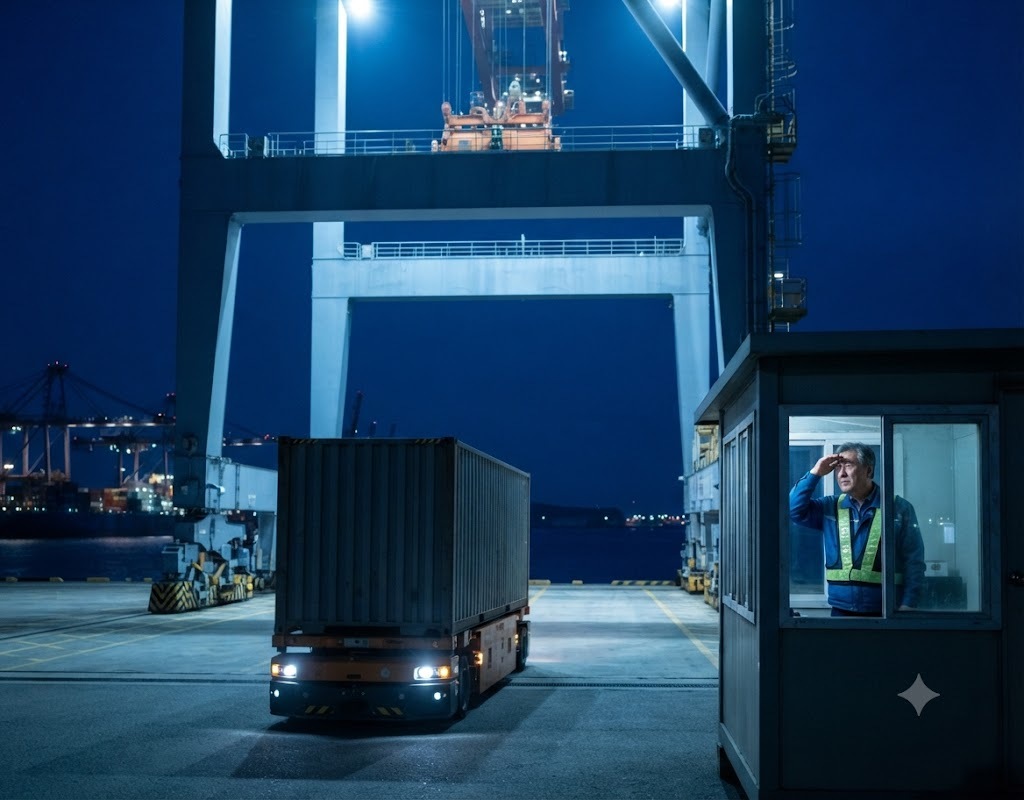
Phase 2-5 of the West Container Terminal at Busan New Port is operating as Korea's first fully automated terminal, applying automation to the entire quay, transfer, and yard areas. Unmanned transfer equipment, automated cranes, and terminal operating systems are interconnected, and approximately 340 billion won worth of domestically produced cargo handling equipment has been deployed. This serves as evidence that port automation has moved beyond the planning and demonstration stages to the commercial operation phase. ( Ministry of Oceans and Fisheries )
The expansion of automation is also confirmed. The Busan Port Authority completed the delivery of six container cranes to Phase 2-6 of the West Container Terminal in the New Port in June 2026, and in August, began the delivery of 34 domestically produced automated transfer cranes manufactured at Jaseongdae Wharf in the North Port to the New Port. Equipment transportation and commissioning will continue until April 2027. ( Busan Port Authority )
Busan City also pursued research and development for an intelligent unmanned automation smart logistics system, investing approximately 13.857 billion won from 2020 to March 2025. Technologies and patents resulting from the participation of local companies were derived, including remote and unmanned forklifts, port geofence safety management, and virtual reality-based integrated monitoring of logistics centers. The scope of automation expanded from large terminal equipment to logistics centers and safety and operation software. ( Busan Metropolitan City , Unmanned Forklift Patent , Geofence Patent )
However, the publicly available data does not link how much of the 340 billion won in domestic equipment and 13.8 billion won in R&D was attributed to Busan-based companies in terms of orders, sales, employment, exports, and intellectual property revenue. There is a gap between the evidence that the equipment was installed and partially assembled in Busan and the evidence that Busan companies secured technology, parts, and operational rights.
If large offshore companies and overseas platforms secure key supply chains between 2026 and 2029, when the equipment and operating systems for Jinhae New Port and Phases 2-6 of the West Container Terminal are finalized, Busan will remain a user region for automated ports. Currently, while the automation of Busan Port is transforming the port, it has not yet been determined that it is structurally changing Busan's regional industries.
Phase 2-5 of the West Container Terminal has put unmanned transfer equipment and automated yard and quay equipment into commercial operation, and six domestically produced container cranes and 34 transfer cranes are being sequentially introduced into Phase 2-6. This is a stage where automated facilities are repeatedly deployed across multiple berths, rather than as a single pilot piece of equipment.
The unit of investment in automation has also expanded from a single piece of equipment to the entire terminal operating system. As cargo handling equipment, communication networks, control, safety, maintenance, power, and software are combined into a single system, the competitiveness of suppliers has shifted to a structure where it is determined by integrated operation and long-term maintenance capabilities rather than manufacturing capacity.
However, a supply chain map showing which areas Busan-based companies were responsible for—among equipment manufacturing, control, sensors, parts, maintenance, and operating software—is not available. If subsequent orders remain fixed around system integrators for two to three years, local companies will be unable to secure long-term operating profits even if they participate in short-term manufacturing and on-site construction.
Although the automation of Busan Port has passed the initial introduction phase, the supplier status of Busan's industries has not yet been determined.
The Ministry of Oceans and Fisheries reported that approximately 340 billion won worth of domestic cargo handling equipment was deployed in Phase 2-5 of the West Container Terminal, resulting in a value-added effect of 211 billion won and a production inducement effect of 641.7 billion won. This is evidence that the structure has shifted from reliance on foreign equipment to the utilization of the domestic supply chain.
However, the domestically produced equipment is equipment supplied by South Korean companies and is not identical to the equipment supplied by Busan companies. The fact that the equipment was assembled at Jaseongdae Wharf in the North Port is also distinct from the fact that design rights, control technology, core components, software, and intellectual property belong to Busan.
There is no publicly available data separating the localization rate, the procurement rate of Busan companies, employment of Busan workers, regional R&D expenditures, and maintenance contract amounts. Even if subsequent automation equipment continues to be ordered from 2027 to 2029, if the role of Busan companies remains limited to assembly, transportation, and installation, regional sales will end along with the termination of facility investment.
While the localization of equipment at Busan Port has been confirmed, it cannot be concluded that this localization led to the industrialization of Busan.
Revenue in the traditional port industry was linked to cargo volume and on-site labor, such as cargo handling, transportation, warehousing, inspection, ship supplies, and repairs. In fully automated ports, equipment control, operational algorithms, sensors, digital twins, cybersecurity, predictive maintenance, and energy management have emerged as areas generating recurring revenue.
The center of value added in the industry has shifted from physical workload to system operation rights and data access rights. The structure is such that companies collecting, updating, maintaining, and optimizing equipment status information secure long-term business relationships, rather than the companies that installed the equipment.
While the number of shipping and port companies and logistics infrastructure in Busan are confirmed, there are no separate industrial statistics compiling smart port software sales, automation equipment maintenance sales, or port data service exports. If we rely solely on existing industry classifications over the next two to three years, the supply chain will be determined without even measuring whether new industries are emerging.
Busan's port industry is shifting from a cargo handling-centered approach to a technology service-centered one, but Busan's industrial statistics and corporate ecosystem have not yet captured this shift.
The 34 transfer cranes that began arriving at West Container Terminal Phase 2-6 in August 2026 underwent assembly and inspection at Jaseongdae Wharf in the North Port starting in April 2025. Six container cranes were also brought in prior to that over an eight-month period. A large-scale equipment supply process involving manufacturing, transportation, installation, and commissioning took place within Busan Port.
However, the manufacturing location, corporate headquarters, core component production sites, technology development sites, and the location attributable to contract revenue do not coincide. While structural fabrication, painting, electrical work, and transportation may remain in the region, control systems, motors, sensors, and operating software may be attributed to offshore supply chains.
Local Content Evidence disclosing the amount of orders won by Busan companies, the composition of first and second-tier subcontractors, the deployment of local personnel, and long-term maintenance contracts within the total order amount has not been confirmed. If local companies are excluded from maintenance contracts after the commissioning ends in 2027, only temporary revenue from the construction period will remain, and the accumulation of technology will cease.
While equipment investment in Busan Port is being executed locally, the scale of industrial assets accumulated by local companies is not confirmed.
Busan City conducted research and development on an intelligent unmanned automation smart logistics system worth approximately 13.857 billion won from June 2020 to March 2025. Participating companies developed technologies such as remote and unmanned forklifts, geofence port safety management, and virtual reality logistics center monitoring, and filed for patents.
The structure of R&D has shifted from simple equipment purchasing to the development of source and commercialization technologies by local companies. Ports and hinterland logistics centers have been designated as demonstration spaces for local technologies, and a foundation has been established to connect technology development with on-site implementation.
However, after the project ends in March 2025, the results of registration, commercialization, field installation, sales, exports, and follow-up investments by patent will not be disclosed in an integrated manner. If research results do not lead to actual purchase contracts at Busan Port within two to three years, the patents may remain, but the company's market share and recurring revenue will not be formed.
While Busan's smart logistics R&D produced technological achievements, there is a lack of evidence that it was closed down due to industrial results.
Fully automated terminals connect unmanned transport equipment, cranes, yards, and gates to a terminal operating system. Busan City completed the Busan Port Smart Digital Twin Integrated Platform Information Strategy Plan in May 2025 and included an AI port testbed in its work plan for 2026.
The unit of competition in smart ports has shifted from the performance of individual equipment to the data integration and operational algorithms of the entire terminal. Even if the equipment is domestically produced, if external companies control the operating systems and AI models, the port's recurring software revenue and data learning effects accumulate externally.
The percentage of Busan companies participating in the design, modules, APIs, updates, and cybersecurity contracts for the terminal operating system is not confirmed. If the operating platform becomes entrenched as the standard between 2026 and 2029, the entry of latecomer local companies will be limited to peripheral functions and subcontracted development.
The biggest gap in the smartification of Busan Port lies not in the localization of equipment, but in the lack of local ownership of operating software and data control.
Full automation is a structure that enhances port continuity, safety, and equipment utilization through the unmanned operation of yard operations and container transfers. Busan Port is expanding its internal productivity base by simultaneously proceeding with automated terminal operations and subsequent berth expansion.
However, international freight forwarding, transportation, warehousing, and ship supply businesses outside the port differ in scale and level of informatization. Unless automated data within the port is connected to dispatching, warehousing, customs clearance, and shipper orders, increases in terminal productivity do not spread to the productivity of local businesses.
There is no publicly available data comparing the empty vehicle rate, warehouse turnover rate, revenue per person, working hours, and operating profit margin of Busan logistics companies before and after automation. If the productivity gap between the port and hinterland companies widens over two to three years, the city's overall logistics costs will stagnate even if the terminal reduces processing time.
While productivity improvements at Busan Port are underway, they have not been confirmed for the Busan logistics industry.
Busan City has concluded five years of smart logistics research and development and included the advancement of smart port equipment and digital service infrastructure in the leading sectors of new marine industries for 2026. The Busan Port Authority is also operating a startup support system that provides port infrastructure as a space for technology demonstration.
However, the supply chain of Busan's smart port industry—connecting equipment manufacturing, parts, control, operating systems, data, and maintenance—and the number of companies by sector are not confirmed in publicly available data. While industrial development projects exist, there is no baseline to determine which technologies Busan supplies internally and which it relies on external sources for.
If the identification of the supply chain is delayed while subsequent automation orders are being placed between 2026 and 2029, local companies will have to find individual subcontracting areas after the order specifications are finalized. Busan's industrial readiness level is currently at a stage where R&D and demonstration infrastructure exist, but a completed smart port supply chain has not yet been identified.
Multiple technologies and patents have been derived from smart logistics R&D in Busan, including unmanned forklifts, geofence safety management, and virtual reality logistics center monitoring. The Busan Port Authority continues to provide startups with port testbeds and opportunities for technology demonstration in 2026.
However, the publicly available data does not confirm how many Busan Port terminals, hinterland complexes, and warehouse companies the developed technology has actually been introduced to, nor how much accidents, working hours, costs, and revenue have changed since its implementation. It has not yet been determined whether the patents and demonstrations led to repeat purchases and standard adoption.
If adopting companies remain at a small number of demonstration sites for the next two to three years, automation equipment will be concentrated in large terminals, and the operating methods of small and medium-sized logistics companies will not change. While Busan Smart Port technology has spread during the development phase, its expansion into commercial sites remains unconfirmed.
The Busan Port Authority has been operating "1876 Busan," a startup support platform for the shipping, port, and logistics sectors, since 2022 , and has supported 12 startups as of August 2026. It was disclosed that supported companies in 2025 saw an increase in average revenue by 78%, employees by 26%, and the number of intellectual property rights held by 48% compared to the previous year. ( Busan Port Authority )
The structure of support expanded from the provision of office space to Busan Port demonstration, joint research and development, investment linkage, and connection to overseas programs. In 2026, the Busan Institute of Technology and Startup Investment and Busan Technopark participated, and technology cooperation with Singapore's PIER71 was also carried out.
However, the baseline sales revenue for the average growth rate, Busan Port supply contracts by company, follow-up investments, survival rates, and export sales are not disclosed. If tenant companies fail to become actual suppliers for Busan Port within two to three years, the disconnect between the incubation results and the port industry supply chain persists.
Busan's shipping and port startups demonstrated growth evidence, but they were not deemed to have established themselves as smart port suppliers.
12-1. New Port West Container Terminal — Expansion of Automation Facilities
Phase 2-5 of the West Container Terminal is operating as the nation's first fully automated terminal, and six domestically produced container cranes and 34 transfer cranes are being introduced to Phase 2-6. It is structured so that the operation, expansion, and commissioning of automated terminals occur continuously within the same area.
However, there is no publicly available tracking data showing how the operational performance of stages 2-5 was reflected in stage 2-6 equipment specifications and procurement by local companies. There also remains a gap between the localization of equipment and the entry of Busan companies as key suppliers.
Once equipment delivery and commissioning are completed in 2027, the supplier and maintenance system will be fixed for a long period. The West Container Terminal at the New Port is a demonstration site for Busan's smart port, but it has not been determined to be a demonstration site for the growth of Busan companies.
12-2. North Port & Yeongdo Area — Foundation for Startups and Technology Commercialization
The Busan Port Authority operates 1876 Busan in the North Port and supports 12 shipping and port startups, and the Yeongdo and North Port areas retain infrastructure for marine research, ship repair, ship supplies, and port services. Conditions have been established for existing industries and technology startups to coexist within the same port zone.
However, structural diffusion data regarding joint development, delivery, mergers and acquisitions, and supply contracts between the technology of startups and existing repair, logistics, and marine supply companies is not confirmed, aside from individual cases. A connection gap remains between startup incubation and the AX of existing industries.
If the two ecosystems are separated for two to three years, startups will move to the metropolitan area or overseas markets after demonstration, while existing companies will remain in their existing processes. The North Port and Yeongdo areas possess technology startup hubs, but they have not been designated as AX clusters for the existing port industry.
West Container Terminal operates unmanned transfer equipment and automated cranes, and the same automation structure is being expanded to subsequent berths. The structure is being reorganized from roles centered on on-site operation and equipment handling to roles centered on remote control, system operation, predictive maintenance, and data analysis.
However, no evidence has been confirmed linking the number of employees by job function before and after automation, changes in subcontracted workers, wages, retraining, reassignment, or new local hiring. The transition risks for directly employed and subcontracted workers are also separated.
As the number of automated berths increases between 2027 and 2029, the time lag between the decrease in existing field positions and the increase in new technical positions may widen. If new technical positions are filled by system suppliers and specialized personnel from outside the region, Busan will absorb the job losses but fail to secure high-wage jobs.
Although changes in the job structure have begun due to the labor transition at Busan Port, there is no evidence to conclude that it has led to a qualitative improvement in local employment.
The introduction of automation equipment for Phase 2-6 of the West Container Terminal will continue until April 2027, and Jinhae New Port is also being developed on the premise of fully automated operation. The period from 2026 to 2029 is when equipment suppliers, operating systems, communication standards, and maintenance systems are finalized simultaneously.
There is no integrated evidence yet to assess the procurement rate, self-reliance of core components, software rights, long-term maintenance contracts, or local workforce ratio of Busan companies. The speed of ordering and installation is faster than the speed of verifying the local supply chain.
Changing suppliers after the automation platform and equipment ecosystem have been established entails costs related to equipment compatibility, security, operational downtime, and re-certification. Consequently, latecomers tend to enter the market as vendors with backward compatibility with existing systems rather than as independent suppliers.
Busan's irreversibility lies not in the failure of automation, but in the fact that Busan companies remain outside the supply chain even after automation is successful.
AX Response System | Connection Evidence | Judgment function | 2026–2029 Assessment Criteria |
| Smart Port Supply Chain Graph | Ordering · Prime Contractor · Parts · Software · Maintenance · Local Companies | Tracking the regional attribution of automation investment funds | Busan Companies' Procurement Rate and Contract Amount |
| Equipment Local Content Director | Design, Control, Sensors, Structures, Assembly, Transportation | Separation of localization and Busan industrialization | Busan Supply Ratio by Technology Level |
| R&D-to-Contract Runtime | Projects · Patents · Demonstration · Certification · Delivery · Sales | Verification of actual contract conversion of research results | Commercialization and repeat purchase rates by patent |
| Port Tech Demonstration Exchange | Port Issues · Corporate Technology · PoC · Purchasing Department | Linking Demonstration and Procurement | Purchase contract rate after PoC |
| Operational Software and Data Rights Director | TOS · AI Model · API · Update · Access Rights | Decision on the Attribution of Control over Smart Port | Busan company module and rights ratio |
| Predictive Maintenance Industry Twin | Equipment condition, breakdowns, parts, maintenance time, contract | Tracking the formation of the long-term maintenance market | Regional Maintenance Revenue · Downtime |
| Port Job Transition Monitor | Job duties, employment type, wages, training, reassignment | Determination of local employment transfer of automation | Reassignment and regional technical job recruitment rates |
| Golden Time Dashboard | Investment, Procurement, R&D, Sales, Employment, Exports | Calculation of Regional Industry Conversion Grades | Determination of introduction, diffusion, industrialization, and dependency |
AX Response Determination: If the investment in port automation is not linked to the supplier, technology rights, local employment, and recurring sales for each piece of equipment, the industrial ripple effect in Busan remains an estimated effect and the actual attribution is not determined.
Current Assessment: Implementation of port automation, expansion of domestic equipment, and regional industrialization are unconfirmed
2-Year Determination: The point of industry entry where the supply chain for subsequent equipment and operating systems is established.
3-Year Assessment: The phase where local companies become entrenched in assembly, construction, and simple service roles if they fail to enter as core suppliers.
Spread Assessment: Confirmed in large terminals and some R&D/startup companies, but not confirmed in all existing logistics, repair, and parts companies.
Employment Assessment: Automation of field jobs is in progress, net increase in local technical positions is not assessed
Determination of Irreversibility: Sharp Surge in Upstream Supply Chain Costs for Local Companies Following Finalization of Platform, Equipment, and Maintenance Standards
Overall Assessment: Busan Port is becoming smart, but it is not yet at the stage where it can be judged that Busan's port industry has also transformed into a smart industry.
- Total project cost and equipment order amount per automation terminal
- Proportion of domestic equipment and procurement rate of Busan companies
- Headquarters and production bases of prime contractors, first-tier and second-tier subcontractors
- Suppliers by design, control, sensors, communications, and structures
- Order value and operating profit of companies based in Busan
- Employment of automation equipment in the Busan area
- Localization and regionalization rates of key components by equipment
- Companies that develop and own operating systems and AI models
- Access rate of Busan companies to port data API
- Maintenance Contract Period, Contract Amount, and Ratio of Local Companies
- Automation equipment failure rate and average recovery time
- Registration and commercialization rates of smart logistics R&D patents
- Conversion rate of demonstration technology to Busan Port purchase contracts
- Changes in sales, exports, and investment of R&D participating companies
- 1876 Survival, Graduation, and Local Retention Rates of Tenant Companies in Busan
- Supply and recurring contracts at Busan Port by startup
- AX adoption rate of existing logistics, repair, and ship supplies companies
- Changes in employment, wages, and tenure by job function before and after automation
- Retraining and reassignment rates of port workers
- Smart Port Employment Rate of Busan University and Specialized High School Workforce
- Regional revenue and employment per 100 million won of investment in port automation
- Date of Confirmation of Jinhae New Port Phased Suppliers and Operational Standards
Cities possessing automated ports install equipment and increase productivity. Cities supplying automated ports sell cranes, sensors, controllers, operating systems, cybersecurity, and predictive maintenance, and generate recurring revenue while the port is in operation. The former arises from the location of the facility, while the latter arises from the ownership of technology and contracts.
Although Busan has secured the nation's first fully automated dock and subsequent automated berths, the procurement rates of Busan-based companies by equipment type and the rights structure of operating software remain unclear. Even if localization proceeds, if key suppliers are located outside the region, Busan serves merely as the operational hub for automation facilities, while industrial profits accumulate in other areas.
Once the equipment and platforms for Jinhae New Port are finalized, identical specifications will secure subsequent berth, maintenance, and update contracts for decades. It is difficult to regain supplier status during the operation phase that was not secured in the initial order.
The turning point for the transformation of Busan's regional industries is determined not by the degree of automation at Busan Port, but by whether Busan companies can sell automated port solutions to other ports.
Judgment point | Confirmed Evidence | Risk level | verdict |
| 2020~2023 | Launch of 13.857 billion KRW Smart Logistics R&D, Development of Unmanned Forklift, Safety, and Monitoring Technologies | caution | Entry into regional technology development |
| 2024 | West Container Terminal Phase 2-5 Fully Automated Operation | Caution~Alert | Securing commercial operations, local ownership unconfirmed |
| 2025 | Smart Logistics R&D Completed, Digital Twin ISP Completed | boundary | Absence of determination on contract conversion of research results |
| 2026 | Stages 2-6 Import of Domestic Cranes, Support for 12 Companies in 1876 Busan | boundary | Expansion of equipment and startups, spread to the entire industry unconfirmed |
| 2027~2028 | Subsequent Automation Equipment Commissioning and Operation System Confirmed | Boundary~Critical | Supply chain and maintenance status entrenched |
| 2029 | Visualization of Jinhae New Port Smart Port Supply Structure | Critically possible | Confirmation of the branch between the user city and the supply city |
