


Analysis Region: Sacheon, Jinju, and Changwon in Gyeongsangnam-do and the Western Gyeongnam Aerospace Industry Sphere
Key Areas: Korea Aerospace Administration (KASA), KAI, aviation, satellite, and launch vehicle companies, Gyeongnam Aerospace National Industrial Complex, Satellite Development Innovation Center, Space Environment Testing Facility, universities, research institutes, and testing organizations
Agenda: Are the opening of KASA's Sacheon office and the expansion of the national budget leading to an aerospace industry ecosystem that extends beyond the mere location of an administrative agency to a circulation of private enterprises, orders, investments, technology commercialization, skilled personnel, and regional added value?
Golden Time Type: Institutional Anchor Opportunity + Aerospace-to-Space Conversion Risk
Reference Date: August 28, 2026
Version: Regional AX Golden Time Intelligence v3.2 Enhanced Criteria
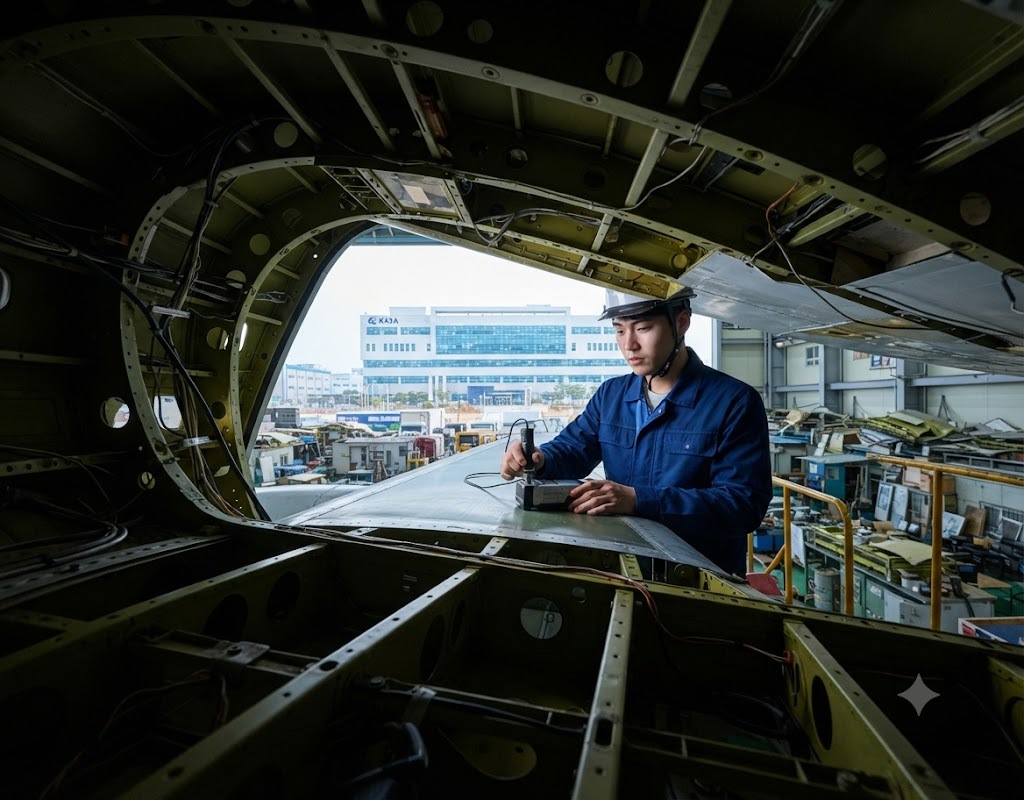
The Korea Aerospace Administration was launched in Sacheon, South Gyeongsang Province, on May 27, 2024. Its 2026 budget is 1.1201 trillion won , an increase of 155.2 billion won (16.1% ) compared to 964.9 billion won in 2025. 266.2 billion won was allocated for space transport, 236.2 billion won for satellite communications, navigation, and observation, and 173.8 billion won for a private-sector-led industrial ecosystem. The conditions have been established for a national aerospace policy agency and an annual budget exceeding 1 trillion won to operate based in Sacheon. ( Korea Aerospace Administration , Republic of Korea Policy Briefing )
Gyeongnam also possesses a substantial existing industrial base. The Gyeongnam Provincial Council projected that by 2026, there would be 109 aerospace businesses , accounting for 60% of the national total, and 12,819 employees , representing 74% of the national total. In 2021, the production value of Gyeongnam's aviation industry was 3.7836 trillion won, or 71.8% of the national total, while the production value of the space industry was 168.1 billion won, or 34.2% of the national total. However, there is a discrepancy between the concentration of aerospace manufacturing and the actual production scale of the space industry. ( Gyeongsangnam-do Provincial Council , Gyeongnam Jinju Small but Strong Special Zone Support Center )
As of 2020, there were 21 space-related companies in Gyeongnam, employing a total of 15,454 people and generating approximately 16.4 trillion won in total revenue. However, revenue directly related to space amounted to about 200 billion won , representing just 1.2% of total revenue. While the participation of large-scale aerospace and defense companies in the space business inflated the figures for both employees and total revenue, the revenue base for the space business itself was relatively small. ( Survey on the Aerospace Manufacturing Industry in Gyeongnam )
Industrial infrastructure is expanding. A space environment testing facility worth 155.4 billion won will be established at the Gyeongnam Aerospace National Industrial Complex in Jinju by 2028, while a Satellite Development Innovation Center worth 37.1 billion won will be built in Sacheon. The physical infrastructure responsible for testing, certification, and support for satellite companies has been confirmed as a national project, moving beyond the planning stage. ( Yonhap News , Korea Aerospace Administration )
KAI is participating in the total assembly of the Next-Generation Medium Satellite and the Korean Launch Vehicle, as well as the development of first-stage propellant tanks, in Sacheon. Although the company's total revenue in 2025 is projected at 3.6964 trillion won and its year-end order backlog at approximately 27.3 trillion won, the majority of revenue is generated from defense, finished aircraft, and aircraft components. While there is evidence that Gyeongnam's largest aerospace enterprise has secured the capability to execute space projects, evidence that space revenue has been separated as an independent growth axis is limited. ( KAI Financial Information , KAI Korean Launch Vehicle Project )
The Korea Aerospace Administration's new aviation projects for 2026 amount to a total budget of 211.7 billion won . These projects include core engine technologies, high-strength materials and components, eco-friendly aviation, aviation AI reliability, and future aviation technologies. The scope of projects where the Administration's budget and Gyeongnam's manufacturing base will directly intersect has been expanded. ( Korea Aerospace Administration )
However, publicly available regional data showing how much of the Aerospace Agency's budget has been converted into orders, private investment, new employment, and space-related revenue for companies in Gyeongnam is unavailable. The agency's location, R&D execution site, lead company headquarters, actual production site, and partner company revenue are recorded in different statistics.
At the Sacheon Aviation National Industrial Complex, reports of a 54% sales rate by March 2025 coexisted with the announcement of the private contract supply of 47 industrial land parcels in November of the same year . Although corporate interest increased following the establishment of the Aerospace Administration, actual occupancy, commencement of construction, and employment conversion on the industrial land have not yet been completed. ( Gyeongnam Ilbo , LH )
Therefore, the current Golden Time for Gyeongnam's aerospace industry is determined to be Institutional Anchor Opportunity + Aerospace-to-Space Conversion Risk .
- Space Agency Location ≠ Space Enterprise Cluster
- Increase in aerospace budget ≠ Increase in sales for Gyeongnam companies
- Aviation industry cluster ≠ Space industry ecosystem
- Construction of test facilities ≠ occurrence of private sector orders
- National Industrial Complex Sale ≠ Company Operation
- R&D execution ≠ repeatable space business
Gyeongnam's aerospace industry is structured to connect KAI, the Korea Aerospace Agency, and the National Aerospace Industrial Complex in Sacheon; the space component testing, education, and research infrastructure in Jinju; and engine, precision machinery, and materials companies in Changwon. Sacheon focuses on the assembly of finished aircraft, satellites, and launch vehicles; Jinju on testing, certification, and research; and Changwon on engines, machinery, and defense components.
With 109 businesses and 12,819 employees in Gyeongnam's aerospace industry, the region demonstrates the highest level of production concentration in the country. However, in 2021, production value was divided into 3.7836 trillion won for aviation and 168.1 billion won for space. The production value of space accounts for approximately 4.4% of that of aviation. The structure is such that the unified designation of "aerospace" obscures the actual difference in the scale of the industry. ( Gyeongsangnam-do Provincial Council , Gyeongnam Jinju Small but Strong Special Zone Support Center )
The Gyeongnam Aerospace National Industrial Complex spans a total of 1,596,710 square meters , comprising 793,369 square meters in Jinju and 803,341 square meters in Sacheon . The site designated for industrial facilities is approximately 1,098,000 square meters. While physical accommodation space has been secured, the actual rates of occupancy, groundbreaking, and operation by space companies must be verified separately from the sales announcement. ( Invest Korea )
The current structure is assessed as having a large-scale aviation manufacturing base and a relatively thin independent revenue and corporate layer in the space industry .
The Aerospace Administration is a central administrative agency with policy, R&D, and industrial support functions, and its budget for 2026 is 1.1201 trillion won. In Sacheon, a testing infrastructure linked with KAI and the Korea Testing Laboratory, the Satellite Development Innovation Center, and the Aerospace National Industrial Complex are also being integrated.
On the other hand, the fact that the national budget is executed in Sacheon is not the same as the fact that companies in Gyeongnam become the suppliers of the budget. Space R&D is allocated competitively among universities, research institutions, and companies nationwide, and its functions are dispersed among the Goheung Launch Vehicle Zone, the Daejeon Research Talent Zone, and satellite companies in the Seoul metropolitan area.
Seven domestic companies participated in the Aerospace Administration's (NASA) meeting on lunar orbital communications satellites in May 2026, but only a few, such as KAI, were headquartered in Gyeongnam. Even if policy discussions are held in Sacheon, there is no separate evidence confirming that the production, employment, or investment of participating companies will relocate to Gyeongnam. ( NASA )
The current status is determined as Policy Institution Concentration confirmed / Commercial Enterprise Concentration unconfirmed .
The first change is the shift of industrial actors from state research institutions to private companies. Launch vehicles, satellites, and exploration missions are no longer confined to government development projects but are being separated into private manufacturing, launch, operation, and data service contracts. The Korea Aerospace Administration has also allocated 173.8 billion won to a private-sector-led industrial ecosystem by 2026.
The second change is that the unit of competition has shifted from manufactured goods to missions . The revenue structure is not complete solely through the production of satellite bodies. Launch, control, communications, image analysis, data sales, insurance, and maintenance constitute a mission economy.
The third change is that production competition has shifted from a single large conglomerate to a supply chain of multiple specialized firms . Microsatellites, payloads, optical communications, AI semiconductors, ground stations, and space environment testing are performed by different companies. The corporate diversity of the New Space ecosystem cannot be judged solely by the large-scale aerospace manufacturing structure centered on KAI.
The fourth change is that location competition has shifted from attracting institutions to access to talent, capital, and markets . For researchers to work in Sacheon and startups to settle there long-term, corporate orders, access to investors, mobility of professionals, jobs for spouses, and education and medical care must all operate within the same living area.
Gyeongnam is assessed to be in the testing phase of transitioning from a national aerospace manufacturing hub to a private space economy base .
Of the 2026 budget for the Korea Aerospace Administration, 236.2 billion won was allocated to satellite communications, navigation, and observation; 266.2 billion won to space transport; and 173.8 billion won to the private ecosystem. The industrialization direction of the budget has expanded beyond just research and development to include private sector participation and satellite services. ( Republic of Korea Policy Briefing )
The Sacheon Satellite Development Innovation Center is being pursued with the goal of completion in 2027 as a support hub for satellite companies. The Jinju Space Environment Test Facility will invest 155.4 billion won by 2028 to establish equipment for orbital and launch environment testing, as well as ground testing. The infrastructure to connect satellite development and testing within Gyeongnam is currently in the construction and establishment phase. ( Yonhap News , Korea Aerospace Agency Basic Plan )
The Korea Aerospace Administration (KAEA) has unveiled new aviation projects with a total budget of 211.7 billion KRW for 2026. The projects include aviation gas turbine engines, high-strength materials and components, eco-friendly materials, and aviation AI reliability technology. The specific scope of technology for existing Gyeongnam aviation companies to participate in has been determined. ( KAEA )
KAI has participated in the total system assembly of the Korean Launch Vehicle, the development of first-stage propellant tanks, and the next-generation medium-sized satellite. Recently, it unveiled the application of AI for aerospace and defense, as well as AI semiconductors for satellite payloads. This confirms the response of large conglomerates expanding their aerospace and defense manufacturing capabilities into space and AI. ( KAI , KAI Korean Launch Vehicle )
The current response level is determined as confirmed for budget, center, and large enterprise projects, and unconfirmed for private sector revenue and startup scale-up .
Gyeongnam is a large-scale manufacturing hub that accounts for 71.8% of the domestic aviation industry's production value. It ranks among the top in the country in aviation manufacturing infrastructure, including aircraft system integration, fuselages, wings, engines, and machining.
The proportion of production value in the space industry is 34.2%, lower than that of aviation, and in 2020, space-related sales by companies in Gyeongnam accounted for 1.2% of total sales. Although the scale of companies and the number of employees are large, the concentration of sales in the space business was low. Gyeongnam's space industry is assessed to have a structure in which business divisions within large aviation and defense conglomerates account for a significant portion.
Daejeon possesses research institutions and space technology companies, the Seoul metropolitan area has satellite, telecommunications, and data startups and capital, and Goheung has a launch site. While Gyeongnam holds an advantage in manufacturing, it does not have a structure that possesses research, investment, services, and launches all within its borders.
The current position is assessed as Aerospace Manufacturing Readiness being at the top of the nation / Independent Space Economy Readiness being in the early growth stage.
The Aerospace Agency's budget for 2026 is 1.1201 trillion won .
It increased by 155.2 billion won , or 16.1%, compared to the previous year .
The budget for the private-sector-led industrial ecosystem is 173.8 billion won .
The total project cost for the five new aviation projects is 211.7 billion won .
The Jinju Space Environment Testing Facility is worth 155.4 billion won , and the Sacheon Satellite Development Innovation Center is worth 37.1 billion won .
It was reported that there are 109 aerospace industry businesses in Gyeongnam and 12,819 employees .
In 2021, the production value of Gyeongnam's aviation industry was 3,783.6 billion won , and the production value of the space industry was 168.1 billion won .
In 2020, the total revenue of 21 space-related companies in Gyeongnam was approximately 16.4 trillion won , but space-related revenue was approximately 200 billion won , or 1.2% of the total .
The area of the Gyeongnam Aviation National Industrial Complex is approximately **1,597,000 m²**, but as of November 2025, 47 parcels of industrial facility land in the Sacheon district remained subject to private contract. ( LH )
The bottleneck revealed by the numbers is not a lack of national investment.
It is determined that the growth rate of institutions, budgets, and facilities does not match the growth rate of space-specialized companies, private sales, and industrial complex operations .
The first gap lies between aviation and space . While Gyeongnam is dominant in aviation production clustering, space-related revenue accounts for only a small portion of total corporate revenue. There is no evidence that aviation manufacturing technology automatically expands into the satellite, launch vehicle, and space services markets.
The second gap lies between the national budget and local revenue . The National Aeronautics and Space Administration's budget is allocated to projects nationwide. An increase in the budget of an agency located in Sacheon does not equate to increases in orders, employment, or tax revenue for companies in Gyeongnam.
The third gap lies between the infrastructure and the user companies . While the project costs, equipment, and completion plans for the Satellite Development Innovation Center and the Space Environment Testing Facility have been confirmed, tenant companies, annual testing demand, fee revenue, and the post-certification order conversion rate are still in the pre-implementation stage.
The fourth gap lies between large conglomerates and multi-layered corporate ecosystems . While KAI possesses satellite and launch vehicle capabilities, the regional concentration of startups in microsatellites, payloads, communications, ground stations, and data services is not confirmed in publicly available data.
The largest readiness gap at present is determined to be the statistical illusion of considering aerospace manufacturing agglomeration as a space industry ecosystem .
The Korea Aerospace Administration, the Gyeongnam Aerospace Industrial Complex, the Satellite Development Innovation Center, the Space Environment Testing Facility, KAI, and universities and testing institutions have been established in the Sacheon-Jinju region. Physical components to connect policy, production, and testing are being secured or are currently being constructed.
In contrast, the Satellite Development Innovation Center is scheduled for completion in 2027, and the Space Environment Test Facility in 2028. As of 2026, the project is currently in the construction and equipment introduction phase, rather than the completed corporate support runtime. If user companies and test demand are not secured over the next two years, a gap will occur between facility completion and industrial operation.
The Aerospace Administration's authorized staffing level was 293 at the time of its launch, but the workforce in December 2024 was reported to be approximately 180. Although recruitment has been ongoing since then, the current workforce by rank and specialty as of 2026, as well as the long-term retention rate in Sacheon, are not permanently disclosed. ( Report on Aerospace Administration personnel status )
Current conditions are determined as follows : Physical Infrastructure is under construction / Settlement of skilled personnel and facility demand Readiness is Data GAP .
In 2026, the Aerospace Agency unveiled five new aviation projects and details worth 211.7 billion won in Sacheon. Gas turbine engines, materials and components, and aviation AI are areas with high technological overlap with existing aviation and machinery companies in Gyeongnam.
However, the number of projects selected, order value, new hires, follow-up private investment, and post-development mass production contracts for companies in Gyeongnam have not yet been disclosed. The conversion rate between participation in the briefing and actual project acquisition has also not been confirmed.
In the space sector, KAI's participation in satellites and launch vehicles is confirmed, but the increase in space sales of second and third-tier suppliers and the number of new entrants are not separated in official regional statistics.
The current level of diffusion is assessed as follows : access routes for large corporations and existing aviation companies are confirmed, while the diffusion of Space Revenue for small and medium-sized enterprises is unconfirmed.
The Korea Aerospace Administration, KAI, the Satellite Development Innovation Center, and national industrial complexes are concentrated in Sacheon. Space environment testing facilities, universities, and testing and research functions are located in Jinju. While Changwon possesses engine, precision machinery, and materials companies, it is far removed from space policy agencies and satellite-specialized infrastructure.
Comparative data on the increase in companies, employment, and sales in cities and counties of western Gyeongnam, excluding Sacheon and Jinju, since the establishment of the Aerospace Administration is unavailable. While the spatial concentration of institutions and large-scale facilities has progressed, industrial diffusion across the entire living area is not being measured.
The land sale at the Sacheon National Industrial Complex and the construction of testing facilities in Jinju are proceeding on different schedules. If the time lag between company occupancy, facility completion, and workforce settlement is prolonged, production and testing spaces will be separated even within the same cluster.
The current spatial gap is determined to be between the concentration of institutions in Sacheon and the economic diffusion of Sacheon, Jinju, Changwon, and western Gyeongnam .
The Aerospace Agency has entered its third year and surpassed a budget of 1 trillion won for the first time in 2026. The Satellite Development Innovation Center is scheduled for completion in 2027, and the Space Environment Test Facility in 2028. The stabilization of the agency and the completion of industrial facilities will be concentrated within two to three years.
Although the Gyeongnam Aviation National Industrial Complex has already entered the supply phase, 47 plots in the Sacheon district remained available for private contract in November 2025. If the structure of securing corporate demand after industrial facilities are completed is prolonged, the locational benefits occur later than the facility investment.
The National Aeronautics and Space Administration (NASA) officially formalized plans for the South Coast Aerospace Industry Belt and the Sacheon Aerospace Hub by 2026. Between 2026 and 2028, when policy directions and physical infrastructure are finalized, corporate locations, procurement, research, and talent flows will also become established. ( NASA )
The period from 2026 to 2028 is determined to be the timeframe in which it will be decided whether the Aerospace Agency will remain a local institution or become an industrial demander that generates local businesses .
12-1. Golden Time Application Case in Basic Local Governments ① — Sacheon City
Sacheon is home to the Korea Aerospace Administration, KAI, the Satellite Development Innovation Center, and the Sacheon District of the Gyeongnam Aerospace National Industrial Complex. The conditions for concentration, where policy agencies, system enterprises, industrial land, and business support facilities are located within a single city, have been secured.
On the other hand, 47 plots of land for industrial facilities in the national industrial complex remain subject to private contract supply in November 2025, and the Satellite Development Innovation Center is scheduled for completion in 2027. A time lag of at least several years is confirmed between the establishment of institutions and the operation of enterprises.
The Special Act on the Aerospace Complex City was also scheduled to remain in the National Assembly discussion stage until 2026. There is a risk of time delays, as skilled professionals may choose their living areas before special provisions regarding settlement, education, medical care, transportation, and investment are finalized. ( Center for Public Participation in Legislation )
In Sacheon, Institutional Concentration is determined as confirmed / Enterprise Settlement is determined as being in progress.
12-2. Golden Time Application Cases in Basic Local Governments ② — Jinju City
A space environment testing facility will be constructed in Jinju by 2028 with an investment of 155.4 billion won. It is a national-level facility that expands and relocates the existing Korea Testing Laboratory's Space Component Testing Center and adds orbital and launch environment testing equipment.
While the test facility serves as a foundation to reduce development time and testing costs for satellite companies in the metropolitan area and overseas, the number of satellites scheduled for annual testing, the utilization rate by local companies, and the number of external companies relocating to Jinju have not yet been confirmed.
If user companies are secured after the facility is completed, it will remain as a public testing institution, and if development companies relocate to the facility, it will move into an industrial hub. Whether demand is secured between 2026 and 2028 will determine the two paths.
Jinju is assessed as National Test Infrastructure Opportunity + Low Local Capture Risk .
The first time risk is the entrenchment of the separation between the agency and the industry . If the Aerospace Agency's budget is allocated to national R&D while only the office building and administrative personnel remain in the region, the benefits of attracting the agency and the corporate ecosystem will become separated.
The second time risk is the entrenchment of the aviation statistical illusion . If the revenue and employees of major aviation and defense companies are aggregated based on the space industry, the actual shortage of dedicated space companies, space revenue, and private demand is discovered too late.
The third time risk is the upfront investment in facilities . If user companies, test demand, and linked projects are not secured before the completion of the Satellite Development Innovation Center and the Space Environment Testing Facility, equipment utilization rates and regional added value will be confirmed belatedly.
The fourth time risk is the non-settlement of skilled personnel . Even if they work in Sacheon, if family, education, medical, cultural, or spouse jobs remain in other regions, their employment at the institution and their settlement in the region become separated. Consequently, professional networks are not accumulated through local startups and universities.
The fifth time risk is the outflow of service value . If Gyeongnam produces only satellite and launch vehicle hardware while control, communications, image analysis, and data service companies remain in the Seoul metropolitan area, high-value-added recurring revenue will be generated externally.
Currently, irreversibility is judged not to be losing the space agency, but to be unable to create space companies and a private market even while possessing the space agency .
From 2026 to 2028, the Aerospace Agency's budget of over 1 trillion won, new aviation projects worth 211.7 billion won, test facilities worth 155.4 billion won, the Satellite Development Innovation Center worth 37.1 billion won, and the Gyeongnam Aerospace National Industrial Complex will operate simultaneously.
The outcomes quantifiable in this section are not the budget execution rate or the facility completion rate. The number of new space companies, revenue from specialized space businesses, private sector orders, investment attraction, facility utilization rates, and the settlement rate of local specialized personnel are the actual results of the industrial ecosystem.
If this figure increases, Gyeongnam's aerospace manufacturing base will expand into satellites, launch vehicles, aviation AI, and data services. If it does not increase, the Aerospace Agency and national facilities will exist, but the industrial structure will remain stuck in the existing aerospace manufacturing centered on KAI.
The currently achievable benefit is determined not to be the effect of attracting institutions, but to the formation of an independent space economy distinct from the aviation industry .
Observation target | Apply AX | On-site judgment | Verification indicators |
| Space Agency budget | Budget-to-Regional Value Tracker | Separation of national budget and regional performance | Yesan → Gyeongnam corporate orders |
| National R&D | Mission Portfolio Registry | Task duplication/disconnection judgment | Research → Demonstration → Procurement Rate |
| Aerospace companies | Aerospace-to-Space Conversion Map | Separation of aviation and space revenue | Proportion of space sales by company |
| Satellite development | Satellite Digital Thread | Linking design, test, and launch history | Development period and test pass rate |
| Space Environment Testing Facility | Test-demand Runtime | Connecting facilities with actual demand | Equipment utilization rate · Firm utilization rate |
| Satellite Development Innovation Center | Startup-to-Scale Tracker | Distinction between move-in and growth | Move-in → Investment → Sales |
| National Industrial Complex | Land-to-Production Tracker | Distinction between presale and operation | Contract → Commencement of Construction → Employment |
| Aerospace talent | Talent Settlement Graph | Distinction between work and settlement | Recruitment, tenure, and transfer rates |
| supply chain | Space Supplier Registry | Regional Procurement and Bottleneck Assessment | Gyeongnam procurement rate |
| private market | Public-to-Commercial Tracker | Assessment of dependency on government projects | Proportion of private sales |
| satellite services | Space Data Marketplace | Connecting Manufacturing and Service Value | Data and service revenue |
| invest | New Space Capital Map | Determination of Funding Gap by Company | Investment raised · Follow-up investment |
| Sacheon, Jinju, Changwon | Aerospace Gap Map | Comparison of Functions and Performance by Region | Corporate, Revenue, and Employment GAP |
| space mission | Mission Outcome Audit | Distinction between launch success and industrial achievement | Mission → Repeat Order |
Gyeongnam Space Economy Runtime
National Mission → R&D → Selection of Gyeongnam Companies → Design & Manufacturing → Testing & Certification → Launch → Operation → Data Services → Private Sector Revenue → Reinvestment → Next Mission
Aerospace-to-Space Conversion Chain
Aerospace manufacturing base → Space expertise → Specialized space enterprise → Testing and demonstration → Public procurement → Private market → Global export → Regional value added
Institutional Anchor Opportunity + Aerospace-to-Space Conversion Risk
Gyeongnam is not a region lacking in aerospace institutions.
It is not a region without an aerospace manufacturing base either.
It is not a stage where the national budget and industrial facilities have not been secured.
The current risk is that the scale of the aviation industry and the existence of the space agency will be judged as success before actual space companies, space revenue, and the private market are formed .
If the aerospace manufacturing base expands into independent space sales and a multi-layered corporate ecosystem between 2026 and 2028, Gyeongnam will move from being an administrative seat for aerospace to a hub for the space economy.
If not expanded, the structure will become entrenched where the Space Administration exists in Sacheon, testing facilities in Jinju, and large aerospace companies in Gyeongnam, but the high added value of the space industry is generated in other regions.
Currently, Golden Time is determined by Institutional Anchor Opportunity + Aerospace-to-Space Conversion Risk .
- Aerospace Agency Staffing and Current Personnel
- Recruitment rate by professional rank
- Transfer rate of Korea Aerospace Agency employees to Gyeongnam
- Aerospace Agency Annual Budget
- Proportion of the private industrial ecosystem in the budget
- Number of R&D projects by the Aerospace Agency
- Number of projects selected by Gyeongnam lead organizations
- R&D order amount by Gyeongnam companies
- Number of aerospace companies in Gyeongnam
- Number of space-specialized companies
- Number of new startups
- Number of externally transferred companies
- Aviation and Space Revenue by Company
- Private and Public Sector Proportions of Space Sales
- Direct employment in the space industry
- Proportion of research, software, and data personnel
- Average tenure of professional staff
- Employment and settlement rate of local university graduates
- KAI Space Business Revenue and Order Backlog
- Gyeongnam SMEs Win Space Business Contracts
- Satellite Development Innovation Center Completion Rate
- Number of tenant and user companies at the center
- Investment attracted by tenant companies
- Space Environment Test Facility Completion Rate
- Reservation and Operation Rates by Test Equipment
- Local company test utilization rate
- Post-test certification/order conversion rate
- Gyeongnam Aviation National Industrial Complex Sales Rate
- Actual construction start rate of subdivided plots
- Actual operating rate of companies that have started construction
- New hiring by tenant companies
- Satellite and launch vehicle regional procurement rate
- Public R&D Post-Procurement Conversion Rate
- Private satellite and data service revenue
- Number of satellite imagery, communications, and control companies
- Global space export value
- Companies, Employment, and Sales by Sacheon, Jinju, and Changwon
- Regional value added relative to public investment
- Repeat order rate after completion of national mission
- Aerospace company's Space Revenue conversion rate
Data GAP: While business data for the Korea Aerospace Agency budget, KAI performance, national industrial complexes, and test facilities and centers exists, a publicly available runtime linking the sequence of National Budget → Gyeongnam Companies → Space Sales → Employment → Test/Launch → Service → Private Orders → Regional Reinvestment as a single Mission unit is not available.
Runtime Chain
Policy & Budget → Mission → Company Selection → Local Procurement → Development → Testing → Launch → Operation → Data & Services → Revenue → Employment & Settlement → Reinvestment → Next Mission
There is only one structural insight into Gyeongnam's aerospace industry. The size of the aviation industry is a preparatory asset for the space industry, but it is not the achievement of the space industry.
Aircraft, satellites, and launch vehicles share technologies in precision machining, composites, electronics, quality, and systems integration. However, aerospace companies carrying out government space projects and specialized space firms generating recurring revenue in the private market represent different industrial stages. The larger the existing aerospace revenue, the more easily the small proportion of the space business is obscured within integrated statistics.
The establishment of the Aerospace Agency does not automatically resolve this gap. While the agency establishes missions and budgets, the corporate ecosystem is generated by recurring procurement, private investment, data services, and follow-up orders. Unless a layer of commercial space enterprises is formed between Sacheon's administrative agglomeration and Gyeongnam's aerospace manufacturing agglomeration, the two assets will merely exist side by side and will not combine into a single ecosystem.
Golden Time Thesis — Gyeongnam’s golden time is not the period of announcing more facilities after attracting the Aerospace Agency, but rather the period between 2026 and 2028 to separate space revenue from the total revenue of existing aviation companies and prove whether national missions can be converted into recurring private revenue. If this transition is confirmed, the aerospace manufacturing base will become a launch pad for the space industry. If it is not confirmed, a structure will become entrenched in which only the Aerospace Agency, test facilities, and national industrial complexes remain, while the scale of aviation masks the vulnerability of space.
Version | Reference Date/Revision Date | Major changes |
| v1.0 | 2026.08.28 | This report was prepared for the first time based on the enhanced criteria of Regional AX Golden Time Intelligence v3.2. It cross-verified the following: the Korea Aerospace Administration's 2026 budget of 1.1201 trillion won (a 16.1% increase from the previous year), a private ecosystem budget of 173.8 billion won, new aviation projects of 211.7 billion won, the Jinju Space Environment Testing Facility of 155.4 billion won, the Sacheon Satellite Development Innovation Center of 37.1 billion won, 109 aerospace businesses and 12,819 employees in Gyeongnam, 2021 aviation production of 3.7836 trillion won and space production of 168.1 billion won, and 1.2% of total revenue from participating companies in Gyeongnam in 2020 related to space. The Golden Time was identified as Institutional Anchor Opportunity + Aerospace-to-Space Conversion Risk, and the structural insight was summarized into a single statement: "The size of the aviation industry is a preparatory asset for the space industry, but it is not the achievement of the space industry." |
