

Judgment axis | detail |
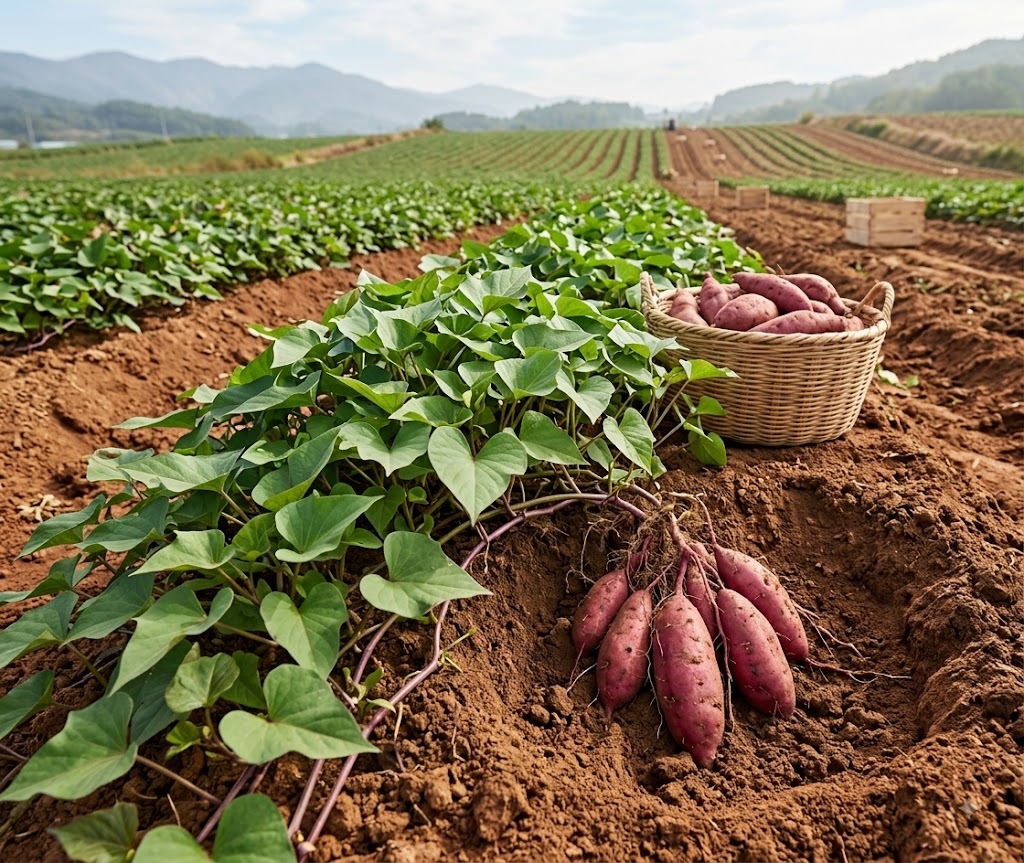
| Item Identity | Sweet potatoes are root crops that utilize the enlarged tuberous roots of the sweet potato (*Ipomoea batatas*) for food and processing. |
| Basic registration range | Manages raw sweet potatoes, washed and sorted sweet potatoes, variety-specific raw materials such as chestnut and pumpkin sweet potatoes, roasted and steamed sweet potatoes, cut and frozen products, and dried sweet potato slices, chips, powder, and starch raw materials. |
| Core separation | For edible, processing, seedling production, and feed use, as well as varieties, harvest time, storage conditions, and processing stages, are separated into Product and Lot units. |
| Purchase criteria | It is a report on variety, production location, harvest year, size and shape, skin damage and spoilage, sugar content and dry matter content, meat color, storage history, texture after heating, and safety. |
| Major risks | These include low-temperature damage, spoilage or weight loss during storage, mismatch between variety and intended use, inclusion of damaged raw materials, variations in sweetness or texture after heating, and discontinuity in the history of pretreatment or drying processes. |
| Industry Opportunities | This involves variety-specific small packaging such as chestnut sweet potatoes and pumpkin sweet potatoes, pre-processing for school and restaurant use, roasted sweet potatoes and HMR, dried snacks, chips, and powder materials, as well as RFQ matching between producers, processors, and private brand buyers. |
| Operational direction | It connects production, harvesting, curing, storage, sorting, processability testing, RFQ, and delivery/repurchase on a Lot basis. |
division | Registration details |
| Korean name | sweet potato |
| English name | Sweet potato |
| Representative scientific name | Ipomoea batatas (L.) Lam. |
| class | Convolvulaceae |
| Edible parts | A storage root, which is an enlarged root |
| Non-edible/Cautionary parts | Leaves and stems may be managed as separate edible vegetable products, but the basic scope of this container is tuberous roots. Raw materials contaminated with rot, mold, or foreign matter are excluded from the edible lot. |
| Harvesting stage | Harvesting after tuber enlargement and maturation / Separation into states according to post-harvest curing and storage purposes |
| Product form | Unwashed raw materials, washed whole sweet potatoes, sorted/small-packaged products, peeled/cut products, steamed/roasted sweet potatoes, refrigerated/frozen products, dried sweet potatoes, chips, paste, powder, starch |
| Processing stage | Harvesting · Curing · Storage · Washing · Sorting · Peeling · Cutting · Steaming · Baking · Drying · Frying · Freezing · Milling · Starch Extraction · Packaging |
| Basic use | Home/restaurant/school meal preparation, snacks, HMR, bakery, beverages/desserts, dried snacks/chips, powdered/starch food materials |
| Separation target | Potatoes, cassava, taro, yams, Jerusalem artichokes, seedlings and seedlings for production, ornamental Convolvulaceae plants |
Kew Plants of the World Online presents the scientific name for sweet potato as Ipomoea batatas (L.) Lam. Since the edible part of the sweet potato is the tuberous root rather than the underground stem like the potato, the storage, processing, and quality dataset is not integrated with that of the potato.
Product Master | Key Management Standards |
| Edible raw sweet potatoes | Variety, Origin, Harvest Year, Size, Shape, Skin, Wounds, Spoilage, Meat Color |
| Curing and storing sweet potatoes | Harvest date · Curing conditions · Storage temperature · Humidity · Storage period · Weight loss · Spoilage |
| Variety types such as chestnuts and pumpkin sweet potatoes | Basis for variety identification, meat quality, sweetness, texture after heating, color |
| For school meals and dining out | Size uniformity, washability, peelability, cutability, shape retention after heating |
| Roasted sweet potatoes · Steamed products | Raw Material Lot · Heating Conditions · Sugar Content · Moisture · Texture · Packaging Stability |
| Dried chips | Heat treatment, drying, moisture, color, texture, microorganisms, packaging |
| For powder and starch | Raw material specifications, dry matter content, moisture, particle size, viscosity, microorganisms, and composition |
| Myo and Jongsun | Application of a separate entity, separate production history, and separate distribution system from edible raw materials |
Classification criteria | Subdivision type | Management principles |
| plant species | Ipomoea batatas / Solanum tuberosum / Manihot esculenta, etc. | Isolation of sweet potato-like starch crops based on scientific names |
| Breed and meat quality | Chestnut sweet potato type / Pumpkin sweet potato type / Purple sweet potato type / Functional/processed type | Record of basis for verification of breed name, meat color, and use |
| production purpose | For food / For processing / For seedling/sprout production / For animal feed | Separation of Product Master and Lot by Purpose |
| Harvest and storage status | Fresh Sweet Potatoes / After Curing / Stored Sweet Potatoes / Processing Raw Materials | Harvest date, curing, and storage conditions must be recorded. |
| Product form | Raw material / Washed / Peeled/Cut / Steamed/Baked / Freezed / Dried / Powder/Starch | Lot connection by process |
| Final use | Home Meal/Restaurant/School Meals / Snacks / HMR / Bakery / Beverages / Food Ingredients | Verification of heating, drying, and formulation suitability |
| Transaction type | Direct from Farm / Bulk / Small Packaging / OEM / Private Label / Import/Export | Separation of MOQ, delivery time, packaging, and labeling standards |
Both sweet potatoes and potatoes are underground starchy agricultural products, but potatoes are tubers of the Solanaceae family, while sweet potatoes are tubers of the Convolvulaceae family. In particular, they are managed as separate items due to differences in post-harvest curing, risks of low-temperature storage, sweetness and texture after heating, and variety-specific distribution structures.
step | Essential Dataset | Management purpose |
| Seedlings and cultivation | Variety · Seedling · Seedling Source · Production Area · Cultivation Method · Planting Date · Production Purpose | Confirmation of variety and production purpose |
| Growth management | Soil, Irrigation, Fertilization, Pests and Diseases, Estimated Harvest Date | Production history and safety management |
| harvest | Harvest date, harvest year, packaging, damage rate, appearance | Distinguishing between new sweet potatoes and stored sweet potatoes |
| curing | Curing status, duration, temperature, humidity, and wound healing status | Management of Zhejiang Province and Spoilage Risks |
| save | Storage facilities, temperature, humidity, ventilation, low-temperature damage, spoilage, weight loss | Quality and Shipment Stability Management |
| Sorting and shipment | Size, shape, meat color, wounds, spoilage, packing date | Standards and Claim Prevention by Application |
| process | Peeling, cutting, steaming, baking, drying, freezing, and milling conditions | Tracking yield, sweetness, texture, and safety |
Domestic cultivation area, production volume, and shipment volume by region are registered after verifying the item definition, base year, and unit from KOSIS and raw data from the Ministry of Agriculture, Food and Rural Affairs and the Rural Development Administration. In this v1.0, unverified figures are not arbitrarily entered.
Quality items | raw sweet potato | Stored sweet potatoes | Steamed and Roasted Sweet Potatoes | For drying and powdering | Public rating |
| Scientific name, variety, use | core | core | core | core | Verified |
| Place of production · Harvest date · Harvest year | core | core | core | core | Verified |
| Size, shape, weight, and skin | core | core | importance | importance | Verified |
| Wounds, decay, foreign matter, soil | core | core | core | core | Verified/NDA |
| Meat color, sweetness, and dry matter content | importance | core | core | core | Verified/NDA |
| Curing and storage conditions | importance | core | importance | importance | Verified/NDA |
| Texture, color, and yield after heating | corresponding | importance | core | importance | NDA |
| Residual substances, microorganisms, test reports | Terms of trade | Terms of trade | core | core | NDA |
| Packaging and distribution stability | importance | core | core | core | Verified/NDA |
Lot Master Required Field
Lot ID · Item Name · Basis for Verification of Scientific Name · Variety/Line · Production Purpose · Product Form · Final Use · Country of Origin/Origin · Producer/Shipper · Cultivation History · Harvest Date/Year · Curing Conditions · Date of Receipt · Size/Weight/Shape · Skin/Wounds/Spoilage/Foreign Matter · Meat Color/Sugar Content/Dry Matter · Storage Conditions/Storage Period · Test Report · Processing Process Lot · Packaging Date · Shipment/Return/Claim
Customers | Purchase criteria | Cooperation opportunities |
| Production area, agricultural cooperative, joint sorting | Variety, Harvest Time, Size, Defects, Storage Life | Origin Lot Standardization · Curing Traceability |
| Local food and retail | Appearance, Variety, Sweetness, Small Packaging, Country of Origin, Labeling | Chestnut, pumpkin, and purple variety type PB |
| Dining Out & School Meals | Size uniformity, washability, peelability, delivery time | Washed and Pre-treated Sweet Potato RFQ |
| Roasted sweet potato and snack business operators | Variety, sweetness, size, texture after heating, and supply stability | Seasonal Matching of Raw Materials and Finished Products |
| HMR manufacturing | Texture, shape, refrigeration, and freezing stability after steaming and baking | Joint development of sweet potato HMR |
| Drying and chip manufacturing | Meat color, sweetness, dry matter content, drying yield, texture | Contract farming for dried snacks and chips |
| Bakery, Beverage, and Materials Companies | Color, aroma, sweetness, particle size, and composition of paste and powder | Sweet potato material RFQ |
| PB · Online Distribution | Origin, Variety, Labeling, Packaging, Repurchase | Small-package and subscription products by use |
Market size and sales volume by channel are not calculated using arbitrary figures until official statistics or verifiable distribution data are secured. Initially, a demand map is created by accumulating actual RFQ, delivery, return, and repurchase data.
step | Key variables | Operational judgment |
| Production and Procurement | Variety, Origin, Harvest Year, Final Use | Procurement of raw materials suitable for sales and processing purposes |
| Harvest and warehousing | Harvest date, wounds, spoilage, foreign matter, meat color | Sorting out lots unsuitable for storage and processing |
| Curing · Storage | Curing, temperature and humidity, ventilation, low-temperature damage, spoilage, changes in sugar content | Maintaining shelf life and quality |
| Selection | Size, shape, skin, meat color, defects | Separation of standards for raw, roasted, school meals, and processed sweet potatoes |
| Preprocessing and processing | Peeling, cutting, steaming, baking, drying, freezing, milling | Yield, Texture, Color, and Sweetness Connection |
| Quality and Safety | Residual substances, microorganisms, foreign matter, test reports, labeling | Buyer Submission Document Management |
| Buyer RFQ | Product Type · Application · Specifications · MOQ · Delivery Time · Packaging | Matching suitability other than price |
| Repurchase | Delivery · Returns · Texture · Dryness · Reorder | Producer, Lot, and Process Evaluation Update |
Import volume, country of origin, and customs clearance unit price are entered after determining the HS product range, base year, quantity unit, and value unit in the Korea Customs Service Import & Export Trade Statistics . Since raw sweet potatoes, frozen products, prepared products, powder, and starch may have different HS and quarantine/food standards, they are not aggregated with the same figures.
Products and processes | Key conditions | RFQ conversion |
| Washed and sorted raw sweet potatoes | Variety, Size, Damage, Spoilage, Packaging | Retail, Food Service, and Restaurant RFQ |
| Peeled and cut sweet potatoes | Raw Material Lot · Cutting Specifications · Browning · Hygiene · Refrigeration | School Meals, Dining Out, and HMR RFQ |
| Steamed and roasted sweet potatoes | Heating conditions, sweetness, moisture, texture, shape | Snack, Convenience Store, and HMR RFQ |
| frozen sweet potatoes | Texture after cutting, steaming, quick freezing, and thawing | RFQ for School Meals, Dining Out, and Convenience Foods |
| Dried sweet potato slices | Raw material variety, drying method, moisture, color, texture | Snacks · PB RFQ |
| sweet potato chips | Cutting thickness · Frying · Drying · Oil absorption · Texture | Snack Manufacturing RFQ |
| Paste/Powder | Heat treatment, drying, particle size, color, sugar content, blending | Bakery, Beverages, and HMR RFQ |
| Starch and food materials | Raw material specifications, starch yield, moisture, viscosity, microorganisms | RFQ for Sauce, Noodle, and Bakery Materials |
The processing suitability of sweet potato raw materials may vary depending on the variety, harvest, curing, and storage history, as well as sugar content and dry matter content. Suitability for roasted sweet potatoes, dried sweet potato slices, chips, and powder is not confirmed until verification of the processing, sensory evaluation, and test reports for each actual lot is completed.
first of all | Execution item | Performance indicators |
| 1 | Variety, Use, Harvest Year, and Lot ID are required. | Required value input rate |
| 2 | Separation of Product Entities: Raw Food, Roasted Sweet Potatoes, School Meals, Dried Sliced Snacks, Chips, Powder | Misclassification reduction rate |
| 3 | Production–Curing–Storage–Sorting–Processing–Outbound History Linkage | Lot tracking rate |
| 4 | Data conversion of damage, spoilage, sugar content, processing tests, and test reports | Quality document connection rate |
| 5 | Connecting Producer, Processor, Private Brand, and Buyer RFQs with Repurchases | Matching rate · Repurchase rate |
Problem group | Problem Definition | Required data |
| mismatch between variety and use | Raw materials for raw consumption, roasted sweet potatoes, dried sweet potato slices, and powder are traded under the same standards. | Variety, meat color, sugar content, dry matter content, final use |
| Cure history interruption | Post-harvest curing conditions are not linked to storage and release quality | Harvest date · Curing · Storage temperature and humidity · Spoilage |
| Cold damage and decay | Quality degradation and claims arising from unsuitable storage conditions | Storage records, visual inspection, weight reduction |
| Workpiece deviation | Color, sweetness, and texture after heating and drying do not correspond to the original lot | Raw Material Lot · Processing Conditions · Sensory Test |
| Missing quality certificate | Information on residual substances, microorganisms, and foreign substances is not reflected in the transaction document | Review of test reports, inspection, and labeling |
| Confusion regarding labeling and country of origin | Information on variety, place of production, and product type is lost during the distribution stage | Product Master · Packaging · Shipping Documents |
| Repurchase data disconnection | Texture, dryness, spoilage, and returns are not returned to the production lot after delivery | Delivery · Return · Claim · Reorder |
RFQ Type | Public Registration | Verify/NDA |
| contract farming for food | Production area, variety group, harvest season, product use | Area, Estimated Volume, Contract Unit Price, Producer |
| Supply of stored sweet potatoes | Variety, Harvest Year, Packaging, Desired Supply Time | Storage Inventory · Storage Conditions · Unit Price · Test Report |
| Roasted sweet potato raw material | Variety, Size, Sugar Content, Purpose of Heating, Supply Time | Actual volume, samples, unit price, contract |
| Raw materials for school meals and dining out | Size, Washing, Packaging, Delivery Time | Daily volume, unit price, and inspection standards |
| Ingredients for dried fruit and chips | Target product, variety, color, sugar content, processing time | Building ratio, standard testing, and contract conditions |
| Powder and starch raw materials | Product form, particle size, heat treatment, and application | Yield, Certificate, Unit Price, Sample |
| Pre-processing and HMR cooperation | Peeling, cutting, steaming, refrigeration, and freezing conditions | Process Cost · Quality Certificate · MOQ |
| PB·Distribution Cooperation | Sales channels, product form, labeling, and packaging | Customer, Quantity, Unit Price, Delivery Date, Contract |
① Need Products & Materials
Companies and institutions seeking necessary products, agricultural products, raw materials, and processed goods register purchasing demands. Registered requests are utilized to review cooperation with potential suppliers and producers based on the RFQ Intelligence Library.
Process:
RFQ Registration → Supplier/Product Review → Collaboration Connection → Future AI Matching
Register
② We are looking for production and manufacturing partners. (Need Suppliers & Manufacturers)
Register a request to find necessary production and supply partners, ranging from farms and producer organizations to processing companies, OEM, ODM, and private label manufacturers.
Process:
RFQ Registration → Review of Production & Manufacturing Capabilities → Collaboration Connection → Future AI Partner Matching
Register
③ We are looking for domestic and international buyers. (Need Buyers)
Farmers, producer organizations, and manufacturing companies are requesting cooperation with new buyers, such as domestic and international distributors, importers, brand companies, and food service and catering businesses.
Process:
RFQ Registration → Product & Supply Capability Review → Market & Buyer Connection → Future AI Buyer Matching
Register
Contact : mail@markethub.org
Version | Main contents | situation |
| v1.0 | Registration of basic structure for raw sweet potato, curing, storage, processing, and RFQ | complete |
| v1.1 | Verification of KOSIS·Korea Customs Service raw data and domestic distribution structure | expected |
| v2.0 | Separation of standards for variety type, raw consumption, roasted sweet potatoes, dried sweet potatoes, chips, and powder | expected |
| v3.0 | Production–Storage–Processing–PB·Buyer Verified Container Combination | expected |