


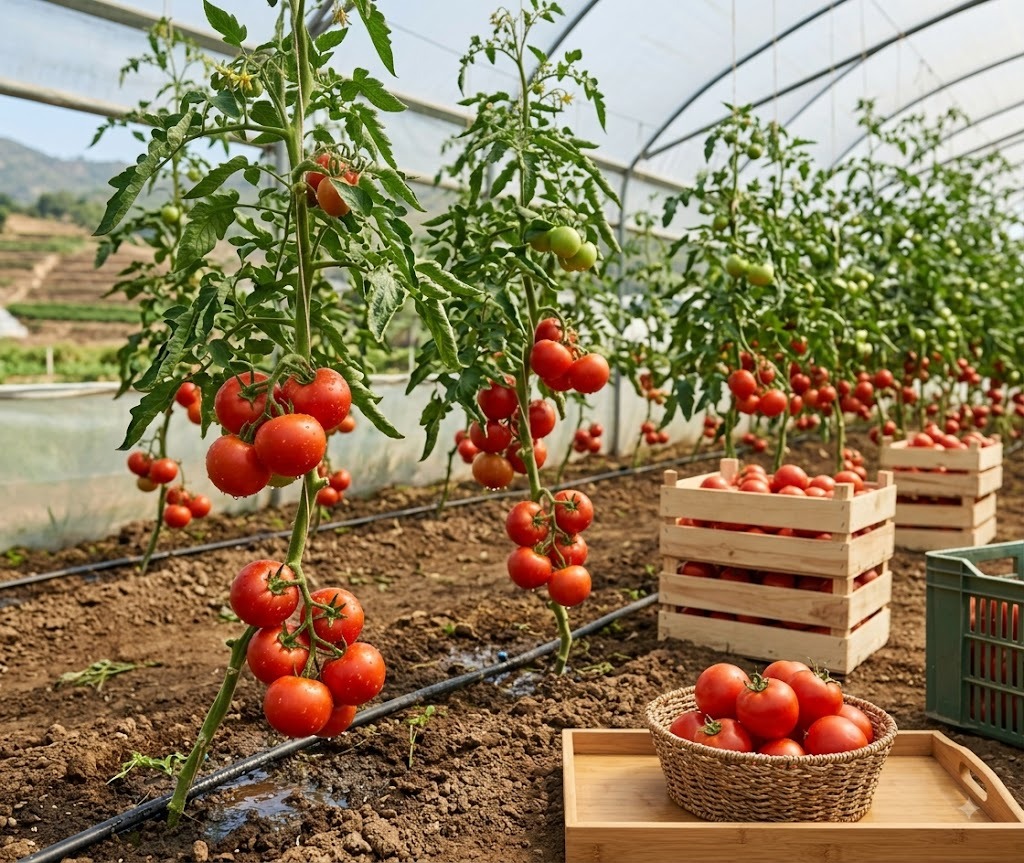
Judgment axis | detail |
| Item Identity | The currently internationally accepted species of tomato is Solanum lycopersicum L., which belongs to the genus Solanum of the family Solanaceae. ( Plants of the World Online ) |
| Domestic agricultural scientific names | Existing cultivation data from the Rural Development Administration uses the notation Lycopersicon esculentum Mill. Currently, Kew treats this name as a synonym for S. lycopersicum. ( Nongsaroo ) |
| Edible parts | The fruit that has enlarged and matured after pollination and fruit set is the main edible part, and the leaves, stems, and roots are separated from general edible products. |
| Classification of varieties and products | Large-sized and regular tomatoes, cherry tomatoes, cluster tomatoes, fully ripe and unripe shipment types, products by color and shape, and those for fresh consumption and processing are separated in the Product Master. The Rural Development Administration also classifies variety groups such as fully ripe, unripe, cluster, and cherry types. ( Nongsaroo ) |
| Cultivation characteristics | According to the Rural Development Administration's agricultural work schedule standards, the optimal temperature for germination is 25–30℃, for seedling growth 20–25℃, for flowering 20–25℃, for growth 17–27℃, and for fruit enlargement 25–30℃. ( Nongsaroo ) |
| Suitable cultivation site | According to the Rural Development Administration standards, deep soil with good drainage and a pH range of 5.5 to 7.0 is suggested as suitable for cultivation. ( Nongsaroo ) |
| Growth disorders | The Rural Development Administration identifies conditions of 10℃ or below and 30℃ or above as the range for growth disorders, and explains that under hot and humid conditions, there is a possibility of poor fruit set, sluggish fruit enlargement, fruit cracking, quality degradation, and an increase in diseases. ( Nongsaroo ) |
| Weather and light risks | Greenhouse tomatoes are sensitive to changes in sunlight. The Ministry of Agriculture, Food and Rural Affairs ordered strengthened management of photosynthesis for greenhouse vegetables, such as green peppers, zucchini, and tomatoes, when cloudy weather persists in 2024. ( Ministry of Agriculture, Food and Rural Affairs ) |
| Harvesting principle | Create a harvest lot by checking coloration, ripeness, fruit weight, stem, shape, hardness, sugar content, cracking, blossom end rot, deformities, lesions, and stem condition. |
| Product separation | Separate regular tomatoes, large tomatoes, cherry tomatoes, date-shaped cherry tomatoes, cluster tomatoes, unripe tomatoes, ripe tomatoes, tomatoes by color, fresh-cut tomatoes, and raw materials for juice, puree, sauce, and paste. |
| Domestic statistics | In the "Vegetable Production (Fruit Vegetables)" section of the National Statistical Portal KOSIS, the cultivated area (ha), yield per 10a (kg), and yield (ton) of greenhouse tomatoes exist as separate statistical items. The finalized figures for 2025 should be entered after querying the raw tables and verifying the base year. ( KOSIS ) |
| Statistical Operation Principles | Do not aggregate data for regular tomatoes, cherry tomatoes, greenhouses, and open fields without verifying the statistical ranges. Store the item, facility classification, base year, and unit together. |
| Safety Management | For pesticide residue standards in agricultural products on Food Safety Korea, individual standards are applied first, and for pesticides without a separate MRL, a standard of 0.01 mg/kg or less is applied. The actual tomato lot is linked to the latest item-specific MRL on the inspection date. ( Food Safety Korea ) |
| AX Core | It is designed as a representative greenhouse horticulture AX item connecting greenhouse environment–growth–flowering–fruit setting–fruit enlargement–ripening–harvest prediction–AI sorting–Lot–Buyer Reorder. |
| Final goal | Connects Buyer RFQs and repurchase data across the farm-seedling-facility/smart farm-APC/sorting-wholesale/distribution-foodservice/dining-processing-export chains. |
division | Registration details |
| Korean name | tomato |
| English name | Tomato |
| International representative scientific name | Solanum lycopersicum L. — Kew accepted species ( Plants of the World Online ) |
| Domestic agricultural data scientific names | Lycopersicon esculentum Mill. — Rural Development Administration previous spelling ( Nongsaroo ) |
| Taxonomy Principles | Lycopersicon esculentum is currently linked as a synonym of Solanum lycopersicum. ( Plants of the World Online ) |
| classification | Solanaceae → Solanum → Solanum lycopersicum ( Plants of the World Online ) |
| Edible parts | Edible fruit parts including the peel, flesh, placenta, and seeds |
| Non-edible · Separate management | Leaves, stems, roots, seeds/seedlings for cultivation, diseased/rotted fruit |
| Major growth stages | Seed → Germination → Seedling → Transplanting → Vegetative Growth → Flower Cluster Formation → Flowering → Pollination & Fruit Set → Fruit Enlargement → Green Ripening → Coloring Begins → Red Ripening → Fully Ripened → Overripening |
| Major harvesting stages | Actual ripeness standards, such as Unripe/Green → Breaker → Turning → Pink → Light Red → Red/Fully Ripe, are linked to Standard/Buyer-specific Specifications. |
| Basic product form | Large/Regular Tomatoes, Cherry Tomatoes, Date Cherry Tomatoes, Cluster Tomatoes, Shipped Unripe, Shipped Fully Ripe, Colored Tomatoes, Fresh-cut, For Processing |
| Basic processing stage | Seeds → Seedlings → Transplanting → Training & Pruning → Pollination & Fruit Setting → Thinning → Harvesting → Sorting → Washing → Pre-cooling → Packaging → Cutting, Juicing, & Crushing → Concentration & Heating → Sauces, Purees, & Pastes |
| Basic use | Raw food, salad, cooking, dining out, school meals, sandwich, meal kit, juice, sauce, puree, paste, HMR, OEM·PB |
| Similarity Principle | Cherry tomatoes, date cherry tomatoes, and cluster tomatoes are linked as Product/Variety Entities within the same Species, but specifications, Buyers, and production statistics are separated. |
| Difference in the previous items | Bamboo shoots are the young shoots of the bamboo species and are a product group, while tomatoes are the mature fruit products of the Solanaceae family, so their production and harvesting structures are completely different. |
| Back item relationship | No. 061 chili pepper and No. 062 paprika are also fruit vegetables of the Solanaceae family, but they belong to the genus Capsicum and are distinct Species Entities from tomatoes. |
Product Master
Product Master | Key Management Standards |
| Regular large tomatoes | Variety, fruit weight, fruit diameter, color, hardness, sugar content, harvest date |
| Ripe tomatoes | Ripness, Coloration Rate, Hardness, Distribution Distance |
| Unripe tomatoes for shipment | Harvest ripeness, post-harvest ripening, and delivery period |
| cherry tomatoes | Fruit weight, stem, sugar content, cracking, stem |
| Date cherry tomatoes | Fruit shape, length, weight, sugar content, and firmness |
| Cluster tomatoes | Fruit per cluster, uniformity, cluster weight, coloration |
| red tomatoes | Variety, Color, Ripening |
| Yellow, orange, and other colors | Variety, Color, Buyer Use |
| Tomato Salad | Size, Hardness, Sugar-Acid Ratio, Freshness |
| Fresh-cut | Raw Material Lot · Washing · Cutting · Microorganisms · Use-by Date |
| For school meals | Safety, Size, Hardness, Inspection, Delivery Time |
| For dining out | Fruit shape, ripeness, cutability, delivery cycle |
| For Juice | Sugar content, acidity, and processing yield |
| For Puree | Flesh ratio, solids content, color, yield |
| For sauce | Processability, Solid Content, Acidity, Color |
| For Paste | Solid content, concentration yield, and amount of raw materials |
| OEM·PB | Raw Material Lot · Processing Method · Package · Trademark |
| Non-standard negligence | Size, appearance defects, and suitability for processing conversion |
| by-product | Separate management of excluded parts, peels, seeds, stems, leaves, etc., according to use |
Classification criteria | Subdivision type | Management principles |
| Species | S. lycopersicum | International Taxonomy Standards |
| agricultural science name | Lycopersicon esculentum | Synonym Source Connection |
| Fruit size | Large / Medium / Bell | The actual g standard varies by variety and buyer. |
| Family type | Round / Flattened / Oblong / Jujube-shaped / Others | Variety Master |
| Cluster shape | Single fruit / Cluster | Separation of harvest and packaging standards |
| color | Red / Yellow / Orange / Others | Color Difference Dataset |
| Harvest maturity | Unripe / Coloring begins / Medium ripe / Hard ripe | Separation of Buyer and Distribution Distance |
| Cultivation type | Open Field / Sheltered / Facility / Smart Farm / Hydroponics/Nutrient Solution | Farm Type Separation |
| Cultivation method | Forced / Semi-forced / Inhibited / Long-term cultivation / Others | Link to actual Rural Development Administration crop type standards |
| Harvesting type | Individual fruit / Cluster / Repeated harvest | Harvest Runtime |
| Distribution methods | Raw materials from the source / APC sorting / Small packaging / Fresh-cut | Lot Inheritance |
| Processing form | Juicing / Crushing / Puree / Sauce / Paste / Drying | Process Lot |
| Final use | Home / Salad / School Meals / Food Service / Processed Food / Private Brand / Export | Buyer Specification |
| Transaction type | Source Procurement / Contract Farming / Regular Supply / Processing Raw Materials / Export / OEM·PB | Price and quantity are subject to NDA |
The Rural Development Administration's agricultural work schedule suggests that the optimal temperature for tomato and cherry tomato germination is 25–30°C, seedling cultivation 20–25°C, flowering 20–25°C, growth 17–27°C, and fruit enlargement 25–30°C. It also explains that the possibility of growth disorders increases under conditions below 10°C or above 30°C, and that high temperature and humidity conditions may lead to poor fruit set, sluggish fruit enlargement, fruit cracking, quality degradation, and increased disease incidence. ( Nongsaroo )
step | Essential Dataset | Management purpose |
| Production plan | Variety, Cultivation Type, Facilities, Area, Buyer Contract | Supply plan |
| satellite | Variety · Seed Company · Seed Lot | Variety Traceability |
| Seedling cultivation | Sowing date, germination, seedling age, nursery | Tomb quality |
| formula | Planting date · Number of trees · Planting density · Bed | Production history |
| Soil and medium | Soil/Coco peat/Rock wool, etc. · pH · EC | Root zone management |
| Nutrient solution | Prescription · EC · pH · Supply volume · Drainage | hydroponics |
| Watering | Time, quantity, frequency | Fruit enlargement and cracking |
| Facility Environment | Temperature, humidity, CO₂, light, ventilation | Growth and fruit setting |
| ilsa | Cumulative light intensity and sunshine hours | Production forecast |
| Growth | Plant height, stem diameter, number of leaves, growing point | Vegetative growth |
| art supply store | Flower cluster number, blooming date, number of flowers | Production forecast |
| correction | Methods/dates such as bees, vibrations, hormones, etc. | Fruit set |
| Fruit set | Fruit set and fruit set rate by flower cluster | Quantity forecasting |
| Enemy | Removal and Remaining | Fruit uniformity |
| Excessive negligence | Estimated fruit diameter, fruit weight, and growing days | Harvest forecasting |
| pests | Occurrence, Diagnosis, and Control | Production risk |
| pesticide | Pesticide, spraying date, and safe usage period | safety |
| Physiological disorders | Fruit cracking, blossom end rot, hollow fruit, deformed fruit, etc. | quality |
| Accommodation assessment | Coloration rate, color intensity, and hardness | Optimal harvest time |
| Sweetness | °Brix·Measurement Date·Sample | Buyer suitability |
| Sando | pH, titratable acidity, etc. | Flavor and processing |
| harvest | Firefighting, negligence, date, worker | Raw Lot |
| Selection | Weight, Size, Color, Appearance | Grade |
| APC | Sorting line · Processing date · Packaging | Distribution Lot |
| purifying | Washing water and process | Hygiene by Product |
| Pre-cooling | Temperature and time | quality |
| packaging | Weight, container, and packaging date | circulation |
| save | Temperature, humidity, and period | Sudokdo·Gyeongdo |
| delivery | Vehicle, Temperature, Time | Cold/Supply Chain |
| ripening | Temperature, Period, Coloration | Immature Shipment Product |
| Incoming inspection | Ripness, firmness, sweetness, appearance, temperature | Buyer rating |
| process | Crushing, juicing, heating, and concentration | Processing Lot |
| Claim | Cracking, softness, overripe, immaturity, wounds | Supplier Score |
| Repurchase | Buyer · Variety · Specifications · Quantity | Next harvest and planting plan |
For pesticide residue limits on agricultural products on the Food Safety Korea website, individual item standards are applied first, and for pesticides for which separate standards have not been established, a limit of 0.01 mg/kg or less is applied. For tomatoes and cherry tomatoes, the actual applicable standard is determined by linking the latest MRL for each item and pesticide at the time of inspection to the Lot. ( Food Safety Korea )
Quality items | Regular tomato | cherry tomatoes | Fresh-cut | For processing | Public rating |
| Variety · Farm · Lot | core | core | core | core | Verified |
| Cultivation type/Farming type | core | core | importance | importance | Verified |
| Harvest date · Flower cluster | core | core | core | core | Verified/NDA |
| Harvest maturity | core | core | core | core | Verified/NDA |
| Overweight | core | core | core | importance | Verified/NDA |
| Fruit diameter/size | core | core | core | importance | Verified/NDA |
| Family type | core | core | importance | importance | Verified/NDA |
| Color/Coloration | core | core | core | core | Verified/NDA |
| hardness | core | core | core | importance | Verified/NDA |
| Brix | importance | core | importance | importance | Verified/NDA |
| Sando | importance | importance | importance | core | Verified/NDA |
| Dangsanbi | importance | importance | importance | importance | Verified/NDA |
| tap state | core | core | importance | Not applicable | Verified/NDA |
| Heat and | core | core | core | importance | Verified/NDA |
| navel rot | core | core | importance | importance | Verified/NDA |
| Deformity and joint | core | importance | importance | importance | Verified/NDA |
| Wounds/Compression | core | core | core | core | Verified/NDA |
| lesions and decay | core | core | core | core | Verified/NDA |
| Pesticide usage records | core | core | core | core | NDA |
| Pesticide Residue Test Report | core | core | core | core | NDA |
| Cleaning history | By product | By product | core | core | NDA |
| microorganism | importance | importance | core | core | NDA |
| Processing yield | Not applicable | Not applicable | importance | core | NDA |
| Solids | Not applicable | Not applicable | By product | core | NDA |
| Storage and Delivery | core | core | core | importance | Verified/NDA |
| Incoming inspection | core | core | core | core | NDA |
| Returns and Claims | core | core | core | core | NDA |
| Repurchase | core | core | core | core | NDA |
Lot Master Required Field
Lot ID · Product Type · Accepted Species · Agricultural Synonym · Variety · Seed Lot · Farm/Facility · Cultivation Type · Cultivation Method · Planting Date · Flower Cluster Number · Flowering Date · Fruit Set Date · Harvest Date · Harvest Ripness · Fruit Weight · Diameter · Fruit Shape · Color · Coloration · Hardness · Sugar Content · Acidity · Sugar-Acid Ratio · Stem Condition · Cracking · Blossom End Rot · Deformity · Hollow · Wound · Disease Spot · Rot · Pesticide Use Records · Pesticide Residue · Microbiological Test Report · Sorting Grade · APC Lot · Washing · Pre-cooling · Packaging · Storage · Shipping · Fresh-cut or Process Lot · Processing Yield · Departure Destination · Incoming Inspection · Returns/Claims · Repurchase
Customers | Purchase criteria | Cooperation opportunities |
| Tomato farm | Variety, Crop Type, Estimated Harvest Yield | contract production |
| Smart Farm | Long-term production, environment, and yield forecasting | Runtime RFQ |
| Seedling company | Variety, seedling age, grafting, delivery time | Seedling RFQ |
| Nonghyup · APC | Grade, Overweight, Color, Quantity | Joint screening |
| wholesale market | Size, ripeness, packaging, and shipping date | Shipment from the production area |
| Large-scale distribution | Specifications, sweetness, appearance, and supply stability | Regular Supply · PB |
| Online fresh food distribution | Ripness, Packaging, Shipping Durability | Direct from the farm |
| Salad company | Hardness, size, and safety | Fresh-cut RFQ |
| food service companies | Ripness, Cutability, Taste, Delivery Cycle | Foodservice RFQ |
| School and public meals | Safety, Size, Inspection, Delivery Time | School Meal RFQ |
| hotel | Variety, Appearance, Taste, Special Color | Premium RFQ |
| sandwiches and burgers | Thickness, Hardness, and Slice Suitability | Processed raw materials |
| Meal kit | Sukdo · Small Pack · Freshness | Kit RFQ |
| Juice manufacturer | Sugar content, acidity, and processing yield | Raw Material RFQ |
| sauce manufacturer | Solids, Color, Acidity, Yield | Processing RFQ |
| Puree and Paste Companies | Solid content, yield, and bulk supply | contract production |
| HMR companies | For sauce, cutting, and heating | Food manufacturing |
| PB business operator | Freshness, Juice, Sauce, Package | OEM·PB |
| export companies | Variety · Standards · Quarantine · Shelf-life | Export RFQ |
| Seed company | Yield, disease resistance, sugar content, fruit shape | Variety Verification |
| technology companies | Environmental control, harvest forecasting, robots, sorting | AX Pilot |
| Research Institute | Growth, fruit setting, quality, storage, and processing | joint research |
| local government | Smart Farm · APC · Processing · Export · Young Farmers | Regional Tomato AX |
step | Key variables | Operational judgment |
| satellite | Variety · Seed Lot · Disease Resistance | production suitability |
| Seedling cultivation | Age, Grafting, Quality | Official plan |
| facilities | Scale, Environmental Control, Energy | Year-round production |
| Growth | Light, temperature and humidity, CO₂, and the rhizosphere | Production risk |
| flowering | Flowering tree | Fruit set prediction |
| Fruit set | Fruit set rate · Fruit tree | Yield forecasting |
| Excessive negligence | Diameter/Estimated Weight | Shipping time |
| Sukdo | Color and hardness | Harvest by Buyer |
| harvest | Variety, Flower Cluster, Date | Raw Lot |
| APC screening | Weight, Size, Color, Defects | Grade |
| packaging | Capacity, container, label | Distribution Channels |
| Storage and ripening | Temperature, Time, and Degree of Culinary Experience | Distribution Street |
| Domestic distribution | Wholesale, Retail, Online, and Food Service | Market |
| process | Juice, sauce, puree, paste | Processing |
| import | Fresh/Processed Product · Country · Unit Price | competitive structure |
| export | Country, Standards, Quarantine, Logistics | Export Match |
| FTA | Agreement, Rule of Origin, Tariff | Trade Cost |
| RFQ | Variety, Specifications, Quantity, Period | AI Match |
| contract | Unit price, quantity, quality, inspection | Terms of trade |
| delivery | Lot · Quantity · Temperature | Implementation verification |
| Buyer rating | Taste, Hardness, Waste Rate, Yield | Supplier Score |
| Repurchase | Recurring orders/annual contracts | Production planning feedback |
Products and processes | Key conditions | RFQ conversion |
| Regular raw tomatoes | Variety, Ripeness, Weight, Hardness | Retail and Food Service RFQ |
| Ripe tomatoes | Color, taste, and hardness | Direct from the farm · Dining out |
| cherry tomatoes | Fruit weight, sugar content, cracking, stem | Retail · Salad |
| Cluster tomatoes | Cluster uniformity, fruit size, and coloration | Premium RFQ |
| Fresh-cut | Raw Material Lot · Washing · Cutting · Microorganisms | Salad · HMR |
| juice | Sugar content, acidity, and juice yield | Juice RFQ |
| Puree | Flesh ratio, color, and solid content | Processing |
| sauce | Raw Material Lot · Blending · Concentration · Heating | OEM·HMR |
| Paste | Solid content and concentration yield | industrial raw materials |
| Tomato Whole Dice | Peeling, cutting, and heating | Canned goods · HMR |
| dried tomatoes | Moisture, drying conditions, color | Foodservice and Processing |
| frozen tomatoes | Pretreatment and Thawing Characteristics | Processing |
| Non-standard and | Safety, ripeness, and processing yield | Processing Conversion RFQ |
| pericarp | Amount produced · Pigment · Fiber | Review of materialization |
| satellite | Amount, Fat, and Components | Materials and seeds will be reviewed separately. |
| Stem and leaves | Occurrence volume, diseases, and pesticide history | Compost and Biomass Review |
PRP — Product Research Profile
PRP items | Details of investigation and verification |
| PRP-01 Taxonomy | S. lycopersicum and Lycopersicon esculentum relationship |
| PRP-02 Large | Variety, Fruit Weight, Ripening, Distribution |
| PRP-03 drops | Variety, Sugar Content, Fruit Cracking, Harvest |
| PRP-04 Jujube Drops | Fruit shape, firmness, and sugar content |
| PRP-05 cluster | Fruit quantity and color uniformity per cluster |
| PRP-06 fully ripened type | Accommodation, Distribution Distance, Longitude |
| PRP-07 Immature Shipment | Ripening, Distribution, and Taste |
| PRP-08 facility | Temperature, humidity, light, CO₂, and production volume |
| PRP-09 Hydroponics/Nutrient Solution | EC·pH·drainage·water volume |
| PRP-10 Seedling/Grafting | Seedling quality, disease resistance, and productivity |
| PRP-11 flamethrower | Flowering, fruit setting, and harvesting by flower cluster |
| PRP-12 modification | Bees, other pollination methods, and fruit set rate |
| PRP-13 light | Cumulative light intensity, fruit set, and sugar content |
| PRP-14 temperature | Growth, flowering, enlargement, and disorders |
| PRP-15 moisture | Irrigation, fruit cracking, and fruit enlargement |
| PRP-16 heat and | Variety, Irrigation, Ripening, Environment |
| PRP-17 navel rot | Root zone, nutrients, and incidence rate |
| PRP-18 Sukdo | Color · Hardness · Shelf-life |
| PRP-19 sugar content | Variety, Environment, Harvest Stage |
| PRP-20 Storage and Curing | Temperature, Hardness, Coloration |
| PRP-21 Fresh-cut | Cutting · Microorganisms · Shelf-life |
| PRP-22 juice | Juice yield · Sugar acidity |
| PRP-23 Sauce/Puree | Solid content, color, and processing yield |
| PRP-24 Buyer | Specifications · MOQ · Delivery Time · Price |
| PRP-25 Reorder | Delivery Quality, Claims, and Repurchases |
| PRP-26 byproduct | Utilization of non-standard fruits, fruit peels, and seeds |
first of all | Execution item | Performance indicators |
| 1 | Variety–Farm–Facility–Crop Cycle–Lot required value | Data integrity |
| 2 | Separation of Large Fruit – Cherry – Jujube – Cluster – Processing Product | Misclassification reduction rate |
| 3 | International Taxonomy – Agricultural Name Auto-linking | scientific name verification rate |
| 4 | Real-time collection of Temperature, Humidity, CO₂, Light, and Rho-sphere Datasets | Environmental collection rate |
| 5 | AI measurement of growth point, plant height, and stem diameter | Growth assessment accuracy |
| 6 | Flower bed and flower number image recognition | Flowering data automation rate |
| 7 | Automatic counting of fruit set | Fruit set prediction accuracy |
| 8 | Estimated AI for fruit size and weight | Yield prediction |
| 9 | Maturity and Coloration AI Assessment | Harvest judgment accuracy |
| 10 | Cracks, navel rot, malformations, and AI detection | Defect detection rate |
| 11 | Prediction of estimated harvest quantity and harvest date | Supply forecasting accuracy |
| 12 | APC AI Screening and Lot Connection | Automatic screening rate |
| 13 | Connecting Sugar Content, Hardness, and Color Datasets | Quality integrity |
| 14 | Pesticide Use – Harvest – Automatic Report Linkage | Safety document connection rate |
| 15 | Fresh/Processing Buyer AI Match | RFQ Match Rate |
| 16 | Integrated evaluation of smart farm energy and production | Energy efficiency per kg |
| 17 | Buyer Scrap Rate · Processing Yield · Claim Recycling | Supplier Score |
| 18 | Reorder → Automatic connection for flower cluster harvesting and next cropping season planning | Repurchase linkage rate |
Problem group | Problem Definition | Required data |
| Mixed scientific names | Mixed spelling of Lycopersicon and Solanum | Taxonomy·Source |
| Mixed statistics of large and small fruits | Discrepancy between product group and production statistics scope | Product · Statistical Range |
| Mixing of variety and product names | Market names and variety names such as jujube, cluster, and ripe are mixed. | Variety·Product |
| Seedling quality variation | Early seedling quality affects long-term productivity | Seedling Dataset |
| Facility environment deviation | Changes in production volume due to differences in temperature, humidity, light, and CO₂ | Facility Runtime |
| Low-level work | Impact on growth, fruit set, and supply due to reduced light intensity | Light, Fruit Set, Harvest |
| High temperature | Poor fruit set, reduced fruit size, and reduced quality | Temperature, fire, fruit |
| humid | Increased disease and quality risks | RH·Disease |
| Fruit set deviation | Non-uniformity in fruit number and size by flower cluster | Flower·Fruit Set |
| Edit Management | Differences in fruit set depending on pollination method and environment | Pollination and fruit set rates |
| Heat and | Product loss/claim occurrence | Watering, humidity, maturity |
| navel rot | Increased waste disposal due to physiological disorders | Root rights, negligence, environment |
| deformity and | Quality issues regarding low-temperature seedling cultivation, environment, etc. | Seedling growth, temperature, and quality |
| Sugar content variation | Difference between Buyer's Expected Quality and Actual Quality | °Brix·Variety·Environment |
| Sukdo mismatch | Discrepancy between distribution distance and harvest maturity | Accommodation/Delivery Time |
| Hardness reduction | Marketability declines due to overripening and storage | Hardness, temperature, and time |
| APC Lot disconnection | Lack of tracking for farm lots and sorting/packaging lots | Raw·APC Lot |
| pesticide residues | Spraying and harvest management required for recurring harvest items | Spray·Harvest |
| Fresh-cut microorganisms | Hygiene risks after amputation | Cleaning and microorganisms |
| supply forecasting | Flower cluster and fruit set data are not linked to transactions | Yield Forecast |
| Price fluctuations | Price fluctuations based on short-term shipment volume and quality | Shipment price |
| Shortage of raw materials for processing | Discrepancy between fresh produce varieties/specifications and processing yield | Brix·Yield |
| Non-standard and waste | Does not separate appearance defects and food processing suitability | Grade·Processing |
| Energy costs | Heating and electricity costs for greenhouse cultivation affect production costs | Energy·Yield |
| Export Shelf-life | Discrepancy between transportation period and maturity/hardness | Export Logistics |
| Repurchase not reflected | Buyer evaluations are not fed back into varieties, flower clusters, and production plans | Evaluation·Reorder |
RFQ Type | Public Registration | Verify/NDA |
| General large fruit procurement from production areas | Variety group, origin, specifications, shipping time | Farm · Quantity · Unit Price · Lot |
| Ripe tomatoes | Ripness, weight, color, use | Actual quantity and unit price |
| cherry tomatoes | Fruit weight, sugar content, fruit shape, and period | Variety, Quantity, Price |
| Jujube bells | Fruit shape, sweetness, firmness, packaging | Lot · MOQ · Unit Price |
| Cluster tomatoes | Cluster size, color, and fruit size | Production volume and price |
| Regular supply of facilities | Cultivation type, period, and weekly specifications | Weekly Quantity and Unit Price |
| Smart farm contract production | Variety, Quality, Period, and Harvest Forecast | Area, Production Volume, Contract |
| School and public meals | Safety, Standards, Inspection, Delivery Time | Test Report, Quantity, Price |
| For dining out | Ripening, Hardness, Fruit Diameter, Period | MOQ · Price · Claims |
| Salad/Fresh-cut | Hardness, microorganisms, and cutting ability | Test results and expiration dates |
| Juice ingredients | Sugar content, acidity, and processing yield | Volume, Cost, Contract |
| Sauce ingredients | Solid content, color, and processing suitability | Yield and price per ton |
| Puree/Paste | Brix · Color · Bulk Supply | Process and contract volume |
| Non-standard and processing | Safety, ripeness, and processing use | Actual volume and unit price |
| PB Fresh | Origin, variety, packaging | MOQ · Brand · Price |
| OEM processing | Juice, Sauce, Puree Product | Formulation · MOQ · Contract |
| export | Standards, Country, Shipment Date, Packaging | Quarantine, volume, FOB, etc. |
| Technology demonstration | Growth prediction, AI sorting, and robotic harvesting | Equipment and test results |
| Research cooperation | Variety · Light · Fruit Set · Fruit Cracking · Storage | Samples and test results |
| local government cooperation | Smart Farm · APC · Processing · Export | Farms, Facilities, Budget, and Project Conditions |
① Need Products & Materials
Companies and institutions seeking necessary products, agricultural products, raw materials, and processed goods register purchasing demands. Registered requests are utilized to review cooperation with potential suppliers and producers based on the RFQ Intelligence Library.
Process:
RFQ Registration → Supplier/Product Review → Collaboration Connection → Future AI Matching
Register
② We are looking for production and manufacturing partners. (Need Suppliers & Manufacturers)
Register a request to find necessary production and supply partners, ranging from farms and producer organizations to processing companies, OEM, ODM, and private label manufacturers.
Process:
RFQ Registration → Review of Production & Manufacturing Capabilities → Collaboration Connection → Future AI Partner Matching
Register
③ We are looking for domestic and international buyers. (Need Buyers)
Farmers, producer organizations, and manufacturing companies are requesting cooperation with new buyers, such as domestic and international distributors, importers, brand companies, and food service and catering businesses.
Process:
RFQ Registration → Product & Supply Capability Review → Market & Buyer Connection → Future AI Buyer Matching
Register
Contact : mail@markethub.org
Version | Main contents | situation |
| v1.0 | Tomato Taxonomy · Greenhouse Cultivation · Flower Cluster · Fruit Set · Ripening · APC · Processing · RFQ Basic Structure Registration | complete |
| v1.1 | Verification of KOSIS official data on production, varieties, markets, HS codes, and import/export | expected |
| v2.0 | Large Fruit · Ripe · Cherry · Jujube Cherry · Cluster · Fresh-cut · For Processing Product Specification Separation | expected |
| v3.0 | Seed–Seedling Cultivation–Smart Farm–Flower Cluster & Fruit Setting–APC–Processing–Buyer Verified Container Combination | expected |