


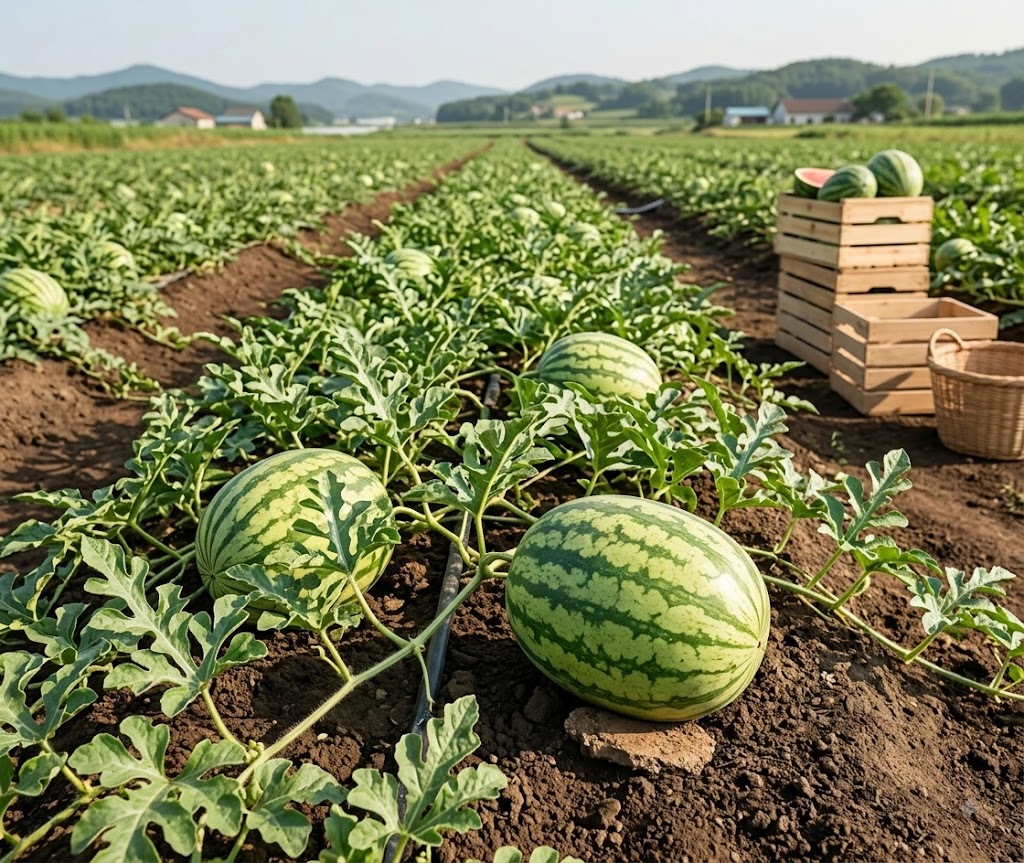
Judgment axis | detail |
| Item Identity | The accepted species of watermelon is Citrullus lanatus (Thunb.) Matsum. & Nakai, and it belongs to the Cucurbitaceae–Citrullus genus. ( Plants of the World Online ) |
| Domestic agricultural data | The Rural Development Administration's watermelon farming schedule designates the scientific name as Citrullus lanatus Matsum. & Nakai and classifies it as the Cucurbitaceae family. ( Nongsaroo ) |
| Edible parts | The main edible part is the flesh of the mature fruit, and the peel, white endocarp, and seeds are managed separately by product regarding whether they are edible or processed. |
| Harvesting stage | It is divided into the stages of young fruit → early fruit set → enlargement → maturation progress → marketability → full ripeness → overripe. |
| Cultivation temperature | The official agricultural work schedule of the Rural Development Administration suggests optimal temperatures of 28–30℃ for germination, 15–20℃ for flowering, 25–30℃ for growth, and 3–10℃ for storage. ( Nongsaroo ) |
| rhizosphere and soil | The Rural Development Administration suggests deep sandy loam with a pH of 5.5 to 6.8 as the suitable growing site. ( Nongsaroo ) |
| Climate characteristics | The Rural Development Administration suggests that watermelon is a warm-loving crop that is relatively resistant to drought but susceptible to high humidity, requiring an accumulated temperature of 800–1,000°C from flowering to maturity. ( Nongsaroo ) |
| Risk of serialization | The Rural Development Administration describes watermelon as a crop unsuitable for continuous cropping and suggests crop rotation and grafting as key management techniques. ( Nongsaroo ) |
| grafting | Grafting is utilized to improve adaptability to vine splitting disease and adverse environments. ( Nongsaroo ) |
| Quality Core | Fruit weight, fruit shape, skin color, pattern, sugar content, flesh color, hardness, ripeness, hollowness, cracking, yellowing, overripeness, decay, and seed condition are managed as a core Quality Dataset. |
| Selection Key | Since it is difficult to fully assess internal sugar content and cavities in watermelons based solely on their appearance, AX offers high value for non-destructive sugar content sorting and image/sensor-based internal quality assessment. The Rural Development Administration has been developing non-destructive sugar content sorting technology for fruits and vegetables, including watermelons. ( Nongsaroo ) |
| Shipping specifications | Data from the Rural Development Administration indicates that watermelon sorting is generally based on weight and that non-destructive sugar content sorting equipment can be utilized. Actual grading by kg is managed according to specifications specific to APCs and Buyers. ( Nongsaroo ) |
| Domestic statistics | The KOSIS "Vegetable Production (Fruit Vegetables)" includes area and production volume items for all watermelons and open-field watermelons. The currently searchable tables cover the years 1980–2024, and the data was updated on October 30, 2025. ( KOSIS ) |
| Latest production figures | The finalized values for the national watermelon cultivation area and production volume for 2025 will not be entered arbitrarily in this registration, but will be updated after verifying the latest KOSIS original table. |
| Food safety | Since watermelon is a product managed as a cucurbit fruit and vegetable, the pesticide use per Lot–harvest date–latest MRL–test report is linked. |
| AX Core | Connect Grafted Seedling–Plant–Female Flower–Pollination–Fruit–Enlargement–Ripeness–Brix–Non-destructive Sorting–Pack Lot–Buyer RFQ. |
| Final goal | Connects RFQs and repurchases from farmers, seedling/grafting, greenhouses/open fields, APCs/non-destructive sorting, distribution/food service/hotels, and Fresh-cut/juice/HMR buyers. |
division | Registration details |
| Korean name | watermelon |
| English name | Watermelon |
| Representative scientific name | Citrullus lanatus (Thunb.) Matsum. &Nakai |
| Domestic agricultural data labeling | Citrullus lanatus Matsum. & Nakai family notation |
| International Taxonomy | Kew Plants of the World Online accepted species ( Plants of the World Online ) |
| classification | Cucurbitaceae → Citrullus → Citrullus lanatus ( Plants of the World Online ) |
| Growth type | Kew is managed as an annual species. ( Plants of the World Online ) |
| Edible parts | The flesh of a mature fruit |
| Conditionally edible parts | Processed endocarp, seeds, and fruit peels |
| Non-edible · Separate management | Stem, leaf, tendril, root, disease, rotten fruit |
| Major growth stages | Seed → Germination → Seedling → Grafting → Rooting → Transplanting → Vine Elongation → Male/Female Flowers → Pollination → Fruit Set → Fruit Enlargement → Maturation → Marketability → Fully Ripened → Overripe |
| Major harvesting stages | Immature fruit → Maturation progress → Marketability → Fully ripe → Overripe |
| Basic product form | Regular large, medium, small/mini, seedless watermelon, red/yellow flesh, black rind/striped, half/quarter, fresh-cut, juice/puree |
| Basic processing stage | Seed → Seedling/Grafting → Planting → Training/Pruning → Flowering/Pollination → Fruit Set → Fruit Enlargement → Ripening Assessment → Harvesting → Sorting → Non-destructive Brix → Packaging → Cutting/Washing → Juicing/Puree → Refrigeration |
| Basic use | Raw food, home use, gift use, catering, hotel/buffet, fresh-cut, cafe/juice, HMR, dessert, PB |
| Similarity Principle | No. 065 Pumpkin is Cucurbita, and Watermelon is Citrullus; they are separate Species Entities. |
| Future Item Relations | No. 067 Melon and No. 068 Korean Melon belong to the Cucumis lineage and are a separate genus from watermelon. |
| Past scientific name relationships | Cucurbita citrullus L. is currently treated as a synonym of Citrullus lanatus in Kew. ( Plants of the World Online ) |
Product Master
Product Master | Key Management Standards |
| Regular large watermelon | Variety, Fruit Weight, Fruit Shape, Brix, Ripening |
| Medium size watermelon | Weight, Size, Household, Distribution Standards |
| Small fruit · Mini watermelon | Variety · Weight · Consumption Unit · Shelf-life |
| Seedless watermelon | Variety · Drainage · Moisture conditions · Seed traces |
| Red-flesh watermelon | Flesh color, Brix, and weight |
| Yellow-fleshed watermelon | Variety, flesh color, and sugar content |
| Black-skinned watermelon | Skin color, fruit shape, and market size |
| striped watermelon | Stripes, peel color, and appearance |
| High Sugar Content Product | Non-destructive Brix verification standards |
| Gift | Weight · Appearance · Sweetness · Box |
| For school and school meals | Safety · Heavy Load · Cutting · Delivery |
| For hotels and buffets | Sugar content, flesh color, and cutting yield |
| Fresh-cut Cube | Raw Lot · Brix · Microorganisms · Expiration Date |
| 1/2 container | Cutting date · Packaging · Refrigeration · Microorganisms |
| 1/4 of a container | Cutting, Packaging, and Use-by Date |
| Watermelon juice | Raw Material Brix · Juice Yield · Microorganisms |
| Watermelon puree | Flesh Yield, Brix, Seed Removal |
| frozen watermelon | Cutting, freezing, and thawing quality |
| Non-standard and | Appearance, heavy weight, internal quality, processing change |
| Fruit peel by-products | Amount generated · White area · Processability |
| Seed by-products | Production volume, variety, edible use, and material utilization status |
Classification criteria | Subdivision type | Management principles |
| Species | Citrullus lanatus | Species Master |
| Overweight | Mini / Small / Medium / Large | Actual kg by Buyer |
| Family type | Round / Oval / Oblong | Variety Connection |
| pericarp | Striped / Black / Light Green / Others | Color Master |
| flesh color | Red / Pink / Yellow / Others | Flesh Color |
| satellite | Seedless Product | Product Separation |
| Cultivation type | Open field / Facility / Rain shelter | Farm Type |
| Grave shape | Seedlings / Grafted seedlings | Rootstock Dataset |
| Cultivation method | Forced / Semi-forced / Facility / Open field, etc. | Regional verification |
| Moisture method | Natural pollination / Bees / Artificial pollination | Pollination Runtime |
| Harvest maturity | Unripe / Moderately ripe / Fully ripe / Overripe | Maturity Master |
| Quality grade | Weight / Brix / Internal defects / Appearance | Buyer Grade |
| Distribution methods | Whole Watermelon / Half / Slice / Fresh-cut | Lot Inheritance |
| Processing form | Juice / Puree / Frozen | Process Lot |
| Final use | Home / Gift / Food Service / Hotel / Fresh-cut / Beverage / Private Brand | Buyer separation |
| Transaction type | Direct Procurement / Contract Farming / Regular Supply / Consignment Sorting / Private Brand (PB) | Price and Quantity NDA |
The Rural Development Administration's watermelon farming schedule suggests optimal temperatures of 28–30°C for germination, 15–20°C for flowering, 25–30°C for growth, and 3–10°C for storage. It indicates that the optimal growing site is deep sandy loam with a pH of 5.5–6.8, explaining that while watermelons are relatively resistant to drought, they are susceptible to excessive moisture and that continuous cropping should be avoided. ( Nongsaroo )
The Rural Development Administration's separate crop information also suggests a cultivation temperature of 25–30℃ and explains initial watering control and moisture management before fruit set, following sufficient watering at the time of transplanting. ( Nongsaroo )
step | Essential Dataset | Management purpose |
| Production plan | Variety · Fruit Group · Cultivation Type · Area · Buyer Contract | Supply forecast |
| satellite | Variety · Seed Lot · Drainage | Traceability |
| stock | Species · Varieties · Seed Lot | Grafting management |
| grafting | Scion · Rootstock · Date · Grafting Rate | Vine splitting disease · Environmental adaptation |
| Seedling cultivation | Sowing date, seedling age, temperature, number of leaves | Tomb quality |
| formula | Date · Plant ID · Planting Density | Production history |
| soil | pH, EC, soil depth, drainage, years of continuous cropping | Root zone and continuous cropping risk |
| Watering | Soil moisture, quantity, and timing | Growth · Brix |
| dispute | N·P·K·Siki | Initial vigor and fruit set |
| Facility Environment | Temperature, humidity, solar radiation, ventilation | Management by crop type |
| vine | Main branch, geodetic branch, length | Plant Runtime |
| female flower | Node position · Flowering date | Fruit setting plan |
| male flower | Flowering date and condition of the pot | Pollination |
| moisture | Nature · Bees · Artificial · Work | Fruit Set |
| Fruit set | Fruit ID · Fruit Set Date | Yield Forecast |
| Enemy | Remaining parts and removed parts | Overburden and quality |
| Excessive negligence | Circumference, Diameter, Length, Estimated Weight | Harvest Forecast |
| Sukdo | Days after fertilization, peel, stem, sound, etc. | Harvest judgment |
| Brix | Non-destructive/destructive measurement · Location · Date | Internal quality |
| flesh color | Flesh Color | Product Grade |
| cavity | Non-destructive and cutting verification | internal defects |
| Heat and | Date of occurrence · Weather · Irrigation | Quality Risk |
| Yellow stalks and fibrous material | Cutting · Internal evaluation | Internal quality |
| pests | Vine splitting disease and other pests | Risk |
| pesticide | Pesticide, spraying date, harvest interval | Safety |
| harvest | Fruit ID · Harvest Date · Worker | Raw Lot |
| Origin sorting | Excessive weight, appearance, and shape | Grade |
| Non-destructive sweetness | Brix · Instrument · Measured Value | Premium Grade |
| Internal quality inspection | Joint, overripe, flesh abnormalities | Complaint Prevention |
| packaging | Quantity · Weight · Box · Pack Lot | circulation |
| save | Temperature and period | leadership |
| transit | Temperature, shock, time | Damage/Quality |
| Fresh-cut | Washing, cutting, seed removal, refrigeration | Convenience |
| Juicing | Juice Yield | Processing |
| Buyer inspection | Sugar content, weight, ripeness, internal defects | Supplier Score |
| Claim | Immature, overripe, hollow, cracked, soft | Feedback |
| Repurchase | Product · Weight · Brix · Order Cycle | Next fruit setting and harvest plan |
Quality items | Whole watermelon | High Sugar · Premium | Fresh-cut | Juice and processing | Public rating |
| Species · Varieties · Farm · Lot | core | core | core | core | Verified |
| Rootstock and Grafting Information | importance | importance | importance | importance | Verified/NDA |
| Cultivation type/Farming type | core | core | importance | importance | Verified |
| Fruit setting date | importance | core | importance | importance | Verified/NDA |
| Harvest day | core | core | core | core | Verified |
| Overweight | core | core | importance | importance | Verified/NDA |
| Family type | core | core | importance | importance | Verified/NDA |
| Peel color and pattern | core | core | importance | importance | Verified/NDA |
| Stem/Fruit stalk | core | importance | Not applicable | Not applicable | Verified/NDA |
| Sukdo | core | core | core | core | Verified/NDA |
| Brix | importance | core | core | core | Verified/NDA |
| Non-destructive sweetness | importance | core | Raw material connection | Raw material connection | Verified/NDA |
| flesh color | importance | core | core | core | Verified/NDA |
| Flesh hardness | importance | importance | core | importance | Verified/NDA |
| cavity | core | core | core | importance | NDA |
| Heat and | core | core | core | importance | Verified/NDA |
| Immature/Overripe | core | core | core | core | NDA |
| Internal discoloration and yellowing | importance | core | core | core | NDA |
| Seed state | importance | importance | core | importance | Verified/NDA |
| Pesticide usage records | core | core | core | core | NDA |
| Pesticide Residue Test Report | core | core | core | core | NDA |
| microorganism | importance | importance | core | core | NDA |
| Cutting hygiene | Not applicable | Not applicable | core | core | NDA |
| pulp yield | Not applicable | Not applicable | core | core | NDA |
| Juice extraction yield | Not applicable | Not applicable | Not applicable | core | NDA |
| Storage and Delivery | core | core | core | importance | NDA |
| Returns and Claims | core | core | core | core | NDA |
| Repurchase | core | core | core | core | NDA |
Lot Master Required Field
Lot ID · Product Type · Species · Variety · Seed Lot · Rootstock · Graft Batch · Farm · Facility · Crop Type · Planting Date · Plant ID · Female Flower ID · Flowering Date · Pollination Method · Pollination Date · Fruit ID · Fruit Set Date · Harvest Date · Maturity Stage · Fruit Weight · Diameter · Circumference · Fruit Shape · Skin Color · Pattern · Brix · Brix Measurement Method · Non-destructive Sorter ID · Flesh Color · Hardness · Hollow Fruit · Cracking · Yellow Band · Immature · Overripe · Pesticide Usage Records · Pesticide Residue · Microbiological Report · Raw Lot · Sorting Lot · Pack Lot · Fresh-cut/Processing Lot · Storage · Transportation · Buyer Inspection · Claims · Repurchase
Customers | Purchase criteria | Cooperation opportunities |
| Open-field watermelon farms | Variety, Fruit Set Time, Shipping Time | contract farming |
| Greenhouse watermelon farm | Crop type, early shipment, quality | Regular supply |
| Mini watermelon farm | Small fruit varieties, fruit weight, and marketability rate | Retail RFQ |
| Seedless watermelon farm | Variety, pollination, fruiting, and seed status | Premium RFQ |
| Grafted seedling nursery | Scion, Rootstock, and Grafting Rate | Seedling RFQ |
| Nonghyup · APC | Overweight · Brix · Sorting · Volume | Joint screening |
| Non-destructive sorting facility | Sweetness, Weight, Internal Quality | Premium Grade |
| wholesale market | Fruit weight, ripeness, appearance, and shipping date | Fresh RFQ |
| Large-scale distribution | Standards, sweetness, and supply stability | PB |
| Online distribution | Heavy weight · Shipping durability · Brix | Direct from the farm |
| School and public meals | Safety, Amputability, and Heavy Weight | School Meal RFQ |
| Hotel Buffet | Sugar content, color, flesh, and cutting yield | Premium Supply |
| Cafe and beverage companies | Brix · Juice Yield · Juice Yield | Juice RFQ |
| Fresh-cut companies | Sugar content, flesh firmness, microorganisms | Processing RFQ |
| HMR and dessert companies | Cube·Puree·Frozen | Ingredient |
| PB business operator | Whole Watermelon · Mini · Fresh-cut · Juice | OEM·PB |
| Seed company | Variety · Small fruit · Seedless · Disease resistance | Variety Pilot |
| agricultural machinery company | Weight, non-destructive sugar content, and AI sorting | AX Pilot |
| Smart farm companies | Environment, Fruit Set, and Harvest Prediction | AX Pilot |
| Research Institute | Rootstock, fruit set, sugar content, ripeness, internal defects | joint research |
| local government | Production Area · APC · Sorting · Processing · Brand | Regional Watermelon AX |
step | Key variables | Operational judgment |
| satellite | Variety · Seed Lot | Marketability |
| grafting | Rootstock · Rooting | Production stability |
| formula | Cultivation method and timing | Supply point |
| vines and flowers | Growth · Female flowers · Male flowers | Fruit set possibility |
| moisture | Bees, artificial, weather | Fruit set |
| Fruit set | Fruit tree · Location | Yield Forecast |
| Enemy | Final fruit per week | Large size and quality |
| hypertrophy | Circumference · Weight | Harvest Forecast |
| Sukdo | Days and environment after modification | Optimal harvest time |
| Brix | Non-destructive measurement | Premium Grade |
| harvest | Date · Fruit ID | Raw Lot |
| Origin sorting | Weight and appearance | Grade |
| Internal sorting | Brix and joint estimation | Risk Reduction |
| packaging | Count · Box · Label | circulation |
| Domestic distribution | Wholesale, Retail, Online | Domestic Match |
| Fresh-cut | Cutting and refrigeration | Convenience |
| Juice and Puree | Pulp, Juice, Crushing | Processing |
| import | Fresh/Frozen/Processed | Competitive Analysis |
| export | Fresh/Processed · Country | Export |
| RFQ | Excess · Brix · Quantity · Period | AI Match |
| contract | Unit price, quantity, sweetness, inspection | NDA |
| delivery | Lot · Quantity · Delivery | Execution |
| Buyer rating | Brix · Ripening · Internal Defects · Waste Rate | Supplier Score |
| Repurchase | Variety · Fruit Weight · Brix | Next fruit setting and harvest plan |
Products and processes | Key conditions | RFQ conversion |
| Regular whole watermelon | Heavy weight · Brix · Ripening | Retail RFQ |
| High-sugar watermelon | Non-destructive Brix·Fruit pulp | Premium RFQ |
| Mini Watermelon | Excessive weight/consumption unit | Online · Single-person households |
| Seedless | Seed condition, Brix, and fruit weight | Premium |
| Yellow meat watermelon | Flesh color and sweetness | Specialty |
| Half a watermelon | Cutting hygiene, packaging, refrigeration | Retail |
| 1/4 of a container | Cut/Use-by date | Convenience |
| Fresh-cut Cube | Brix · Hardness · Microorganisms | School Meals · Hotel |
| Ball Cut | Flesh hardness and specifications | Hotel · Dessert |
| Juice | Brix · Juice Yield | Cafes · Drinks |
| Puree | Flesh yield and seed removal | HMR·Dessert |
| Frozen Cube | Freeze-thaw quality | Beverage |
| Non-standard and | Internal quality and machinability | Juice RFQ |
| White part of the fruit peel | Safety and texture | Review of pickles and food materials |
| Pericarp outer skin | Amount, Moisture, and Components | Bio-compost review |
| satellite | Variety, yield, and oil | Review of food and materials |
| Lungs | Status of spoilage and amount generated | Review of biogas and compost |
PRP — Product Research Profile
PRP items | Details of investigation and verification |
| PRP-01 Taxonomy | Citrullus lanatus standardization |
| PRP-02 variety | Large, medium, small, and seedless |
| PRP-03 Rootstock | Verification by rootstock, such as gourds and pumpkins |
| PRP-04 grafting | Vine splitting disease · Environmental adaptation |
| PRP-05 Seedlings | Germination, seedling age, rooting |
| PRP-06 female flower | Node position, flowering, fruit set |
| PRP-07 moisture | Bees, artificial pollination, weather |
| PRP-08 fruit set | Location, Number of Fruits, Quantity |
| PRP-09 redness | Fruit weight, sugar content, and marketability rate |
| PRP-10 Fruit Hypertrophy | Circumference, Weight, Temperature |
| PRP-11 accumulated temperature | Verification of official standards for flowering to maturity at 800–1,000℃ |
| PRP-12 Sookdo | Days after modification · Peria · Surface · Acoustics |
| PRP-13 sugar content | Brix · Measurement Area · Non-destructive |
| PRP-14 Non-destructive Screening | NIR · Sensor · Weight |
| PRP-15 joint | Occurrence Environment · Non-destructive Detection |
| PRP-16 heat and | Irrigation, Rainfall, and Ripening |
| PRP-17 yellowing | Internal Quality and Environment |
| PRP-18 Low Sugar | Light, irrigation, fruit set, and varieties |
| PRP-19 immaturity | Early harvest · Market quality |
| PRP-20 Overripe | Internal Softness · Shelf-life |
| PRP-21 storage | 3~10℃ Official Data and Verification by Variety |
| PRP-22 shock | Transportation/Internal Damage |
| PRP-23 Fresh-cut | Microorganisms · Drip · Shelf-life |
| PRP-24 Juice | Brix · Juice Yield |
| PRP-25 Buyer | Overload · Brix · MOQ · Delivery Time |
| PRP-26 Reorder | Quality-Harvest Allocation Feedback |
| PRP-27 byproduct | Utilization of fruit peel, seeds, and non-standard fruit |
first of all | Execution item | Performance indicators |
| 1 | Variety–Rootstock–Farm–Crop Cycle ID linking | Data integrity |
| 2 | Large – Mini – Seedless – Colored Meat Product Separation | Misclassification reduction rate |
| 3 | Plant–Flower–Pollination–Fruit ID Setup | Individual tracking rate |
| 4 | Real-time collection of temperature, humidity, solar radiation, and soil moisture | Environmental collection rate |
| 5 | AI automatic recognition of female and male flowers | Flower Judgment Rate |
| 6 | Pollination Mobile Records | Moisture history |
| 7 | Fruit Set AI Automatic Count | Fruit set prediction accuracy |
| 8 | Video measurement of fruit circumference and size | Overweighted prediction accuracy |
| 9 | Fruit Weight AI Forecast | Yield prediction |
| 10 | Maturity AI Assessment | Probability of the right time |
| 11 | Non-destructive Brix automatic connection | Brix measurement rate |
| 12 | Analysis of Joint and Internal Defect Sensors | Internal defect detection rate |
| 13 | Weight + Brix Integrated Automatic Classification | Automatic screening rate |
| 14 | AI Detection of Heat and Lesions | Defect detection rate |
| 15 | Estimated Harvest Quantity – RFQ Automatic Connection | Supply forecast |
| 16 | Pesticide Use – Harvest – Test Report Link | Safety document rate |
| 17 | Fresh-cut Ingredient AI Match | Processing suitability rate |
| 18 | Juice Yield Prediction | Processing yield |
| 19 | Shipping Impact – Claim Link | Cause tracing rate |
| 20 | Reorder → Connect to next Fruit Allocation | Repurchase linkage rate |
Problem group | Problem Definition | Required data |
| Cucumber and pumpkin family classification mixed | The production system is treated similarly because it is a gourd. | Taxonomy |
| Mixing of variety and product names | Mixing of product names and variety names such as Mini and Seedless | Variety·Product |
| Disconnection of major market information | Differences in grafted rootstock are not linked to growth or quality | Rootstock |
| Continuous cropping disorder | Increased risk of soil-borne diseases due to continuous cropping | Rotation·Soil |
| Vine splitting disease | Damage to production base | Disease·Rootstock |
| Humidity damage | Risk of growth problems and diseases due to excessive moisture and poor drainage | Rain·Soil Moisture |
| poor moisture | Differences in bee activity, weather, and artificial pollination | Pollination |
| Variation in fruit set location | Size and quality variations based on location of the error | Node·Fruit |
| Excessive attachment | Possibility of reduced weight and sugar content | Fruit Load |
| Discrepancy in negligence hypertrophy | Differences in variety, irrigation, and light | Growth |
| Low sugar | Complex influence of harvest maturity, light, irrigation, fruit set, etc. | Brix·Environment |
| Immature harvest | Deterioration of consumer quality due to premature shipment based on appearance | Maturity |
| Overripe | Internal softening and shortened shelf life | Harvest Age |
| cavity | Internal defects that are difficult to identify externally | Internal Quality |
| Heat and | Rupture due to rainfall, irrigation, and ripeness | Water·Maturity |
| Yellow stalks and fibrous material | Internal quality defects | Cut Inspection |
| Sugar content test deviation | The measurement location, device, and method are different. | Brix Method |
| Center of gravity selection | Internal sugar content and defects are not sufficiently reflected in the sorting | Nondestructive QC |
| Impact damage | Internal quality deterioration due to impact from loading, unloading, and transportation | Shock Sensor |
| Fresh-cut hygiene | Increased risk of microorganisms after amputation | Hygiene |
| Fresh-cut drip | Loss of moisture from fruit flesh and deterioration of marketability | Cut/Storage |
| Non-standard and waste | Insufficient utilization of fault due to good internal quality and appearance defects | Quality·Processing |
| Large size and consumption burden | Inconvenience of small households consuming large whole watermelons | Consumer Unit |
| Supply concentration | Concentration of volume and price fluctuations during specific shipment periods | Harvest·Price |
| weather changes | Low temperature, sunshine, and rainfall affect fruit set and ripening | Weather |
| Repurchase not reflected | Buyer evaluations are not fed back into variety, fruit set, and harvest plans. | Evaluation·Reorder |
RFQ Type | Public Registration | Verify/NDA |
| Regular large watermelon | Origin, Variety Group, Fruit Weight, Shipping Date | Farm · Quantity · Unit Price · Lot |
| High-sugar watermelon | Brix Standards · Weight · Ripening | Non-destructive Value · Price · Lot |
| Mini Watermelon | Overweight range, size, package | Variety · MOQ · Price |
| Seedless Watermelon | Product · Weight · Flesh Color | Variety, ploidy, price |
| Yellow meat watermelon | Flesh color, Brix, size | Lot · Quantity · Price |
| Greenhouse early watermelon | Production type, supply period, specifications | Facilities, Weekly Volume, Unit Price |
| Open-field watermelon | Production area and harvest period | Volume and Price |
| contract farming | Variety · Fruit Weight · Brix · Period | Area, Contract Quantity, Unit Price |
| Nonghyup·APC Joint Sorting | Weight, Sweetness, Grade | Actual Lot/Selection Results |
| School and public meals | Safety, Size, Cutting | Test Reports/Contracts |
| Hotel Buffet | Brix, flesh color, and cutting yield | Weekly volume and price |
| Fresh-cut | Brix · Hardness · Cutting Standards | Microorganisms · Shelf-life |
| Juice | Brix · Flesh Yield | Juice Yield · Unit Price |
| Puree | Seed removal and flesh yield | Process · MOQ |
| PB small packaging | Mini · Half a Bottle · Fresh-cut | Brand, Packaging, Price |
| Non-standard and processing | Internal quality · Brix · External defects | Actual quantity and price |
| Grafted seedling | Graft · Rootstock · Graft Age · Delivery Date | Seed Lot · Quantity · Unit Price |
| Demonstration of screening technology | Brix · Weight · Internal defects | Equipment, Accuracy, Investment Cost |
| Research cooperation | Sukdo, Gongdong, Dangdo, Daemok | Samples and test results |
| local government cooperation | Main production area · APC · Non-destructive sorting · Processing | Farms, Facilities, and Business Conditions |
① Need Products & Materials
Companies and institutions seeking necessary products, agricultural products, raw materials, and processed goods register purchasing demands. Registered requests are utilized to review cooperation with potential suppliers and producers based on the RFQ Intelligence Library.
Process:
RFQ Registration → Supplier/Product Review → Collaboration Connection → Future AI Matching
Register
② We are looking for production and manufacturing partners. (Need Suppliers & Manufacturers)
Register a request to find necessary production and supply partners, ranging from farms and producer organizations to processing companies, OEM, ODM, and private label manufacturers.
Process:
RFQ Registration → Review of Production & Manufacturing Capabilities → Collaboration Connection → Future AI Partner Matching
Register
③ We are looking for domestic and international buyers. (Need Buyers)
Farmers, producer organizations, and manufacturing companies are requesting cooperation with new buyers, such as domestic and international distributors, importers, brand companies, and food service and catering businesses.
Process:
RFQ Registration → Product & Supply Capability Review → Market & Buyer Connection → Future AI Buyer Matching
Register
Contact : mail@markethub.org
Version | Main contents | situation |
| v1.0 | Watermelon Taxonomy · Grafting · Pollination · Fruit Set · Sugar Content · Non-destructive Sorting · Fresh-cut · RFQ Basic Structure Registration | complete |
| v1.1 | KOSIS Verification of Official Data on Production, Varieties, Rootstocks, Markets, and HS | expected |
| v2.0 | Large · Mini · Seedless · Colored Meat · Premium Brix · Fresh-cut · Juice Product Specification Separation | expected |
| v3.0 | Seed–Rootstock–Farm–Fruit–Non-destructive Sorting–Processing–Buyer Verified Container Combination | expected |