


Judgment axis | Key judgment |
| Item Identity | Based on USDA GRIN Crop Wild Relative data, Almond = Prunus dulcis. It is a variety among Prunus fruit trees where the edible part is the seed. ( Ars Grin ) |
| Key role | Imported edible seeds, snacks, confectionery, bakery products, powders, pastes, vegetable foods, and oil ingredients |
| Harvesting principle | Connect Cultivar, Origin, Maturity, Skin Removal, Dryness, and In-shell/Dehull Status to Lot |
| Product separation | Shells, Raw Eggs, Roasted Eggs, Sliced Eggs, Chopped Eggs, Powder, Paste, Butter, Oil Sold Separately |
| Separation of similar items | It is classified differently from peanuts, and although it belongs to the same Prunus lineage as peaches and apricots, it is distinguished by the fact that its edible product is a seed. |
| Domestic production statistics | Domestic commercial almond exclusive cultivation area and production volume: To be entered after verification of official raw data. |
| Domestic supply structure | Domestic RFQ prioritizes managing the supply chain centered on imported shelled almonds and processing raw materials. |
| Global production | According to the USDA Foreign Agricultural Service's 2025/26 outlook, global almond production is projected to reach approximately 1.8 million tons (kernel basis), with the United States being the largest producer. ( USDA Foreign Agricultural Service ) |
| Major producing countries | Outside of the U.S., Australia is a major producer and exporter, and the USDA FAS projected Australia's 2025/26 production at 175,000 tons (kernel basis) . ( USDA App ) |
| HS structure | Under the Korea Customs Service HS system, fresh and dried almonds are classified into unshelled and shelled almonds within heading 0802. ( Korea Customs Service ) |
| Safety risks | Korea Food Safety is disclosing instances where it has strengthened product inspections of specific exporters following risk information indicating that U.S.-made dried almonds exceeded total aflatoxin standards. ( Korea Food Safety ) |
| Storage risk | The Ministry of Food and Drug Safety emphasizes storing nuts such as almonds in a dry, airtight container, as high temperature, high humidity, and pest damage can increase the risk of mold growth. ( Imported Food Information Center ) |
| Operating Principles | Species–Cultivar–Origin–Harvest–Drying–Shelling–Quality–Processing–Import Lot–Buyer RFQ connection |
| Final goal | Building Supply Chain Intelligence capable of tracking from overseas production and import to domestic processing, manufacturing, and buyer repurchase |
Basic fields | detail |
| Korean name | almond |
| English name | Almond |
| Representative scientific name | Prunus dulcis ( Ars Grin ) |
| classification | Woody fruit tree of the genus Prunus, family Rosaceae |
| Edible parts | nucleus and internal kernel |
| Non-edible · Separate management | Exocarp, hard shell, leaf, branch, pruning byproduct |
| Major harvesting stages | Immature fruit → Fruit maturation/skin splitting → Harvest → Drying → Shell removal seed |
| Basic product form | In-shell · Shelled raw almond · Roast · Slice · Crushed · Powder · Paste · Butter · Oil |
| Basic processing stage | Drainage, drying, peeling, sorting, blanching, roasting, cutting, grinding, pressing |
| Basic use | Snacks, Confectionery, Baked Foods, Cereals, Plant-based Foods, Pastes, Sauces, Private Brands, Oils |
| Principle of similar items | Separation of Plant Entity from other Prunus crops such as peaches and apricots |
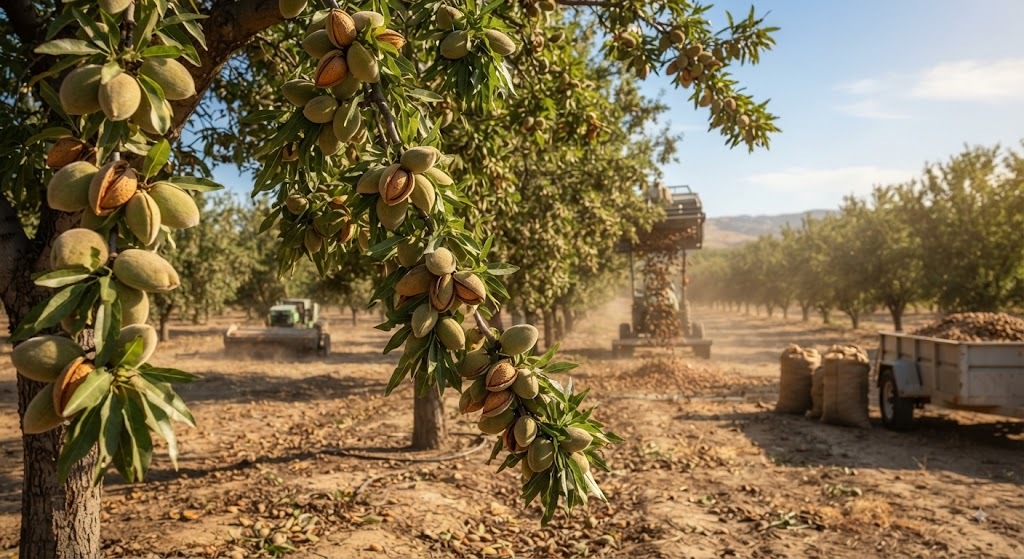
The USDA ARS manages almonds as a Prunus genetic resource and explains that, unlike other stone fruits, the edible part is the seed rather than the fleshy pericarp . Therefore, on MarketHub, in-shell weight, kernel weight, and shelling yield become the core structure of trading and processing, rather than fruit weight. ( Ars Grin )
Product Master
Product ID | Actual product form | Key Management Standards |
| ALMOND-P01 | Inshell almond | Origin · Cultivar · Harvest Year · Moisture · Shell Condition |
| ALMOND-P02 | Peeled raw almond | Kernel Size · Moisture · Defects · Test Report |
| ALMOND-P03 | Blanching almonds | molting rate, color, moisture, microorganisms |
| ALMOND-P04 | Roasted almonds | Roasting Profile · Color · Aroma · Moisture |
| ALMOND-P05 | Salted and seasoned almonds | Seasoning blend, sodium, and allergen cross-contact |
| ALMOND-P06 | Sliced almonds | Thickness, breakage rate, size, color |
| ALMOND-P07 | Sliverd Almonds | Cutting specifications, uniformity, moisture |
| ALMOND-P08 | Crushed almonds | Grain size, roasting status, damage, foreign matter |
| ALMOND-P09 | almond powder | Particle size, moisture, fat, microorganisms |
| ALMOND-P10 | almond paste | Particle Size · Viscosity · Oil Separation · Raw Material Lot |
| ALMOND-P11 | almond butter | Roasting, Viscosity, Blending, Oil Stability |
| ALMOND-P12 | Almond ingredients for confectionery | Slice/Flor/Granule Specifications |
| ALMOND-P13 | Plant-based beverage ingredients | Grinding, extraction suitability, microorganisms |
| ALMOND-P14 | almond oil | Pressing, extraction, purification status, and rancidity |
| ALMOND-P15 | PB · Finished Products | Ingredient Traceability, Labeling, and Use-by Date |
Classification criteria | Subdivision type | Management principles |
| Plant classification | Prunus dulcis | Plant Master |
| Cultivar | Actual commercial varieties | Cultivar ID |
| production site | Country·Region·Orchard | Origin Entity |
| Harvest year | Crop Year | Essential in long-term storage materials |
| Harvesting stage | Immature · Mature · Shell dehiscence · Completely dry | Harvest Stage |
| Shell status | In-shell·Shelled | Product·HS separation |
| Seed coat condition | Natural·Blanched | Product Separation |
| Processing form | Raw·Roasted·Sliced·Slivered·Flour·Paste·Oil | Product ID |
| Grain size and cutting | Whole Slice Granule Powder | Buyer Specification |
| Final use | Snack·Bakery·Confectionery·Plant-based·Oil | Specifications by Buyer |
| Transaction type | Import · Bulk · Regular Supply · OEM · PB | Contract NDA |
step | Essential Dataset | Management purpose |
| Production plan | Cultivar · Orchard · Area · Buyer Use | Supply forecast |
| Seedlings and rootstocks | Cultivar·Rootstock·Nursery | breed tracking |
| formula | Official Year and Planting Information | Orchard productivity |
| Dormancy and blooming | Flowering date, low temperature, weather | Fruit set prediction |
| moisture | Pollinator · Pollination · Weather | Fruit Set |
| Fruit set | Fruit set and fruit drop | Yield Forecast |
| rising | Temperature, rainfall, frost, heatwave | Crop risk |
| Watering | Water volume and water source | Quantity · Kernel Quality |
| dispute | Input amount and timing | Production history |
| pests | Occurrence and Control | Production and quarantine |
| Fruit maturation | Hull Split · Kernel maturation | Harvest judgment |
| harvest | Harvest date and method | Harvest Lot |
| Remove outer shell | Hull removal · Foreign matter | Post-harvest |
| dry | Kernel/Shell Moisture | Storage stability |
| In-shell selection | Size, damage, foreign matter | In-shell Grade |
| peeling | Kernel retrieval/damage | Shelling Yield |
| Kernel screening | Size, color, and defects | Buyer Grade |
| Blanching | Seed coat removal | Product for processing |
| stir-fry | Temperature, Time, Roast Level | Snack Ingredient |
| cutting | Slice · Sliver · Granule | Bakery |
| smash | Flour Meal | Ingredient |
| Paste | Particle size and viscosity | Butter/Paste |
| pressure | Oil yield | Almond Oil |
| save | Temperature, humidity, oxygen, and period | Mold and rancidity management |
| packaging | Oxygen·Moisture Blocking·Lot | Quality maintenance |
| shipment | Container · Departure · Arrival | Trade Runtime |
| Customs clearance and inspection | HS · Country of Origin · Test | Import Lot |
| shipment | Buyer · Delivery Date | Delivery |
Quality items | In-shell · Raw Egg | Pre-treated products | processed goods | finished product | Public rating |
| Species | essential | succession | succession | tracking | Public |
| Cultivar | essential | succession | Raw material standards | tracking | Verified |
| Origin | essential | succession | succession | tracking | Public |
| Crop Year | essential | succession | succession | tracking | Verified |
| Orchard/Supplier | ID | succession | tracking | tracking | Verified |
| Lot | essential | new | new | new | Verified/NDA |
| Harvest day | essential | succession | succession | tracking | Verified |
| Shell status | In-shell/Shelled | corresponding | - | - | Public |
| appearance | Shell/Kernel | core | Raw Material Evaluation | Product Standards | Member |
| weight | In-shell·Kernel | input | calculation | Display amount | Member |
| Kernel Size | core | core | Raw material specifications | Product Standards | Member |
| uniformity | core | core | importance | Product Standards | Verified |
| Broken lip | check | core | Raw material standards | Product Standards | Verified |
| immature teeth | check | eliminate | Raw Material Evaluation | - | Verified |
| discolored lips | check | eliminate | Non-conformity management | Product Standards | Verified |
| Insect damage | check | eliminate | Non-conforming | - | Verified |
| mold | essential | essential | core | Product Standards | Verified |
| alien substance | essential | essential | essential | essential | Verified |
| moisture | core | core | By Product | Product Standards | Verified |
| pesticide residues | Compliant with standards | succession | check | Legal standards | Verified/NDA |
| Total aflatoxin | core | core | core | Legal standards | Verified/NDA |
| microorganism | If necessary | core | core | Product Standards | Verified/NDA |
| Blanching | - | corresponding | succession | tracking | NDA |
| Roasting | - | corresponding | core | tracking | NDA |
| Island | - | Slice/Granule | Flour/Paste Key Points | Product Standards | Verified |
| Fat and rancidity | Kernel characteristics | corresponding | Paste/Oil Key Points | Product Standards | Verified/NDA |
| Processing history | - | essential | essential | essential | NDA |
| packaging | Raw material packaging | B2B | Oxygen and moisture blockage | Labeling packaging | Member |
| save | Dry storage | By Product | By Product | By Product | Verified |
| Expiration date | By product | Test-based | Test-based | mark | Verified |
| Shipment | record | record | record | record | Verified |
| Returns and Claims | record | record | record | record | NDA |
| Repurchase | connection | connection | connection | connection | NDA |
Lot Master Required Field
Lot ID · Item · Product Type · Species · Scientific Name · Cultivar · Crop Year · Country of Origin · Production Region · Orchard · Producer · Exporter · Importer · Harvest Date · Skin Removal Date · Drying Date · Shell Condition · Kernel Size · Weight · Dimensions · Grade · Broken Grains · Immature Grains · Discolored Grains · Insect Damage · Mold · Pesticide Use History · Pesticide Residues · Total Aflatoxins · Microbiological Report · Storage · Shipment History · Export Lot · Import Lot · Raw Material Lot · Blanching · Roasting · Cutting · Grinding · Pasting · Pressing History · Packaging Date · Best Before Date · Shipper · Returns · Claims · Repurchase
Customers | Purchase criteria | Cooperation opportunities |
| Nut importer | Origin·Crop Year·In-shell/Shelled | Global RFQ |
| Specialized nut distribution | Kernel Size · Defects · Roasting | Regular supply |
| Stir-fry and seasoning companies | Size, Moisture, Roast Suitability | Processing RFQ |
| Large-scale distribution | Country of origin, specifications, safety, packaging | Retail/PB |
| Online distribution | Fresh, Roasted, Small Packaging | Direct Commerce |
| confectionery company | Whole · Slice · Granule · Flour | B2B Ingredient |
| Bakery | Slice · Sliver · Flour | Regular raw material supply |
| Macaron and dessert manufacturing | Fine almond powder, particle size, moisture | Flour RFQ |
| Chocolate manufacturing | Whole Granules Paste | Ingredient |
| Cereal and Granola | Slice · Whole · Roast | Regular Supply |
| Plant-based food manufacturing | Kernel, Paste, and Extract Aptitude | Plant-based |
| almond butter production | Roast · Particle Size · Oil Stability | OEM |
| Oil manufacturing and distribution | Oil Grade · Pressing Method | Oil RFQ |
| Hotels and Restaurants | Whole · Slice · Paste | Foodservice |
| School and public meals | Country of Origin, Safety, and Allergy Response | Supply Control |
| PB·OEM | Snack · Butter · Bakery | Product Development |
| exporters | Destination country standards, allergy, and test reports | Export RFQ |
step | Key variables | Operational judgment |
| Overseas orchard production | Country · Cultivar · Crop Year | Supply Forecast |
| harvest | Hull Split · Harvest season | Quality and quantity |
| dry | Moisture and weather | Storage stability |
| peeling | Kernel Yield · Damage | Product Grade |
| Selection | Size · Defect · Color | Buyer Spec |
| Contracts and Procurement | In-shell/Shelled·Crop Year | Purchase Plan |
| export packaging | Bag·Carton·Bulk | Logistics |
| shipment | Freight·Transit Time | Landed Cost |
| Import and Customs Clearance | HS · Origin · Inspection | Import Lot |
| Safety inspection | Aflatoxin, pesticide residues, microorganisms | Release/Reject |
| Stir-frying and cutting | Yield by Product | Domestic Processing |
| Grinding/Paste | Particle size and oil | Ingredient |
| oil | Extraction and purification | Oil Market |
| Distribution and supply | Storage/Delivery | Buyer Evaluation |
| RFQ · Repurchase | Price, Quality, Claims | Supplier Ranking |
Import and export management
item | Management principles |
| Basic HS | Confirmation of Almond Classification in Other Nuts under Customs No. 0802 ( Customs Service ) |
| Inshell | Based on the previous Tariff Schedule 0802110000, undecorated; reconfirmation of current HSK upon 2026 declaration ( Korea Customs Service ) |
| peeling | Removed based on past tariff schedule 0802120000; reconfirmed with current HSK for 2026 declaration ( Korea Customs Service ) |
| Stir-fried and prepared products | Since it may differ from HS Code 0802 of the raw material, please check the HS code by processing state. |
| almond oil | The Korea Customs Service HS explanatory material explains that oil obtained from almonds (HS Code 0802) is moved to the oils and fats classification system. ( Korea Customs Service ) |
| Import volume | Subsequently entered after verification of raw data from the Korea Customs Service Import & Export Trade Statistics 2025/2026 |
| Revenue | Input after official verification of raw data |
| Imports by country | Check HS, quantity, amount, and unit, then enter |
| FTA | Verification of Agreement Tariff Rates and Criteria for Origin by Origin, HS Code, and Processing Status |
| Incoming inspection | Check the latest KFDA inspection conditions for aflatoxin, pesticide residues, etc. |
| Customs clearance unit price | Calculate quantity, amount, and unit within the same HS range |
| Storage and Logistics | Prevents high temperature and humidity, condensation, insect damage, and rancidity |
| allergy | Separate verification of export destination country and OEM buyer marking standards |
Products and processes | Key conditions | RFQ conversion |
| Inshell almond | Crop Year · Moisture · Shell Condition | Raw RFQ |
| Peeled raw almond | Size · Flaws · Aflatoxin | Kernel RFQ |
| Blanching almonds | Shedding rate, color, and damage | Bakery RFQ |
| Roasted almonds | Roast Level · Aroma · Color | Snack RFQ |
| Seasoned almonds | Seasoning · Mixing · Labeling | OEM/PB |
| sliced | Thickness, breakage, and uniformity | Bakery |
| Slivered Almond | Cutting width and length | Confectionery |
| Buntae | Grain size and stir-frying | Chocolate/Bakery |
| powder | Particle size, moisture, fat | Macaron/Bakery |
| Paste | Particle size, viscosity, and oil content | Filling/Sauce |
| almond butter | Roasting, Viscosity, and Separation Stability | Retail/PB |
| plant-based beverage ingredients | Extraction yield, grinding, microorganisms | Plant-based RFQ |
| almond oil | Pressing, Refining, Rancidity | Oil RFQ |
| Shell | Separation from food products | Biomass and materials are verified separately |
| Hull | Separation from food kernel | Utilization of feed and bio-industry is subject to legal and safety verification |
| Broken lip | When safety is compliant | Flour/Paste Conversion |
| Mold · Unsuitable | Food supply chain exclusion | Disposal and recovery management |
Since the USDA ARS clearly distinguishes the edible part of the almond as the seed, the key to PRP is not fruit appearance, but Kernel Yield, Kernel Size, Defect, Storage, and Processing Suitability . ( Ars Grin )
Product Research Profile (PRP)
PRP area | Key question |
| Cultivar | Which product is it suitable for, such as Whole, Slice, Flour, or Paste? |
| Crop Year | What is the quality difference between long-term stored raw materials and new crops? |
| Shelling | What is the actual kernel recovery rate compared to the in-shell? |
| Kernel Size | Does it meet the Size Grade required by the Buyer? |
| defect | What are the rates of damage, immaturity, discoloration, and insect damage? |
| safety | Does it meet the standards for aflatoxin, pesticide residues, and microorganisms? |
| Blanching | What are the Seed Coat removal rate, damage, and color like? |
| stir-fry | What are the optimal roasting conditions for each kernel size? |
| Slice | What are the breakage rate and uniformity after cutting? |
| Flour | Are the particle size, moisture, and fat characteristics suitable for macarons and confectionery? |
| Paste | How is the stability of oil separation, viscosity, and fragrance? |
| Oil | How do actual oil yield and rancidity stability compare to the kernel? |
| Buyer | How do origin, crop year, and processing type affect repurchase? |
first of all | Execution item | Performance indicators |
| 1 | Species·Cultivar·Origin·Crop Year·Lot become mandatory values | Required value completion rate |
| 2 | In-shell·Raw·Roasted·Slice·Flour·Paste·Oil Product separation | Product identification rate |
| 3 | Overseas Crop Conditions, Harvest, Drying, Shipment, and Arrival Connection | Supply Forecast Error |
| 4 | Data conversion of test reports, storage, processing, and incoming inspection history | Traceability rate |
| 5 | Producer–Exporter–Importer–Processor–Buyer RFQ connection | RFQ Match Rate |
| 6 | Video AI Kernel Size, Damage, and Discoloration Screening | Automatic judgment accuracy |
| 7 | Defective AI Detection | Defect detection rate |
| 8 | Mold and Aflatoxin Risk Scoring | Risk Lot Early Detection Rate |
| 9 | Crop Year Supply Forecast | Error compared to actual |
| 10 | Revenue, Inventory, and Lead Time Forecasting | Out of stock rate |
| 11 | Roasting Optimization | Standard Conformity Rate · Yield |
| 12 | Slice/Flor Processing Yield Prediction | Yield Error |
| 13 | Prediction of storage and rancidity risk | Quality claim rate |
| 14 | AI Supplier/Buyer Match | Sample→Contract Conversion Rate |
| 15 | Traceability | Orchard/Exporter → Finished Product Traceability |
Problem group | Problem Definition | Required data |
| Lack of domestic production information | Verification of independent domestic commercial cultivation scale is necessary | Area and production volume |
| dependence on overseas production | Changes in overseas crop conditions directly affect domestic supply | Country·Crop |
| Origin bias | Possibility of dependence on supply from specific countries | Imports by country |
| Cultivar missing | Processing suitability by variety not reflected | Cultivar |
| Crop Year mixed | Quality of old and new crops and storage period are unclear | Harvest Year |
| In-shell/Shelled Mix | Distortion of trade and yield data | Product State |
| Kernel Size deviation | Discrepancy with Buyer specifications | Size Grade |
| Damage/Defect | Decline in yield of confectionery and small-packaged products | Defect Rate |
| Poor drying | Increased risk of mold during storage | Moisture |
| Aflatoxin | Risk of import and food safety non-compliance | Test Result |
| Insect damage | Risk of mold and quality degradation | Damage |
| rancidity | Deterioration of storage quality of high-fat seeds | Storage · Oil Quality |
| Roasting variation | Quality variation by size and moisture | Roast Profile |
| Powder particle size | Differences in Macaron and Confectionery Quality | Particle Size |
| Paste stability | Oil separation and viscosity problems | Processing Data |
| Allergy response | Labeling and Cross-Contact Management by Buyer and Exporting Country | Allergen Rule |
| HS Mixed | The three differences between Raw, Roasted, and Oil | HS Description |
| Repurchase not reflected | Inspection, processing, and claim performance are not reflected in supplier selection | Evaluation·Reorder |
RFQ Type | Public Registration | Verify/NDA |
| Overseas Inshell Almonds | Origin · Crop Year · Cultivar | Producer · Quantity · Price |
| Peeled raw almond | Size · Moisture · Grade | MOQ · Unit Price · Test Report |
| Premium Whole Kernel | Cultivar · Size · Defects | Lot · Actual Price |
| Ingredients for stir-frying | Size · Moisture · Roast suitability | Yield and price |
| Roasted almonds | Roast Level · Standard | MOQ · Delivery Time |
| Seasoned almonds | Formulation/Packaging Type | OEM conditions |
| sliced | Thickness and breakage rate | MOQ · Unit Price |
| Slivered | Cutting specifications | Processing yield |
| Buntae | Particle size and roast status | Regular supply |
| powder | Particle size, moisture, fat | Confectionery Buyer Specifications |
| Paste | Viscosity, particle size, scent | Processing Contract |
| almond butter | Formulation, Viscosity, Packaging | OEM/PB |
| For plant-based beverages | Kernel/Paste specifications | Raw material contract |
| almond oil | Whether pressed or refined | Quality and Unit Price |
| Confectionery and Baking | Whole/Slice/Flour | Regular delivery |
| Hotels and Restaurants | Whole · Slice · Paste | Foodservice |
| PB | Snack · Butter · Bakery | OEM |
| import | Origin · HS · Crop Year | Exporter · Freight · Actual Unit Price |
| Safety verification | Aflatoxin and pesticide residues | Original test report |
| Research cooperation | Cultivar · Storage · Roasting · Processing Yield | Dataset·IP |
① Need Products & Materials
Companies and institutions seeking necessary products, agricultural products, raw materials, and processed goods register purchasing demands. Registered requests are utilized to review cooperation with potential suppliers and producers based on the RFQ Intelligence Library.
Process:
RFQ Registration → Supplier/Product Review → Collaboration Connection → Future AI Matching
Register
② We are looking for production and manufacturing partners. (Need Suppliers & Manufacturers)
Register a request to find necessary production and supply partners, ranging from farms and producer organizations to processing companies, OEM, ODM, and private label manufacturers.
Process:
RFQ Registration → Review of Production & Manufacturing Capabilities → Collaboration Connection → Future AI Partner Matching
Register
③ We are looking for domestic and international buyers. (Need Buyers)
Farmers, producer organizations, and manufacturing companies are requesting cooperation with new buyers, such as domestic and international distributors, importers, brand companies, and food service and catering businesses.
Process:
RFQ Registration → Product & Supply Capability Review → Market & Buyer Connection → Future AI Buyer Matching
Register
Contact : mail@markethub.org
Version | Main contents | situation |
| v1.0 | Plant Identity · Global Procurement · Import · Raw Eggs · Roasted · Cut · Powder · Paste · Oil · Safety · RFQ Basic Structure Registration | complete |
| v1.1 | Domestic Production Status · 2025/2026 Korea Import Volume · Cultivar · HS · FTA · Verification of Market Official Raw Data | expected |
| v2.0 | Detailed quality specifications for Crop Year, Kernel Size, Drying, Aflatoxin, Roasting, Slice, Flour, Paste, and Oil | expected |
| v3.0 | Orchard–Producer–Exporter–Importer–Warehouse–Processor–Manufacturer–Buyer Verified Container combination | expected |