

Judgment axis | Key judgment |
| Item Identity | According to the Rural Development Administration's Nongsaroo, Arachis hypogaea L., English name: Peanut. It is an annual crop belonging to the legume family; although it is treated alongside nuts in the market, it is botanically distinguished from woody nuts. ( Nongsaroo ) |
| Key role | Green peanuts, dried seeds, roasted peanuts, confectionery, sauces, peanut butter, powder, edible oil ingredients |
| Harvesting principle | Green peanuts and ripe peanuts for seed are managed as separate Product Lots from the time of harvest. |
| Product separation | Green peanuts, shelled peanuts, kernel peanuts, roasted, chopped, powder, paste, butter, oil separation |
| Separation of similar items | Plant Entity distinct from woody nuts such as almonds and walnuts, and soybeans |
| Variety management | Sinpalgwang, Haeol, K-ol No. 2, Danmi, etc., are managed as internal peanut cultivars. According to 2025 data from the Rural Development Administration, the nationwide cultivation ratios for these varieties are presented as 53.4% for Sinpalgwang, 3.8% for Haeol, and 0.8% for K-ol No. 2. ( Rural Development Administration ) |
| Domestic production statistics | Based on official statistics presented in the Rural Development Administration's 2025 press release, the cultivated area in 2023 was 3,590 ha and the production volume was 9,186 tons . This represents a decreasing trend from 5,381 ha and 13,991 tons in 2010. ( Rural Development Administration ) |
| main production area | According to the Rural Development Administration in 2025, Gochang in North Jeolla Province, Taean in South Chungcheong Province, Yecheon in North Gyeongsang Province, and Yeoju in Gyeonggi Province are major production areas, accounting for approximately 30% of the national cultivation area. ( Rural Development Administration ) |
| Key growth | Sowing after mid-April, pod formation after flowering in June, and moisture management during the seed enlargement stage in July and August are important. ( Rural Development Administration ) |
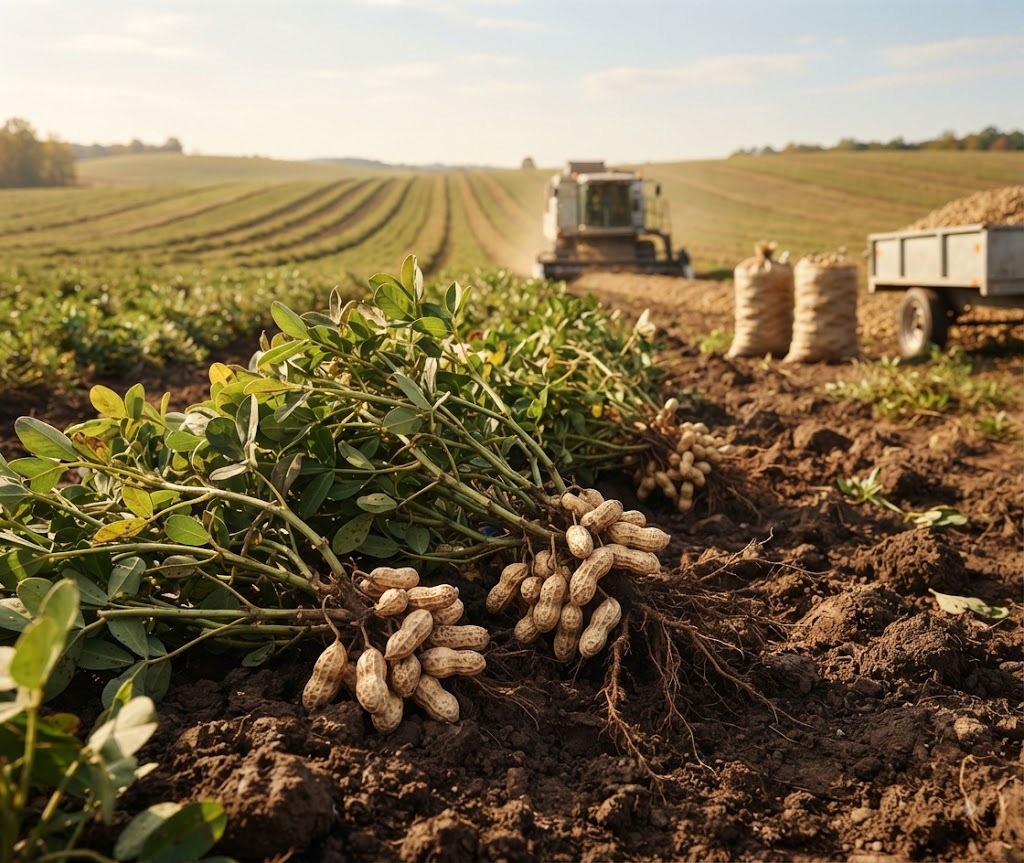
| Harvest classification | According to Nongsaroo, green peanuts are harvested when the pods are fully developed, and mature seeds are harvested when the net-like pattern on the pod becomes distinct. |
| Quality and Safety | Peanuts are subject to domestic allergen labeling requirements, and managing aflatoxin risks is critical. In the 2026 non-compliance cases reported via the Food Safety Korea system, instances were confirmed where the total aflatoxin standards of 15.0 μg/kg or less and B1 standards of 10.0 μg/kg or less were applied. ( Food Safety Korea ) |
| Supply and demand risk | Decrease in cultivated area · Rural labor shortage · Lack of mechanization · Heatwave · Drought · Heavy rainfall · Pests and diseases · Poor drying · Aflatoxin · Allergy |
| Operating Principles | Connecting Cultivar–Origin–Harvest Stage–Moisture–Drying–Quality–Processing–Lot–RFQ |
| Final goal | Feedback of recurring transaction data from domestic producers, processing companies, distributors, confectionery companies, and PB buyers into production, variety, and mechanization decision-making |
According to 2025 data from the National Institute of Food Science and Technology, the domestic peanut cultivation area was 3,590 hectares and production was 9,186 tons in 2023 , marking a continuous decrease from 5,381 hectares and 13,991 tons in 2010. In response, the Rural Development Administration is promoting the distribution of varieties such as Haol and K-ol No. 2, which possess suitability for mechanical harvesting and high oleic acid characteristics, as well as the expansion of mechanization models. ( Rural Development Administration )
Basic fields | detail |
| Korean name | peanut |
| English name | Peanut |
| Representative scientific name | Arachis hypogaea L. ( Nongsaroo ) |
| classification | Annual seed crop of the genus Arachis, family Fabaceae |
| Edible parts | Seeds inside the pod |
| Non-edible · Separate management | Stems, leaves, roots, pod shells, and processing by-products |
| Major harvesting stages | Immature/early maturing for green peanuts → Fully ripe for seeds |
| Basic product form | Green peanuts, shelled peanuts, kernel peanuts, roasted peanuts, chopped peanuts, powder, paste, butter, oil |
| Basic processing stage | Digging, hull removal, drying, shelling, sorting, roasting, grinding, pressing, and pasteurization |
| Basic use | Raw food · Boiled food · Snacks · Confectionery · Baking · Sauces · Butter · Seasoned food · Cooking oil |
| Principle of similar items | Varieties are managed as a sub-Cultivar of peanuts, while almonds, walnuts, etc., are managed as a separate Plant Entity. |
Peanuts have the characteristic that after pollination , the pod stalk grows toward the ground, entering the soil to form a pod. Nongsaroo explains that they grow well in abundant sunlight and high temperatures, and that well-drained loam or sandy loam is suitable .
Product Master
Product ID | Actual product form | Key Management Standards |
| PEANUT-P01 | seeds for cultivation | Cultivar · Germination Rate · Seed Lot |
| PEANUT-P02 | Green peanut pod | Harvest date, pod fullness, and freshness |
| PEANUT-P03 | Green peanuts for boiling | Ripening · Size · Washing · Refrigeration |
| PEANUT-P04 | Ripe peanuts | Dry moisture, pod damage, and diseases |
| PEANUT-P05 | raw peanuts | Peeling · Lip thickness · Color · Flaws · Moisture |
| PEANUT-P06 | Roasted peanuts | Size, uniformity, moisture, variety |
| PEANUT-P07 | Roasted peanuts | Roasting, Color, Aroma, Moisture, and Allergy Labels |
| PEANUT-P08 | Peanut powder | Grain size, roasting level, foreign matter |
| PEANUT-P09 | peanut powder | Particle size, moisture, fat, microorganisms |
| PEANUT-P10 | peanut paste | Viscosity, particle size, roasting, oil separation |
| PEANUT-P11 | peanut butter | Ingredients, Formula, Viscosity, and Allergy Information |
| PEANUT-P12 | High oleic peanut raw material | Cultivar · Oleic Acid Variety · Lot Verification |
| PEANUT-P13 | peanut oil | Pressing, Extraction, Purification, and Rancidity Management |
| PEANUT-P14 | Confectionery and Baking B2B Ingredients | Specifications for powder, granules, and pastes |
| PEANUT-P15 | PB · Finished Products | Ingredient Traceability · Allergy Labeling · Use-by Date |
Classification criteria | Subdivision type | Management principles |
| Plant classification | Arachis hypogaea L. | Basic Plant Entity |
| varieties | Sinpalgwang, Haeol, Keiol No. 2, Danmi, etc. | Managed by Cultivar ID |
| Super-type | crawling, semi-erect, and upright | Cultivation and Mechanical Harvesting Dataset |
| ripening | Early-born, mid-born, late-born | Harvest plan |
| Seed size | Opposition, Neutrality, Minority | Product Specification |
| Harvesting stage | Green peanuts and ripe seeds | Must be a separate product |
| Cultivation method | Ordinary cultivation, mulching cultivation, etc. | Production Type |
| Distribution methods | Peeling, peeling, raw, stir-frying | SKU separation |
| Processing form | Boiled, roasted, minced, powder, paste, oil | Product ID |
| Final use | Snacks, school meals, confectionery, sauces, butter, fats | Buyer Specification |
| Transaction type | Spot products from production · Contract farming · Regular supply · Processed raw materials · PB/OEM | Contract NDA |
step | Essential Dataset | Management purpose |
| Cultivation plan | Cultivar · Area · Foot/Seed/Processing Use | Production and Buyer Plans |
| satellite | Variety · Seed Lot · Germination Rate | breed tracking |
| soil | Soil texture, drainage, lime, continuous cropping history | Poisoning and disease management |
| sowing | Sowing date, depth, and planting distance | Growth history |
| germination | Germination date and germination rate | Hair care |
| growth | Plant type, branching, plant height | Breed and Robe Management |
| rising | Temperature, rainfall, sunshine, heatwave | weather risks |
| Watering | Timing, quantity, and soil moisture | Stability during maturity |
| drainage | Drainage channels and flooding times | moisture prevention |
| dispute | Fertilizer, Lime, Input Amount | Pod formation and growth |
| flowering | Flowering date and amount | Harvest forecasting |
| Formation of the ovary | Underground entry/constriction | Yield Forecast |
| pests | Brown spot disease, net spot disease, white silk disease, grubs, etc. | Quality and quantity |
| Harvest judgment | Green/Ripe · Pod Maturity | Product Branch |
| Excavation | Harvest day · Machinery/Manpower | Raw Lot |
| Breaking down | Pod separation and loss rate | Yield |
| purifying | Application of green peanuts, etc. | hygiene |
| dry | Moisture, Time, Method | Storage stability |
| peeling | Seed recovery rate · Damage | Kernel Lot |
| Selection | Size, color, defects, foreign matter | Grade |
| save | Temperature, humidity, and moisture | Prevents mold and rancidity |
| stir-fry | Time, temperature, and roasting level | Roasted Product |
| smash | Particle size of powder/fragment | Ingredient |
| Paste | Viscosity and oil separation | Peanut Butter |
| Pressing and extraction | Raw materials and yield | Oil Product |
| packaging | Oxygen, moisture, and allergy indicators | circulation |
| shipment | Buyer · Lot · Delivery Date | Delivery |
Quality items | Raw peanuts · Peanuts | Peeled/Pre-treated products | processed goods | finished product | Public rating |
| Species | essential | succession | succession | tracking | Public |
| Cultivar | essential | essential | Raw material standards | tracking | Verified |
| mountainous district | essential | succession | succession | tracking | Public |
| Cultivation method | essential | succession | tracking | - | Member |
| farmhouse | ID | succession | tracking | tracking | Verified |
| Lot | essential | new | new | new | Verified/NDA |
| Sowing date | essential | succession | tracking | - | Verified |
| Harvest day | essential | succession | succession | tracking | Verified |
| Harvesting stage | Green/Ripe | essential | Raw material standards | tracking | Verified |
| appearance | Pods and seeds | core | Raw Material Evaluation | Product Standards | Member |
| weight | Weight of the premises | Seed weight | Input and Output | Display amount | Member |
| Size · Lips | corresponding | core | Raw material specifications | Product Standards | Member |
| rating | Mountain area standards | Raw material standards | Buyer specifications | Product specifications | Member |
| Broken lip | check | core | Removal/Acceptance Criteria | Product Standards | Verified |
| immature teeth | check | core | Raw material compatibility | tracking | Verified |
| Discoloration and mold | essential | essential | Non-conformity exclusion | management | Verified |
| pests | essential | tracking | tracking | - | Verified |
| alien substance | check | essential | essential | essential | Verified |
| moisture | Drying core | essential | By product | Product Standards | Verified |
| pesticide residues | Legal standards | succession | check | Legal standards | Verified/NDA |
| Aflatoxin | Key Safety Items | core | core | Product Standards | Verified/NDA |
| microorganism | If necessary | apply | core | Product Standards | Verified/NDA |
| allergy | Raw material identification | Cross-contact management | Labeling and Process Control | Indication required | Public/Verified |
| Roasting | - | corresponding | core | tracking | NDA |
| Island | - | Powder | core | Product Standards | Verified |
| Maintenance quality | - | royal status | Paste and oil | Product Standards | Verified |
| Processing history | - | corresponding | essential | essential | NDA |
| packaging | The Confession | Raw material packaging | Oxygen and moisture management | Labeling packaging | Member |
| save | Dry storage | Drying, refrigeration, etc. | By product | By product | Verified |
| Expiration date | The relevant city | By product | Test-based | mark | Verified |
| Shipment | record | record | record | record | Verified |
| Returns and Claims | record | record | record | record | NDA |
| Repurchase | connection | connection | connection | connection | NDA |
The Korea Food Safety Agency includes peanuts in the list of domestic allergens subject to labeling . Therefore, for finished products using peanut ingredients—such as ground peanuts, powder, paste, sauces, and confectionery—as well as for peanuts themselves, allergy labeling and cross-contact management are mandatory items in the Buyer Specification. ( Korea Food Safety Agency )
In addition, in 2025, the Ministry of Food and Drug Safety announced cases of recalling peanut or processed nut products that exceeded aflatoxin standards, and for 2026, the non-compliance cases on the Food Safety Korea website present standards of 15.0 μg/kg or less for total aflatoxin and 10.0 μg/kg or less for B1 . Therefore, moisture, storage, and mold management, along with test reports, are directly linked to the Lot. ( Food Safety Korea )
Lot Master Required Field
Lot ID · Item · Product Type · Species · Scientific Name · Cultivar · Cultivation Type · Origin · Cultivation Area · Producer · Seed Lot · Sowing Date · Flowering Date · Podding · Maturity Information · Harvest Stage · Harvest Date · Quality Indicators · Podding Weight · Seed Weight · Dimensions · Grade · Grain Weight · Broken Grains · Immature Grains · Discolored Grains · Pests & Diseases · Appearance Check · Pesticide Use Records · Pesticide Residues · Aflatoxin · Microbiological Test Report · Dry Moisture · Storage History · Raw Material Lot · Podding · Shelling · Roasting · Grinding · Paste · Pressing History · Allergy Cross-Contact Management · Packaging Date · Best Before Date · Shipper · Returns · Claims · Repurchase
Customers | Purchase criteria | Cooperation opportunities |
| Agricultural cooperatives and producer organizations in producing regions | Variety · Shell/Coal Peanut · Harvest Date | Joint Selection and Contract Sales |
| Distribution of green peanuts | Variety, Freshness, Pod Size | Direct from the farm |
| Wholesale and retail | Specifications, Grade, Moisture, Country of Origin | Regular supply |
| Roasted peanut company | Size, uniformity, moisture, taste | Roasting RFQ |
| confectionery company | Minced meat, stir-frying, allergy, aflatoxin | B2B Ingredient |
| Baking and Bakery | Powder, paste | Regular raw material supply |
| Peanut butter manufacturer | Solids, Roasting, Oil, Variety | Contract Processing |
| sauce manufacturer | Paste, viscosity, scent | Food Ingredient |
| Edible oil production | Fat, high oleic acid varieties, yield | Oil RFQ |
| School and public meals | Safety, Allergy Management, Country of Origin | Meal Plan & Delivery Management |
| food service companies | Stir-fry, minced meat, sauce | Regular supply |
| HMR | Powder, powder, paste | Product Development |
| PB·OEM | Stir-fry, butter, crackers, sauce | Manufacturing cooperation |
| Seed and breeding institutions | Cultivar · High oleic acid · Mechanical harvesting | Variety Verification |
| agricultural machinery companies | Plant type, lodging, and harvest loss | Mechanical Harvest Pilot |
step | Key variables | Operational judgment |
| Production in the producing region | Cultivar · Area · Crop Conditions | Domestic supply forecast |
| contract farming | Uses of green/seed/high oleic acid | Buyer Demand Linkage |
| harvest | Maturity and mechanical harvesting status | Yield Labor |
| Decongestion and drying | Moisture loss | Storage stability |
| Dehulling and sorting | Damage, breakage, defects | Product Grade |
| save | Moisture, temperature and humidity, mold | Aflatoxin Risk |
| Import procurement | Origin, HS, Quality, Inspection | Domestic shortage |
| stir-fry | Raw material varieties · Roasting | Snack/B2B |
| Grinding/Paste | Particle size, oil content, viscosity | Ingredient |
| Maintenance | fat and oil yield | Oil |
| Distribution and supply | Allergy Report, Test Report, Delivery Date | Buyer Compliance |
| RFQ · Repurchase | Quality, Yield, Claims | Supplier Ranking |
Import and export management
item | Management principles |
| HS Code | Peanuts, shelled peanuts, roasted peanuts, processed products, and peanut oil are classified by product type in the current Korea Customs Service HSK. |
| Import volume | Input after verification of raw data from the Korea Customs Service's import and export trade statistics. |
| Revenue | Input after official verification of raw data |
| Export volume and value | Input after official verification of raw data |
| Major suppliers | Enter after verifying the raw data for the official country, quantity, and amount by HS code. |
| origin | Separate domestic, imported, and FTA origins |
| FTA | Verification of Agreement Tariff Rates and Criteria of Origin by Country, HS, and Product Status |
| Incoming inspection | Check by Product for Pesticide Residues, Aflatoxins, Microorganisms, etc. |
| allergy | Verify supplier data at the pre-finished product manufacturing and labeling stages. |
| Storage and Logistics | Prevents high temperature and humidity, condensation, and moisture rise |
| Customs clearance unit price | Calculate after verifying quantity, amount, and unit in the original source data. |
Products and processes | Key conditions | RFQ conversion |
| green peanuts | Harvest maturity · Pod fullness | Fresh RFQ |
| Ripe peanuts | Moisture and pod condition | Raw RFQ |
| Shelled peanuts | Size, damage, color, moisture | Ingredient RFQ |
| raw peanuts | Safety · Aflatoxin | Food Manufacturer |
| Roasted peanuts | Roasting, aroma, color, moisture | Snack RFQ |
| Buntae | Grain size and stir-frying | Bakery/Confectionery |
| powder | Particle size, fat, and moisture | Food Ingredient |
| Paste | Viscosity, oil separation, roasting | Sauce/PB |
| peanut butter | Formula, Viscosity, and Allergy Indications | OEM/PB |
| High oleic acid raw material | Cultivar · Oleic Acid Variety Verification | Premium Ingredient |
| peanut oil | Pressing, extraction, and purification | Oil RFQ |
| Oilseed meal | Safety, Ingredients, and Legal Use | Separate verification of feed and food materials |
| Pod shell | Dryness, contamination, foreign matter | Compost and biomaterials |
| Non-product erection | Mold, discoloration, damage | Safety inspection before food conversion |
| Non-conforming | Aflatoxin, mold, etc. | Removed from the food supply chain |
Product Research Profile (PRP)
PRP area | Key question |
| Cultivar | Which use is it suitable for among green peanuts, seeds, high oleic acid, and mechanical harvesting? |
| Harvesting stage | What is the optimal harvest time for green peanuts and ripe seeds? |
| mechanical harvesting | How do plant type and lodging affect mechanical harvest losses? |
| dry | How quickly and evenly moisture is lowered |
| peeling | What are the recovery rate and breakage rate of kernel peanuts compared to shelled peanuts? |
| Seed size | Does it meet the Buyer's conflict-neutral specifications? |
| safety | Does it meet the standards for aflatoxin, pesticide residues, and microorganisms? |
| stir-fry | What are the optimal roasting and aroma quality for each cultivar? |
| high oleic acid | Do variety characteristics and storage stability increase buyer value? |
| Paste | What are the particle size, viscosity, and oil separation stability? |
| milking | What is the actual oil yield relative to the seed? |
| Buyer | How do variety, country of origin, and processing standards affect the repurchase rate? |
first of all | Execution item | Performance indicators |
| 1 | Species·Cultivar·Origin·Harvest Stage·Lot made mandatory | Required value completion rate |
| 2 | Separation of Green, Shelled, Whole, Roasted, Chopped, and Paste Products | Product identification rate |
| 3 | Linking weather, flowering, podding, pollination, and harvest data | Production history connection rate |
| 4 | Datafication of drying, moisture, test reports, storage, and processing history | Traceability rate |
| 5 | Farm – Processing Company – Distribution – Buyer RFQ Connection | RFQ Match Rate |
| 6 | Video AI Pod and Seed Defect Sorting | Automatic judgment accuracy |
| 7 | Pest and disease AI diagnosis | Early detection rate |
| 8 | Monitoring soil moisture during maturity | Quantity and quality stability |
| 9 | Production volume and harvest time forecast | Error compared to actual |
| 10 | Mechanical Harvesting Suitability Analysis | Working hours and loss rate per hectare |
| 11 | Drying Endpoint and Storage Risk Prediction | Target moisture suitability rate |
| 12 | Aflatoxin Risk Scoring | Non-conformity early detection rate |
| 13 | Prediction of roasting and processing yields | Yield Error |
| 14 | AI Supplier/Buyer Match | Sample→Contract Conversion Rate |
| 15 | Traceability | Seed Lot → Finished Product Traceability |
Problem group | Problem Definition | Required data |
| Decrease in cultivated area | Continuous shrinking of domestic production base | Area and farms by year |
| Decrease in production | Reduction of production base and weather fluctuations | Production volume · Yield |
| Mixed varieties | Unseparated uses of green, seed, and high-oleic acid | Cultivar |
| labor shortage | Burden of excavation, dehulling, and sorting work | Working hours and manpower |
| mechanical harvesting shortage | Differences in variety, plant type, and mechanical suitability | Uniforms · Loss Rate |
| abnormal weather | Damage to ripening crops due to heatwaves, droughts, and torrential rains | Weather and soil moisture |
| Poor drainage | Moisture damage and disease outbreaks | Rainfall and drainage |
| disease | Brown spot, net spot, white silk, etc. | Occurrence and Control |
| grub damage | Direct damage to underground pods | soil pests |
| Harvesting time error | Confusion between unripe and fully ripened products | Maturity |
| Poor drying | Mold and quality degradation during storage | Moisture and dryness |
| Aflatoxin | Food safety non-compliance risk | Moisture, Mold, and Test Report |
| Allergy management | Finished product labeling and cross-contact risk | Raw materials and processes |
| peeling loss | Product yield decreases due to damage and immaturity | Shelling Yield |
| Variation in stir-fry quality | Roasting Differences Based on Size and Moisture | Roasting Dataset |
| Competition in imported raw materials | Price and specification differences between domestic and imported products | Origin·Price |
| Dispersion of test reports | Farm/Processing Lot and Inspection Data Not Linked | Certificate |
| Repurchase not reflected | Buyer evaluation not linked to next variety/farm selection | Evaluation·Reorder |
RFQ Type | Public Registration | Verify/NDA |
| Green peanuts sourced directly | Variety, Region, Harvest Period | Farm, Volume, Unit Price |
| Peanut sales | Variety, pollination, specifications | Lot · Actual Price |
| Peanut sales | Size, Grade, Moisture | Physical quantity and price |
| purchase | Product · Specifications | MOQ · Unit Price |
| Regular supply | Product Type · Delivery Cycle | Contract volume and price |
| contract farming | Cultivar · For greens/seeds | Farm, Area, Contract Conditions |
| High oleic variety contract | verified varieties such as Haol and K-Oll No. 2 | Variety certification · Actual quantity |
| Mechanical harvesting complex | Variety, Area, Equipment | Harvest loss and costs |
| Ingredients for stir-frying | Lips · Moisture · Grade | Roasting yield and price |
| Powder | Grain size · Roasting | Test Reports · MOQ |
| Paste | Viscosity and raw material varieties | Processing yield and price |
| Peanut Butter OEM | Blending, Packaging, Raw Materials | Manufacturing Conditions · MOQ |
| Confectionery and Baking | Powder/Smallergy | Regular supply |
| School meals and dining out | Country of Origin · Safety · Allergy | Test Report · Delivery Date |
| cooking oil | For cultivar, fats, and oils | Extraction yield and unit price |
| PB | Stir-fry, butter, snack | OEM conditions |
| import substitution | Domestic vs. Imported Ingredients | Price · Quality · Lead Time |
| Technology demonstration | Mechanical harvesting, drying, and AI sorting | Test conditions |
| Research cooperation | Variety · High Oleic Acid · Storage · Processing | Dataset·IP |
① Need Products & Materials
Companies and institutions seeking necessary products, agricultural products, raw materials, and processed goods register purchasing demands. Registered requests are utilized to review cooperation with potential suppliers and producers based on the RFQ Intelligence Library.
Process:
RFQ Registration → Supplier/Product Review → Collaboration Connection → Future AI Matching
Register
② We are looking for production and manufacturing partners. (Need Suppliers & Manufacturers)
Register a request to find necessary production and supply partners, ranging from farms and producer organizations to processing companies, OEM, ODM, and private label manufacturers.
Process:
RFQ Registration → Review of Production & Manufacturing Capabilities → Collaboration Connection → Future AI Partner Matching
Register
③ We are looking for domestic and international buyers. (Need Buyers)
Farmers, producer organizations, and manufacturing companies are requesting cooperation with new buyers, such as domestic and international distributors, importers, brand companies, and food service and catering businesses.
Process:
RFQ Registration → Product & Supply Capability Review → Market & Buyer Connection → Future AI Buyer Matching
Register
Contact : mail@markethub.org
Version | Main contents | situation |
| v1.0 | Plant Identity · Cultivar · Domestic Production · Green Peanuts · Ripe Seeds · Roasting · Processing · Safety · RFQ Basic Structure Registration | complete |
| v1.1 | Verification of Official Raw Data for 2024·2025 National Production Statistics, Regions, Markets, HS Codes, and Imports/Exports | expected |
| v2.0 | Subdivision of quality standards for Cultivar, ripeness, mechanical harvesting, drying, aflatoxin, roasting, paste, and oil | expected |
| v3.0 | Seed Supplier–Producer–Mechanization–Dryer–Processor–Distributor–Buyer Verified Container combination | expected |