

Judgment axis | detail |
| Item Identity | Kale is a non-heading leafy vegetable managed as the Brassica oleracea L. var. acephala strain, and the main edible part is the leaves. This scientific name and the use of the leaves are also confirmed in data from the Rural Development Administration. ( Nongsaroo ) |
| Key role | It is a leafy vegetable that can be converted into numerous products, including wraps, salads, green juice, regular juice, fresh-cut greens, baby leaves, and raw materials for food processing. Kale is also introduced in domestic public records as a vegetable for green juice, wraps, and salads. ( Science All ) |
| Harvesting principle | Check leaf size, color, texture, petioles, wounds, pests and diseases, yellowing, and wilting, and create lots by distinguishing between sequential leaf harvesting or whole plant and young leaf harvesting methods. |
| Product separation | Leaf for wrapping, curly kale, young leaves, kale for green juice, washed kale, cut/fresh-cut, juice ingredients, and dried/powder ingredients are managed as separate products. |
| Separation of similar items | No.043 Although they belong to the same B. oleracea group as cabbage, the entire head of cabbage is marketable, whereas the non-heading leaves are the main focus of kale. Broccoli and cauliflower also belong to the same group, but they are separate entities as their respective flower heads and flower heads are marketable. |
| Domestic statistics | Official standalone statistics for the 2025 or latest national kale cultivation area and production volume could not be verified at this registration stage, so they will be entered later after verification of raw data from national statistics and public agricultural statistics. |
| Quality Risk | Key quality variables include variability in leaf size, color, and texture by variety, leaf damage, yellowing, and wilting, pests and diseases, pesticide residues, and hygiene management regarding washing and fresh-cutting. |
| Safety Management | For agricultural products such as kale, the individual and group residue tolerance standards of the Korean Food Code shall be applied first, and if there are no separate standards, a uniform standard of 0.01 mg/kg shall be applied. ( National Agricultural Products Quality Management Service ) |
| Processing expansion | Product research is possible for green juice, washed and chopped products, young leaf salads, dried products, powders, etc., and claims of food functionality are used only after verifying separate legal and scientific grounds. |
| Operating Principles | Connects variety, cultivation type, harvest cycle, harvest date, leaf size, lot, pesticide, washing, fresh-cut, drying, powder, packaging, and delivery data. |
| Final goal | Connects RFQs and delivery, evaluation, and repurchase data from farms, producer organizations, APCs/pre-processing, green juice/juice/fresh-cut/food processing, catering/restaurants, distribution, and PB buyers. |
division | Registration details |
| Korean name | Kale |
| English name | Kale |
| Representative scientific name | Brassica oleracea L. var. acephala strain ( Nongsaroo ) |
| classification | Brassicaceae, Brassica |
| Edible parts | Leaves, young leaves, part of the leaf stalk depending on the product form |
| Non-edible · Separate management | Roots, seeds, seedlings, aging leaves, diseased parts, ornamental kale |
| Major harvesting stages | Young leaves → Early marketable leaves → Standard marketable leaves → Mature leaves → Senescence and chlorosis stage |
| Basic product form | Kale for wraps, curly kale, baby leaf kale, kale for green juice, washed kale, chopped kale, fresh-cut, juice ingredients, dried/powdered ingredients |
| Basic processing stage | Sowing/Seedling Cultivation → Transplanting → Growth → Leaf Harvesting → Sorting → Cooling → Washing → Dehydration → Cutting → Juicing → Drying → Grinding → Subdivision/Packaging |
| Basic use | Wraps, salads, baby leaf vegetables, green juice, school meals/dining out, meal kits/HMR, food processing ingredients, powder |
| Similarity Principle | Even though cabbage, broccoli, and cauliflower belong to the same species group, they are managed as separate entities because their product organizations and product roles differ. |
Product Master
Product Master | Key Management Standards |
| Kale for wraps | Variety, leaf size, color, thickness, texture, harvest frequency |
| Curly kale | Leaf curl, color, size, texture, salad suitability |
| green kale | Variety, Leaf Color, Harvest Date, Use |
| purple kale | Variety, Color, Color Stability, Salad, Processing Use |
| young kale | Harvest age, leaf size, color, hygiene |
| Kale for green juice | Leaf weight, freshness, juice yield, foreign matter, safety |
| For juice processing | Raw Material Lot · Washing · Juice Yield · Processing Time |
| Wash kale | Raw Material Lot · Washing Water · Dehydration · Microorganisms |
| Cut kale | Cutting Standards · Washing · Packaging · Refrigeration |
| Fresh-cut kale | Raw Material Lot · Cutting · Washing · Dehydration · Use-by Date |
| For salad mix | Leaf size, color, mixing ratio, and texture |
| Dried kale | Raw Material Lot · Drying Method · Moisture · Color |
| Kale powder | Raw Material Lot · Drying · Grinding · Particle Size · Packaging |
| For school meals and dining out | Specifications, Freshness, Safety, Delivery Time |
| PB products | Origin, Product Type, Packaging, Brand |
| Selected items | Condition, Contamination, Food Conversion Potential, Disposal, Resource Recovery |
Classification criteria | Subdivision type | Management principles |
| Plant classification | Kale / Cabbage / Broccoli / Cauliflower | Even within the same B. oleracea population, separate Product Entity |
| Variety/Leaf type | Flat-leaved / Curly-leaved / Other varieties | Separation of variety, leaf shape, and texture |
| color | Green / Purple / Others | Separation by color and product use |
| Harvesting stage | Young leaves / Standard commercial leaves / Mature leaves / Aged leaves | Separation of use, structure, and processability |
| Harvesting method | Sequential leaf harvesting / Batch harvesting / Young leaf harvesting | Harvest Type required value |
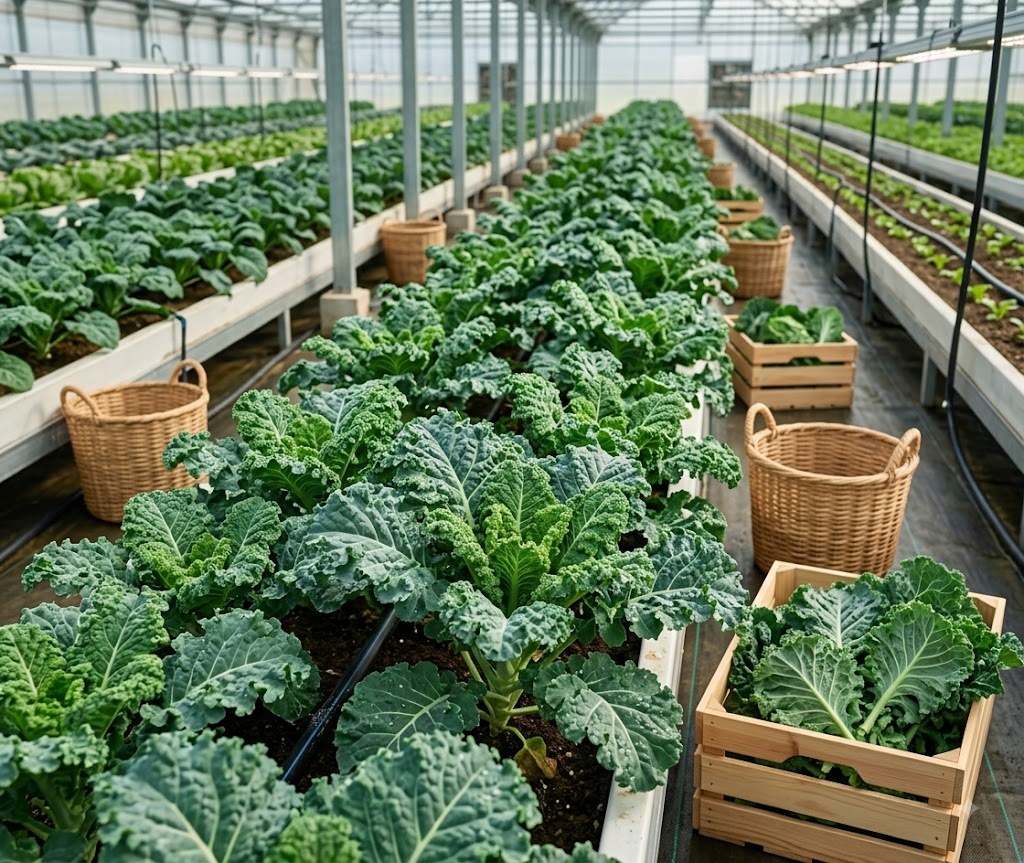
| Cultivation type | Open field / Facility / Hydroponics/Nutrient solution / Plant factory | Separation of production environment, cost, and quality |
| Distribution methods | Raw / Bundle / Bulk / Washed / Small Packaging | Lot inheritance at every stage |
| Processing form | Washing / Cutting / Juicing / Drying / Powder | Separation of process, hygiene, and yield |
| Final use | Wraps / Salad / Green Juice / Juice / School Meals / HMR / Ingredients | Buyer specification separation |
| Transaction type | Source Procurement / Regular Supply / Contract Farming / Processed Raw Materials / OEM·PB | Quantity, unit price, and contract are Verified/NDA |
step | Essential Dataset | Management purpose |
| Cultivation plan | Region, variety, cultivation type, area, contract status | Estimated supply |
| satellite | Variety · Seed Company · Lot | Variety Traceability |
| Seedling cultivation | Sowing date, nursery, seedling condition | Production history |
| formula | Official Date · Planting Distance · Farm ID | Producer–Cultivation Site Connection |
| Soil and nutrient solution | pH·EC·soil·nutrient solution·drainage | Production Environment Management |
| Watering | Water source, date, and amount | Quality and growth management |
| dispute | Fertilizer, Nutrient Solution, Input Date, Amount | Production and Environment Dataset |
| Weather and facility environment | Temperature, humidity, light, rainfall | Growth and quality prediction |
| Growth | Number of leaves · Leaf size · Color · Image | Determining harvest time |
| pests | Occurrence, Damage, and Control | Quality and quantity management |
| pesticide | Medication, Date of Use, Safe Use Period | safety |
| Harvest judgment | Leaf size, color, texture, wounds, and yellowing | Product suitability |
| harvest | Harvest date, number of harvests, yield | Raw Material Lot Creation |
| Selection | Leaf size, color, wounds, foreign matter | Buyer Specification |
| cooling | Temperature and time | wilting inhibition |
| purifying | Washing water, time, and method | Fresh-cut hygiene |
| dehydration | Process, Time, Residual Moisture | Packaging quality |
| cutting | Cutting specifications and working time | Salad · HMR |
| Juicing | Raw material weight, juice volume, yield | Green Juice/Juice Product |
| dry | Method, temperature, time, moisture | Dry Product |
| smash | Grain Size · Equipment · Lot | Powder Product |
| packaging | Weight, Packaging, Date | Traceability |
| save | Temperature, humidity, and period | Freshness |
| delivery | Refrigeration Conditions · Time · Buyer | Cold-chain |
| Inspection | Freshness, foreign matter, specifications | Delivery evaluation |
| Claim | Reason, Quantity, and Responsibility | Supplier Score |
| Repurchase | Buyer · Product · Quantity | Next production plan |
Quality items | raw kale | Washing · Fresh-cut | Green juice ingredients | Dry/Powder | Public rating |
| Variety · Farm · Lot | core | core | core | core | Verified |
| Harvest date · Harvest cycle | core | core | core | core | Verified |
| Leaf size | core | core | importance | importance | Verified/NDA |
| color | core | core | core | core | Verified/NDA |
| texture | core | core | importance | importance | Verified/NDA |
| Yellowing and wilting | core | core | core | importance | Verified/NDA |
| Wounds/lesions | core | core | core | core | Verified/NDA |
| Soil and foreign matter | core | core | core | core | Verified/NDA |
| Pesticide use | core | core | core | core | NDA |
| pesticide residues | core | core | core | core | NDA |
| purifying | Not applicable | core | core | importance | NDA |
| microorganism | importance | core | core | core | NDA |
| Juice extraction yield | Not applicable | Not applicable | core | Not applicable | NDA |
| Drying conditions | Not applicable | Not applicable | Not applicable | core | NDA |
| moisture | importance | importance | By product | core | Verified/NDA |
| Powder particle size | Not applicable | Not applicable | Not applicable | core | NDA |
| packaging | core | core | core | core | Verified/NDA |
| Storage conditions | core | core | core | core | Verified/NDA |
| Shipment and Inspection | importance | core | core | core | NDA |
| Claims · Repurchase | importance | core | core | core | NDA |
For pesticide residues in agricultural products, the individual and group standards of the Korean Food Code shall be applied first; if there is no separate tolerance limit, a uniform standard of 0.01 mg/kg shall be applied. ( National Agricultural Products Quality Management Service )
Lot Master Required Field
Lot ID · Item/Product Type · Scientific Name/Variety · Leaf Shape/Color · Cultivation Method · Origin/Farming Location · Producer · Sowing Date/Planting Date · Harvesting Method · Harvest Cycle · Harvest Date · Leaf Size/Color/Texture · Weight/Specifications/Grade · Check for Yellowing/Wilting/Wounds/Pests/Foreign Matter · Pesticide Usage Records · Pesticide Residue/Microbiological Test Report · Raw Material Lot · Washing/Dehydration/Cutting/Juicing/Drying/Grinding History · Processing Yield · Packaging Date · Use-by Date · Storage Conditions · Shipper · Delivery/Inspection · Returns/Claims · Repurchase
Customers | Purchase criteria | Cooperation opportunities |
| Producer organizations and agricultural cooperatives | Variety, Harvest Date, Specifications, Quantity | Joint shipment and contract farming |
| wholesale market | Freshness, Size, Color, Packaging | Shipment from the production area |
| local food | Regionality, Producer, Harvest Date | Direct transaction |
| Large-scale distribution | Appearance, small packaging, supply stability | PB · Regular supply |
| food ingredient company | Leaf size, freshness, and delivery time | Dining Out & School Meals |
| Leafy vegetable restaurant business | Leaf size, texture, and color | RFQ for Ssam |
| School and public meals | Safety, Standards, and Inspection | School Meal RFQ |
| salad maker | Young leaves, color, washing, microorganisms | Fresh-cut RFQ |
| green juice manufacturer | Raw material quantity, juice yield, safety | Green juice raw material contract |
| Juice manufacturer | Freshness · Raw Material Lot · Juice Yield | Juice Ingredient RFQ |
| Meal Kits · HMR | Washing, cutting, portioning, refrigeration | Preprocessing RFQ |
| Drying and powder companies | Raw material uniformity, moisture, and drying suitability | Powder raw material procurement |
| Online distribution | Origin · Harvest Date · Packaging · Delivery | Direct from the farm |
| PB business operator | Product type, packaging, and brand | Kale PB |
| Smart Farm | Production uniformity and environmental data | Technology demonstration |
| Research Institute | Variety, Growth, Composition, and Processing Data | joint research |
| local government | Local production, greenhouse horticulture, and processing | Local Kale AX Business |
step | Key variables | Operational judgment |
| satellite | Variety/Seed Lot | Product conformity |
| production | Cultivation type, environment, and growth | Supply forecast |
| Leaf harvest | Harvest cycle, size, and quantity | Raw Material Lot |
| Selection | Color, scratches, yellowing, specifications | Buyer suitability |
| Cooling and packaging | Temperature, Weight, Packaging | Freshness |
| Washing · Fresh-cut | Washing, dehydration, and cutting | Salad Switch |
| Juicing | Raw materials, yield, and hygiene | Green juice/juice conversion |
| Dry/Powder | Drying, moisture, grinding | raw material conversion |
| circulation | Refrigeration and Incoming Inspection | Quality responsibility |
| RFQ | Products · Specifications · MOQ · Delivery Time | AI Match |
| contract | Volume, Price, Inspection | Terms of trade |
| delivery | Lot · Quantity · Delivery | Implementation verification |
| evaluation | Quality, Yield, Claims | Supplier Score |
| Repurchase | Reorder | Next production plan |
Products and processes | Key conditions | RFQ conversion |
| Kale for wraps | Leaf size, color, and freshness | Foodservice RFQ |
| young kale | Harvesting stage, hygiene, color | Salad RFQ |
| Wash kale | Washing, Spinning, Refrigeration | School meals · Meal kits |
| Fresh-cut | Cutting, washing, and packaging | Salad · HMR |
| green juice ingredients | Raw material quantity, freshness, and extraction yield | Green Juice Company RFQ |
| Juice ingredients | Raw Material Lot · Juicing · Hygiene | Juice Company RFQ |
| Dried kale | Moisture, color, and drying conditions | Food Ingredient RFQ |
| Kale powder | Drying, grinding, particle size, hygiene | Food and PB ingredients |
| mixed vegetables | Other Leafy Vegetable Lot · Mixing Ratio | Salad · PB |
| Meal kit | Washing, portioning, and packaging | Meal kit OEM |
| Leaves excluded from selection | Status/Amount | Food conversion is verified separately |
| Stem and leaf stalk byproducts | Amount and characteristics | Review of feed, compost, and resource utilization |
| Cultivation residue | Pollution and treatment methods | Review of Circular Agriculture |
PRP — Product Research Profile
PRP items | Details of investigation and verification |
| PRP-01 variety | Leaf shape, color, quantity, and marketability |
| PRP-02 Harvesting Stage | Difference in quality between young and mature leaves |
| PRP-03 Sequential Harvest | Production volume and quality by harvest cycle |
| PRP-04 for wraps | Size, texture, and freshness |
| PRP-05 Salad | Young leaves, color, fresh-cut suitability |
| PRP-06 green juice | Juice yield, color, and safety |
| PRP-07 Juice | Raw materials, juicing, and blending suitability |
| PRP-08 cleaning | Foreign matter, wash water, microorganisms |
| PRP-09 Fresh-cut | Cutting, wilting, color, microorganisms |
| PRP-10 Dry | Drying method, moisture, color |
| PRP-11 powder | Particle size, moisture, dispersibility, hygiene |
| PRP-12 storage | Yellowing, wilting, and loss |
| PRP-13 meal | Inspection, Safety, Standards |
| PRP-14 Buyer | Specifications, MOQ, and Delivery Time by Product |
| PRP-15 Reorder | Quality, Yield, Claims, Reorders |
| PRP-16 byproduct | Utilization of leaf stalks, excluded items, and residues |
first of all | Execution item | Performance indicators |
| 1 | Make Variety, Cultivation Type, Harvest Cycle, Harvest Date, and Lot mandatory | Required value input rate |
| 2 | Separation of Products: Wraps – Young Leaves – Fresh-Cut – Green Juice – Dried – Powder | Misclassification reduction rate |
| 3 | Linking weather, facility environment, and growth data | Environment connection rate |
| 4 | Image-based determination of leaf size, color, chlorosis, and lesions | AI judgment agreement rate |
| 5 | Automatic recording of production volume by harvest cycle | Completeness of production data |
| 6 | Yield prediction | Supply forecasting accuracy |
| 7 | Pesticide–Harvest–Report Linkage | Lot document linkage rate |
| 8 | Washing and Fresh-Cut Hygiene Data | Hygiene history rate |
| 9 | Juice Extraction Yield Runtime Construction | Yield prediction accuracy |
| 10 | Data conversion of drying and powder process yields | Processing yield |
| 11 | Farm–Processing Company–Buyer RFQ Match | Match rate |
| 12 | Buyer Inspection and Claim Feedback | Delivery conformity rate |
| 13 | Next production plan based on repurchase | Repurchase linkage rate |
Problem group | Problem Definition | Required data |
| Conflict between scientific names and variety labels | The scientific names and variety descriptions of kale varieties may vary depending on the source. | Taxonomy · Breeds · Source |
| Cabbage War Corps Overlap | Risk of being integrated with cabbage due to the same B. oleracea | Species·Product Role |
| Mixed varieties | Characteristics such as curly, flat leaves, and purple color are not reflected in the transaction | Variety, Leaf Shape, Color |
| Harvesting stage mixed | Young leaves and mature leaves are treated as the same size. | Harvest date · Leaf size |
| Harvest order deviation | Changes in quality and yield due to repeated harvesting | Harvest cycle, quantity, and quality |
| Leaf quality variation | Variations in size, color, and texture | Quality · Buyer Standards |
| Yellowing and wilting | Freshness decline after harvest | Temperature, humidity, and time |
| pests | Reduced marketability of leaves | Occurrence, Control, and Damage |
| pesticide residues | Safety management of raw and juiced ingredients is necessary | Pesticides, Harvest Date, Inspection |
| alien substance | Soil, insects, etc. on the leaves before washing | Sorting, washing, and inspection |
| Fresh-cut hygiene | Microbial risk after washing and cutting | Process and Microorganism |
| Variation in juice extraction yield | Differences in raw material efficiency according to variety and harvesting stage | Raw material, juice volume, yield |
| Quality variation of dried products | Differences in color and moisture depending on drying conditions | Time, temperature, moisture |
| Lack of powder standardization | Quality differences by particle size, moisture, and lot | Grinding, Particle Size, Inspection |
| functional exaggeration risk | Risk of excessively exaggerating the efficacy of research ingredients to general products | Papers, Laws, and Attribution |
| supply forecasting | Difficulty in verifying the Buyer's estimated supply volume | Growth and Harvest Scheduled |
| Contract production error | Difference between estimated quantity and actual delivered quantity | Contract, Harvest, Delivery |
| Processing Lot Disconnection | Discontinued traceability from raw material to juice to powder | Raw Material/Processed Lot |
| Repurchase not reflected | Quality evaluation is not fed back into production planning | Rate and Reorder |
| Lack of byproduct management | Insufficient data on the occurrence and processing of leaf stalks and sorting exclusions | Generation volume and treatment costs |
RFQ Type | Public Registration | Verify/NDA |
| Procuring kale for wraps | Variety group, origin, specifications, shipping time | Farm · Quantity · Unit Price · Lot |
| young kale | Leaf size, uses, and packaging | Microorganisms, Quantity, Price |
| Regular supply | Product, Period, Delivery Area | Volume, Unit Price, Contract |
| contract farming | Variety, Use, and Quality Standards | Area, Quantity, Price |
| green juice ingredients | Raw form, origin, and harvest period | Juice Yield, Test Report, Unit Price |
| Juice ingredients | Specifications, Raw Material Type, Delivery Time | Yield, Volume, Price |
| Fresh-cut | Cutting, Washing, Refrigeration | Microorganisms · MOQ · Unit Price |
| salad | Young leaves, color, mixed uses | Test Report · Price |
| dried raw materials | Variety, Raw Material Form, and Purpose of Drying | Yield, processing conditions, and unit price |
| Kale powder | Particle size, packaging, and use | Test Report · MOQ · Unit Price |
| school meals | Safety, Standards, Delivery | Test Reports/Contracts |
| Meal Kits · HMR | Washing, portioning, and cutting | Samples · Unit Price |
| PB | Product type, packaging, and channel | Brand · MOQ · Price |
| export | Product Type · Target Country | HS·Quarantine·Test Report |
| Technology demonstration | Environmental, growth, and quality issues | Sensors, AI, Test Results |
| Research cooperation | Research on varieties, ingredients, and processing | Sample and analysis results |
| local government cooperation | local production, processing, and sales channel issues | Farms, Facilities, and Business Conditions |
① Need Products & Materials
Companies and institutions seeking necessary products, agricultural products, raw materials, and processed goods register purchasing demands. Registered requests are utilized to review cooperation with potential suppliers and producers based on the RFQ Intelligence Library.
Process:
RFQ Registration → Supplier/Product Review → Collaboration Connection → Future AI Matching
Register
② We are looking for production and manufacturing partners. (Need Suppliers & Manufacturers)
Register a request to find necessary production and supply partners, ranging from farms and producer organizations to processing companies, OEM, ODM, and private label manufacturers.
Process:
RFQ Registration → Review of Production & Manufacturing Capabilities → Collaboration Connection → Future AI Partner Matching
Register
③ We are looking for domestic and international buyers. (Need Buyers)
Farmers, producer organizations, and manufacturing companies are requesting cooperation with new buyers, such as domestic and international distributors, importers, brand companies, and food service and catering businesses.
Process:
RFQ Registration → Product & Supply Capability Review → Market & Buyer Connection → Future AI Buyer Matching
Register
Contact : mail@markethub.org
Version | Main contents | situation |
| v1.0 | Kale Plant Identity · Raw Material · Fresh-cut · Green Juice · Dried · Powder · RFQ Basic Structure Registration | complete |
| v1.1 | Verification of official production, region, and market raw data | expected |
| v2.0 | Separation of Product Specifications for Wraps, Young Leaves, Green Juice, Fresh-Cut, Dried, and Powder | expected |
| v3.0 | Combination of Farm – Pre-processing – Juicing & Processing – Food Service & Distribution & PB Buyer Verified Container | expected |