

Judgment axis | detail |
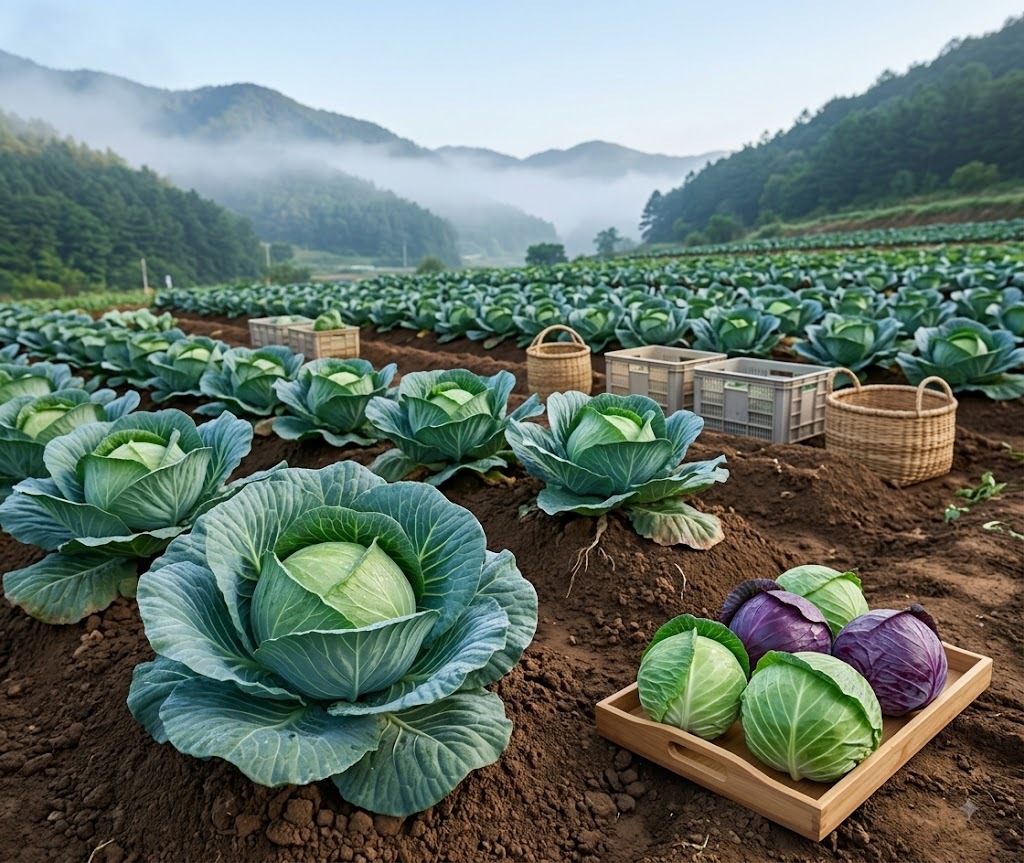
| Item Identity | Cabbage is a head-forming leafy vegetable belonging to the genus Brassica of the family Brassicaceae; MarketHub manages the representative common head type as Brassica oleracea L. var. capitata. Since this variety name is sometimes treated as a synonym for B. oleracea in the International Classification of Plants, the history of scientific name standardization is also managed. ( Plants of the World Online ) |
| Key role | It is a highly versatile head leafy vegetable used not only as whole cabbage and fresh retail vegetables, but also as an ingredient for salads, shredded vegetables, dining out, school meals, meal kits, HMR, pickles, fermentation, and food processing. Kew data also explains that cabbage from the Capitata Group is finely chopped for use in salads and is utilized in fermented cabbage products. ( Plants of the World Online ) |
| Harvesting principle | Check bulb size, head condition, weight, firmness, outer leaves, pests and diseases, cracks, wounds, and rot, and link the harvest date–sorting–pre-cooling–storage–shipping history to a Lot. |
| Product separation | Whole cabbage, trimmed cabbage, cut/shredded cabbage, washed cabbage, salad ingredients, processed ingredients, red cabbage, etc., are separated by Product Type, variety, color, and processing stage. |
| Separation of similar items | Since Napa cabbage belongs to the B. rapa lineage, it is a separate Plant Entity; however, broccoli, cauliflower, and kale differ in their commercialization organizations and product roles even though they belong to the same B. oleracea species group. Brussels sprouts are also managed as a separate product group. |
| Domestic statistics | The finalized values for the nationwide cabbage cultivation area and production volume by item for 2025 are not entered arbitrarily, as direct verification with official raw data has not been completed at this registration stage. They will be entered along with the base year and unit at a later date after verification of the raw data from the National Statistical Crop Production Survey/KOSIS. |
| Cultivation characteristics | The Rural Development Administration's Nongsaroo classifies cabbage cultivation types into spring, summer, autumn, and overwintering, and manages sowing, seedling cultivation, transplanting, and growth management differently for each type. ( Nongsaroo ) |
| Supply and demand risk | Physiological disorders such as unheaded heads, premature bolting, and splitting caused by high or low temperatures and moisture imbalances, as well as diseases and pests including clubroot, wilt, and downy mildew, moths, aphids, and leaf beetles, can affect quality and production stability. ( Nongsaroo ) |
| Quality and Safety | The National Agricultural Products Quality Management Service designates cabbage as an item under agricultural product standard specifications management, and classifies cabbage and Brussels sprouts as head leafy vegetables for the application of pesticide residue standards. ( National Agricultural Products Quality Management Service ) |
| Operating Principles | Separate and link origin, cultivation type, variety, growing area, harvest date, weight, grade, lot, pesticide residue, microorganisms, washing, cutting, storage, and shipment history. |
| Final goal | Connects RFQs with delivery, claim, and repurchase data from producers, origin distributors/APCs, pre-processing/processing companies, catering/restaurants, meal kits/HMRs, distribution/PBs, and import/export buyers. |
division | Registration details |
| Korean name | cabbage |
| English name | Cabbage / Head cabbage |
| Representative scientific name | Brassica oleracea L. var. capitata |
| Caution regarding scientific name management | Kew Plants of the World Online treats Brassica oleracea var. capitata as a synonym for Brassica oleracea L. MarketHub includes the name var. capitata in Product Metadata for agricultural and product identification. ( Plants of the World Online ) |
| classification | Brassicaceae, Brassica |
| Edible parts | It is primarily used for head leaves and leaf stalks. |
| Non-edible · Separate management | Roots, seeds, seedlings for cultivation, seeds for breeding, discarded outer leaves |
| Major harvesting stages | Young leaves → Non-head growth → Head formation begins → Head formation progresses → Optimal market time → Risk of overripening and cracking |
| Basic product form | Whole cabbage, trimmed cabbage, halved/cut cabbage, shredded cabbage, washed cabbage, salad ingredients, processing ingredients, red cabbage, etc. |
| Basic processing stage | Seedling → Transplanting → Growth → Head Formation → Harvesting → Sorting → Leaf Trimming → Pre-cooling → Packaging → Storage → Washing → Cutting/Slicing → Portioning → Processing/Cooking/Fermentation → Packaging |
| Basic use | Raw food, Wraps/Cooked food, Salad, Eating out/Catering, Meal kits/HMR, Pickles/Fermentation, Food manufacturing ingredients, PB |
| Similarity Principle | Do not mix Napa cabbage, kale, broccoli, cauliflower, or Brussels sprouts with regular head cabbage. |
Product Master
Product Master | Key Management Standards |
| Regular green whole cabbage | Variety, Cultivation Type, Origin, Harvest Date, Head Weight, Shape, Head Formation, Outer Leaves, Grade |
| Spring cabbage | Planting, Harvest Time, Variety, Low Temperature, Early Bolting, Shipping History |
| Summer cabbage | Cultivation area · High temperature · Rainfall · Unheaded heads · Pests and diseases · Expected harvest |
| Autumn cabbage | Planting, Head Formation, Harvest Time, Shipment Plan Before Low Temperature, Storage Quality |
| Overwintering cabbage | Overwintering region, low temperature, frost damage, harvest season, storage, and shipping history |
| red cabbage | Variety, Color, Weight, Appearance, Cross-section, Salad, Processing Use |
| Trimmed cabbage | Raw Material Lot · Outer Leaf Removal · Weight · Specifications · Packaging |
| Half/Cut Cabbage | Raw Material Lot · Cutting Specifications · Cutting Time · Packaging · Storage · Use-by Date |
| Shredded cabbage | Raw Material Lot · Shredding Width · Washing · Dehydration · Microorganisms · Packaging · Refrigerated Distribution |
| Washed cabbage | Raw Material Lot · Washing Water · Washing Process · Foreign Matter · Hygiene · Packaging |
| Salad ingredients | Cutting specifications, color, texture, freshness, hygiene, and refrigerated distribution |
| For dining out and catering | Weight, specifications, trimming rate, delivery cycle, inspection, refrigerated distribution |
| For processing raw materials | Variety, Weight, Solids, Texture, Processing Yield, Delivery Time |
| For pickling and fermentation | Raw Material Lot · Cutting · Salting or Fermentation Process · Hygiene · Finished Product Lot |
| By-products and sorted items | Quantity, condition, edibility, feed, compost, and suitability for resource utilization |
Classification criteria | Subdivision type | Management principles |
| Plant classification | Cabbage / Napa Cabbage / Kale / Broccoli / Cauliflower / Brussels Sprouts | Even if botanically related, each is managed as a separate Plant Entity. |
| Color and variety groups | Green Cabbage / Red Cabbage / Other Varieties | Separation by variety, color, appearance, and processing use |
| Harvesting stage | Young leaves / Unheading / Head forming / Fully formed / Overripe | Separation of product specifications and shelf life by harvest stage |
| Cultivation method | Spring / Summer / Autumn / Wintering | Separate management of sowing, planting, harvesting times, and climate risks linked to official Nongsaroo cultivation types ( Nongsaroo ) |
| Distribution methods | Raw materials from the source / Selected products / Trimmed products / Small packages / Cut and washed products | Inheritance of original lot at each conversion stage |
| Processing form | Whole / Cut in half / Cut / Shred / Wash / Pickling/Fermentation / Cooking/Processing | Separate management of process, hygiene, and expiration date |
| Final use | Household Use / Food Service / Catering / Salad / Meal Kits · HMR / Food Manufacturing / Private Brand / Export | Separation of specifications, packaging, delivery time, and inspection standards by buyer |
| Transaction type | Source Procurement / Contract Farming / Regular Supply / Raw Material Supply / Pre-processed Supply / OEM·PB | Quantity, unit price, contract, and actual transaction conditions are Verified/NDA |
| Quality type | General Goods / Processed Raw Materials / Non-marketable/Sorted Excludes | Separation of food conversion feasibility and safety |
| Packaging type | Bulk / Box / Mesh / Small Packaging / Vacuum Sealing / Commercial Use | Connecting Lot with Customer Requirements |
The Rural Development Administration's Nongsaroo provides work schedules for cabbage cultivation, categorized into spring, summer, autumn, and overwintering, with sowing times varying depending on the crop type. It also identifies physiological disorders such as premature bolting, splitting, and under-heading, as well as major diseases including clubroot, wilt, and downy mildew. Therefore, for cabbage, it is necessary to manage data on crop type, weather, moisture, and pests/diseases in conjunction with the production lot. ( nongsaro.go.kr )
step | Essential Dataset | Management purpose |
| Cultivation plan | Origin, Crop Type, Variety, Cultivation Area, Sowing, Planned Planting, Contract Status | Check expected production volume, shipment timing, and procurement feasibility |
| Seed selection | Variety · Seed Company · Lot · Germination Rate · Suitability for Crop Type | Variety–Cultivation Type–Quality Link |
| Seedling cultivation | Sowing date, nursery, potting soil, seedling period, seedling condition | Securing the starting point of the production history |
| formula | Planting Date · Planting Distance · Grower · Field ID | Tracking producers and cultivation sites |
| Soil management | Soil testing, pH, organic matter, drainage, fertilization | Productivity and Environmental Management |
| dispute | Fertilizer type, application date, and amount | Datafication of growth, quality, and environment |
| Watering | Irrigation day, water source, amount of water, soil moisture | Risk management such as cracking and poor growth |
| rising | Temperature, rainfall, humidity, sunshine, cold wave, high temperature | Crop conditions and harvest time prediction |
| Growth management | Number of leaves, plant height, onset of head formation, growth photos | Production volume and harvest time forecast |
| pests | Name of pest/disease, date of occurrence, affected area, control, pesticide | Quality and safety verification |
| Pesticide Management | Medication, Date of Use, Dilution Ratio, Safe Use Period Before Harvest | Assessment of pesticide residues and potential for shipment |
| Harvest judgment | Spherical shape, head shape, head weight, hardness, outer leaves, pests and diseases, cracks | Determination of delivery suitability |
| harvest | Harvest date · Farm · Field · Worker · Yield | Raw Material Lot Creation |
| Selection | Weight, size, appearance, damage, pests, contamination, grade | Buyer specification separation |
| outer leaf trimming | Removal Amount · Loss Rate · Product Weight | Calculation of commercialization rate and by-product volume |
| Pre-cooling | Pre-cooling status, start and end times, temperature | Comparison of quality retention and shelf life |
| save | Storage facilities, temperature, humidity, inbound/outbound dates, loss rate | Inventory and Quality Change Management |
| packaging | Packaging material, unit, weight, packaging date, label | Distribution · Traceability |
| shipment | Shipment Date · Quantity · Vehicle · Buyer · Delivery Location | Confirmation of supply fulfillment |
| purifying | Raw Material Lot · Washing Water · Time · Process · Hygiene | Pre-processed product tracking |
| Cutting and slicing | Cutting specifications, working time, equipment, and yield | Suitability for dining out, school meals, and salads |
| Dehydration and portioning | Moisture management, weight, and packaging unit | Fresh-cut quality control |
| Pickling and fermentation | Raw Material Lot · Processing Conditions · Time · Hygiene | Processing Lot Connection |
| Shipment of finished products | Product Lot · Packaging · Expiration Date · Buyer | Tracking recalls, claims, and repurchases |
While Nongsaroo's cabbage cultivation technical data presents specific growing conditions such as standard fertilizer application rates, MarketHub does not apply them uniformly while disregarding variety, soil testing, and regional farming standards; instead, it stores actual farm-specific fertilization records and official cultivation standards separately. ( Nongsaroo )
Quality items | Whole cabbage | Cut and washed parts | Salads and pre-processed products | Processed raw materials and finished products | Public rating |
| Origin · Cultivation Type · Variety · Farm · Lot | core | core | core | core | Verified |
| Harvest day | core | core | core | core | Verified |
| Weight, size, and shape | core | importance | importance | importance | Verified/NDA |
| Structure and hardness | core | importance | importance | importance | Verified/NDA |
| outer leaves, color, and freshness | core | importance | core | importance | Verified/NDA |
| pests | core | core | core | importance | Verified/NDA |
| cracks, wounds, decay | core | core | core | importance | Verified/NDA |
| alien substance | importance | core | core | core | Verified/NDA |
| pesticide residues | core | core | core | core | NDA |
| Cleaning history | Not applicable | core | core | importance | NDA |
| Cutting history | Not applicable | core | core | importance | NDA |
| microorganism | importance | core | core | core | NDA |
| Pre-cooling and storage | core | core | core | importance | Verified/NDA |
| Cutting specifications | Not applicable | core | core | importance | Verified/NDA |
| Packaging weight | core | core | core | core | Verified/NDA |
| refrigeration conditions | importance | core | core | core | Verified/NDA |
| Expiration date | Not applicable or distribution standards | core | core | core | Verified/NDA |
| Outbound and Inbound Inspection | importance | core | core | core | NDA |
| Returns and Claims | importance | core | core | core | NDA |
| Repurchase | importance | core | core | core | NDA |
In food safety classifications, cabbage is managed under the category of head leafy vegetables along with Brussels sprouts, and the relevant food group classification must be verified when applying pesticide residue standards. ( Food Safety Korea )
Lot Master Required Field
Lot ID · Item/Product Type · Representative Scientific Name/Variety · Cultivation Type · Origin/Cultivation Area · Producer · Cultivation Method · Sowing Date · Planting Date · Harvest Date · Head Formation · Head Weight · Size · Specifications · Grade · Outer Leaf · Color · Cracks · Pest and Disease Check · Pesticide Usage Records · Pesticide Residue/Microbiological Test Report · Pre-cooling/Storage History · Raw Material Lot · Leaf Trimming · Washing · Cutting · Shredding · Dehydration · Pickling · Processing History · Processing Yield · Packaging Date · Use-by Date · Shipper · Incoming Inspection · Returns/Claims · Repurchase
5. Korea Market & Demand Structure
Customers | Purchase criteria | Cooperation opportunities |
| Production Area Distribution Organizations · Agricultural Cooperatives | Crop type · Origin · Specifications · Harvest date · Sorting · Quantity | Contract Farming & Joint Sorting RFQ |
| APC | Arrival Date · Weight · Specifications · Appearance · Commercialization Rate | Joint sorting, pre-cooling, and packaging business |
| wholesale market | Grade, Weight, Packaging, Shipment Time, Marketability | Linking production area shipment and price information |
| Large-scale distribution | Appearance, specifications, small packaging, supply cycle, claim rate | Regular Supply · PB RFQ |
| food ingredient company | Specifications, Weight, Freshness, Delivery Cycle | Foodservice and catering supply |
| food service companies | Shredding suitability · Yield · Cookability · Delivery | Whole, cut, and shredded cabbage |
| Food service franchises such as pork cutlets and salads | Shredding specifications, texture, freshness, browning, and yield | Preprocessing-only RFQ |
| School and public meals | Safety, Standards, Inspection, Delivery Date, Cold Storage Distribution | School Meal Ingredients RFQ |
| Fresh-cut companies | Raw material quality, washing, cutting suitability, yield, microorganisms | Pre-processing raw material contract |
| salad maker | Color, texture, cutting size, freshness, refrigeration | Salad Ingredient RFQ |
| Meal kit and HMR manufacturers | Cutting specifications, subdivision, processing suitability, and shelf life | Supply of pre-processed products |
| food processing company | Processing yield, quality uniformity, composition, delivery time | Processed raw material contract |
| Pickled and fermented product manufacturers | Variety, texture, cutting suitability, fermentation suitability | RFQ for Processing-Specific Raw Materials |
| online seller | Appearance, Weight, Small Packaging, Shipping Damage, Claims | Direct from the farm |
| PB business operator | Specifications, Supply Stability, Packaging, Brand, Country of Origin | Regional/Distribution Private Brand |
| exporters | Standards · Quarantine · Pesticide Residues · Packaging · Shelf Life | Procurement from production areas for export |
| Research and technology institutions | Variety, Climate, Pests and Diseases, Storage, Fresh-cut Data | Joint Testing · AX Demonstration |
step | Key variables | Operational judgment |
| Seeds and seedlings | Variety, Cultivation Type, Seed Lot, Seedling Status | Regional and seasonal suitability |
| Production in the producing area | Crop type · Origin · Planting · Weather · Growth · Pests and diseases | Harvest timing and supply risks |
| Production forecast | Cultivation area, growth, bulb weight, and expected harvest | Estimated supply |
| Contract farming and procurement | Variety, Specifications, Area, Quantity, Delivery Date | Buyer demand pre-connection |
| harvest | Harvest date, head weight, head formation, and marketability rate | Delivery suitability |
| Sorting and packaging | Grade, Appearance, Weight, Packaging | Product separation by channel |
| Pre-cooling and storage | Storage conditions, period, quality change, inventory | Shipment control |
| Preprocessing | Trimming outer leaves, washing, cutting, slicing, and dehydrating | E-dining, school meals, and Fresh-cut transition |
| process | Pickling · Fermentation · Cooking · HMR | Raw Material–Product Lot Connection |
| circulation | Refrigeration, Delivery, and Incoming Inspection | Verify quality responsibility sections |
| export | HS · Quarantine · Pesticide Standards · Packaging · Transport | Country-specific conformity verification |
| RFQ | Product Type · Specifications · MOQ · Delivery Time · Test Report | Provider AI Match |
| contract | Quantity, Price, Inspection, Liability, and Exemption | Transaction terms confirmed |
| delivery | Lot · Quantity · Delivery Date · Inspection | Supply fulfillment evaluation |
| Repurchase | Buyer Reviews · Claims · Returns · Reorders | Update Provider Score |
Products and processes | Key conditions | RFQ conversion |
| Whole cabbage | Variety, cultivation method, origin, head weight, head size, harvest date | Retail, Foodservice, and Catering RFQ |
| Trimmed cabbage | outer leaf removal · weight · specifications · packaging | Distribution & Food Service RFQ |
| Half a cabbage | Raw Material Lot · Cut Surface · Packaging · Refrigeration | Retail & Food Ingredients RFQ |
| Cut cabbage | Cutting specifications, washing, hygiene, packaging | Food Service & Dining Out RFQ |
| Shredded cabbage | Shredding width, texture, browning, washing, and dehydration | Franchise & Salad RFQ |
| Washed cabbage | Washing process, wash water, foreign matter, microorganisms | School Meals · Fresh-cut RFQ |
| Salad ingredients | Color, texture, cutting specifications, refrigeration, and expiration date | Salad Manufacturer RFQ |
| Meal kit ingredients | Cutting, portioning, mixing, packaging, and distribution | Meal Kit OEM/PB RFQ |
| HMR ingredients | Heatability, Texture, Yield, Mixing | HMR Manufacturer RFQ |
| Pickled products | Cutting, salting, hygiene, packaging | Processed Food RFQ |
| fermented products | Raw Material Lot · Fermentation Conditions · Microorganisms · Aging | Fermented Food RFQ |
| Freeze-dried raw materials | Pretreatment · Moisture · Color · Restoration | Food Material RFQ |
| red cabbage processing | Color, variety, cutting, and processing stability | Salad & Processed Food RFQ |
| outer leaf | Quantity, Contamination, Freshness, and Edibility | Conversion to food use requires separate safety verification |
| Heart and cutting by-products | Generation Amount, Characteristics, and Recovery Conditions | Review of feed, compost, and bioresource utilization |
| Non-product items | Disease, Damage, Safety, Treatment Cost | Individual verification of the possibility of processing conversion |
PRP — Product Research Profile
Cabbage PRP is operated as a Product Research Profile that investigates the following items for actual product development, procurement, and processing, rather than simply introducing ingredients .
PRP items | Details of investigation and verification |
| PRP-01 variety | Burrow weight, texture, color, and shelf life by variety |
| PRP-02 type | Differences in production and quality by spring, summer, autumn, and winter |
| PRP-03 Fresh-cut | Browning, moisture loss, texture, and microorganisms after cutting |
| PRP-04 Salad | Cutting specifications, mixing, refrigeration, and expiration date |
| PRP-05 Eating Out | Shredding Yield, Cookability, and Workability |
| PRP-06 meal service | Standards, Inspection, Cleaning, Safety |
| PRP-07 HMR | Texture and yield after heating and cooking |
| PRP-08 Pickling and Fermentation | Variety, texture, cutting, salting, and fermentation suitability |
| PRP-09 Storage | Storage, Loss, and Spoilage by Variety and Cultivation Type |
| PRP-10 by-product | Possibility of resource utilization for outer leaves, cores, and sorted excluded items |
| PRP-11 Buyer | Specifications, MOQ, Delivery Time, and Quality Standards by Buyer |
| PRP-12 Reorder | Evaluation of yield, claims, and repurchase after delivery |
first of all | Execution item | Performance indicators |
| 1 | Item, Cultivation Type, Variety, Origin, Planting Date, Expected Harvest Date, and Lot ID are required values. | Required value input rate |
| 2 | Whole Cabbage – Red Cabbage – Trimmed Product – Cutting & Washing – Shredded Product – Processed Raw Material Product Separation | Product Misclassification Reduction Rate |
| 3 | Linking weather, soil, growth, pests and diseases, head formation, and harvest data by crop type | Harvest forecast accuracy |
| 4 | Image-based quality assessment of sphere size, appearance, cracks, and pests | Automatic judgment agreement rate |
| 5 | Production yield prediction using cultivation area, growth, and bulb weight data | Production forecast error rate |
| 6 | Data conversion of pesticide residues, microorganisms, pre-cooling, storage, and fresh-cut test reports | Lot–Test Report Connection Rate |
| 7 | APC Inbound–Sorting–Pre-cooling–Storage–Outbound Data Connection | Lot tracking rate |
| 8 | Shipment optimization combining storage environment, inventory, and buyer demand | Shrinkage Rate · Inventory Turnover Day |
| 9 | Data conversion of yield by slicing, washing, and pretreatment processes | Accuracy of predicting processing yield |
| 10 | Farms–APC–Fresh-cut–Food Ingredients–School Meals/Restaurant–PB RFQ Connection | RFQ Match Rate |
| 11 | Reflect delivery inspection, claim, and return data in the Supplier Score | Claim rate |
| 12 | Feedback of buyer repurchase data into next production and contract farming plans | Repurchase rate |
Problem group | Problem Definition | Required data |
| Mixed varieties | Although quality, storage, and processing suitability vary by variety, they are traded collectively as general cabbage. | Variety, Seed, Bulb Weight, Storage, Processing Yield |
| Mixed cultivation methods | Spring, summer, autumn, and winter cabbage are treated under the same supply conditions. | Crop type · Origin · Planting · Harvesting · Shipment |
| Mixing of similar items | Lack of distinction between entities such as napa cabbage, kale, red cabbage, and Brussels sprouts | Scientific name, variety, product part, product form |
| High and low temperature risks | Marketability may be reduced due to physiological disorders such as incomplete heads or premature bolting. | Weather, variety, planting, head formation, damage rate |
| Moisture imbalance and fissures | Cracks and reduced marketability may occur due to drought and fluctuations in irrigation. | Soil moisture, irrigation, rainfall, and crack rate |
| pests | Production risks such as root knot disease, wilt disease, downy mildew, and moths | Date of occurrence, area, control, weather, damage rate |
| Fluctuation in production volume | Changes in cultivated area and crop conditions lead to fluctuations in supply and prices. | Area, growth, production volume, shipment, price |
| Concentration of harvest season | Possibility of oversupply due to simultaneous shipment of specific regions and crop types | Expected Harvest · Shipment Volume · Buyer Demand |
| Quality deviation | Buyer inspection deviations occur due to differences in structural integrity, form, appearance, and cracks. | Quality Grade · Inspection · Return |
| Discrepancy between origin and processing specifications | Discrepancy between market standards for whole cabbage and raw material standards for fresh-cut and foodservice use | Buyer Specification · Processing Yield |
| Storage loss | Loss, spoilage, and quality change are possible during long-term storage. | Receiving, temperature and humidity, storage period, and loss |
| Fresh-cut quality | Management of moisture loss, browning, and microorganisms is necessary after cutting. | Raw Material Lot · Cutting · Washing · Temperature · Microorganisms |
| outer leaf disposal | By-products such as outer leaves and cores are generated during the commercialization process | By-product volume, processing costs, and characteristics |
| Dispersion of test reports | Residual pesticide and microorganism test data separated from the Lot | Inspection Agency · Inspection Date · Lot · Report |
| Discrepancy in contract farming | Difference between projected production volume and buyer purchase volume/specifications | Contract area · Estimated quantity · Actual yield · Delivery |
| Logistics quality | Unclear responsibility for quality degradation during transit from origin to buyer | Vehicle, Temperature, Time, Incoming Inspection |
| Price fluctuations | Information on production area, wholesale, and contract prices is separated from production plans | Price, Production, Inventory, Demand |
| Repurchase not reflected | Delivery quality, yield, and claims are not reflected in the selection of the next supplier | Delivery Evaluation · Returns · Claims · Reorders |
| Data disconnection | Farm-APC-Processing-Buyer data is distributed by system | Entity ID · Lot · RFQ · Contract |
| Lack of supply forecasting | It is difficult for the buyer to check the estimated harvest quantity for each crop type in advance. | Area, Growth, Bulb Weight, Estimated Harvest, Contracted Quantity |
RFQ Type | Public Registration | Verify/NDA |
| Whole cabbage sourced from the producer | Cultivation type, production area, use, specifications, shipping time | Farm · Actual Quantity · Unit Price · Harvest Date · Lot |
| Regular supply | Product type, supply period, specifications, delivery area | Weekly Volume, Unit Price, Inventory, and Contracts |
| contract farming | Variety, Cultivation Type, Delivery Period, Quality Standards | Contract area, production volume, price, and risk sharing |
| Red cabbage supply | Variety group, color, weight, use | Farm · Lot · Unit Price · Test Report |
| For processing raw materials | Weight, quality, processing use, and harvest period | Yield, Actual Quantity, Unit Price, Delivery Time |
| Cut and washed parts | Cutting Standards · Washing · Portioning · Refrigeration | Hygiene data, microorganisms, expiration date, unit price |
| Shredded cabbage | Shredding width, packaging, refrigeration, and delivery cycle | Yield · Test Report · MOQ · Price |
| Salad ingredients | Product type, freshness, packaging, delivery | Microorganisms, expiration date, unit price, contract |
| Foodservice supply | Whole · Cutting · Shredding · Packaging · Delivery | Quantity, delivery unit price, claims |
| School and public meals | Specifications, safety standards, packaging, and delivery cycle | Test Report · Quantity · Contract · Inspection |
| Meal kit | Cutting specifications, subdivision, and mixing suitability | Sample · Prescription · Expiration Date · Cost |
| HMR | Applications for processing, cutting, and heating | Yield · Sample · Unit Price · Contract |
| Pickling and fermentation | Raw material form, variety, and processing use | Process conditions, yield, and price |
| Distribution Private Brand | Product type, packaging, brand, and sales channels | MOQ · Brand · Unit Price · Inventory |
| local specialties | Regionality, Variety, Product Form, Story | Producer, Contract, and PB Conditions |
| export | Product type, specifications, target country, packaging | Quarantine, Test Report, Unit Price, Quantity |
| Technology demonstration | Target Problems · Farm Types · Required Technologies | Packaging, Growth, Sensor, Test Results |
| Research cooperation | Evaluation items for variety, storage, fresh-cut, and processing | Samples, Test Conditions, and Research Results |
| Utilization of by-products | Types of by-products, origins, and utilization directions | Quantity, Characteristics, Unit Price, Contract |
① Need Products & Materials
Companies and institutions seeking necessary products, agricultural products, raw materials, and processed goods register purchasing demands. Registered requests are utilized to review cooperation with potential suppliers and producers based on the RFQ Intelligence Library.
Process:
RFQ Registration → Supplier/Product Review → Collaboration Connection → Future AI Matching
Register
② We are looking for production and manufacturing partners. (Need Suppliers & Manufacturers)
Register a request to find necessary production and supply partners, ranging from farms and producer organizations to processing companies, OEM, ODM, and private label manufacturers.
Process:
RFQ Registration → Review of Production & Manufacturing Capabilities → Collaboration Connection → Future AI Partner Matching
Register
③ We are looking for domestic and international buyers. (Need Buyers)
Farmers, producer organizations, and manufacturing companies are requesting cooperation with new buyers, such as domestic and international distributors, importers, brand companies, and food service and catering businesses.
Process:
RFQ Registration → Product & Supply Capability Review → Market & Buyer Connection → Future AI Buyer Matching
Register
Contact : mail@markethub.org
Version | Main contents | situation |
| v1.0 | Cabbage Plant Identity · Crop Type · Raw Material · Fresh-cut · Processing · RFQ Basic Structure Registration | complete |
| v1.1 | Verification of official raw data on production, shipment, and supply by nation and region | expected |
| v2.0 | Separation of specifications for whole cabbage, red cabbage, pre-processed products, shredded products, salads, and processed raw materials | expected |
| v3.0 | Farm – APC – Storage – Fresh-cut – Catering/Food Service/PB Buyer Verified Container Combination | expected |