


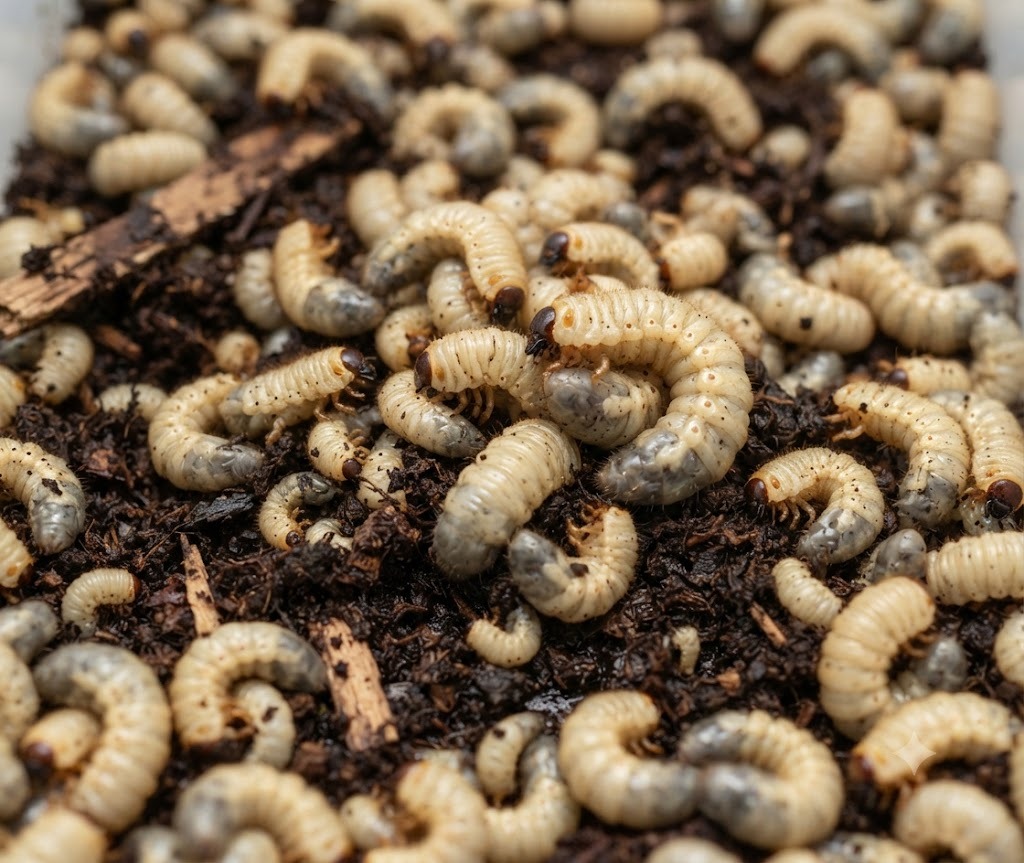
Crickets are a representative industrial insect that can be utilized as food, animal feed, and a source of alternative protein. In Korea, the two-spotted cricket has been reclassified as a general food ingredient, establishing an institutional framework that allows anyone to use it in food manufacturing; furthermore, edible insects are included within the scope of protein raw materials for health functional foods. ( Ministry of Food and Drug Safety )
MarketHub does not view crickets as merely a dried insect product for sale. It connects the process from breeding stock → egg laying/hatching → rearing → harvesting → drying/grinding → protein/lipid/functional materials → food/feed buyers , and manages raw material safety, allergies, microorganisms, rearing substrates, and processing yield together.
Judgment axis | Key points |
| Main purpose | Food, feed, protein, functional materials |
| Main Products | Dried crickets, powder, protein, lipids |
| production core | Breeder, hatching, growth, food, temperature and humidity |
| Quality Core | Protein, fat, moisture, particle size, hygiene |
| Major risks | Microorganisms, allergies, heavy metals, substrate pollution |
| market | Food · Sports Food · Feed · Pet Food · Ingredients |
| AX | Environment, Feed, Biomass, Growth, and Yield Prediction |
| RFQ | Fresh · Dried · Powder · Protein · Buyer |
| Final goal | Converting farm raw materials into standardized protein ingredients |
The FAO views crickets as a high-quality protein source for food and feed, explaining that they can possess higher feed conversion efficiency than general livestock species. However, since this figure varies significantly by species and rearing conditions, MarketHub uses it only as a global benchmark, not as a confirmed farm FCR. ( FAOHome )
Crickets are insects that undergo incomplete metamorphosis, growing from egg to nymph to adult. In the Korean industry, the two-spotted cricket (*Gryllus bimaculatus*) is a representative edible ingredient, while in the global market, the house cricket (*Acheta domesticus*) is also being widely researched and commercialized as a food ingredient.
Even though they are the same cricket, fresh, dried, powder, defatted powder, and protein concentrate are completely different products. Therefore, MarketHub places the Processing Stage and Buyer Use, rather than the species itself, as the core of the Product Master.
division | Main purpose | Product Entity |
| Jongchung | breeding | Breeding Stock |
| egg | multiplication | Egg Lot |
| Rearing individual | production | Growing Cricket |
| Dry products | Food and Feed | Dried Cricket |
| powder | Food and Feed | Cricket Powder |
| Degreased powder | High-protein ingredients | Defatted Powder |
| Protein fraction | raw material | Protein Ingredient |
| Geological fractions | subject matter | Cricket Oil |
The basic structure is Cricket → Life Stage → Processing Stage → Product → Buyer .
In the case of crickets, the intended use is more important than the variety name. For food use, food hygiene, allergies, and ingredient standards are critical; for animal feed, target livestock species, nutrition, and price competitiveness are important; and for functional materials, extraction, purification, and ingredient standardization are crucial.
Even in global studies, nutritional content varies significantly depending on the cricket species and rearing and processing conditions. A 2021 review reported that protein in edible crickets ranged from approximately 55% to 73% on a dry matter basis, but this should not be used as a single fixed value due to large variations by species, region, and method. ( AGRIS )
Production type | Key criteria | Major Buyers |
| For food use | Hygiene, Ingredients, and Allergy Labeling | food companies |
| for animal feed | Nutrition, Unit Price, Target Livestock | feed company |
| For protein | Protein content and processability | raw material companies |
| functional materials | Extraction ingredients and specifications | biotech companies |
| breeding insect | Spawning, hatching, and reproduction | Insect farm |
At MarketHub, production conditions are reverse engineered in the order of Use → Specification → Rearing → Processing .
Cricket productivity must be evaluated in conjunction with breeder egg-laying and hatching rates, nymph survival rates, growth rate, and feed efficiency. Particularly in intensive indoor rearing, temperature, humidity, ventilation, stocking density, and feed management can directly affect growth and mortality.
Based on the experience of commercial cricket farming accumulated in Thailand and other countries, the FAO provides separate guidelines for sustainable cricket farming. This demonstrates that cricket farming is not merely collection, but a production industry capable of standardizing breeding stock, egg laying, rearing environments, feed, and harvesting . ( FAOHome )
Management area | Things to see at a farm |
| Jongchung | spawning and survival |
| egg | Hatching rate |
| nymph | Survival and Growth |
| prey | Type, Input Quantity, Price |
| environment | Temperature, humidity, and ventilation |
| density | Individuals per breeding box |
| harvest | Timing · Live weight |
| expense | Feed, Electricity, Labor |
The core production formula is to view the sequence from feed input → surviving individuals → biomass → dry weight → final raw materials for sale .
Because crickets are used as ingredients for food and feed, farm-to-fork safety management is more important than livestock infectious diseases. The EFSA's risk assessment of house crickets identified high total bacterial counts, spore-forming bacteria capable of surviving even after heat treatment, potential allergies, and the accumulation of heavy metals such as cadmium as major risks to consider. ( European Food Safety Authority )
Therefore, simply stating that the animals are raised cleanly is not sufficient. The feed lot, rearing batch, harvest date, heat treatment and drying conditions, and final product lot must be linked to enable traceability in the event of a problem.
step | Key Management |
| Jongchung | Breeding Batch |
| prey | Feed Lot |
| breeding | Environment and Density |
| harvest | Harvest Lot |
| Preprocessing | Cleaning/Inactivation |
| heat treatment | Time and temperature |
| dry | Moisture and Process |
| smash | Particle Size · Product Lot |
| test | Microorganisms, heavy metals, and components |
The typical structure is Feed Lot → Rearing Batch → Harvest → Heat/Dry Process → Powder/Protein Lot → Buyer .
In Korea, the two-spotted cricket is recognized as a general food ingredient, so a legal basis for its utilization in the food industry already exists. The Ministry of Food and Drug Safety has reclassified the two-spotted cricket as a general food ingredient, along with mealworm larvae, white-spotted flower beetle larvae, and rhinoceros beetle larvae. ( Im Food )
However, being edible is different from having a stable market. In the actual industry, it is necessary to first verify the potential of the processed B2B raw material market , such as food products utilizing powder and protein, sports and nutritional products, and feed and pet food ingredients, rather than whole crickets.
Participants | Things needed | RFQ |
| Insect farm | Breeder, Feed, and Sales Channels | Producer |
| food companies | Powder/Protein | Food RFQ |
| Nutritional food company | High-protein ingredients | Ingredient |
| feed company | Protein source | Feed RFQ |
| Pet food company | Dry/Powder | Pet Feed |
| processing company | Drying, grinding, and degreasing | Processing |
| biotech companies | Extracted and functional materials | Material |
| Research Institute | Nutrition, Safety, Processing | R&D |
MarketHub prioritizes industrial raw material buyers capable of repeat purchases over the raw material consumption market .
In the international trade of crickets, live insects, dried products, powder, and protein raw materials must be regarded as distinct products. In particular, since regulations in destination countries vary depending on whether the product is intended for food or animal feed, trade conditions should not be determined solely by the name "Cricket Powder."
In the EU, house crickets have been subject to safety assessments under the Novel Food framework, and risk assessments have covered production systems as well as HACCP and Good Farming Practices. Since Korean products are not automatically accepted overseas, the latest food and feed regulations of the destination country must be reconfirmed before actual export. ( European Food Safety Authority )
Breeding → Rearing → Harvesting → Heat Treatment/Drying → Powder/Protein → Inspection/Packaging → Import/Export → Buyer
Confirmation area | Main contents |
| Bio | Species and growth stages |
| dried product | For food and feed purposes |
| powder | Moisture, particle size, and composition |
| protein | Content/Processing Method |
| safety | Microorganisms, heavy metals, allergies |
| trade | HS · Customs · Country of Origin |
| regulation | Food/Feed/Novel Food |
| Buyer | Specifications, Quantity, Delivery Time |
In an actual RFQ , Species + Product Form + Intended Use + Regulatory Status + Buyer Specification are checked.
The industrial value of crickets lies not solely in the consumption of whole insects. Drying and grinding make them easier to mix into other foods, and defatting, protein separation, and hydrolysis can expand their scope of application as B2B industrial raw materials.
A 2019 study on house cricket powder found that the analyzed products contained approximately 42–46% protein and 24–29% fat on a dry matter basis, and various minerals were also identified. Since these are analysis values for specific commercial products, MarketHub uses them only as example benchmarks for product specifications. ( AGRIS )
Product Entity | Main uses |
| Dried Cricket | Food and Feed |
| Cricket Powder | Food formulation |
| Defatted Powder | High-protein ingredients |
| Protein Concentrate | Food and Feed |
| Protein Hydrolysate | Research on functional materials |
| Cricket Oil | lipid raw materials |
| Chitin Fraction | Materials Research |
The key questions regarding PRP are: Is powder more advantageous than control products? Is it profitable to produce protein raw materials after degreasing? What are the protein, particle size, and moisture specifications desired by the buyer? And what is the actual margin, including processing yield and selling price ?
Crickets are industrial insects that are relatively easy to apply AX to because they can be raised in multi-tiered indoor systems. By recording temperature, humidity, feed input, biomass, mortality, and harvest time for each rearing box, differences in productivity can be quickly compared.
While video AI can be used to analyze density and activity or link automatic feeding and automatic harvesting, the first step of farm AX must be data that connects input quantities with the final sales quantity .
Apply AX | Expected effects |
| environmental sensor | Temperature, humidity, and ventilation stability |
| Automatic feeder | feed standardization |
| Video AI | Density and activity analysis |
| Automatic weight | Biomass estimation |
| Batch Management | Productivity Comparison |
| Harvest forecasting | Schedule Management |
| Processing yield | Cost Analysis |
| Buyer Matching | Planned production |
The basic structure is Feed Input → Cricket Biomass → Harvest → Dry Yield → Protein Yield → Buyer Price .
The biggest problem with the cricket industry is that the fact that they are high in protein alone cannot create a market. Due to consumer aversion to edible insects, a limited market for raw products, quality variations among farms, and processing costs, profits may not follow even if production volume increases.
Furthermore, allergies and hygiene safety can directly impact market expansion. As the EFSA also identifies allergies and microbial/heavy metal risks in house crickets as critical management items, establishing a safety management system must take precedence over price in the context of industrialization. ( European Food Safety Authority )
problem | Data to verify |
| Hatching and survival variation | Breeder insects and environment |
| Growth deviation | Food and density |
| production costs | Feed, Electricity, Labor |
| drying yield | Fresh → Dry |
| Protein deviation | Product Analysis |
| hygiene | Microorganisms and heat treatment |
| allergy | Display/Buyer Requirements |
| heavy metals | Feed·Product Inspection |
| Consumer acceptance | Product Type · Market |
| Buyer shortage | Monthly demand and price |
The basic solution structure is Batch Standardization → Processing Standardization → Safety Verification → Buyer Test → Contract Production .
Connecting only farms and end buyers for the cricket RFQ is insufficient. For actual industrialization, breeding farms, drying and grinding companies, protein processing companies, and food and feed companies must be interconnected.
In particular, if farmers utilize joint drying, powder, and protein processing companies rather than setting up all processing facilities themselves, even small-scale farms are more likely to meet the specifications required by industrial buyers.
RFQ Type | Collaboration Examples |
| Jongchung | production troops |
| Bio | Rearing and processing |
| dried crickets | Food and Feed |
| powder | food ingredients |
| Degreased powder | High-protein ingredients |
| protein | Food and Feed |
| process | Drying, grinding, and extraction |
| OEM·ODM | high-protein foods |
| Pet Food | Raw material supply |
| AX Pilot | Standard breeding and cost |
Ingredients, price, processing yield, and Buyer Specification are managed at the Verified/NDA stage.
Crickets are an RFQ item that requires the product form to be determined first . Since it is impossible to determine from just 1 ton of crickets whether they are fresh or dried, for food or feed use, or as powder or protein, accurate price comparison and supplier matching are difficult.
Therefore, it is advisable to first register the protein content, moisture, particle size, monthly supply volume, and safety conditions required by the buyer, and then design production and processing in reverse.
① Find products/raw materials.
Need Products & Materials
Companies seeking live or dried crickets, powder, defatted powder, protein raw materials, etc., register their purchase demands. MarketHub reviews available producers and companies by verifying the intended use, species, processing form, ingredients, quantity, and delivery time.
RFQ Submission → Product Specification Review → Connecting Producers and Companies → AI Matching
Register
② We are looking for production and processing partners.
Need Suppliers & Manufacturers
We are seeking cricket farms, drying, grinding, defatting, protein processing, OEM, and ODM companies. We evaluate not only production scale but also hygiene, raw material traceability, processing yield, and standardization capabilities.
RFQ Submission → Review of Production/Processing Capabilities → Partner Connection → AI Partner Matching
Register
③ We are looking for domestic and international buyers.
Need Buyers
Farms and processing companies seek new buyers, including food, sports food, animal feed, pet food, and raw material suppliers. We verify product type, ingredients, safety, and supply volume to connect them with suitable buyers.
RFQ Registration → Supply Capability Review → Buyer Connection → AI Buyer Matching
Register
Contact : mail@markethub.org
It is more efficient to design a cricket dataset centered on Breeding Batch, Rearing Batch, Feed Lot, and Product Lot rather than on individual specimens . Quality improvement for farms and processing companies is possible only by knowing what growth characteristics and nutritional components were exhibited by which batch fed which feed.
In particular, since there is a significant weight difference between fresh products and dried or powdered products, the processing yield must be recorded. This prevents the error of directly comparing the kg price of fresh products with the kg price of powdered products.
Dataset | Simply put |
| Master | Type, Product, and Usage Standards |
| Entity | Farm · Batch · Processor · Buyer |
| Relationship | Feed, rearing, processing, and products |
| Runtime | Biomass, Yield, Composition, Price |
The representative structure is as follows.
Breeder Batch → Egg Lot → Rearing Batch → Feed Lot → Environment → Harvest → Drying → Powder/Protein → Buyer
Economic feasibility is:
Feed Cost + Electricity + Labor + Mortality → Live Weight kg → Dry Yield → Protein Yield → Selling Price → Margin
Analyze as.
Crickets are industrial insects recognized as domestic food ingredients and backed by sufficient global research in the food and feed sectors. However, since the two-spotted cricket recognized in Korea and the house cricket found in European research and Novel Food data are different species, the Species must be separated in the MarketHub Dataset as well. ( Im Food )
Furthermore, the general feed efficiency or nutritional content of crickets according to the FAO is not used as confirmed values for individual Korean farms. In actual transactions, the relevant supplier's test reports and batch-specific product analyses are prioritized. ( FAOHome )
Evidence | source |
| A | Ministry of Food and Drug Safety, FAO, EFSA, Official Government Data |
| B | Papers · Research Institutes |
| C | Verification Industry Data |
| D | Farm, Business, and Transaction Data |
| E | Additional verification needed |
Key factual basis
- In Korea, the two-spotted cricket has been reclassified as a general food ingredient and can be used in food manufacturing. ( Im Food )
- Edible insects, such as the two-spotted cricket, have been included in the scope of protein raw materials under health functional food standards. ( Ministry of Food and Drug Safety )
- The FAO evaluates crickets as a protein source for food and feed, highlighting their high feed conversion efficiency and potential for nutritional utilization. ( FAOHome )
- Since the protein and fat content of edible crickets varies significantly depending on the species, region, rearing method, and analysis method, they should not be generalized as fixed nutritional values. ( AGRIS )
- In the safety risk assessment of house crickets, microorganisms, spore-forming bacteria, allergens, and heavy metals such as cadmium were presented as major management items. ( European Food Safety Authority )
- Cricket powder can be utilized as a source of protein, fat, and minerals, and research has been conducted on the possibility of identifying the raw material through the analysis of species-specific proteins and peptides even after heat treatment. ( AGRIS )
Version History
Version | Main contents | situation |
| v1.0 | First Registration of RFQ Structures for Food, Feed, Protein, and Functional Materials | complete |
| v1.1 | Reinforcement of official data on domestic production farms, production volume, prices, and distribution | expected |
| v2.0 | Species·Feed·Batch·Dry Yield·Protein PRP Runtime connection | expected |
| v3.0 | Production Farms · Processing Companies · Food · Feed Buyer Verified Matching | expected |