


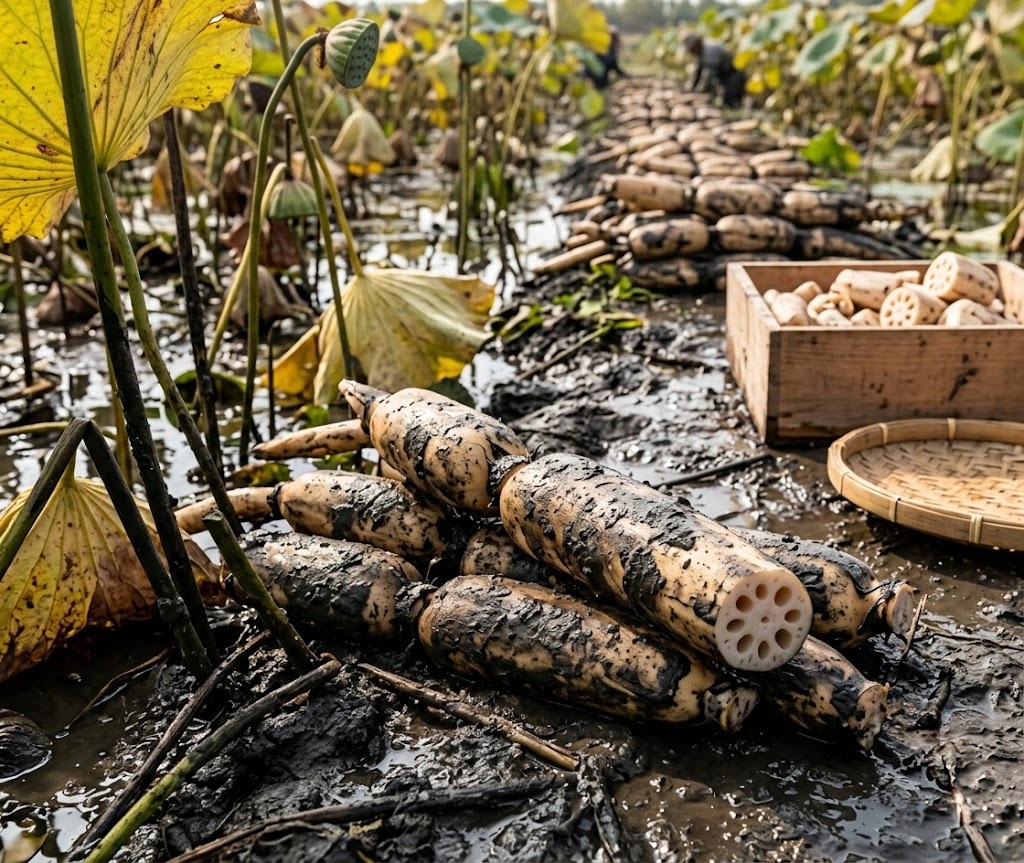
Judgment axis | Key judgment |
| Item Identity | Aquatic root vegetables whose swollen rhizomes are edible. |
| Key role | Fresh · School Meals · Dining Out · Side Dishes · Braised · Pickled · Fresh-cut · Freezing · Dried · Powdered Ingredients |
| Harvesting principle | Assess variety, rhizome enlargement, nodes, thickness, length, internal cavity, maturity, epidermis, and Buyer's intended use together. |
| Product separation | Raw materials with mud attached, washing, peeling, whole, slice, dice, fresh-cut, blanching, freezing, pickling, stewing, drying, and powder are managed separately. |
| Separation of similar items | Separating the purposes of lotus leaves, lotus seeds, ornamental lotuses, and Plant Part/Product. |
| Domestic statistics | Nationwide lotus root exclusive cultivation area and production volume: To be entered after verification of official raw data. |
| Cultivation characteristics | The Rural Development Administration explained that in barren and hard soil, lotus roots may become small, have hard tissues, and result in lower productivity. |
| Water depth and climate risks | Nongsarado suggests that lotus root enlargement may be delayed in cold regions or deep water. |
| Quality Risk | Rhizome size variation, node damage, internal discoloration, cavity defects, soil, washing damage, peeling loss, browning |
| Storage risk | Moisture loss, browning of the cut surface, spoilage, and quality deterioration during storage |
| Processing risk | Washing, peeling yield, slice uniformity, browning, blanching, pickling, freezing, and drying yield deviations |
| Operating Principles | Propagation Rhizome–Field–Harvest Lot–Wash/Peel/Cut–Processing–Buyer RFQ |
| Final goal | Convert the actual amount available to the Buyer after washing, peeling, and cutting, rather than the yield, into the procurement unit. |
Plant Identity
Basic fields | Lotus root registration standards |
| Korean name | lotus root |
| English name | Lotus root |
| Representative scientific name | Nelumbo nucifera Gaertn. |
| classification | Nelumbonaceae · Nelumbo |
| Growth type | Aquatic and underground hard perennial |
| Edible parts | enlarged rhinoceros |
| Separate edible parts | Leaves, flowers, seeds, etc. are separate Product Master |
| Reproductive part | Rhizomes for seedlings |
| Non-edible · Separate management | Diseases, decaying rhizomes, aged tissue, poor residue |
| Major harvesting stages | Young rhizomes / Commercial lotus roots / For storage and processing / For seedlings |
| Basic product form | Mud-attached Raw Material · Washing · Peeling · Whole · Slice · Dice · Fresh-cut · Blanched · Frozen · Pickled · Braised · Dried · Powder |
| Basic processing stage | Washing → Sorting → Peeling → Cutting → Browning Management → Blanching · Freezing · Pickling · Stewing · Drying · Grinding |
| Basic use | Some raw food items · side dishes · braised dishes · fried dishes · school meals · dining out · HMR · pickles · frozen · dried ingredients |
| Similarity Principle | Separate Species/Product classification for lotus leaves, lotus seeds, ornamental lotus, and American Coptis (Nelumbo lutea). |
Kew recognizes Nelumbo nucifera as an accepted species and indicates that there are two accepted species in the sequence: N. nucifera and N. lutea. Therefore, different Nelumbo species are not merged based solely on their common names. ( Plants of the World Online )
Product Master
Product ID | Product type | Key Management Standards |
| LOT-P01 | Jonggeun | Variety · Source · Node · Health |
| LOT-P02 | Underground roots for formal use | Length, eyes, wounds, diseases |
| LOT-P03 | Mountain mud-attached lotus root | Origin · Harvest Date · Lot |
| LOT-P04 | Selected whole lotus root | Length, diameter, segments, weight |
| LOT-P05 | Premium Whole | Appearance, thickness, joints, damage |
| LOT-P06 | Washed lotus root | Removal of soil and debris · Skin damage |
| LOT-P07 | Peeled lotus root | Peeling yield, color, and hardness |
| LOT-P08 | Whole peeled | Appearance, browning, refrigeration |
| LOT-P09 | Round Slice | Diameter, thickness, cavity shape |
| LOT-P10 | Thin Slice | Thickness, browning, and pickling suitability |
| LOT-P11 | Dice | Specifications, Hardness, and Heat Suitability |
| LOT-P12 | Half/Quarter Cut | Diameter and cutting yield |
| LOT-P13 | Fresh-cut | Browning, microorganisms, refrigeration |
| LOT-P14 | Pre-processing for school meals | Slice · Dice · Safety |
| LOT-P15 | Bulk for food service | Washing, peeling, and specifications |
| LOT-P16 | Blanched lotus root | Blanching conditions, color, and hardness |
| LOT-P17 | Frozen Slice | Freezing, Thawing, Color |
| LOT-P18 | Frozen Dice | Size · Thawed tissue |
| LOT-P19 | Ingredients for pickling | Slice Specifications · Hardness |
| LOT-P20 | Pickled lotus root | Acidity, salinity, sugar, tissue |
| LOT-P21 | Ingredients for braising | Diameter, thickness, and cookability |
| LOT-P22 | Braised lotus root semi-finished product | Heating, sauce absorption, and hardness |
| LOT-P23 | HMR braised finished products | Raw Material Lot · Processing Batch |
| LOT-P24 | Lotus root chip ingredients | Diameter · Slice Suitability |
| LOT-P25 | Dry Slice | Moisture, Color, Rehydration |
| LOT-P26 | Dry Flake | Moisture content and particle size |
| LOT-P27 | lotus root powder | Moisture, particle size, color |
| LOT-P28 | Extra-standard healthy lotus root | Processing upon safety compliance |
| LOT-P29 | Cutting and peeling by-products | Review of Generation and Resource Utilization |
| LOT-P30 | Lotus Leaf Lot | Plant Part Separate |
| LOT-P31 | Lotus Seed Lot | Seed Product separate |
| LOT-P32 | PB·OEM finished products | Raw Material Lot · Manufacturing Batch |
Classification criteria | Subdivision type | Management principles |
| Plant classification | Nelumbo nucifera | Species Master |
| Variety/Cultivation Type | Edible lotus root type, ornamental type, etc. | Confirmation of actual variety and purpose |
| breeding materials | Rhizomes for planting and transplanting | Propagation Product |
| Edible parts | Rhizome, leaves, seeds | Product Separation |
| Harvesting stage | Young · Product · Processed · Rootstock | Product Separation |
| Underground shape | Thickness, length, nodes, and branches | Actual measurements |
| Cultivation environment | Rice paddy type, wetland type, facility type, etc. | Production Container |
| depth of water | Actual Depth Dataset | Growth and enlargement connection |
| Soil | Sandy, clayey, soil strength, etc. | Quality and Yield Link |
| Distribution methods | Mud adhesion · Washing · Peeling · Fresh-cut | Product Separation |
| Processing form | Blanch·Frozen·Pickled·Braised·Dry·Powder | Process Lot |
| Final use | Retail · School Meals · Dining Out · Side Dishes · HMR · Pickles · Dried | Buyer-specific management |
| Transaction type | In-kind · Regular supply · Contract farming · OEM · PB | Contract |
| origin | Domestic/Imported | Traceability |
step | Essential Dataset | Management purpose |
| Cultivation plan | Variety · Buyer · Product · Harvest Season | Production plan |
| Securing rootstock | Variety · Source · Lot · Soundness | production base |
| Rootstock storage | Temperature, humidity, and conditions | Germination and decay management |
| Rootstock selection | Eyes, joints, wounds, diseases | uniform growth |
| Pavement composition | Rice paddies, aquatic fields, drainage, and irrigation | Cultivation base |
| Check soil type | Saturn, Hardness, Organic Matter | Enlargement and harvest |
| formula | Date, Placement, Depth | Production schedule |
| initial freshwater | Water depth and temperature | survival |
| Germination and leaf emergence | Number of appearances/leaves | Early growth |
| Underground kidney | Length and segments | Rhizome Runtime |
| Leaf growth | Leaf count and plant vigor | Production forecast |
| Water level management | Water depth and fluctuations | Growth and enlargement |
| Water temperature and air temperature | Air temperature and water temperature | Growth |
| Pipes and drainage | Water inflow and drainage | Packaging Management |
| dispute | Soil, Fertilizer, Timing | Growth management |
| Weeds and algae | Occurrence and Management | Competition and water quality |
| pests | Occurrence and Control | Product rate |
| Initiation of hypertrophy | Node/rhizome thickness | Harvest Forecast |
| Underground hypertrophy | Diameter, Length, Weight | Production forecast |
| Harvest judgment | Hypertrophy · Maturation · Buyer Spec | Harvest |
| Drainage and harvest preparation | Water level control | Workability |
| Excavation | Damage/Scratch | Harvest Quality |
| Preservation of mud condition | Maintaining epidermal moisture | Local distribution |
| Selection | Size, nodes, damage, disease | Grade |
| purifying | Water quality and sediment removal | commercialization |
| peeling | Yield and epidermal loss | Fresh-cut |
| cutting | Slice · Dice | Buyer Spec |
| Browning management | Color change, time, and conditions | quality |
| blanching | Time and temperature | Frozen and braised dishes |
| freezing | Slice/Dice | Year-round supply |
| pickles | Acid, Salt, Sugar, Time | Pickled |
| afforestation | Heating, Sauce, Hardness | HMR |
| dry | Moisture and color | Dried |
| smash | Powder | Ingredient |
| packaging | Fresh/Processed | Sales unit |
| shipment | Buyer · Lot · Delivery Date | Delivery |
Quality items | raw materials | Pre-treated products | processed goods | finished product | Public rating |
| Species | essential | succession | succession | tracking | Public |
| varieties | essential | succession | tracking | tracking | Public/Verified |
| mountainous district | essential | succession | succession | mark | Public |
| Packaging type | Aquatic fields, rice paddies, etc. | succession | - | - | Member |
| producer | ID | succession | tracking | - | Verified |
| Lot | Harvest Lot | Process Lot | Processing Lot | Manufacturing Lot | Verified/NDA |
| Official date | record | succession | - | - | Verified |
| Harvest day | core | succession | succession | tracking | Verified |
| Underground length | Actual measurements | Selection | Cut Input | - | Member |
| diameter | Actual measurements | core | Slice specifications | - | Member |
| weight | Object/Lot | Batch | Input | - | Verified |
| Number of nodes | If necessary | Selection | - | - | Verified |
| Joint shape | Check when cutting | Slice Key Points | Product appearance | By product | Verified |
| skin color | check | Before peeling | - | - | Member |
| Interior color | Cut confirmation | core | Processing quality | By product | Verified |
| hardness | Fresh | Fresh-cut | Pickle/Braise | By product | Verified |
| fibrous texture | Accommodation evaluation | core | Fabrication aptitude | - | Verified |
| mud and soil | Raw material characteristics | Wash removal | Compliance with standards | Compliance with standards | Member/Verified |
| wound | Inspection during excavation | Selection | Processing review | - | Verified |
| break | Nodes and cross-sections | Selection | Processing candidate | - | Verified |
| browning | Measurement after cutting | core | Product color | By product | Verified |
| disease and decay | exception | exception | Food conversion ban | - | Verified |
| alien substance | check | purifying | Compliance with standards | Compliance with standards | Verified |
| pesticide residues | test | succession | Compliance with standards | Compliance with standards | Verified/NDA |
| microorganism | If necessary | Fresh-cut key | Pickled and braised dishes | Compliance with standards | Verified/NDA |
| Washing yield | - | core | cost | - | NDA |
| Peeling yield | - | core | cost | - | NDA |
| Cutting yield | - | core | Input | - | NDA |
| blanching rate | - | - | core | cost | NDA |
| pickling yield | - | - | core | cost | NDA |
| afforestation yield | - | - | core | cost | NDA |
| Refrigeration yield | - | - | core | cost | NDA |
| drying yield | - | - | core | cost | NDA |
| Final moisture | - | - | Dry/Powder | Product Spec | Verified |
| Island | - | - | Powder | Product Spec | Verified |
| packaging | Mud adhesion/washing | Fresh-cut | process | Final | Member |
| save | Product temperature and moisture | cold storage | By product | By product | Verified |
| Expiration date | The relevant city | Fresh-cut key | processed goods | mark | Member |
| Returns and Claims | record | record | record | record | NDA |
| Repurchase | connection | connection | connection | connection | NDA |
Lot Master Required Field
Lot ID · Item/Product Type · Scientific Name · Variety · Rhizome Source · Propagation Rhizome Lot · Origin/Cultivation Area · Producer · Packaging Type · Soil Type · Water Depth/Temperature History · Planting Date · Harvest Date · Rhizome Length/Diameter/Weight · Number of Nodes · Cavity Shape · Skin Color/Internal Color · Hardness/Fiberiness · Damage/Wound/Browning · Diseases/Spoilage · Pesticide Use History · Pesticide Residue/Microbiological Test Report · Storage History · Raw Material Lot · Washing/Peeling/Slice/Dice/Browning Management · Blanching/Frozen/Pickling/Braised/Drying/Powder History · Packaging Date · Best Before Date · Shipper · Returns/Claims · Repurchase
Customers | Purchase criteria | Cooperation opportunities |
| production area distribution organization | Variety, Origin, Harvest Season, Specifications | Contract shipment |
| wholesale market | Thickness, length, nodes, appearance | Raw material trading |
| local food | Domestic · Fresh · Origin | local specialties |
| Large-scale distribution | Washing, Size, Packaging, Freshness | Retail |
| food service companies | Peeling · Slice · Dice · Safety | Preprocessing |
| food service companies | Whole peeled · Slice | Regular supply |
| side dish companies | Slice · Forest suitability · Hardness | Key RFQ |
| HMR manufacturers | Braised · Sliced · Frozen | semi-finished products |
| Meal kit | Washing · Peeling · Slice | Meal Kit |
| Pickled food companies | Thin Slice · Color · Hardness | Pickle |
| frozen vegetable company | Blanching · Slicing · Dice | Frozen |
| Drying company | Drying yield, color, rehydration | Dried |
| Powder company | Moisture, particle size, color | Powder |
| food ingredient company | Lotus root powder, puree, etc. | Product Research |
| PB·OEM | Braised, pickled, frozen | Product development |
| exporters | Fresh/Frozen/Processed | Trade |
| Research Institute | Variety · Aquatic cultivation · Storage · Browning · Processing | PRP |
step | Key variables | Operational judgment |
| Securing rootstock | Breed · Health · Source | production base |
| Pavement composition | Soil type, water depth, and drainage | Cultivation suitability |
| Planting and growth | Schedule, water temperature, rhizome | Production forecast |
| Underground hypertrophy | Nodes, Diameter, Weight | Supply Forecast |
| contract farming | Buyer Specifications · Estimated Quantity | stable procurement |
| harvest | Degree of ripeness, size, damage | Product Branch |
| mud attachment distribution | Moisture and epidermal protection | Fresh |
| purifying | mud and wounds | Retail/Processing |
| Peeling and amputation | Yield and browning | Foodservice |
| blanching | Color and hardness | Frozen/HMR |
| pickles | Color, hardness, and acidity | Pickled |
| afforestation | Slice · Heat · Sauce | HMR |
| freezing | Slice/Dice | Year-round supply |
| dry | Moisture and color | Ingredient |
| powder | Particle size and color | Food Material |
| Distribution and supply | Refrigeration, Packaging, Delivery Time | Buyer SLA |
| RFQ | Fresh/Cut/Processed | Match |
| Repurchase | Quality, Yield, Delivery Time | Repeat trading |
HS·Trade Management
Product | HS Operating Principles |
| Fresh and refrigerated lotus root | Current Korea Customs Service HSK verification |
| frozen lotus root | Check frozen vegetables three times separately |
| dried lotus root | Check dried vegetables three times |
| Pickled lotus root | Classification of prepared and preserved vegetables |
| Braised lotus root | Separate verification depending on the condition of the product |
| lotus root powder | Check drying and grinding standards |
| Jonggeun | Plants for planting and quarantine status must be checked separately. |
Products and processes | Key conditions | RFQ conversion |
| Jonggeun | Variety, nodes, and health | Farmer RFQ |
| Mud-attached raw material | Variety, Origin, Ripening | Fresh |
| Washed lotus root | Washing yield · Epidermal damage | Retail |
| Peeled lotus root | Peeling yield · Browning | Foodservice |
| Whole peeled | Size and hardness | School meals and dining out |
| Slice | Diameter, thickness, cavity | Side dishes and pickles |
| Thin Slice | Uniformity and browning | Pickle |
| Dice | Standards and Cookability | HMR |
| Fresh-cut | Browning and microorganisms | Convenience |
| Blanched | Color and hardness | Frozen |
| Frozen Slice | Thawing and cooking properties | B2B |
| Pickled | Acidity, color, and hardness | Retail/PB |
| Braised | Heating, Sauce, Texture | HMR |
| Dried Slice | Moisture, Color, Rehydration | Ingredient |
| Powder | Moisture, particle size, color | Food Material |
| Extra-standard healthy lotus root | Safety and internal quality | Slice/Dice/Dry |
| Broken lotus root | Processing when freshness grade is lost | Recovery RFQ |
| peel residue | Generation Amount · Safety | Resource utilization research |
| Diseased and rotten lotus roots | Food supply chain exclusion | waste/compost |
Product Recovery Principles
Shape/Nomole Damage Fresh Drop + Normal Internal Quality + Food Safety Suitable
→ Slice·Dice·Stew·Pickle·Dry Product Candidates
Browning occurs, but it is safe and suitable for processing.
→ Decide whether to use after verifying the Buyer Spec and processing procedures
Disease, spoilage, and safety non-compliance
→ Prohibition on conversion to food processing
PRP — Product Research Profile
PRP ID | Product Research Profile |
| PRP-LOT-01 | Variety–Rhinoplasty Form Mapping |
| PRP-LOT-02 | Rootstock quality – early growth |
| PRP-LOT-03 | Water depth – thickening of stems, leaves, and rhizomes |
| PRP-LOT-04 | Water temperature – Sprouting and enlargement |
| PRP-LOT-05 | Soil – Rhizome Size and Texture |
| PRP-LOT-06 | Soil Hardness – Yield · Excavation Damage |
| PRP-LOT-07 | Rhizome nodes – Product specifications |
| PRP-LOT-08 | Harvest time – Hardness · Fiber texture |
| PRP-LOT-09 | Excavation Method – Damage Rate |
| PRP-LOT-10 | Mud attachment – storage and moisture retention |
| PRP-LOT-11 | Washing – Epidermal Damage · Storage Resistance |
| PRP-LOT-12 | Peeling – Browning · Yield |
| PRP-LOT-13 | Slice Thickness – Browning & Cookability |
| PRP-LOT-14 | Blanching – Color and Hardness |
| PRP-LOT-15 | Pickling – Color and Texture |
| PRP-LOT-16 | Braising – Hardness · Sauce Absorption |
| PRP-LOT-17 | Frozen tissue |
| PRP-LOT-18 | Drying – Color · Yield · Rehydration |
| PRP-LOT-19 | Non-standard/Damaged Lotus Root Product Recovery |
| PRP-LOT-20 | Variety–Shape–Processing–Buyer AI Match |
first of all | Execution item | Performance indicators |
| 1 | Variety, rootstock, origin, water depth, planting date, harvest date, and Lot must be mandatory | Required input rate |
| 2 | Mud-on/Fresh/Washed/Peeled/Processed Product Separation | Product identification rate |
| 3 | Air temperature, water temperature, water depth, stems and leaves, and rhizome enlargement connection | Runtime connection rate |
| 4 | Data conversion of quality, certificates, storage, and processing history | Lot completion rate |
| 5 | Connecting Farmers – Washing/Processing – School Meals/HMR Buyer RFQs | Match rate |
| 6 | Video AI Diameter, Length, and Node Measurement | Measurement error |
| 7 | AI Detection of Damage, Damage, and Browning | Defect detection rate |
| 8 | Prediction of rhinophyme enlargement | Forecast Error |
| 9 | Yield prediction | Forecast Error |
| 10 | Harvest timing prediction | Harvest Error |
| 11 | Prediction of Excavation Damage Risk | Damage rate |
| 12 | Prediction of product yield after washing | Grade Accuracy |
| 13 | Prediction of peeling and cutting yields | Actual measurement error |
| 14 | Browning Risk Prediction | Color quality non-conformity rate |
| 15 | Blanch/Frozen Quality Prediction | Buyer approval rate |
| 16 | Pickle/Braise Aptitude Prediction | Processing approval rate |
| 17 | Dry/Powder Yield Prediction | Input–Output Error |
| 18 | Fresh→Processing Recovery AI | Recovery rate |
| 19 | AI Buyer Match | Sample approval rate |
| 20 | Traceability | Finished Product → Chong Kun Dang Lot Traceability |
| 21 | Repurchase Runtime | Buyer reorder rate |
Problem group | Problem Definition | Required data |
| Mixed varieties and uses | Differences in purpose: edible, ornamental, and seed. | Variety |
| Rootstock quality variation | Differences in early growth and diseases | Propagation |
| Depth variation | Delay in rhizome enlargement possible | Water Depth |
| Water temperature/low temperature risk | Influence on growth and enlargement periods | Water Temperature |
| Soil inconsistency | Differences in size, organization, and productivity | Soil |
| Hard soil | Shrinking rhizomes and difficulty in excavation | Soil Hardness |
| Drainage and irrigation problems | Packaging management and delayed harvesting | Water Management |
| Weeds and algae | Burden of growth and water quality management | Weed/Algae |
| pests | Decline in production volume and quality | Disease |
| rhizome hypertrophy deviation | Uneven thickness and nodes | Rhizome Growth |
| Excavation damage | Fresh Grade Loss | Harvest Method |
| epidermal damage | Quality degradation during washing and distribution | Surface Damage |
| mud removal costs | Washing yield · Processing cost | Washing |
| Common standard deviation | Slice appearance non-uniformity | Cross-section |
| browning | Fresh-cut product quality decline | Browning |
| Hardness deviation | Difference in quality between pickled and braised dishes | Firmness |
| Storage loss | Moisture loss and spoilage | Storage |
| Fresh-cut microorganisms | Safety of cut products | Microbiology |
| Peeling yield variation | Impact on meal and dining costs | Peeling Yield |
| Cut yield deviation | HMR Cost Impact | Cutting Yield |
| Variation in blanching quality | Frozen and HMR quality | Blanching |
| Variation in pickling quality | Color, hardness, and acidity | Pickling |
| Variation in afforestation quality | Hardness and sauce absorption | Braising |
| Tissue changes after freezing | Thawing marketability | Frozen |
| Drying yield variation | Powder cost | Dry Yield |
| Insufficient utilization of damaged lotus roots | Fresh rejection loss of value | Recovery |
| Mixed origins | Verification of domestic and imported products is necessary | Origin |
| Lack of official national statistics | Limitations on determining industry size | Statistics |
| Lot history interruption | Rootstock → Processed Product Traceability | Traceability |
| Repurchase not reflected | Buyer evaluation non-recovery | Repurchase |
RFQ Type | Public Registration | Verify/NDA |
| Jonggeun purchase | Variety, Origin, Node, Harvest Season | Producer · Lot · Quantity · Unit Price |
| Jonggeun sales | Variety, health, and specifications | Actual Lot/Price |
| Procurement of raw materials from the source | Variety, Region, Shipment Date | Farm, Volume, Unit Price |
| Mud Attachment Fresh | Size, thickness, and nodes | Lot · Price |
| Washed lotus root | Diameter, Appearance, and Cleanliness | Washing yield and test report |
| Peeled lotus root | Color and hardness | Peeling yield |
| Regular supply | Product Cycle | Weekly and monthly volume |
| contract farming | Variety · Buyer Product | Area, Quantity, Price |
| For school meals | Whole/Slice/Dice | Microorganisms · Delivery Time |
| For dining out | Whole peeled · Slice | Delivery cycle |
| side dish companies | Sliced for braising | Hardness and heat resistance |
| HMR | Braised/Frozen | Process conditions |
| pickles | Thin Slice · Hardness | Pickling Test |
| freezing | Blanched Slice/Dice | Thawing test |
| dry | Slice | drying yield |
| powder | Moisture, particle size, color | Test Reports · MOQ |
| Damaged/Substandard Raw Materials | Safety and internal quality | Recovery Price |
| PB·OEM | Braised, pickled, frozen | MOQ · Contract |
| local specialties | Origin, Variety, Story | Verified Origin |
| export | Fresh/Processed | HS·Quarantine |
| Technology demonstration | Water depth, AI sorting, browning | Dataset |
| Research cooperation | Variety · Aquatic cultivation · Processing | PRP |
① Need Products & Materials
Companies and institutions seeking necessary products, agricultural products, raw materials, and processed goods register purchasing demands. Registered requests are utilized to review cooperation with potential suppliers and producers based on the RFQ Intelligence Library.
Process:
RFQ Registration → Supplier/Product Review → Collaboration Connection → Future AI Matching
Register
② We are looking for production and manufacturing partners. (Need Suppliers & Manufacturers)
Register a request to find necessary production and supply partners, ranging from farms and producer organizations to processing companies, OEM, ODM, and private label manufacturers.
Process:
RFQ Registration → Review of Production & Manufacturing Capabilities → Collaboration Connection → Future AI Partner Matching
Register
③ We are looking for domestic and international buyers. (Need Buyers)
Farmers, producer organizations, and manufacturing companies are requesting cooperation with new buyers, such as domestic and international distributors, importers, brand companies, and food service and catering businesses.
Process:
RFQ Registration → Product & Supply Capability Review → Market & Buyer Connection → Future AI Buyer Matching
Register
Contact : mail@markethub.org
Version | Main contents | situation |
| v1.0 | Plant Identity · Rootstock · Aquatic Cultivation · Rhizome · Water Depth · Soil · Washing · Peeling · Fresh-cut · Pickling · Stewing · Freezing · Drying · Powder · RFQ Basic Structure | complete |
| v1.1 | Verification of official production, region, market, price, HS, and import/export raw data | expected |
| v2.0 | Subdivision of Product Quality Standards for Varieties, Rhizome Specifications, Hollows, Browning, Washing, Peeling, Stewing, Pickling, and Freezing | expected |
| v3.0 | Rootstock Supplier – Producer – Washing & Processing Company – Food Service, Side Dishes, HMR, Buyer Verified Container Combination | expected |