


Analysis Region: Gyeonggi-do and 31 Cities & Counties Core Regions of the Legislative System
: Gyeonggi Provincial Assembly, Gyeonggi Provincial Government, 31 City & County Councils, and the Metropolitan-Local Policy Linkage System
Agenda: Can local councils verify the transition to mega-scale AX sectors (semiconductors, AI, GTX, healthcare, agriculture, energy, etc.) based on data and evidence at the preliminary, process, and outcome stages?
Golden Time Type: Opportunity + Institutional Risk
Reference Date: August 28, 2026
Version: Regional AX Golden Time Intelligence v3.1
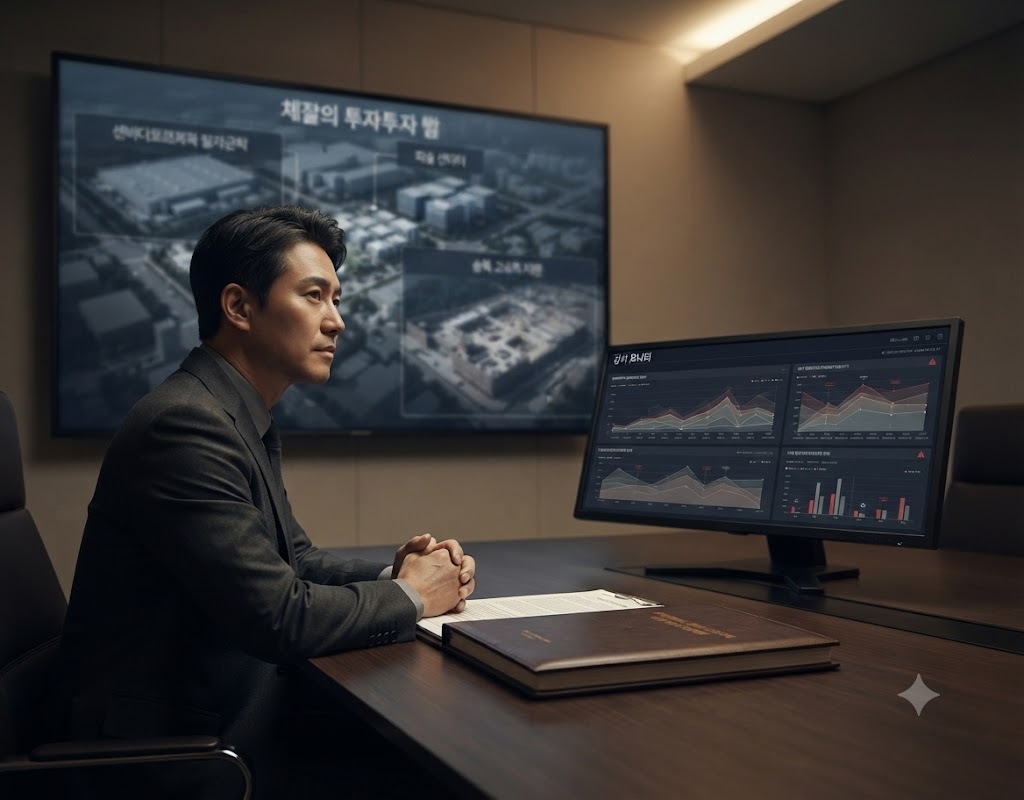
As Gyeonggi Province's transition to AX grows, the role of the Gyeonggi Provincial Council must also change.
Gyeonggi Province's original budget for 2026 was 40.0577 trillion won , and the total budget, including the first supplementary budget finalized in May, expanded to 41.6799 trillion won . This budget encompasses almost all "Golden Time" agendas analyzed in these No. 001–011 reports, including AI, semiconductors, robotics, climate technology, metropolitan railways, care services, medical services, and infrastructure in Northern Gyeonggi. ( Gyeonggi News Portal )
The policies that the Assembly must handle have also become more complex than in the past. A semiconductor cluster is not merely a single industrial policy, but a massive system involving the simultaneous operation of electricity, water, transportation, housing, education, SMEs, and the environment. Regarding the GTX, reviewing only the railway budget makes it impossible to assess its actual effects on living areas, commercial districts, housing, and regional disparities. AI administration should not merely examine whether a system has been introduced; it must verify what data is used, what decisions are automated, and what impact it has on citizens.
The institutional foundation of the Gyeonggi Provincial Council has been significantly strengthened compared to the past. Starting with the 12th Council, the number of council members was expanded from 156 to 167 , and accordingly, the authorized number of policy support officers increased from 78 to 83. The current Local Autonomy Act allows for the appointment of specialized policy support personnel up to half of the total number of council members, and policy support officers assist with legislative activities such as the collection, investigation, and research of legislative data, as well as ordinances, budgets, and administrative audits. ( Gyeonggi Provincial Office of Education )
As of January 2026, the Assembly Secretariat itself consists of 379 personnel, organized into one bureau, eight divisions, and 14 specialized committee offices , with separate divisions such as the Budget Analysis Division, the Legislation Division, the Digital Proceedings Division, and the Legislative Support Division. In practice, the Budget Analysis Division releases 14 volumes of analysis reports on the 2026 budget proposal and produces separate analysis materials regarding the first supplementary budget and the settlement of accounts. ( Gyeonggi Metropolitan City Hall )
A more significant change is that the Gyeonggi Provincial Assembly itself has also begun adopting AI. The 2025 Digital Legislative Committee has pushed for the establishment of an AI legislative platform, blockchain-based mobile legislative support, and the AI chatbot 'Sowon AI .' Sowon AI provides 24-hour Q&A functionality based on information from meeting minutes, bills, and the Assembly website. The planned AI legislative platform includes one-stop bill processing, automatic generation of data requests, real-time subtitling for meeting videos, and AI assistants for staff. ( Gyeonggi Metropolitan City Hall )
In July 2026, the "Draft Ordinance on the Utilization of Artificial Intelligence for Innovation in Supporting Legislative Activities of the Gyeonggi Provincial Council" was announced for legislative notice again. The draft ordinance includes AI ethical principles, AI introduction and utilization, education, effectiveness evaluation, and security management. This serves as evidence that local councils have begun to treat AI not merely as administrative automation, but as a matter of systems and accountability . ( Gyeonggi Metropolitan City Hall )
However, Congress using AI and being able to verify AI·AX policies are different matters.
- AI Meeting Minutes Search ≠ AX Policy Verification
- Increasing the number of policy support officers ≠ Securing expertise by sector
- Budget Analysis ≠ Outcome Verification
- Administrative audit ≠ Runtime monitoring
- Enacting an AI ordinance ≠ ensuring algorithmic accountability.
The key finding of this analysis is therefore two-sided.
The Gyeonggi Provincial Council already possesses a significant portion of the basic assets needed to transition into an AX Council, including organization, policy support officers, expert committee offices, budget analysis, digital legislative affairs, and AI ordinances.
On the other hand, a Legislative Intelligence System that connects the mega-policies identified in No. 001 to 011 to continuously verify from planning → execution → actual results → regional disparities → next policy adjustment has not yet been sufficiently verified.
The Gyeonggi Provincial Council's Golden Time does not lie in its members using AI more.
The key is whether, within the next two to three years, we can move away from a legislature that receives reports later than the executive branch and transition to an evidence-based legislature that discovers policy changes first through data and constantly verifies the gap between plans, budgets, execution, and outcomes.
The scale of administration that the Gyeonggi Provincial Council must scrutinize is on a different level compared to most other local councils.
The 2026 main budget alone exceeded 40 trillion won, and following the supplementary budget, it surpassed 41.6 trillion won. Under the Gyeonggi Provincial Organization, there are extensive departments, bureaus, and public institutions, and the scope of its policies is broad—encompassing AI, industry, economy, welfare, transportation, environment, agriculture, safety, and education—to a level nearly equivalent to that of the national government. ( Gyeonggi News Portal )
The total number of members for the 12th Gyeonggi Provincial Council is 167. Accordingly, the authorized number of policy support officers has been increased to 83. In addition to policy support officers, specialized organizations such as the expert offices of each standing committee, the Budget Analysis Division, and the Legislation Division support legislative activities. ( Gyeonggi Provincial Office of Education )
However, a large administrative scale does not simply mean that there are many documents to review.
The bigger problem is that a single project spans multiple committees simultaneously.
For example, the Yongin semiconductor cluster is a matter of future industries and urban planning, as well as issues regarding power transmission networks and water supply, and also concerns transportation, housing, the environment, and the supply chain for small and medium-sized enterprises.
The GTX is also not just an agenda for the Construction and Transportation Committee. It affects urban development around stations, the regional economy, housing, youth employment, and even the gap between the north and south.
This is even more true for AI.
As of April 2026, the Gyeonggi AI Registration System recorded 187 AI services operated by the province, 31 cities and counties, and public institutions, with 32 local governments adopting the services and 81 operating agencies. The welfare sector alone accounts for 66 of them. ( Gyeonggi Provincial Government )
Therefore, the core issue of the Gyeonggi Provincial Council is not the lack of standing committees.
The problem is that while policies cross the boundaries of standing committees, the verification system remains divided by sector .
The most traditional powers of the council are the enactment of ordinances, budget deliberation, administrative audits, and questioning of the executive branch.
This authority remains just as important in the AX era.
However, the verification method must be changed.
In the previous legislative process, performance could be verified based on project plans, execution rates, and budget usage details.
That alone is not enough in the AX policy.
- Launch of AI project ≠ AI policy outcome
- 100% budget execution rate ≠ problem solving
- Platform construction completion ≠ Resident usage performance
- Number of corporate support ≠ Corporate scale-up
- Number of trainees ≠ Improvement of future competencies
- Opening of a railway ≠ improvement of living area.
Looking solely at the Gyeonggi Provincial AI Bureau, its 2026 budget is 67.7 billion won , and it is pursuing three major goals: AI administrative innovation, resident-centered AI, and a major transformation of the AI industry. In July 2026, the Future Science Cooperation Committee of the 12th Provincial Assembly received a work report from the AI Bureau and began reviewing related projects. ( Gyeonggi Provincial Office of Education )
However, the AI policy evaluation does not end simply by confirming whether the budget of 67.7 billion won was properly executed.
If AI in public healthcare has been introduced, we must examine whether actual diagnosis time, accuracy, and patient accessibility have improved.
If AI administration has been introduced, we need to examine whether the time required to process civil complaints and the working hours of public officials have decreased.
If you supported an AI company, you need to see if it led to revenue, investment, employment, and scale-up.
In other words, in the AX era, the unit of parliamentary verification must shift from programs to outcomes.
The first change is the shift from post-audit to continuous verification .
Traditional administrative audits intensively review policies implemented over the course of a year for a specific period.
In fact, the Gyeonggi Provincial Assembly’s Future Science Cooperation Committee conducted a 14-day administrative audit targeting the AI Bureau, International Cooperation Bureau, and Future Growth Industries Bureau, as well as related public institutions for 2025. The committee stated that its goal was not merely a simple administrative inspection, but rather the development of future industries and policy improvement. ( Gyeonggi Metropolitan City Hall )
However, the AI, industrial, and energy environments are changing faster than a year.
Therefore, from now on
- Year-end appreciation
- Moreover
- Monthly and quarterly runtime monitoring is required.
The second change is the shift from document verification to data verification .
If you look only at the reports submitted by business departments, you end up viewing policies centered on the indicators selected by the executive branch.
The council must be able to independently link public data, statistics, budget, project performance, civil complaints, and regional indicators.
The third is the shift from individual projects to system verification .
Taking No. 007's electricity and water supply as an example, only the industrial complex budget should not be reviewed.
The Fab construction schedule → transmission network → water supply → roads → company entry should be viewed as a single Critical Path.
The fourth is the shift from technology-neutral legislation to algorithmic accountability .
When public AI begins to affect residents' welfare, employment, safety, and civil complaints, the council must not merely be an institution that approves AI budgets, but must verify what data was used, whether there is a possibility of discrimination, whether humans intervene in the final decision, and whether citizens can demand an explanation .
The Gyeonggi Provincial Assembly is already moving from digital legislative affairs to AI legislative affairs.
At the 2025 Digital Legislative Committee, the plan to establish an AI legislative platform, blockchain-based mobile legislative support, and the AI chatbot 'Sowon AI' were presented as key projects. The AI legislative platform includes functions for processing bills, drafting data requests, real-time subtitling of meeting videos, and an AI assistant for staff. ( Gyeonggi Metropolitan City Hall )
Sowon AI was introduced as the first-ever AI chatbot for a local council and was designed to allow users to search for meeting schedules, agenda items, and minutes using natural language queries. ( Gyeonggi Provincial Office of Education )
In 2025, an AI-based design platform was also piloted in 15 departments. The system was designed to evaluate utilization, production efficiency, and potential for budget savings after the pilot operation to determine whether to expand it to all departments. Although it is a small-scale project, it is significant that it follows a structure of introduction → usage → effectiveness evaluation → decision on expansion . ( Gyeonggi Metropolitan City Hall )
The "Draft Ordinance on the Utilization of Artificial Intelligence for Innovation in Support for Legislative Activities of the Gyeonggi Provincial Council," which was announced for legislative review in July 2026, includes not only the use of AI but also ethical principles, training, effectiveness evaluation and improvement, and security management. ( Gyeonggi Metropolitan City Hall )
Another direction is AI legislation regarding the policy itself.
In 2026, legislation was enacted to expand AI into education, urban, and industrial policies, including the Youth AI Ethics Education Ordinance, the Digital Inclusion Ordinance, and the Ordinance on Support for the Creation of Data Clusters in Development Project Zones. ( Gyeonggi Metropolitan City Hall )
In other words, the Gyeonggi Provincial Assembly is already moving in two directions: an assembly that uses AI and an assembly that regulates AI .
The next step is the council to verify AI policy outcomes .
The expertise of local councils in South Korea reached a significant turning point following the complete revision of the Local Autonomy Act in 2022.
Article 41 of the current Local Autonomy Act allows for the appointment of specialized policy support personnel within the scope of half the total number of local council members, and policy support officers support legislative activities such as data collection, investigation, and research, as well as ordinances, budgets, and administrative audits. ( Ministry of Government Legislation )
The Gyeonggi Provincial Assembly has secured 83 policy support officers for its 167 members, resulting in a structure close to the legal limit. ( Gyeonggi Provincial Office of Education )
This represents a significant institutional advancement compared to the past structure, where local council members had to vet the vast executive organization based on their individual capabilities.
However, the problems of the AX era go beyond a simple shortage of personnel.
It is difficult for a single policy support officer to deeply analyze AI, semiconductors, the power market, medical data, transportation demand, and climate finance all at once.
Therefore, future legislative expertise will not be sufficient with the Personal Staff Model alone, and the Shared Intelligence Model must be adopted as well.
In other words, separate from assigning policy support officers to individual members, specialized functions available to the entire council regarding budget intelligence, industrial intelligence, AI governance, regional disparities, and performance analysis must be strengthened.
Gyeonggi Province is the most suitable local council to demonstrate this model in terms of scale.
Connecting the numbers makes the issue of verification capability clear.
The 2026 budget managed by Gyeonggi Province is approximately 41.6799 trillion won based on the supplementary budget . ( Gyeonggi News Portal )
The Gyeonggi Provincial Assembly will operate with 167 members and 83 policy support officers. ( Gyeonggi Provincial Office of Education )
As of January 2026, the existing organizational staffing of the Assembly Secretariat was 379, and 14 specialized committee offices were in operation. ( Gyeonggi Metropolitan City Hall )
As of April 2026, there are 187 AI services in Gyeonggi Province's public sector alone . ( Gyeonggi Provincial Government )
The AI Bureau alone operates with 4 divisions, 18 teams, and a staff of 98, with a 2026 budget of 67.7 billion won. ( Gyeonggi Provincial Office of Education )
Here, dozens of complex policies, including semiconductor clusters, GTX, public hospitals, agricultural AI, northern development, and climate and energy, are moving simultaneously.
The conclusion shown by the numbers is simple.
The complexity of policies has already exceeded what can be verified solely through the efforts of individual lawmakers.
Therefore, simply increasing the number of policy support officers is not enough.
The parliament's joint analysis capabilities must be amplified through data and AI.
The first is the gap between executive branch data and legislative data .
The executive branch accesses the source data first because it carries out the project. If the council waits for the report to be submitted, a time lag in information occurs.
The second is the gap between budget review and outcome verification .
The Budget Analysis Division of the Gyeonggi Provincial Council produces extensive budget and settlement analysis reports. However, establishing a structure to continuously compare final policy outcomes across all 31 cities and counties remains a separate task. ( Gyeonggi Metropolitan City Hall )
The third is the gap between the division of labor in the standing committee and convergence policy .
Semiconductors, GTX, AI, healthcare, and climate span across multiple committees.
The fourth is the gap between the quantitative expansion of policy support officers and the depth of their expertise .
The 83 people are an important asset, but analysis in a super-specialized field requires a joint specialized organization.
The fifth is the gap between AI usage and AI verification .
While Sowon AI and the AI legislative platform can improve the efficiency of council affairs, they are not systems that automatically verify the errors, biases, and performance of the executive branch's AI.
The sixth is the gap between the ordinance and actual Algorithm Governance .
Even if an AI registration system exists and related ordinances are enacted, transparency may remain merely perfunctory unless the council distinguishes high-risk AI and verifies it separately.
The core infrastructure of the AX Council is not the meeting rooms or computer systems, but the Legislative Data Layer .
Currently, bills, minutes, budgets, settlements of accounts, administrative audits, and policy research materials are accumulated in the Assembly.
The executive branch includes public data, business performance, contracts, subsidies, AI registration information, and regional policy indicators.
Connecting these two enables a new verification structure.
For example, for a single project, you can track the sequence of commitments/plans → ordinances → budget → contracts → execution → regional benefits → performance indicators → administrative audits → next budget on a single screen.
In terms of talent , the capability to verify analyses generated by AI is more important than having policy support officers use AI .
- Are the standards of the statistics the same?
- Did you not interpret correlation as causation?
- Did you not use projected employment as if it were actual employment?
- It must be possible to verify whether the investment amount in the MOU was calculated as actual CAPEX.
Institutionally, as public AI increases, it is also necessary to review the legislature's authority and procedures for algorithm audits .
Gyeonggi Province's AI Registration System is a mechanism that strengthens transparency and accountability by disclosing usage fields, technology types, data used, and data sources. If this information is linked to the Provincial Assembly's audits and budget reviews, the AI Registration System can evolve from a mere public list into a verification tool. ( Gyeonggi Provincial Government )
The ultimate goal of legislative activities is not the efficiency of the assembly members' work, either.
It is to verify whether the policy was actually effective for the residents .
Even if an AI legislative platform quickly generates data requests, if it fails to detect policy errors using that data, it is difficult to consider it an AX.
Even if Sowon AI successfully locates meeting minutes, transparency is limited if residents cannot know what budget was invested in their region and what results were produced.
Therefore, the next stage of provincial legislative services must go beyond simple searching and be able to show “what projects were invested in our city, how much was invested, and what has actually changed?”
For example, Yongin residents should be able to see not only the investment plan for the semiconductor cluster but also how far the transmission network, water supply, and transportation processes have progressed.
Farmers in Yeoncheon must be able to verify how yield, damage, and income have changed since the AI agricultural demonstration.
Uijeongbu residents should be able to verify how much actual companies and employment have increased since the designation of the AI cluster.
At that moment, legislative data becomes not the資料 of the assembly members, but an infrastructure for policy verification by the provincial residents .
Another reason why the verification capability of the Gyeonggi Provincial Council is important is due to the disparity among the 31 cities and counties.
While the policy appears successful when looking only at the overall average for Gyeonggi Province, completely different results can emerge when broken down by region.
In No. 002, the AI accessibility gap was identified.
In No. 010, regional differences in access to medical and care services were identified.
No. 011 analyzed the risk of high-tech industries and R&D being concentrated in the South.
Therefore, the Assembly needs to look more at the distribution of the 31 cities and counties than the Gyeonggi-do average going forward.
For example, the number of 187 AI services is impressive.
However, it is meaningful to compare by region how many there are in each city and county, what the actual utilization rate is, and how much residents' administrative time or access to welfare has improved. ( Gyeonggi Provincial Government )
Metropolitan councils that do not verify regional disparities may miss the results of distribution even if they deliberate on the entire budget.
Therefore, the core of the Gyeonggi Provincial Council AX is to move from Average Governance to Distribution Governance.
The first reason is that the 12th Gyeonggi Provincial Council was newly launched in July 2026 .
Now is the time to design the new four-year legislative operation system from the ground up based on data and AI. In the 12th Assembly, along with the increase in the number of council members, the system of policy support officers will also be expanded to 83. ( Gyeonggi Provincial Office of Education )
The second reason is the rapid spread of AI within the Gyeonggi provincial administration.
As of April 2026, 187 AI services have already been registered. Moving forward, it is highly likely that more AI in the fields of welfare, healthcare, transportation, and administration will influence the actual decision-making of residents. ( Gyeonggi Provincial Government )
The third reason is that the Gyeonggi Provincial Council's own AI platform is currently being developed.
Before it becomes fixed on simple document creation and search, functions for policy gap detection and performance verification can be included in the structure.
The fourth reason is that Gyeonggi Province is entering the Critical Phase of mega-investments over the next few years.
Yongin Semiconductor, GTX, Northern Development, Public Hospital, Agriculture AX, etc. are currently in the planning and investment stages.
It is much more important to track the critical path starting now than to be grateful after completion.
Therefore, the period from 2026 to 2028 is the Golden Time for the Gyeonggi Provincial Council to transition from a council that uses AI to a council that verifies AX .
12-1. Golden Time Application Case in Basic Local Governments ① — Paju City
Paju is a good example showing why AX policy verification is necessary at the local council level.
In 2026, Paju City reorganized the existing Information and Communication Division into the AI Policy Bureau, directly under the Vice Mayor, and strengthened the overall management and coordination functions for AI affairs. The city is also preparing the Comprehensive Plan for the Intelligent Information Society for 2027–2029 and is establishing a mid-to-long-term AI development strategy to respond to the AX era, moving beyond DX. ( Paju City Council )
Accordingly, the Local Administration Committee of the Paju City Council directly reviewed the "Partial Amendment to the Paju City Intelligent Informationization Ordinance" and the "Partial Amendment to the Paju City Artificial Intelligence Framework Ordinance" in July 2026. The committee also reviewed the restructuring of the Intelligent Informationization Officer and the AI Committee following the reorganization of the AI Policy Bureau. ( Paju City Council )
The significance of this case is that, after the executive branch initiated the AI policy, the legislature came to verify the organization, officials, committees, and ordinances simultaneously, rather than just looking at the budget .
Paju's next Golden Time is to take it a step further.
The City Council must continuously track not only what projects the AI Policy Officer has promoted, but also the entire process from AI projects → usage data → budget → actual utilization → administrative efficiency → citizen outcomes.
In particular, Paju can be utilized as a demonstration area for the AX legislative initiative of a basic local government because different policy issues such as GTX-A, high-tech industries, border regions, agriculture, and population growth exist simultaneously .
12-2. Golden Time Application Cases in Basic Local Governments ② — Suwon Special Status City
Suwon demonstrates a different type of verification task.
Suwon City is pursuing 31 AI-related projects worth 4.9 billion won by 2026 and is operating an AI Basic Society Strategy centered on 'AI Citizens' Hall, AI Industry Hall, AI Administration Hall, AI Education, and Talent Development.' It is also pushing for mandatory AI training for public officials. ( Suwon City Hall )
Although the scale of the policy is still smaller than that of Gyeonggi Province’s AI Bureau, it is important to note that local governments have begun to expand AI from being an informatization project for a specific department into an operating model for the entire municipal administration .
At this point, the role of the city council should not be a dichotomy of “actively pursue AI” or “cut the budget.”
The 31 projects must be classified into citizen services, administrative efficiency, industrial development, education, and high-risk decision-making, and different indicators must be applied to each.
For example, in AI education, changes in competency are more important than the number of participants.
In AI administration, reducing work hours is more important than the number of systems.
For AI citizen services, the actual problem-solving rate is more important than the number of subscribers.
If AI is used for selecting welfare recipients or assessing safety risks, its accuracy, bias, and objection procedures must also be verified.
Therefore, the Suwon-style Golden Time is not to audit the 31 AI projects as 31 individual projects, but to verify them as a single AI Portfolio .
If this model is established, it can be expanded into a common AX audit system that can be used by the councils of 31 cities and counties in Gyeonggi Province.
The first loss is Policy Oversight Lag .
If the executive branch rapidly promotes AI and high-tech industries, but the legislature belatedly identifies problems during year-end work reports and administrative audits, the cost of policy changes increases.
The second is the opportunity cost of the budget.
If projects with minimal actual impact are repeated, the opportunity to allocate that budget to more important Golden Time tasks is lost.
The third is algorithmic accountability.
If rules for transparency, objections, and human review are established after public AI has expanded to the point where it affects residents, incorrect decision-making may already have accumulated.
The fourth is regional disparity.
If policy reviews continue to look only at the overall average of Gyeonggi Province, the actual differences in outcomes between the south and the north, and between urban and rural areas, will not be discovered.
The fifth is the time for expertise.
Congressional expertise in semiconductors, AI, bio, climate, medicine, and data is not built in a short period of time.
The sixth is the trust of the provincial residents.
If the council fails to verify the repeated discrepancies between project announcements and actual results, trust in not only the executive branch but also local politics as a whole may weaken.
The Gyeonggi Provincial Council actually has the conditions to be the first to create the AX model for local councils in South Korea.
It is large in scale.
There is a specialist committee office.
The number of policy support officers has been expanded to 83.
There is a specialized organization for budget analysis.
Meeting minutes, agenda items, and budget data have been accumulated in vast quantities.
An AI legislative platform is also being promoted.
By connecting this asset, you can create a Legislative Intelligence OS .
For example, if a council member asks, “Is the Yongin Semiconductor Cluster proceeding as planned?”, it is not just simple search results.
It is a method that shows the current status and delayed items of Investment → Site → Electricity → Water → Transportation → Company Relocation → Small and Medium Enterprises → Employment.
If asked, “What effect has GTX-A had on Paju?” the answer is users → commute time → population → commercial district → businesses → housing.
It shows change.
If asked, “Is AI care effective?”, verification is performed via the sequence: Service Usage → Risk Detection → Human Intervention → Hospitalization/Emergency → Health Outcome.
If this happens, the lawmaker's question itself changes.
Moves from “How much did you spend?” to “So what changed?”
The Gyeonggi Provincial Council needs to establish the Legislative AX Intelligence Runtime .
Changes to observe | Things to do with AX | Legislative Decision | Verification indicators |
| Large-scale business plan | Linking planning, budget, and process | Conditional budget and supplementary requests | Plan-Actual Gap |
| Budget execution | Runtime Analysis by Project | Increase, Decrease, Redesign | Execution Rate + Outcome |
| AI services | Registration Information and Data Analysis | High-risk AI intensive audit | Errors, Bias, and Objections |
| Semiconductor investment | Interconnection of businesses, electricity, and water | Critical Path Check | Actual operation schedule |
| GTX | Traffic, Commercial Area, and Population Analysis | Adjustment of connecting transportation and station areas | Door-to-Door Time |
| Medical care | Access Time and Performance Analysis | Budget priority for vulnerable areas | Regional Outcome GAP |
| Agriculture AX | Demonstration and income linkage | Scale-up assessment | Productivity and income |
| regional disparities | Comparison of 31 cities and counties | Balanced budget adjustment | Distribution GAP |
| Policy Support Officer | Establishment of a shared knowledge system | Placement in specialized fields | Analysis reuse rate |
| Administrative audit | Tracking Risk Signals throughout the year | Preemptive investigation of pending issues | Point of problem discovery |
In particular, the structure of parliamentary questioning must be changed from Project Name → Budget → Execution Rate to Problem → Policy → Budget → Implementation → Outcome → GAP → Adjustment.
This is Legislative AX .
Opportunity + Institutional Risk
It is inaccurate to evaluate the Gyeonggi Provincial Assembly as an 'unprepared assembly.'
The number of council members has been expanded to 167, and the number of policy support officers will increase to 83. An Office of Expert Committee Members and a budget analysis organization exist, and separate expert analysis reports on the 2026 budget proposal, supplementary budget, and settlement of accounts are continuously produced. ( Gyeonggi Provincial Office of Education )
Work reports and administrative audits regarding the AI Bureau are already underway. ( Gyeonggi Provincial Office of Education )
The parliament's own transition to AI is also quite rapid.
Specific changes are confirmed, including the AI Legislative Platform, Sowon AI, the AI Design Platform, and AI-utilizing ordinances. ( Gyeonggi Metropolitan City Hall )
Therefore, there is a foundation for Readiness.
The question is whether this resource was connected to the real-time verification system of the mega-AX policy.
Based solely on currently available evidence , it is difficult to conclude that a continuous Cross-Committee Policy Intelligence has been established to address the semiconductor, GTX, AI, healthcare, agriculture, and regional disparities .
So the final verdict is
Opportunity + Institutional Risk c.
Institutional Risk does not mean that the parliament is not functioning.
The risk is that the speed and complexity of policies are accelerating faster than the existing legislative verification cycle .
In future runtime analysis, at least the following evidence must be continuously tracked.
- Actual authorized staffing and current number of policy support officers
- Distribution of Specializations for Policy Support Officers
- Policy analysis support per lawmaker
- Expert Committee Office Field-specific Analysis Personnel
- Number of budget analyses and policy performance analyses
- Timing of actual construction and operation of the AI legislative platform
- AI Platform Usage Rate of Lawmakers and Policy Support Officers
- Sowon AI Usage, Accuracy, and Error Rate
- AI-generated data verification process
- AI training completion rate for lawmakers and staff
- AI ethics and security incidents
- Number of executive branch AI registration services
- Separate parliamentary review rate for high-risk AI
- Level of algorithm and data disclosure in AI businesses
- Implementation rate of issues raised in the administrative audit
- Recurring land survey project ratio
- Actual adjustment amount after budget analysis
- Large-scale Project Plan-Actual Process GAP
- Investment Agreement - Actual Investment Conversion Rate
- Expected Employment - Actual Employment GAP
- Policy Outcome Disclosure Rates by 31 Cities and Counties
- Number of joint policy verifications between standing committees
- Number of data cooperation cases between provincial councils and city/county councils
- Provincial residents' access to and utilization of policy information
- Cases where actual policies were modified through parliamentary analysis
The most significant data gap at present is that while the vast amount of meeting minutes, budgets, bills, and audit materials produced by the Gyeonggi Provincial Council are being disclosed individually, there is still insufficient integrated disclosure system that connects a single policy from planning to budget, execution, performance, audit, and redesign to present it as a runtime .
Runtime Chain
Local Issues → Policy Planning → Ordinances → Budget → Contracts & Execution → Regional Output → Outcome → Council Verification → Policy GAP → Budget & Ordinance Adjustment → Re-verification
The first key evidence of this analysis is the scale subject to verification by the Gyeonggi Provincial Council . The 2026 main budget for Gyeonggi Province was approved at 40.0577 trillion won and expanded to 41.6799 trillion won following the first supplementary budget. Future transformation projects, including those in AI, semiconductors, robotics, climate, transportation, and care services, are being implemented simultaneously within this budget. ( Gyeonggi News Portal )
The second piece of evidence is that the institutional foundation for parliamentary expertise has been strengthened compared to the past. Following the expansion of the number of members in the 12th Council, the authorized number of policy support officers increased from 78 to 83. The Local Autonomy Act permits the appointment of specialized policy support personnel up to half the total number of members, and the Enforcement Decree defines the duties of policy support officers as data collection, investigation, research, and support for various legislative activities. ( Gyeonggi Provincial Office of Education )
The third piece of evidence is the specialized analysis organization . As of January 2026, the Gyeonggi Provincial Assembly operated an Assembly Secretariat with 379 personnel and 14 specialized committee offices, and the Budget Analysis Division separately produces analysis reports on the 2026 budget proposal, supplementary budget proposals, and settlement of accounts. ( Gyeonggi Metropolitan City Hall )
The fourth point is the Council's own transition to AX. Digital legislative infrastructure, such as the AI Legislative Platform, Sowon AI, and Mobile Legislative Support, is being promoted, and in July 2026, a draft ordinance regulating ethics, education, effectiveness evaluation, and security regarding the use of AI was announced for legislative notice. ( Gyeonggi Metropolitan City Hall )
The fifth point is the fact that the executive branch's AI, which is the subject of verification, has already expanded to a significant scale. As of April 2026, 187 services, 32 adopting local governments, and 81 operating agencies were registered in Gyeonggi Province's AI registration system. ( Gyeonggi Provincial Government )
The sixth point is that actual legislative verification has begun. The Future Science Cooperation Committee is conducting work reports and administrative audits of the AI Bureau, and the new council in 2026 is also reviewing the bureau's organization—consisting of 4 divisions, 18 teams, and 98 personnel—as well as budget projects worth 67.7 billion won. ( Gyeonggi Provincial Office of Education )
Structural insights remaining from this analysis
The first thing to distinguish regarding the Gyeonggi Provincial Assembly AX is that the 'assembly using AI' and the 'assembly verifying AX' are different .
- AI can summarize meeting minutes.
- You can prepare a data request form.
- You can compare draft ordinances.
- You can also search for budget data.
- This increases the productivity of the parliament.
However, it cannot be concluded that the inherent functions of the parliament have been strengthened based on this alone.
The essential competitiveness of the legislature lies in how early, accurately, and independently it can verify policies pursued by the executive branch .
For example, let's assume we are verifying a semiconductor megacluster.
It does not constitute verification for the Assembly to cite the same figures again when the executive branch reports a “hundreds of trillions of won investment.”
What the Assembly must ask is
- What is the actual amount invested?
- Has the company started construction?
- When is the power supplied?
- How far has the water pipeline construction progressed?
- How many small and medium-sized enterprises have entered the supply chain?
- How many young people were actually hired?
- The question is where the regional economic effects appeared.
The same goes for GTX.
The fact that it has been opened is the Output.
The outcome is whether the residents' door-to-door commute time has been reduced.
The same goes for agricultural AI.
The output is that the system was applied to 220 farms.
The outcome is whether pesticides, labor hours, damage, and income have changed.
Congress's AX must be the ability to track the relationship between this Output and Outcome .
Another important factor is the information position of the parliament.
The executive branch directly implements policies.
Therefore, it has the data first.
If the council receives and analyzes reports prepared by business departments, it is structurally bound to be delayed.
Therefore, the future parliament needs an Independent Evidence Layer .
The council must be able to independently analyze public data, budgets, disclosures, statistics, administrative data, local news, civil complaints, project progress, etc.
In that case, the lawmaker's questions will also change.
If you previously asked, “Is this project going well?”, going forward, it will be, “The water supply process has been four months behind schedule since the last quarter; how is this affecting the fab operation schedule?”
You can present evidence first and then ask questions, like this.
This is Reverse Evidence Oversight .
And this structure must not end with the Gyeonggi Provincial Council.
As seen in the case of the Paju City Council, basic local governments have also begun to address AI policy officers, basic AI ordinances, and intelligent information plans. ( Paju City Council )
Going forward, all 31 city and county councils must verify their respective AI and AX projects.
However, it is inefficient for 31 local councils to each secure experts in semiconductors, AI, algorithms, data, climate, and medicine.
Therefore, it is worth considering a plan to create a structure where the Gyeonggi Provincial Council takes the lead in establishing Intelligence for the metropolitan council → Shared Evidence for 31 local councils .
For example, if the Gyeonggi Provincial Council creates a GTX impact analysis model, the councils of Paju, Goyang, Seongnam, Yongin, and Hwaseong can input their local data and use it.
If AI algorithm audit standards are established, city councils in Suwon, Paju, Uijeongbu, and other areas can verify AI projects using the same criteria.
If semiconductor supply chain indicators are created, the councils of Yongin, Hwaseong, Pyeongtaek, Icheon, and Anseong can compare with one another.
This is the Legislative Intelligence Network .
In that case, the local council, in the organization that reviews the materials submitted by the executive branch
You can move to an organization that independently detects regional changes and questions the government first .
The most important principle, which was repeatedly verified in Nos. 001 through 011, also reappears here.
- Planning ≠ Execution
- Investment Agreement ≠ Actual Investment
- Expected employment ≠ Actual employment
- Facility Construction ≠ Policy Outcome
- AI adoption ≠ AX transition.
One of the final institutions that must continuously verify these five ≠s is the local council.
Therefore, the final of the 12 topics of Gyeonggi-do AX Golden Time ultimately boils down to the validator's readiness .
No matter how rapidly an industry grows, flawed policies can grow if they are not followed by verification.
Conversely, if Congress tries to block all changes, it could miss the Golden Time itself.
What is needed is not approval and disapproval.
It is a council that speeds up what is fast and corrects what is wrong early on, based on evidence .
Golden Time Thesis — The AX Golden Time for the Gyeonggi Provincial Council does not lie in council members and staff using AI more. The key lies in whether, within the next two to three years, it is possible to continuously connect policies regarding a budget exceeding 40 trillion won—covering semiconductors, AI, GTX, healthcare, agriculture, and regional disparities—through the sequence of Planning → Budget → Execution → Outcome → Regional Gaps, thereby transitioning from a council waiting for reports from the executive branch to an Evidence-based Legislature that proactively identifies problems through data. If Gyeonggi Province is the largest AX demonstration region in South Korea, the Gyeonggi Provincial Council also needs to become the country's first Legislative Intelligence demonstration council.
Version | Reference Date/Revision Date | Major changes |
| v1.0 | 2026.08.28 | This is the first analysis of whether the Gyeonggi Provincial Assembly possesses the institutional, organizational, and data capabilities to verify Gyeonggi Province's mega-scale AX transition. The study confirmed Gyeonggi Province's finances projected to reach over 40 trillion won by 2026, the structure of the 12th Assembly consisting of 167 members and 83 policy support officers, an Assembly Secretariat with a staff of 379 including expert committee members and budget analysis functions, the AI legislative platform, Sowon AI, and AI-utilizing ordinances, as well as 187 Gyeonggi public AI services and legislative verification cases by the AI Bureau. Through application cases in the basic local governments of Paju and Suwon, the study presented the necessity of transitioning from an assembly that uses AI to one that verifies AX, establishing a Legislative AX Intelligence Runtime, and building a metropolitan-basic Legislative Intelligence Network; it assessed the "Golden Time" as Opportunity + Institutional Risk. |
