


Analysis Area: 31 cities and counties in Gyeonggi-do
Key Areas: The Southern High-tech Industrial Axis (Yongin, Seongnam, Suwon, Hwaseong, Pyeongtaek, Icheon, etc.) and the Northern Growth Axis (Goyang, Paju, Uijeongbu, Yangju, Namyangju, Yeoncheon, etc.)
Agenda: Verification of whether investment effects in semiconductors, AI, bio, R&D, talent, corporate support, and transportation infrastructure are re-concentrating in Southern Gyeonggi, or whether the North can establish a separate future industrial ecosystem
Golden Time Type: Opportunity + Structural Risk
Reference Date: August 28, 2026
Version: Regional AX Golden Time Intelligence v3.1
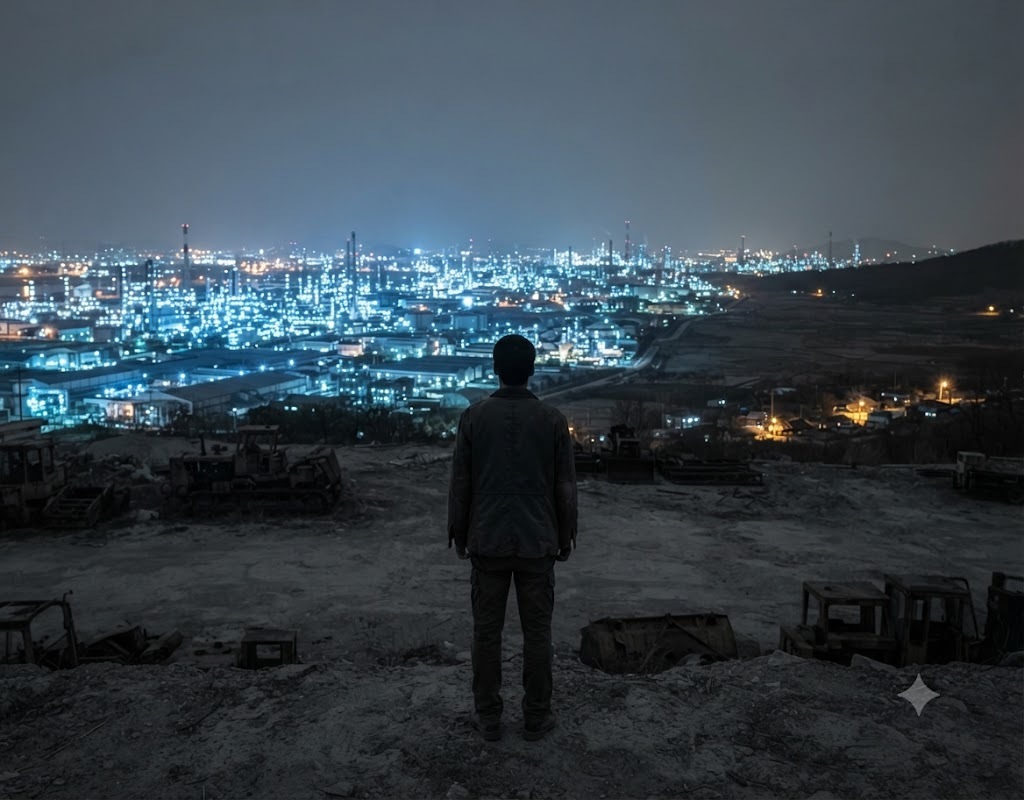
There is a paradox in Gyeonggi Province's strategy for AI and high-tech industries. While the province as a whole has high growth potential due to possessing the strongest semiconductor, AI, and bio-industry foundations in South Korea, there is also a high possibility that this very same strong industrial base will draw additional investment and talent back to southern Gyeonggi, where industry and R&D are already concentrated .
The gap in the past was already significant. According to official Gyeonggi Province data citing the Gyeonggi Research Institute, in 2019, the GRDP of Northern Gyeonggi accounted for approximately 17% of the province's total , while manufacturing businesses comprised only 13.74% of the total. Analysis at the time showed that out of 12,806 research institutes in the province, 11,426—approximately 89.2%—were located in Southern Gyeonggi . While these figures do not directly reflect the current situation and should be classified as a Historical Official Baseline , it is clear that the starting lines of innovation capabilities differed significantly even before the transition to AI and high-tech industries began. ( Gyeonggi News Portal )
Even in the latest evidence from 2026, it is difficult to conclude that structural differences have been completely resolved. The Gyeonggi Research Institute analyzed that in July 2026, the production efficiency of general industrial complexes in northern Gyeonggi Province was lower than that of southern Gyeonggi and the national average. The cause was diagnosed as a structural problem combining industrial location, infrastructure, the business support environment, and overlapping regulations, rather than merely the competitiveness of individual companies. In particular, the institute proposed that northern industrial complexes should be transformed from simple manufacturing spaces into high-density, mixed-use industrial districts that integrate R&D, ICT, testing and certification, startups, and social infrastructure . ( Gyeonggi News Portal )
In contrast, in the South, as confirmed in Nos. 001–007, semiconductor megaclusters centered around Yongin, Hwaseong, Pyeongtaek, and Icheon; R&D and AI in Suwon and Seongnam; bio and high-tech manufacturing in Siheung and Gwanggyo; and large-scale power, water, and transportation infrastructure are being reconnected. Since high-tech industries inherently prefer regions with existing companies, research institutes, universities, and talent, self-reinforcing agglomeration—where one cluster leads to another— is prone to occur.
Gyeonggi Province is also aware of this. By 2026, it plans to connect six AI innovation clusters— including Pangyo, Siheung, Bucheon, Hanam, Uijeongbu, and the Seongnam General Industrial Complex —into a single cooperative network and is promoting technology development, recruitment, open innovation, and investment linkages for 127 resident and membership companies. A key point is that Uijeongbu has been included as a northern AI hub. Gyeonggi Province has begun shifting from a single Pangyo-centric AI model to a multi-hub model. ( Gyeonggi News Portal )
Furthermore, the "Northern Gyeonggi Grand Development 2040," announced in March 2026, includes foundations for new industries such as the Goyang Ilsan-Yangju Techno Valley, Namyangju Wangsuk Urban High-tech Industrial Complex, the Defense Venture Center, the Defense Industry Innovation Cluster, climate technology, and AI, drones, robots, and semiconductors. However, the production ripple effect of approximately 160 trillion won and the value-added ripple effect of 68 trillion won presented by Gyeonggi Province are merely projected results based on long-term plans and must be distinguished from actual investment, corporate relocation, and employment. ( Gyeonggi News Portal )
Therefore, the core question of this topic is not “whether to build more industrial complexes in the north.”
It is more important whether to replicate the successful industrial structure of the South in the North, or to create a new industrial portfolio by combining the North's unique characteristics—such as space, regulations, security, culture, environment, and agriculture—with AI .
Gyeonggi Province's Golden Time is not a time to suppress the growth of high-tech industries in the south. It lies in whether a new Regional Innovation Network can be established within the next two to three years that expands the growth assets of the south while spreading the synergistic effects of R&D, talent, corporate support, demonstration, and investment to the north and east .
Gyeonggi Province's industrial space has long been centered in the south.
Large corporate production bases, semiconductor and electronics companies, research institutes, universities, and industrial complexes are continuously distributed across Suwon, Seongnam, Hwaseong, Yongin, Pyeongtaek, and Icheon. Pangyo has grown into a cluster of ICT, gaming, AI, and platform companies, while Yongin, Hwaseong, Pyeongtaek, and Icheon are connecting to form a global semiconductor production hub.
The strength of this structure lies in the fact that when a company joins, it is not just the company that enters.
Partner companies follow.
Talent moves in.
Research and development facilities are established.
Venture investment and specialized services increase.
Educational institutions change to meet industrial demands.
This is the Agglomeration Economy.
Conversely, Northern Gyeonggi Province started with a low proportion of industrial production and innovation institutions relative to its population size. As of 2019, the North's share of GRDP was 17.3%, significantly lower than its population share of approximately 26% at the time. The average monthly salary of workers in the North in 2021 was also analyzed to be approximately 2.63 million won, which is 89.4% of the average of approximately 2.942 million won in Southern Gyeonggi. Since this is historical data, it should be viewed as the Historical Official Baseline . ( Yonhap News )
Therefore, regional disparities in the era of AI and high-tech industries do not start from a blank slate.
It starts again on top of the differences between existing companies → research institutes → universities → talent → investment → infrastructure .
If this structure is left unchecked, investment in high-tech industries itself is likely to amplify existing disparities rather than reduce regional gaps.
The most important thing to be careful about in balanced regional development policies is equating the area of industrial complexes or investment plans with regional growth.
The following must be distinguished.
- Development of industrial complexes ≠ Corporate clustering
- MOU for attracting companies ≠ actual investment
- Investment Plan ≠ Actual CAPEX
- Expected employment ≠ Actual employment
- Establishment of research facilities ≠ R&D achievements
- Designation of an AI hub ≠ formation of an AI ecosystem.
An analysis by the Gyeonggi Research Institute for 2026 also revealed that the low production efficiency of general industrial complexes in northern Gyeonggi is not simply due to a shortage of complexes, but is the result of the complex interplay of industrial structure, infrastructure, business support environment, and overlapping regulations. ( Gyeonggi News Portal )
Therefore, simply creating more industrial complexes in the north does not automatically create an innovation ecosystem like the one in the south.
The competitiveness of the South is not the result of factories alone.
There are semiconductor fabs, materials, parts, and equipment companies in the surrounding area, research institutes and universities, and even residential, transportation, education, and cultural infrastructure that allows skilled personnel to move.
The core of industrial policy in northern Gyeonggi Province must also shift from the stage of supplying industrial land to the stage of designing an ecosystem .
The first change is that corporate location criteria are shifting from land to ecosystems .
High-tech companies do not move based solely on cheap land.
- Are there high-level talents?
- Is there a research institute?
- Do you have partner companies?
- Can it be proven?
- Can you meet with investment institutions?
- We also look at whether the living environment is good.
The second change is that AI expands the scope of the industry .
The AI industry does not refer only to software companies in Pangyo.
- Defense + AI
- Agriculture + AI
- Logistics + AI
- Content + AI
- Tourism + AI
- Manufacturing + AI
- Drone + AI
- Existing regional industries can be redefined, such as through the Climate Industry + AI.
This actually presents an opportunity for northern Gyeonggi.
The third change is that the R&D center and the demonstration area can be different .
AI, robots, autonomous driving, drones, and smart agriculture require large spaces and actual industrial sites.
The Gyeonggi Research Institute's proposal to utilize the Northern Industrial Complex as a special demonstration zone for drones, UAM, autonomous driving, smart logistics, RE100, and distributed energy by 2026 is also in the same context. ( Gyeonggi News Portal )
The fourth is changes in transportation.
If the GTX analyzed in No. 008 is actually connected to the future KTX, SRT, and wide-area roads, accessibility to talent in the northern region could also change.
In other words, the strategy for the North in the AI era should not be to create another semiconductor hub by competing with the South, but rather to transform the demonstration spaces and industrial characteristics that the South finds difficult to possess into new competitiveness .
One of the most important changes Gyeonggi Province is pursuing in 2026 is the multi-nuclearization of AI hubs .
The council of six AI innovation clusters, including Pangyo, Siheung, Bucheon, Hanam, Uijeongbu, and Seongnam General Industrial Complex, officially launched in April 2026. It provides support to 127 resident and membership companies in areas such as technology development, recruitment linkages, open innovation, and global investment linkages. ( Gyeonggi-do News Portal )
A method is being pursued to connect resources from anchor institutions in Pangyo, such as Cisco and KAIST, with startups in other hubs.
This structure is important.
This is because there is a possibility that the approach will shift from gathering all companies in Pangyo to sharing Pangyo's technology, capital, and talent with other regions .
The second axis is Northern Gyeonggi Development 2040 .
The plan announced in March 2026 included the Goyang Ilsan Techno Valley, Yangju Techno Valley, Namyangju Wangsuk Urban High-tech Industrial Complex, the Defense Venture Center and Defense Industry Innovation Cluster, and the Climate Tech Cluster. ( Gyeonggi-do News Portal )
The third is regulations and the structural improvement of existing industrial complexes.
In 2026, the Gyeonggi Research Institute proposed revising the system to transform northern general industrial complexes into high-density, mixed-use facilities and to accommodate R&D centers, knowledge service providers, ICT companies, testing and certification centers, and startup spaces. It also suggested selectively relaxing total factory capacity regulations and standardizing consultation procedures for investments in new industries, eco-friendly initiatives, and job-creating sectors. ( Gyeonggi News Portal )
In other words, recent policies are gradually shifting from simply 'building industrial complexes in the north' to 'changing the industrial ecosystem of the north.'
The spatial concentration of high-tech industries is not a phenomenon unique to Gyeonggi-do.
Globally, the semiconductor, AI, and bio industries show a strong tendency for additional investment to be made in regions where research personnel, companies, universities, capital, and infrastructure already exist.
Recognizing this issue, the Korean government presented directions in its 2026 industrial R&D policy to alleviate concentration in the capital region, allocate approximately 2 trillion won to regional growth engine R&D , and establish 30 joint industry-research laboratories centered on regional innovation institutions by 2030. At the same time, it is pursuing the establishment of 500 AI factories and 15 leading manufacturing AI models. ( Motir )
From Gyeonggi Province's perspective, this policy has two sides.
Since the entire Gyeonggi-do is part of the capital region, it may receive a lower priority for support in national-level regional balance policies.
However, within Gyeonggi Province, there is a significant difference in the industrial base between the south and the north.
In other words, Northern Gyeonggi Province occupies a dual position: while it is part of the capital region nationally, it has vulnerabilities similar to those of some non-capital regions in terms of industrial structure .
Therefore, development policies for the northern region require a separate strategy to navigate between the national frame that "it is the capital area, so it is already sufficient" and the provincial internal frame that "it must grow like southern Gyeonggi."
Although it is based on past standards, the structure is clear if you check the starting line.
In 2019, the GRDP of northern Gyeonggi Province accounted for **17.3%** of the total Gyeonggi Province. At that time, its population share was approximately 26%. ( Yonhap News )
During the same period, approximately 89.2% of research institutes in Gyeonggi-do were located in the south , while the figure was about 11% in the north. ( Gyeonggi-do News Portal )
Furthermore, the latest 2026 study by the Gyeonggi Research Institute also confirmed that the production efficiency of general industrial complexes in the northern region is lower than that of the southern region and the national average. ( Gyeonggi News Portal )
On the other hand, Uijeongbu is the representative hub of the North among the six AI Innovation Cluster bases by 2026. Compared to existing industrial and urban areas such as Pangyo, Seongnam, Siheung, Bucheon, and Hanam, the density of AI hubs in the North is not yet high. ( Gyeonggi-do News Portal )
Therefore, if you connect the numbers, it is not a simple 'past gap'.
It shows the possibility that the structure in which new investments in the AI era are built upon innovation assets in already strong regions will continue .
However, on the other hand, new industrial assets in the north are also being formed at the same time, such as the Uijeongbu AI hub, Goyang-Yangju Techno Valley, Wangsuk Urban High-tech Industrial Complex, and defense, drone, and climate tech.
Therefore, it is reasonable to view the current situation as a turning point rather than a state where the gap has already been determined.
The first is the R&D gap .
One of the most important resources in the high-tech industry is corporate research institutes, universities, and testing and certification bodies, but existing R&D assets are heavily concentrated in the South.
The second is Anchor Company GAP .
While world-class semiconductor companies exist in Yongin, Hwaseong, Pyeongtaek, and Icheon, the northern region has relatively few anchor companies capable of attracting an industrial ecosystem of the same scale.
The third is the Talent Gap .
High-tech companies prefer regions where top talent is likely to relocate. If industry, universities, housing, culture, and transportation are not interconnected, it is difficult to retain talent solely through attracting companies.
The fourth is the Infrastructure GAP .
Infrastructure such as transportation, electricity, water, industrial support agencies, and testbeds requires long-term investment.
The fifth is the Regulation Gap .
The Gyeonggi Research Institute analyzed that the northern region is facing constraints on new industry locations and demonstration projects due to overlapping regulations, such as growth management zones, military protection zones, and development restriction zones. ( Gyeonggi News Portal )
The sixth is the gap between the Investment Announcement and the actual ecosystem .
Even if techno valleys, industrial complexes, and AI clusters in the north are announced, it is necessary to separately track whether corporate occupancy, R&D, employment, and investment results actually materialize.
To reduce the regional industrial gap, Regional Innovation Capacity must be measured.
A simple comparison of GRDP alone is insufficient.
At a minimum, we must connect companies → research institutes → R&D personnel → universities → investment → patents → demonstration → scale-up → high-wage jobs.
In particular, Gyeonggi- do needs an Innovation Asset Map for its 31 cities and counties.
- Where are the AI companies located?
- Where is the research institute located?
- Where is the test equipment located?
- Where are the university researchers?
- We must spatially connect where investment institutions are located.
In the 2026 Gyeonggi Province Quantum-Semiconductor Fab Utilization Support program, up to 30 million won is being provided to 15 companies and universities within the province to enable them to use the fabs of the Korea Institute of Nanotechnology and Sungkyunkwan University. This serves as an example demonstrating that it is possible to share advanced R&D infrastructure rather than individual companies owning it entirely . ( Sungkyunkwan University )
If this concept is applied to the North, there is no need to rebuild all advanced research facilities.
It is also possible to create a Shared R&D Infrastructure where northern companies use research equipment, universities, and experts from the south .
The final criterion for determining balanced regional development is not the area of industrial complexes.
- Is the income of northern residents rising?
- Do young people find good jobs in the region?
- Is the sales of local companies increasing?
- We need to see if small and medium-sized enterprises are entering the new supply chain.
The 2026 Gyeonggi AI Innovation Cluster began providing technology development, recruitment, open innovation, and global investment linkages to 127 resident and membership companies. Separate support for AI technology development, up to 30 million won per company, was also implemented. ( Gyeonggi News Portal )
The important thing is to track this support by region.
It must be possible to determine whether the support results are from Pangyo companies or Uijeongbu companies, and whether northern companies collaborated with southern anchor companies.
In addition, the Gyeonggi Research Institute proposed that to enhance the competitiveness of northern industrial complexes, essential social infrastructure such as worker dormitories, childcare, culture, and medical facilities should be integrated within the complexes . ( Gyeonggi News Portal )
This is connected to the No. 006 youth employment analysis.
If a region attracts only companies but does not want young people to live there, it is difficult to complete an advanced industrial ecosystem.
One of the biggest structural problems in Gyeonggi Province is that it is structured so that successful regions are more likely to succeed .
Taking Yongin as an example, when a semiconductor company moves in, materials, parts, and equipment companies follow, power, water, and road infrastructure expand, and specialized workforce training is concentrated.
This is industrially efficient.
The problem is that in the process, public investment and corporate support may also move further to the same region.
Conversely, the North has a weak industrial base, making it difficult to attract companies. Since there are few companies, there is a shortage of R&D and skilled personnel, which in turn can lead to a "low-density trap" where high-tech companies do not enter .
However, it is not accurate to define the entire northern region as a single vulnerable area.
Goyang has the potential to be connected to content, MICE, bio, and AI; Paju to display, content, and logistics; Uijeongbu to AI and services; Yangju to manufacturing, defense, and Techno Valley; Namyangju to Wangsuk Urban High-tech Industry; and Yeoncheon and Pocheon to agriculture, bio, drones, and defense.
Therefore, the key to the development of the North is not to replicate the South, but to connect the industrial characteristics of each region .
The first reason is that investment in high-tech industries in the South is highly likely to grow further in the future.
As confirmed in No. 001 and No. 003, investment in the semiconductor megaclusters of Yongin, Hwaseong, Pyeongtaek, and Icheon is planned to continue for a long period.
Once this investment gets underway in earnest, it is highly likely that additional companies, talent, and R&D will also move to the South.
The second reason is that the industrial infrastructure in the north is currently being built .
This is a time when the Goyang Ilsan Techno Valley, Yangju Techno Valley, Namyangju Wangsuk Urban High-tech Industrial Complex, and plans for AI, defense, and climate technology are being pursued simultaneously. ( Gyeonggi-do News Portal )
The third reason is that wide-area transportation networks such as GTX, KTX, and SRT have the potential to change industrial location conditions in the north.
As analyzed in No. 008, if travel time is reduced, the range of opportunities for talent to work at northern companies also changes.
The fourth reason is that Gyeonggi Province's AI cluster is still in the early network stage.
Before Pangyo becomes entrenched in a structure that absorbs all resources, it can connect the flow of technology, talent, and investment with other hubs such as Uijeongbu.
Therefore, the period from 2026 to 2028 is a Golden Time to design the principles of dispersion and connection before the spatial structure of Gyeonggi-do's high-tech industries becomes entrenched again .
12-1. Golden Time Application Case in Basic Local Governments ① — Yongin Special Status City
Yongin is the most representative region that simultaneously demonstrates the strengths of Gyeonggi-do's high-tech industries and the risks of spatial concentration.
In Yongin, large-scale semiconductor investments are underway centered around national and general industrial complexes, and as confirmed in No. 007, an industrial scale is being formed that requires securing more than 10 GW of power alone in the long term.
Industrial agglomeration itself is not the problem.
Rather, the Yongin semiconductor ecosystem must succeed for the industrial competitiveness of Gyeonggi Province and the entire Republic of Korea.
The problem is the possibility that as Yongin becomes more successful, public R&D, skilled personnel, startups, materials, parts, and equipment companies, and even industrial support institutions will all be concentrated in Yongin and the surrounding southern region .
Therefore, Yongin's Golden Time is not to disperse industrial growth, but to create a structure that spreads the externalities of growth throughout Gyeonggi-do .
For example, problems required by large corporations in Yongin can be disclosed as tasks in the areas of AI process improvement, robotics, logistics, materials, equipment, energy, and environment, enabling SMEs, universities, and startups in Gyeonggi Province, including the northern region, to participate in joint development.
Then, Yongin becomes not just a simple industrial cluster, but a Demand Anchor for all companies in Gyeonggi-do .
In other words, rather than viewing Yongin's success as a regional disparity issue, we must manage how far that success extends to the supply chain and R&D.
12-2. Golden Time Application Cases in Basic Local Governments ② — Goyang Special Status City
Goyang is a representative region where the north can build a new portfolio of high-tech industries without replicating the south.
Goyang Ilsan Techno Valley is included as one of the key industrial hubs in the 2026 Northern Gyeonggi Development Strategy. Under the original plan, Ilsan Techno Valley was developed on a scale of approximately 872,000 square meters to attract bio-medical, media-content, and high-tech manufacturing companies. While the projected estimates during the planning stage included 18,000 jobs and 1.6 trillion won in new investment, these should be classified as expected effects based on the business plan rather than actual results. ( Gyeonggi News Portal )
Goyang's strength does not lie in having land to build semiconductor factories.
It lies in the fact that there is urban infrastructure that can be combined with content, services, and AI , such as KINTEX, the broadcasting and content industry, medical and bio assets, accessibility to Seoul, and the future GTX-A.
Therefore, the cat-type AX is
- Content + Generative AI
- MICE + AI
- Bio/Medical + AI
- Industrializing urban services + AI might be a more suitable direction.
In particular, if Ilsan Techno Valley, KINTEX, and the Broadcasting and Video Valley are connected into a single ecosystem of business, demonstration, exhibition, and investment, there is a possibility of creating a Northern Digital-Service Cluster distinct from the manufacturing-type high-tech industries of the South .
Goyang's Golden Time is not the completion of the Techno Valley.
Now is the time to actually decide which companies to house and which inter-industry connections to create .
The first loss is the self-reinforcing of the high-tech industry gap .
If more companies move into the South, research institutions and talent will relocate, creating a virtuous cycle that attracts new companies.
In the north, the opposite cycle may occur.
The second is the youth.
If young people from the north move to the south or Seoul in search of better jobs, local companies will find it difficult to secure talent, and local consumption and tax revenue may weaken.
The third is the fiscal efficiency of industrial policy.
If industrial complexes are merely established without attracting companies, R&D firms, and talent, large-scale public investment will not lead to actual productivity and employment.
The fourth is the opportunity for independent industries in the North.
While belatedly imitating the southern semiconductor model, the north may miss out on industrial opportunities it could seize, such as defense, drones, content, climate technology, and smart agriculture.
The fifth is social costs.
When disparities in industry, income, education, healthcare, and transportation overlap, they become entrenched as regional disparities that are difficult to resolve through simple industrial support alone.
Gyeonggi Province, on the contrary, has the conditions to utilize the differences between the south and the north as a single industrial network .
The South has world-class manufacturing and R&D assets.
The northern region has relatively extensive demonstration spaces, defense and border areas, content and tourism resources, and environmental and agricultural resources.
Connecting the two enables a new division of roles.
for example
- Southern AI Companies → Northern Drone & Defense Demonstration
- Southern Robotics Company → Northern Logistics and Agriculture Demonstration
- Southern Semiconductor Company → Northern Small and Medium-sized Manufacturing Company AX
- It is a structure like Pangyo startups → Goyang content and MICE market .
This is different from policies that forcibly disperse industries.
It is a method of spatially connecting some functions of technology, R&D, demonstration, and commercialization while maintaining the productivity of existing industrial agglomerations .
In this way, the South and the North will not have a zero-sum relationship, but will become a single Distributed Innovation System .
Gyeonggi Province needs 31 Innovation Diffusion Runtimes in its cities and counties .
Changes to observe | Things to do with AX | Policy decision | Verification indicators |
| Corporate investment | Tracking actual CAPEX by region | Designing Linkage Conditions for Vulnerable Areas | Actual investment by region |
| high-tech companies | Analysis of corporate density by city and county | Cluster support coordination | New Companies · Scale-up |
| R&D | Mapping of corporate research institutes and projects | Expansion of Shared R&D | Northern R&D share |
| Talent | Analysis of Highly Skilled Workforce Mobility | Education, housing, and transportation support | Net inflow of talent |
| AI cluster | Analysis of inter-base collaboration | Expansion of joint projects | Cross-region project |
| Large enterprise supply chain | Vendor Region Analysis | Northern Business Matching | Entry into new supply chains |
| industrial complex | Analysis of production and employment efficiency | High-density and composite materials | Production Value / Area · Employment |
| startups | Investment and Demonstration Location Analysis | Northern PoC expansion | Investment and commercialization |
| regulation | Analysis of the causes of business delays | Selective regulatory improvement | Permit period |
| spatial gap | Comparison of 31 cities and counties | Prioritization of budget and infrastructure | Innovation GAP |
In particular, it is necessary to track the Innovation Flow rather than simply the scale of subsidies by region .
When a connection such as demand from large corporations in the south → technology development by small and medium-sized enterprises in the north → joint demonstration → delivery → sales occurs, the economic effects of the high-tech industry have spread beyond administrative boundaries.
AX should not be used as a tool to score balanced development, but rather as intelligence to discover where the flow of growth is stopping .
Opportunity + Structural Risk
The concentration of Gyeonggi Province's high-tech industries in the south is not simply the result of policy failure.
Industries highly dependent on companies, talent, and R&D, such as semiconductors, AI, and biotechnology, inherently have strong agglomeration effects.
Therefore, curbing agglomeration in the south may not be beneficial to the overall competitiveness of Gyeonggi Province.
The question is whether the success of the South is connected to the North .
Positive changes are also currently being observed.
Uijeongbu has been included as one of the six hubs of the Gyeonggi AI Innovation Cluster, and Gyeonggi Province has established a cooperation system to connect resources from anchor institutions, such as Pangyo, with other clusters. ( Gyeonggi News Portal )
New industrial hubs are also being promoted in Goyang, Yangju, Namyangju, and other areas. ( Gyeonggi-do News Portal )
On the other hand, even in the latest 2026 analysis by the Gyeonggi Research Institute, the production efficiency of northern industrial complexes is lower than that of the south, and complex problems involving regulations, industrial structure, infrastructure, and corporate support persist. ( Gyeonggi News Portal )
Therefore, the current stage is determined as Opportunity + Structural Risk .
The opportunity lies in the potential to connect the South's world-class industrial assets with the North, while the structural risk is the possibility that investments in AI and high-tech industries could reinforce existing clusters, further widening the innovation gap within Gyeonggi Province.
In future runtime analysis, at least the following evidence must be continuously tracked.
- GRDP by 31 cities and counties
- Changes in the share of Southern and Northern GRDP
- Regional disparities in GRDP per capita
- Manufacturing production value by city and county
- Industrial complex production value and employment efficiency
- Number of companies by city/county
- Number of high-tech companies
- Distribution of AI companies and startups
- Distribution of corporate research institutes
- Regional share of R&D investment
- National and Gyeonggi-do R&D project beneficiary regions
- distribution of R&D personnel
- Net migration of highly skilled youth workforce
- Average wages by city and county
- New hiring in semiconductor, AI, and bio sectors
- Venture investment inflows by region
- Number of new corporations and scale-up companies
- Achievements of AI Innovation Cluster Resident and Membership Companies
- Number of joint R&D projects between clusters
- Southern conglomerate-Northern company supply contract
- Actual number of tenant companies in Northern Techno Valley
- Actual investment amount in Goyang, Yangju, and Wangsuk Advanced Industrial Complexes
- Northern Industrial Complex Vacancy and Operating Rates
- Delay in investment and licensing due to regulations
- Employment and income growth rates in northern high-tech industries
The most significant data gap currently is that while the total investment in high-tech industries in Gyeonggi Province is announced, it is difficult to track, using a single set of data, how that investment has spread across R&D, employment, corporate sales, and supply chains in each of the 31 cities and counties .
Runtime Chain
Investment in high-tech industries → Corporate agglomeration → R&D & talent → Supply chain → Local enterprise participation → Employment & wages → Consumption & tax revenue → Additional investment → Strengthening of concentration in the South or expansion to the North and East
The first key evidence of this analysis is the innovation gap that existed even before the AI era . In 2019, Northern Gyeonggi Province's GRDP accounted for 17.3% of the province's total, while its population share was below approximately 26%. Analysis showed that about 89% of the province's research institutes were located in the south at that time. Since this does not represent current figures, it is limited to the Historical Official Baseline . ( Yonhap News )
The second piece of evidence is that it is difficult to view the gap as merely a legacy of the past. The Gyeonggi Research Institute analyzed that even in July 2026, the production efficiency of general industrial complexes in northern Gyeonggi would be lower than that of southern Gyeonggi and the national average. It attributed the cause not to simple corporate competitiveness, but to a structural problem resulting from a combination of industrial location, regulations, infrastructure, and the business support environment. ( Gyeonggi News Portal )
The third point is a change in policy. By 2026, Gyeonggi Province has integrated six AI innovation clusters in the Pangyo, Siheung, Bucheon, Hanam, Uijeongbu, and Seongnam General Industrial Complexes into a single cooperative system and began promoting technology development, recruitment, open innovation, and investment linkages for 127 resident and membership companies. ( Gyeonggi News Portal )
The fourth point is the new industrial base in the north. The Northern Gyeonggi Development Plan 2040 presented the Goyang-Yangju Techno Valley, the Namyangju Wangsuk Urban High-tech Industrial Complex, and sectors such as defense, AI, drones, robots, semiconductors, and climate technology as core industrial axes. However, the projected production ripple effect of 160 trillion won and value-added effect of 68 trillion won are long-term forecasts and cannot be used as actual results. ( Gyeonggi News Portal )
The fifth point concerns the development strategy for the northern region. A recent analysis by the Gyeonggi Research Institute proposed transforming northern industrial complexes from low-density, monolithic manufacturing spaces into high-density, mixed-use innovation districts that combine R&D, ICT, testing and certification, startups, housing, and culture, while also assigning them functions as special demonstration zones for technologies such as drones, UAM, smart logistics, and distributed energy. ( Gyeonggi News Portal )
Structural insights remaining from this analysis
The most dangerous approach to resolving the industrial gap in Gyeonggi Province is the simplistic distribution logic that “the South has too much, so let’s divide it up to the North.”
Industrial concentration in the south is not a weakness of Gyeonggi Province.
It is one of the most powerful assets South Korea can use in the global semiconductor and AI competition.
Therefore, slowing down the growth of the South cannot be a solution.
The problem is the ripple effect of that growth .
If demand remains limited to southern companies when semiconductor factories are established in Yongin and investment expands in Hwaseong, Pyeongtaek, and Icheon, the regional gap will widen.
On the other hand, if companies and universities in Goyang, Paju, Uijeongbu, Yangju, and Pocheon solve the AI, robot, equipment, environment, and logistics issues required by companies in Yongin and even sign supply contracts, the location of production facilities and the extent to which industrial effects spread become separate issues.
Therefore, future balanced regional development should be Opportunity Redistribution, not Factory Redistribution .
Rather than forcibly relocating factories , R&D opportunities, demonstration opportunities, supply chain entry opportunities, talent, data, and investor access
It is to move it.
In the AI era, this has become much more possible than in the past.
The researcher is in Yongin, and the verification site could be Pocheon.
Pangyo AI companies can solve Yeoncheon's agricultural problems.
Startups in Seongnam can validate their technology in Goyang's content industry.
A manufacturing company in Yangju can carry out collaborative projects with a major semiconductor company in Yongin.
This is Distributed Regional AX .
The North also needs to abandon the mindset of following the South.
Having many semiconductor factories does not make a region a high-tech area.
When combined with AI, the North's border, defense, drone, agriculture, logistics, content, tourism, and climate environment can become tangible assets that the South finds difficult to easily replicate.
Therefore, the goal of the North should not be to create multiple 'second Yongin's' or 'second Pangyo's,' but to create new industrial associations that are possible only in the North .
And at this time, research institutes, companies, and universities in the South must be connected with the demonstration and industrial spaces in the North.
Ultimately, balanced development in Gyeonggi Province is not a matter of reducing the gap between the south and the north by a single number.
If the South grows from 100 to 150 while the North grows from 30 to 35, the gap widens further.
Conversely, if the North grows from 30 to 60 and possesses different industrial competitiveness, the spatial gap can be narrowed without hindering the growth of the South.
Therefore, what needs to be looked at going forward is not the simple amount of investment, but the Growth Diffusion Rate —that is, how much the growth of high-tech industries in one region has been transferred to companies, talent, and employment in other regions.
No. 001's high-tech industrial ecosystem, No. 002's AI regional disparities, No. 003's SME supply chain, No. 006's future jobs for youth, and No. 008's GTX living zones ultimately converge into one theme.
If the chain of industry → AI → companies → talent → transportation → regions is not connected, regional disparities could widen even if high-tech industries grow.
Conversely, if connected in the opposite way, the concentration in the south of Gyeonggi Province can be used as a growth engine to boost all 31 cities and counties, rather than a weakness.
Golden Time Thesis — The golden time for Gyeonggi-do’s advanced industries is not a time to suppress the growth of semiconductors, AI, and biotechnology in the south and divide investments. The new spatial disparity of Gyeonggi-do will be determined by whether, within the next two to three years, we can create a 'Distributed Innovation System' where factories remain in the south but growth opportunities move throughout Gyeonggi-do by connecting large corporations, R&D, talent, and capital in the south with defense, drones, content, agriculture, climate, and demonstration spaces in the north.
Version | Reference Date/Revision Date | Major changes |
| v1.0 | 2026.08.28 | This study provides the first analysis of whether the growth benefits of advanced industries, such as AI, semiconductors, and biotechnology, are being redistributed to Southern Gyeonggi. It verifies the historical baseline of GRDP and research institute distribution in Northern Gyeonggi, the projected efficiency of industrial complexes in the region by 2026, six AI innovation clusters, the Northern Gyeonggi Development Plan (2040), and new industrial hubs such as Goyang, Yangju, and Wangsuk. Through the cases of Yongin and Goyang, it proposes the necessity of establishing an Opportunity Redistribution and Distributed Innovation System rather than Factory Redistribution. The "Golden Time" is defined as Opportunity + Structural Risk. |
