


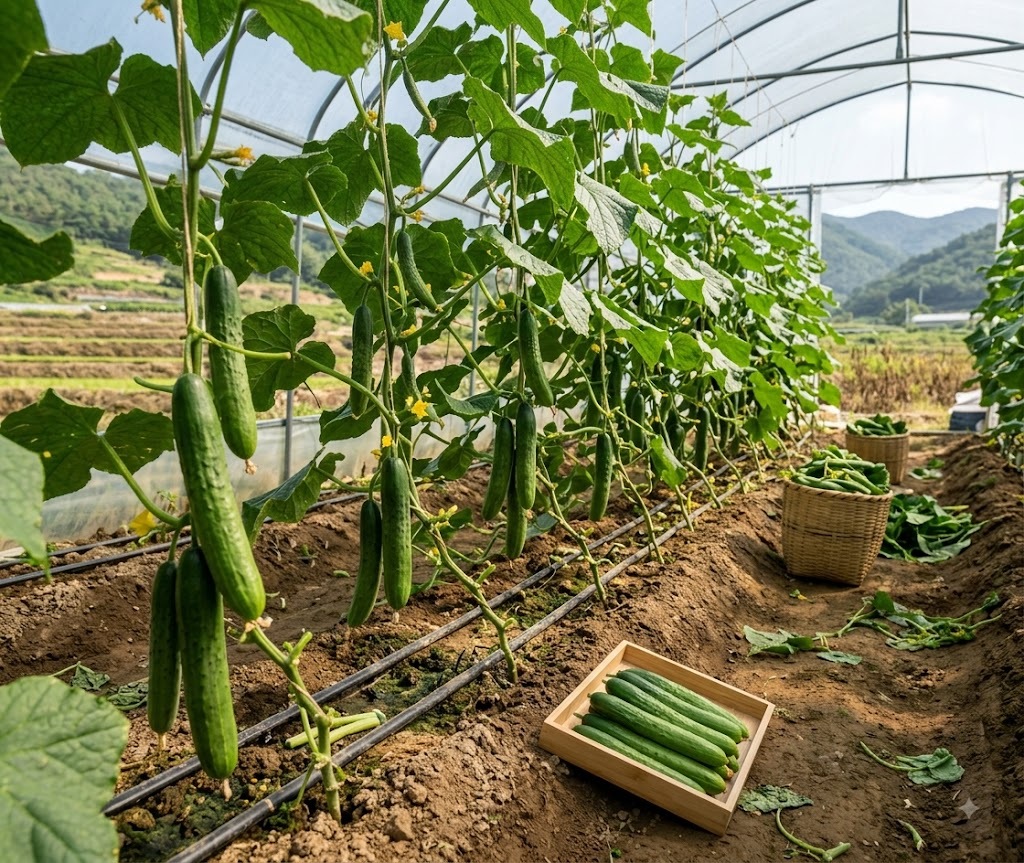
Judgment axis | detail |
| Item Identity | The representative scientific name for the cucumber is Cucumis sativus L., and it is managed as an accepted species by Kew. ( Plants of the World Online ) |
| classification | It is a fruit vegetable of the genus Cucumis in the family Cucurbitaceae. The Rural Development Administration also classifies it as belonging to the Cucurbitaceae family. ( Nongsaroo ) |
| Growth type | Kew manages C. sativus as an annual. ( Plants of the World Online ) |
| Edible parts | Immature fruits developed through pollination or parthenocarpy are primarily consumed. The peel, flesh, and soft seed portion are the marketable parts. |
| Growth temperature | According to the Rural Development Administration standards, the optimal temperature for germination is 25–30℃, for seedling growth 18–25℃, for plant growth 20–25℃, for the root zone 20–23℃, and for storage 5–10℃. ( Nongsaroo ) |
| Suitable cultivation site | The Rural Development Administration suggests that growth is good at a pH of 5.5 to 6.8 and that the plant may die at a pH of 4.3 or lower. ( Nongsaroo ) |
| Componentization | Cucumbers produce separate male and female flowers on a single plant, and temperature and day length play a major role in sexual differentiation. The Rural Development Administration explains that low nighttime temperatures of approximately 15°C and short-day conditions of 8 to 10 hours promote female flower differentiation during seedling growth. ( Nongsaroo ) |
| Unit result | The Rural Development Administration describes cucumbers as fruit vegetables with high parthenocarpy. ( Nongsaroo ) |
| grafting | Grafting is used to control vine splitting disease, enhance cold elongation and heat tolerance, and maintain plant vigor. ( Nongsaroo ) |
| Harvest characteristics | Cucumbers are repeatedly harvested at an immature stage when they have reached the target length, diameter, color, curvature, and hardness for each intended use, rather than when the fruit is fully ripened. |
| Quality Core | Manage fruit size, stem, weight, straightness, curvature, skin color, gloss, spines, stems, hardness, cavities, yellowing, wounds, and lesions. |
| Product Classification | Products are classified into raw consumption, Baekdadagi type, Chwicheong type, Gasi-oi type, Nogak type, mini/snack type, pickle type, fresh-cut, and marinated types. |
| Statistical structure | KOSIS "Vegetable Production (Fruit Vegetables)" manages not only the total cucumber production but also the area (ha), yield per 10a (kg), and yield (ton) for open-field and greenhouse cucumbers separately. The latest confirmed values are entered after verifying the source tables. ( KOSIS ) |
| Safety classification | Food Safety Korea classifies cucumbers as 'cucurbit fruit vegetables' along with melons, watermelons, Korean melons, and pumpkins. ( Food Safety Korea ) |
| disease risk | The Rural Development Administration suggests removing affected plants and soil disinfection as preventive management measures, as cucumber sclerotinia disease can increase under cold and humid conditions. ( Nongsaroo ) |
| Operating Principles | Connect Variety–Rootstock–Farm–Stem/Node–Female Flower–Fruit–Harvest–Raw Lot–Sorting–Fresh/Processing Lot–Buyer RFQ. |
| Final goal | Connects farms – seedling/grafting – facilities/open fields – origin distribution/sorting – school/food service – fresh-cut – pickling/pickle processing with Buyer's RFQ and repurchase. |
division | Registration details |
| Korean name | cucumber |
| English name | Cucumber |
| Representative scientific name | Cucumis sativus L. |
| International Taxonomy | Kew Plants of the World Online accepted species ( Plants of the World Online ) |
| classification | Cucurbitaceae → Cucumis → Cucumis sativus |
| Growth type | Annual ( Plants of the World Online ) |
| Edible parts | Pericarp, flesh, and soft seed part of an immature fruit |
| Non-edible · Separate management | Roots, stems, leaves, tendrils, flowers, senescent seeds, diseases, and decaying fruit |
| Major growth stages | Seed → Germination → Seedling → Decision on Grafting → Transplanting → Vine Elongation → Node Formation → Male/Female Flower Differentiation → Flowering → Fruit Set → Fruit Elongation → Marketable Harvest → Sensitization/Yellowing → Mature Seed Fruit |
| Major harvesting stages | Young fruit → Marketable unripe fruit → Stage before large fruit/mature cucumber → Mature cucumber/fully ripened |
| Basic product form | Fresh cucumber, Baekdadagi type, Chwicheong type, Gasi cucumber type, mini cucumber, Nogak, for pickling, cutting/washing, pickling, pickle |
| Basic processing stage | Seed → Seedling/Grafting → Planting → Training/Leaf Removal → Female Flower/Fruit Set → Fruit Elongation → Harvest → Sorting → Washing/Pre-cooling → Packaging → Cutting → Pickling/Pickling → Refrigeration/Packaging |
| Basic use | Raw food, Wraps/Muchim, Kimchi/Sobagi, Cold soup, School meals, Eating out, Salad, Fresh-cut, Pickles, Preserved foods, HMR, Meal kit |
| Similarity Principle | No. 067 Melon belongs to the same genus Cucumis but is classified as C. melo Species. Other cucurbit fruits and vegetables, such as No. 065 Pumpkin and No. 066 Watermelon, are also managed as separate Species Entities. |
| Difference in the previous items | Paprika belongs to the family Solanaceae·Capsicum, while cucumber belongs to the family Cucurbitaceae·Cucumis; they are completely different species with different growth structures. |
Product Master
Product Master | Key Management Standards |
| Regular raw cucumber | Variety, Origin, Length, Diameter, Color, Hardness |
| Baekdadagi type | Variety · Fruit length · Fruit diameter · Light green · Use |
| Listening type | Variety · Dark green · Fruit size · Hardness · Food service use |
| Cucumber type | Surface spines, fruit shape, color, freshness |
| Mini snack cucumber | Exaggeration, excessive weight, sweetness, packaging |
| Old cucumber | Harvest stage, fruit weight, peel, seed development |
| For cucumber kimchi | Exaggeration, diameter, curvature, texture |
| For kimchi and pickling | Flesh hardness, size, and uniformity |
| For pickles | Length, diameter, flesh, ovary, hardness |
| Fresh-cut | Raw Lot · Washing · Cutting · Microbiology |
| For slicing | Fruit stalk, linearity, ovary, cutting yield |
| For school meals | Safety, Standards, Inspection, Supply Cycle |
| For dining out | Exaggeration, Linearity, Freshness |
| PB small packaging | Product · Origin · Packaging Weight |
| Non-standard and | Curvature, size, appearance, safety, and machinability |
| by-product | Stem, cut end, non-standard fruit, vine, leaf |
Classification criteria | Subdivision type | Management principles |
| Species | Cucumis sativus | Species Master |
| Variety/Market Type | Baekdadagi / Chwicheong / Gasihyeong / Mini / Pickling etc. | Separation of Variety and Market Type |
| Cultivation type | Open field / Facility / Rain shelter | Separation of production statistics |
| Grave type | Seedlings / Grafted seedlings | Rootstock Dataset |
| Cultivation method | Forced / Semi-forced / Inhibited / Open field, etc. | Verification of actual cropping methods by region and facility |
| Flower component | Female flower / Male flower | Runtime per Node |
| Fruit set type | Natural Correction / Unit Result Centered | Separation by variety |
| Harvesting stage | Young fruit / Marketable unripe fruit / Large fruit / Mature cucumber | Harvest Stage |
| Family type | Straight line / Curved line / Deformed shape | Quality AI |
| length | Short / Standard / Long | CM standards per buyer |
| Distribution methods | Raw Material / Sorting / Washing / Fresh-cut / Pickling | Lot Inheritance |
| Final use | Home / Kimchi / School Meals / Eating Out / Salad / Pickles / HMR | Buyer separation |
| Transaction type | Source Procurement / Contract Production / Regular Supply / Processed Raw Materials / Private Brand (PB) | Actual Conditions NDA |
The Rural Development Administration suggests the optimal temperature for cucumber germination as 25–30°C, seedling growth as 18–25°C, growth as 20–25°C, root zone as 20–23°C, and storage as 5–10°C. Growth is optimal in soil pH 5.5–6.8. ( Nongsaroo )
step | Essential Dataset | Management purpose |
| Production plan | Variety, Use, Crop Type, Facilities, Area, Contract | Supply forecast |
| satellite | Variety · Seed Lot · Seed Company | Origin and variety |
| stock | Rootstock Species·Variety·Lot | Graft tracking |
| Seedling cultivation | Sowing date, temperature, seedling age, number of leaves | Tomb quality |
| grafting | Grafting date, rootstock, scion, and survival rate | Disease and initial stages |
| formula | Date · Plant ID · Planting Density | Packaging history |
| Soil and medium | pH·EC·Organic matter·Drainage | Root zone management |
| Watering | Water source, quantity, time, soil moisture | Fruit growth |
| government official | Nutrient solution, fertilizer, EC, pH | Water quantity and salts |
| Facility temperature | Day and night temperatures | Composition and Growth |
| humidity | RH · Condensation · VPD | disease risk |
| ilsa | Sunshine and cumulative light intensity | Growth |
| Stem attraction | Stem ID · Attraction Height | Growth tracking |
| Section | Node number | Flower/Fruit Runtime |
| female flower | Node · Differentiation · Flowering Date | Fruit set prediction |
| male flower | Node · Flowering date | Componentization analysis |
| Fruit set | Fruit ID · Fruit Set Date | Production forecast |
| Fruit growth | Fruit length, fruit diameter, daily growth amount | Harvest forecasting |
| curvature | Linearity · Curvature Score | Marketability |
| pests | Diseases, Pests, Occurrence Dates, and Control | Risk |
| pesticide | Pesticide, spraying date, and safe usage period | Safety |
| Harvest judgment | Length, Diameter, Color, Hardness | Buyer suitability |
| harvest | Fruit ID · Date · Worker · Quantity | Raw Lot |
| Selection | Exaggeration, excessive diameter, curvature, appearance | Grade |
| Whether or not to use bags | Bags · Application Period · Product Rate | Quality verification |
| purifying | Washing water, time, foreign matter | Hygiene |
| Pre-cooling | Temperature and time | Freshness |
| packaging | Specifications · Weight · Pack Lot | circulation |
| save | Temperature and period | Sulfation and moisture loss |
| Fresh-cut | Washing, cutting, dehydration, and packaging | Convenience |
| pickles | Raw Lot · Salinity · Time | Process Lot |
| pickles | Specifications, Mixing, Acidity, Heating | Process Product |
| delivery | Temperature and time | Supply Chain |
| Buyer inspection | Fruit shape, hardness, color, and freshness | Supplier Score |
| Claim | Curved fruit, yellowing, softness, wound, cavity | Quality feedback |
| Repurchase | Product · Specifications · Quantity · Cycle | Next harvest allocation |
Quality items | fresh cucumber | For kimchi and pickling | Fresh-cut | For pickles | Public rating |
| Species · Varieties · Farm · Lot | core | core | core | core | Verified |
| Rootstock and Grafting Information | importance | importance | importance | importance | Verified/NDA |
| Cultivation type/Farming type | core | core | importance | importance | Verified |
| Harvest day | core | core | core | core | Verified |
| exaggeration | core | core | core | core | Verified/NDA |
| Gyeong | core | core | core | core | Verified/NDA |
| Overweight | importance | importance | importance | importance | Verified/NDA |
| Linearity and curvature | core | importance | importance | core | Verified/NDA |
| Skin color | core | importance | core | importance | Verified/NDA |
| gloss | core | importance | importance | importance | Verified/NDA |
| Thorns/Surface | By variety | By variety | importance | importance | Verified/NDA |
| tap state | core | importance | importance | importance | Verified/NDA |
| hardness | core | core | core | core | Verified/NDA |
| Joint/Seed pod | importance | core | core | core | Verified/NDA |
| sulfuration | core | core | core | core | Verified/NDA |
| Wounds/Compression | core | core | core | core | Verified/NDA |
| lesions and decay | core | core | core | core | Verified/NDA |
| Pesticide usage records | core | core | core | core | NDA |
| Pesticide Residue Test Report | core | core | core | core | NDA |
| purifying | By product | By product | core | core | NDA |
| microorganism | importance | importance | core | core | NDA |
| Cutting yield | Not applicable | By product | core | importance | NDA |
| salinity and acidity | Not applicable | core | Not applicable | core | NDA |
| Storage and Delivery | core | core | core | importance | NDA |
| Expiration date | By Product | core | core | core | Verified/NDA |
| Returns and Claims | core | core | core | core | NDA |
| Repurchase | core | core | core | core | NDA |
Lot Master Required Field
Lot ID · Product Type · Species · Variety · Seed Lot · Rootstock · Graft Batch · Farm · Facility · Cultivation Type · Planting Date · Plant ID · Stem ID · Node · Female Flower Date · Fruit ID · Fruit Set Date · Harvest Date · Fruit Length · Diameter · Weight · Curvature · Color · Gloss · Thorns · Stem · Hardness · Hollow · Deformity · Yellowing · Wounds · Diseases · Rot · Pesticide Usage Records · Pesticide Residue · Microbiological Report · Raw Lot · Sorting Lot · Pack Lot · Washing · Pre-cooling · Storage · Shipping · Fresh-cut Lot · Pickle/Processing Lot · Incoming Inspection · Returns · Claims · Repurchase
Customers | Purchase criteria | Cooperation opportunities |
| Open-air cucumber farm | Variety, Crop Type, Harvest Period | contract farming |
| greenhouse cucumber farms | Long-term supply, specifications, and harvest cycle | Regular supply |
| Grafted seedling nursery | Scion · Rootstock · Grafting Rate · Delivery Date | Seedling RFQ |
| Nonghyup · APC | Length, linearity, color, quantity | Joint screening |
| wholesale market | Specifications, Freshness, Packaging, Shipment Date | Fresh RFQ |
| Large-scale distribution | Standards, Hardness, Supply Stability | PB |
| Online distribution | Harvest date, packaging, and shipping durability | Direct from the farm |
| Kimchi company | Excessive, excessive, hard, supply amount | Sobakgi/Jeorim RFQ |
| School and public meals | Safety, Standards, and Freshness | School Meal RFQ |
| food service companies | Product types and standards such as Chwicheong and Baekdadagi | Regular supply |
| salad maker | Hardness, linearity, microorganisms | Fresh-cut |
| sandwich companies | Fruit stalk, ovary, slice yield | Processed raw materials |
| Pickle manufacturer | Size, hardness, uniformity, seed chamber | Pickling RFQ |
| HMR companies | Cutting, washing, and pickling | Ingredient |
| Meal kit | Cutting, portioning, refrigeration | Kit RFQ |
| PB business operator | Fresh, Pickled, Pickles, Packaged | OEM·PB |
| Seed company | Variety, disease resistance, fruit shape, yield | Variety Pilot |
| Smart farm companies | Environment, Growth, and Harvest Prediction | AX Pilot |
| Research Institute | Female flower differentiation, grafting, yield, quality | joint research |
| local government | Greenhouse Vegetables · APC · Smart Farm · Processing | Regional Cucumber AX |
step | Key variables | Operational judgment |
| satellite | Variety · Seed Lot | Marketability |
| Grafted seedling | Scion, Rootstock, Rooting | Production stability |
| formula | Cultivation type, facilities, and water supply | Production plan |
| Componentization | Female flowers, male flowers, temperature, day length | production potential |
| flowering | Node · Flowering date | Fruit set prediction |
| Fruit set | Fruit ID · Quantity | Yield Forecast |
| Fruit growth | Exaggeration, excessive diameter, curvature | Harvest forecasting |
| harvest | Specifications/Date | Raw Lot |
| Selection | Length, linearity, color | Grade |
| APC | Lot·Pack·Shipment | Traceability |
| Domestic distribution | Wholesale · Retail · Food Service · Restaurant | Domestic Match |
| Fresh-cut | Washing, cutting, and refrigeration | Convenience |
| Pickled vegetables and kimchi | Specifications, Hardness, Salting | Processing |
| pickles | Size, ovary, acidity, specifications | Industrial |
| import | Fresh, Pickled, and Pickled Products | Competitive Analysis |
| export | Fresh · Processed · Country · Quarantine | Export |
| RFQ | Variety, Specifications, Quantity, Period | AI Match |
| contract | Quantity, Unit Price, Quality, Inspection | NDA |
| delivery | Lot · Quantity · Temperature | Execution |
| Buyer rating | Hardness, linearity, and rejection rate | Supplier Score |
| Repurchase | Weekly/Monthly Orders | Harvest Allocation |
Products and processes | Key conditions | RFQ conversion |
| White cucumber | Exaggeration, linearity, color, hardness | Retail and Kimchi RFQ |
| Listening type | Length · Dark green · Hardness | Foodservice RFQ |
| Cucumber type | Surface, shape, and freshness | Local & Dining |
| Mini Cucumber | Size, Packaging, Sweetness | Snack RFQ |
| Old cucumber | Ripeness, excess weight, seed pod | Home dining out |
| For cucumber kimchi | Length, Diameter, Texture | Kimchi RFQ |
| Pickled cucumber | Flesh, hardness, saltiness | Processing |
| For pickles | Size, uniformity, seed chamber, hardness | Pickle RFQ |
| Fresh-cut | Washing, cutting, microorganisms | salad |
| Slice Cut | Diameter and cutting yield | Sandwiches and school meals |
| Stick Cut | Linearity, length, and hardness | HMR |
| Refrigeration pretreatment | Cutting, Packaging, and Use-by Date | Food Service |
| Non-standard and | Curvature, Excess, Appearance, Safety | Pickling and processing conversion |
| Tip/Cut-off | Amount of generation · Moisture | Composting and resource recovery |
| Lungs | Safety and corruption | Feed and Compost Review |
| vines and leaves | Pesticides, diseases, and occurrence amounts | Biomass and compost |
PRP — Product Research Profile
PRP items | Details of investigation and verification |
| PRP-01 Taxonomy | Cucumis sativus standardization |
| PRP-02 breed group | Baekdadagi, Chwicheong, Gasioi, etc. |
| PRP-03 main point | Grafting Rootstock Species · Varieties |
| PRP-04 grafting | Rooting, vine splitting disease, plant vigor |
| PRP-05 Seedlings | Temperature, photoperiod, and female flower differentiation |
| PRP-06 component formulation | Female flower · Male flower · Node |
| PRP-07 Unit Result | Variety, Environment, Fruit Set |
| PRP-08 Greenhouse cultivation | Temperature, humidity, light, and cropping type |
| PRP-09 open-field cultivation | Weather, rainfall, and disease |
| PRP-10 Irrigation | EC·pH·quantity |
| PRP-11 Solar Radiation Management | Quantity and Energy |
| PRP-12 Fruit Extension | Days, Length, Diameter |
| PRP-13 curve and | Plant vigor, fruit set, environment |
| PRP-14 joint | Fruit quality and moisture management |
| PRP-15 sulfide | Harvesting, storage, and distribution |
| PRP-16 Sclerotinia | Low temperature and high humidity · Soil management |
| PRP-17 vine splitting disease | Grafting, Soil, Rootstock |
| PRP-18 harvest frequency | Repeated Harvest · Product Rate |
| PRP-19 bag cultivation | Standardization and sorting labor |
| PRP-20 storage | 5~10℃ Standard · Quality |
| PRP-21 Fresh-cut | Cutting · Microorganisms · Shelf-life |
| PRP-22 Pickles | Saltiness and texture |
| PRP-23 Pickles | Size, Hardness, Seed Chamber |
| PRP-24 Buyer | MOQ · Specifications · Delivery Cycle |
| PRP-25 Reorder | Harvest Allocation · Next Crop |
| PRP-26 byproduct | Non-standard fruit, vines, and cuts |
first of all | Execution item | Performance indicators |
| 1 | Variety–Rootstock–Farm–Crop Cycle ID required | Data integrity |
| 2 | Baekdadagi – Chwicheong – Pickle – Nogak Product Separation | Misclassification reduction rate |
| 3 | Plant–Stem–Node–Female Flower–Fruit ID construction | Individual tracking rate |
| 4 | Real-time collection of temperature, humidity, light, and rhizosphere | Environmental collection rate |
| 5 | AI automatic recognition of female and male flowers | Component determination rate |
| 6 | Automatic counting of fruit set | Quantity prediction accuracy |
| 7 | Automatic measurement of exaggerated and exaggerated diameter images | Accuracy of specification judgment |
| 8 | AI judgment on curvature and linearity | Selection accuracy |
| 9 | Color and Yellowing AI Assessment | Freshness judgment rate |
| 10 | Detection of lesions, sclerotia, and malformations | Defect detection rate |
| 11 | Daily yield forecast | RFQ Supply Forecast |
| 12 | Construction of a Harvest Frequency–Fruit Growth Model | Probability of the right time |
| 13 | APC AI Screening – Automatic Lot Connection | Traceability |
| 14 | Pesticide Use – Harvest – Report Linkage | Safety document connection rate |
| 15 | Fresh/Kimchi/Pickle Buyer AI Match | RFQ Match Rate |
| 16 | Management Costs & Insolation – Quantity & Quality Optimization | productivity |
| 17 | Energy–Quantity Runtime | Energy per kg |
| 18 | Buyer Claim → Plant/Farm Traceback | Cause tracing rate |
| 19 | Reorder → Connect to next harvest/crop season plan | Repurchase linkage rate |
Problem group | Problem Definition | Required data |
| Mixing of variety and product names | Market names such as Baekdadagi and Chwicheong are mixed with actual varieties. | Variety·Product |
| Mixed open fields and facilities | Interpreting with the same statistics despite differences in productivity and shipping structures | Farm Type |
| Disconnection of grafting information | Rootstock characteristics are not linked to production or disease | Rootstock |
| Female flower differentiation deviation | Differences in temperature and day length affect female flower development | Temp·Daylength |
| Fruit set deviation | Differences in fruit set by node and variety | Flower·Fruit |
| Initial imbalance | Excessive vegetative and reproductive growth affects fruit quality | Growth |
| Song and | Product rate decline due to lack of linearity | Curvature |
| deformity and | Increase in quality grades and waste | Fruit Shape |
| cavity | Internal quality issues are difficult to identify based on appearance alone. | Internal Quality |
| sulfuration | Color change during storage and distribution | Temp·Time |
| moisture loss | Freshness and weight loss | RH·Logistics |
| Vine splitting disease | Reduced growth and productivity due to soil-borne diseases | Rootstock·Soil |
| drop | Risk of occurrence in low temperature and high humidity | RH·Temp·Disease |
| Pesticide management for repeated harvesting | Managing spraying and harvesting intervals is complex | Spray·Harvest |
| Standard deviation | Differences in exaggeration, overdiameter, and curvature | Vision QC |
| Selective labor | Increase in sorting personnel during concentrated harvests | Labor·Volume |
| Harvest delay | Exceeding specifications due to rapid fruit growth | Growth Rate |
| APC Lot disconnection | Lack of traceability for farm/harvest lots and pack lots | Relationship |
| Fresh-cut hygiene | Increased risk of microorganisms after amputation | Hygiene |
| Pickled texture | Texture varies depending on raw materials and salt content | Processing |
| Discrepancy in pickle ingredients | Difference in specifications between raw consumption and pickling | Product Spec |
| Non-standard and waste | Even safe raw materials such as grains can be discarded. | Grade·Processing |
| Supply and demand fluctuations | Daily repeated harvesting and prices fluctuate sensitively | Harvest·Price |
| Energy costs | Impact on facility heating and ventilation costs | Energy |
| Repurchase not reflected | Buyer preferences are not fed back to the variety and harvest stages | Evaluation·Reorder |
RFQ Type | Public Registration | Verify/NDA |
| Regular raw cucumber | Origin, Product Type, Specifications, Shipment Time | Farm · Quantity · Unit Price · Lot |
| Baekdadagi type | Length, linearity, color | Variety, Quantity, Price |
| Listening type | Exaggeration, color, hardness, duration | Lot · Unit Price |
| Cucumber type | Surface, Dimensions, Freshness | Supply volume and price |
| Mini Cucumber | Size, Packaging, and Use | MOQ · Unit Price |
| Old cucumber | Harvesting stage, weight, and use | Actual Lot/Price |
| Regular supply of facilities | Product type, specifications, and supply period | Weekly Quantity and Unit Price |
| contract farming | Variety, Use, Period | Area, Contract Quantity, Price |
| cucumber kimchi | Exaggeration, exaggeration, and hardness | Quantity, Test Report, Unit Price |
| School meals | Safety, Standards, and Inspection | Test Reports/Contracts |
| dining out | Product Type, Specifications, and Period | Weekly Quantity and Price |
| Fresh-cut | Washing, cutting, and refrigeration | Microorganisms · Shelf-life |
| sandwich | Pericarp, linearity, ovary | Cutting yield · Price |
| pickles | Size, Hardness, Seed Chamber | Processing yield · Unit price |
| pickles | Specifications, Hardness, and Salt Suitability | Yield/Contract |
| PB small packaging | Product type, weight, and package | Brand · MOQ · Price |
| Grafted seedling | Graft · Rootstock · Graft Age · Delivery Date | Seed Lot · Quantity · Unit Price |
| Technology demonstration | Fruit coefficient, curvature, and harvest prediction | AI, Sensors, and Performance |
| Research cooperation | Composition, Grafting, Quality, Diseases | Samples and test results |
| local government cooperation | Greenhouse Vegetables · APC · Smart Farm · Processing | Farms, Facilities, and Business Conditions |
① Need Products & Materials
Companies and institutions seeking necessary products, agricultural products, raw materials, and processed goods register purchasing demands. Registered requests are utilized to review cooperation with potential suppliers and producers based on the RFQ Intelligence Library.
Process:
RFQ Registration → Supplier/Product Review → Collaboration Connection → Future AI Matching
Register
② We are looking for production and manufacturing partners. (Need Suppliers & Manufacturers)
Register a request to find necessary production and supply partners, ranging from farms and producer organizations to processing companies, OEM, ODM, and private label manufacturers.
Process:
RFQ Registration → Review of Production & Manufacturing Capabilities → Collaboration Connection → Future AI Partner Matching
Register
③ We are looking for domestic and international buyers. (Need Buyers)
Farmers, producer organizations, and manufacturing companies are requesting cooperation with new buyers, such as domestic and international distributors, importers, brand companies, and food service and catering businesses.
Process:
RFQ Registration → Product & Supply Capability Review → Market & Buyer Connection → Future AI Buyer Matching
Register
Contact : mail@markethub.org
Version | Main contents | situation |
| v1.0 | Cucumber Taxonomy · Grafting · Female Flower · Fruit Set · Repeated Harvesting · Sorting · Pickling · RFQ Basic Structure Registration | complete |
| v1.1 | KOSIS Verification of Official Data on Production, Varieties, Rootstocks, Markets, and HS | expected |
| v2.0 | Baekdadagi, Chwicheong, Gasioi, Mini, Nogak, Fresh-cut, Pickle Product Specification Separation | expected |
| v3.0 | Seed–Rootstock–Seedling Production–Farmer–Fruit–APC–Processing–Buyer Verified Container Combination | expected |