

Judgment axis | detail |
| Item Identity | Paprika is a representative sweet pepper product of the Capsicum annuum L. strain, while Kew manages C. annuum as an accepted species. ( Plants of the World Online ) |
| relationship with chili peppers | Although it belongs to the same Species lineage as No. 061 chili pepper, it is managed as a separate Product Entity because it differs in spiciness, harvest maturity, fruit shape, flesh thickness, color, distribution, and processing purpose. |
| Edible parts | The peel and flesh of the fruit that has reached maturity or commercial ripeness are the core, and the internal placenta and seeds are separated according to use during the cooking and processing process. |
| Key Product Features | Fruit weight, fruit shape, fruit diameter, length, flesh thickness, color, color uniformity, hardness, gloss, stem condition, cracking, deformity, and blemishes are the main specifications. |
| Color separation | Green unripe fruit and fully colored products (such as red, yellow, or orange) are not aggregated as the same product. The variety and harvest maturity are recorded together. |
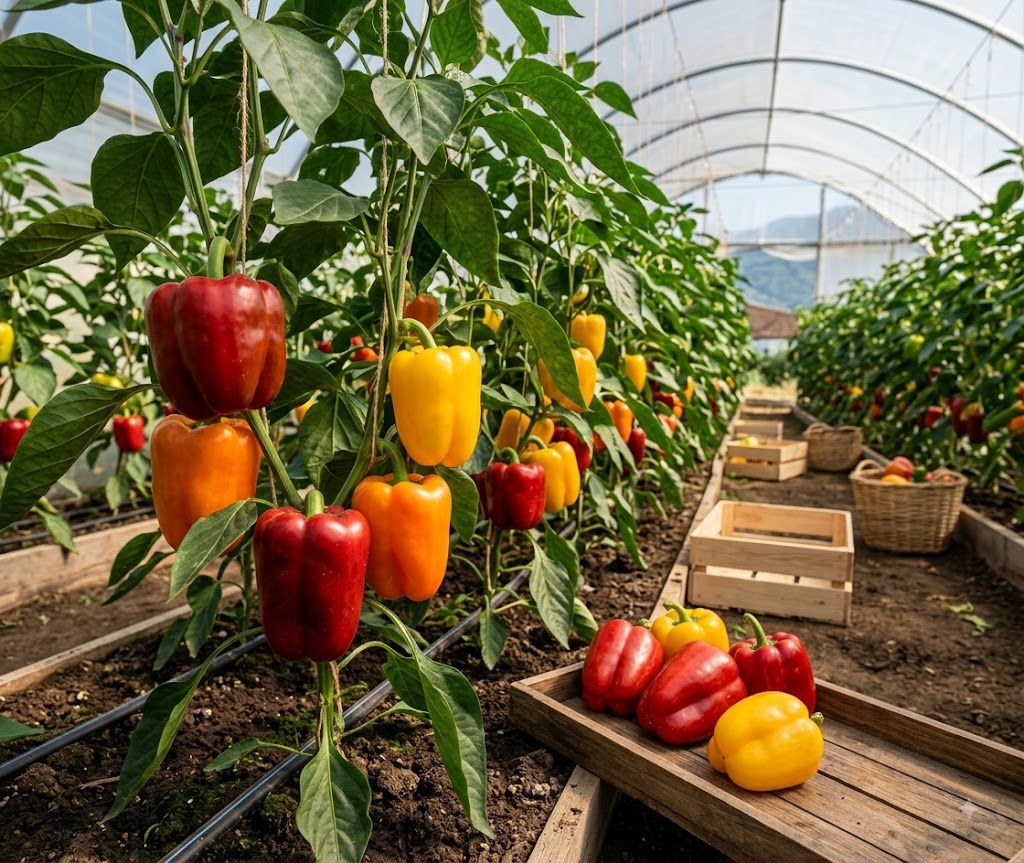
| Cultivation type | Domestic paprika is managed as a representative crop grown in greenhouses and hydroponically, linking data across Farm, Greenhouse, Slab, Plant, Stem, and Fruit units. The Rural Development Administration's paprika schedule presents planting and environmental management based on hydroponics and slab cultivation. ( Nongsaroo ) |
| Seedling cultivation and transplanting | Data from the Rural Development Administration presents management examples for the seedling stage, including daytime temperatures of 25°C, nighttime temperatures of 22°C, and substrate temperatures of approximately 22°C, as well as nutrient solution EC management and slab coverage before transplanting. These serve as standard values for the corresponding cultivation formula and are managed in conjunction with the Source. ( Nongsaroo ) |
| Attraction and fruit setting | For paprika, vine training after branching and controlling fruit set are important management factors for productivity and the marketable fruit rate. The Rural Development Administration generally recommends a two-stem V-shaped training method and management techniques for fruit set and side branches. ( Nongsaroo ) |
| Cultivation method | The Rural Development Administration classifies paprika cultivation into winter and summer types, providing examples for winter cultivation as sowing in mid-to-late July, transplanting from mid-August to early September, and harvesting from early November to early July of the following year, and for summer cultivation as sowing from mid-February to late March, transplanting from late March to mid-April, and harvesting from early June to late January of the following year. ( Nongsaroo ) |
| High temperature risk | High temperatures have been studied as a major risk factor for poor fruit set and reduced yield in summer cultivation, and the Rural Development Administration separately disseminated stable production technologies for high-temperature periods in 2025. ( Nongsaroo ) |
| hydroponics | The Rural Development Administration's 2026 data on recirculating hydroponics presents baseline data indicating that paprika accounts for 493 ha, or 8.8%, of the total domestic hydroponic cultivation area. The total baseline area is presented as 5,634 ha. These figures are stored along with the reference point and survey scope. ( Nongsaroo ) |
| Importance of exports | Paprika is one of Korea's representative fresh agricultural export items, and KATI conducted a separate study on the 2025 Japanese market analysis and strategies to expand exports to Japan. ( Kati ) |
| Japanese market | KATI's 2025 data for the Japanese market indicates that Korean products accounted for 86% of the approximately 25,000 tons of paprika imported into Japan in 2023. This data is based on the 2023 Japanese import market and should not be confused with current values. ( KATI ) |
| Korean production statistics | The accurate finalized national statistical values for 2025 regarding the latest nationwide paprika cultivation area, production volume, and facility area could not be verified up to the original table in this verification, so they will not be entered arbitrarily and will be managed through future official verification. |
| Operating Principles | Variety-Greenhouse-Environment-Stem-Flower-Fruit Set-Fruit-Color Stage-Harvest-Pack Lot-Export/Buyer Connect the RFQ. |
| Final goal | Connects RFQs and repurchases from farms, seedlings, smart farms, sorting and packaging, export organizations, large-scale distribution, catering and food service, and Fresh-cut Buyers. |
division | Registration details |
| Korean name | paprika |
| English name | Paprika / Sweet pepper / Bell pepper |
| Representative scientific name | Capsicum annuum L. |
| International Taxonomy | Kew Plants of the World Online accepted species ( Plants of the World Online ) |
| classification | Solanaceae → Capsicum → Capsicum annuum |
| Agricultural Product Characteristics | Sweet pepper · Colored sweet pepper family |
| Growth type | Kew describes C. annuum as a species that can be an annual, subshrub, or shrub. ( Plants of the World Online ) |
| Edible parts | Skin, thick flesh |
| Separate management area | Placenta, seed, stem, pedicel |
| Non-edible · Separate management | Leaves, stems, and roots; seeds and seedlings for nursery cultivation; diseased and rotten fruits |
| Major growth stages | Seed → Seedling → Transplanting → Branching → Flower cluster/Flowering → Fruit set → Fruit enlargement → Green fruit → Initiation of coloring → Color development → Marketability → Overripening |
| Major harvesting stages | Green, unripe products / products with ongoing coloring / fully colored products |
| Basic product form | Green, Red, Yellow, Orange, Other Colors, Large, Medium, Mini/Snack Size, Mixed Colors, Fresh-cut |
| Basic processing stage | Seed → Seedling → Transplanting → Training & Pruning → Fruit Setting → Fruit Thinning → Enlargement → Coloring → Harvest → Sorting → Pre-cooling → Packaging → Cutting & Washing → Refrigeration & Processing |
| Basic use | Raw food, Salad, Stir-fry, Grilled food, Pizza/Pasta, Eating out, School meals, Fresh-cut, Meal kit, HMR, Export, Private brand |
| Difference from chili peppers | Chili peppers focus on green, red, and dried peppers, chili powder, and spiciness, while paprika focuses on sweet peppers, large size, flesh thickness, color, coloring, and fresh export. |
| Relationship with bell peppers | In domestic food classifications, bell peppers and paprika may be managed as the same or adjacent food groups, but MarketHub manages them as separate products or sub-products by verifying product name, variety, color, harvest maturity, and buyer specifications. |
Product Master
Product Master | Key Management Standards |
| green bell pepper | Variety, Immature Harvest, Fruit Weight, Fruit Shape, Hardness |
| red bell pepper | Variety, Coloration Rate, Color Intensity, Fruit Weight, Sugar Content |
| yellow bell pepper | Variety, Color Uniformity, Gloss, Fruit Weight |
| Orange bell pepper | Variety, Color, Weight, Hardness |
| Other colored bell peppers | Variety, Color, Market Use |
| Large bell peppers | Fruit weight, length, width, flesh thickness, lobes |
| Medium and paprika | Weight, uniformity, and packaging specifications |
| Mini/Snack Pepper | Variety, Size, Sweetness, Packaging |
| Mixed Color Pack | Each Color Lot · Composition Ratio · Pack Lot |
| Paprika for export | Color·Grade·Size·Quarantine·Packhouse |
| For domestic distribution | Color, specifications, packaging, and shipping distance |
| For hotels and restaurants | Flesh thickness, color, cutability, and freshness |
| For school meals | Safety, Size, and Trimming Rate |
| Fresh-cut | Raw Material Lot · Washing · Cutting · Microorganisms |
| For salad | Color, sweetness, hardness, size |
| For meal kits | Washing, cutting, portioning, refrigeration |
| For HMR | Cutting, heating suitability, and color retention |
| frozen cuts | Cutting specifications, freezing, and thawing quality |
| PB small packaging | Color combination · Weight · Brand |
| Non-standard and | Shape, defects, size, safety, processing conversion |
| Cultivation by-products | Non-standard fruit, leaves, stems, roots, spent substrate |
Classification criteria | Subdivision type | Management principles |
| Species | Capsicum annuum | Species Master |
| Product Role | Chili pepper / Bell pepper / Paprika | Separation of product purposes |
| Spicy flavor | Sweet / Pungent | Paprika is basically a sweet pepper product |
| color | Green / Red / Yellow / Orange / Others | Connected to variety and ripeness |
| Coloring stage | Rust / Onset of coloring / Partial coloring / Complete coloring | Harvest Stage |
| Family type | Blocky / Lamuyo type / Mini, etc. | Actual registration by variety |
| size | Mini / Intermediate / Large | Buyer Specification |
| pulp | Thin / Medium / Thick | Actual mm measurement |
| Fruit waterproofing | 3-lobe / 4-lobe, etc. | Dataset upon Buyer's request |
| Cultivation type | Winter cultivation / Summer cultivation | Rural Development Administration connection with crop types |
| Cultivation type | Soil cultivation / Solid medium hydroponics / Recirculating hydroponics, etc. | Facility separation |
| Distribution methods | Raw Material / Sorting / Small Packaging / Mixed Pack / Fresh-cut | Lot Inheritance |
| use | Domestic Retail / Food Service / Catering / Fresh-cut / Export | Buyer separation |
| Transaction type | Regular Supply / Contract Farming / Joint Sorting / Export Contracts / Private Brand (PB) | Actual Price/Quantity NDA |
The Rural Development Administration's paprika farming schedule presents a structure for greenhouse and hydroponic cultivation that follows the sequence of seedling cultivation, slab filling, transplanting, stem and branch management, fruit setting, nutrient solution management, and harvesting . As an example for the seedling stage, it suggests a daytime temperature of 25°C, a nighttime temperature of 22°C, and a substrate temperature of approximately 22°C. It also provides management standards for filling the slabs with a nutrient solution EC of 3.0 dS/m prior to transplanting. These values are stored along with the Source as official standards for the relevant Rural Development Administration cultivation techniques. ( Nongsaroo )
step | Essential Dataset | Management purpose |
| Production plan | Cultivation type · Variety · Color · Area · Export/Domestic contract | Supply plan |
| satellite | Variety · Color · Seed Lot · Seed Company | Variety Traceability |
| sowing | Sowing Date · Batch | Crop Cycle |
| Seedling cultivation | Day/night temperature, substrate temperature, seedling age, number of leaves | Tomb quality |
| formula | Date · Facility · Slab · Plant ID | Plant Traceability |
| planting density | Rows, weekly distances, and stems per square meter | productivity |
| badge | Rock wool, coco peat, etc. Lot | Root-zone |
| Nutrient solution | EC·pH·prescription·supply volume | Root zone environment |
| drainage | Drainage rate, EC, pH | amniotic fluid balance |
| ilsa | Solar radiation · Cumulative light intensity | Supply and production forecasts |
| Facility temperature | Daytime, Nighttime, and 24-hour average | Growth and fruit setting |
| humidity | RH·VPD | Increased production and disease |
| CO₂ | Time period and concentration | photosynthesis |
| root zone temperature | Culture medium and nutrient solution temperature | High temperature risk |
| invitation | Number of stems and attraction methods | Initial price and quantity |
| basin | Branching Order · Stem ID | Flowering and fruit setting |
| flowering | Node · Number of flowers · Blooming date | Fruit set prediction |
| Fruit set | Fruit ID · Fruit Set Date · Number of Fruit Sets | Yield Forecast |
| Enemy | Removal and Remaining | Resize |
| Excessive negligence | Length, width, and estimated weight | Harvest forecasting |
| coloring | Color · Coloration Rate · Color Stage | Harvest Forecast |
| pests | Occurrence, Diagnosis, and Control | Production risk |
| virus | Symptoms · Diagnosis · Plant ID | risk of facility spread |
| pesticide | Pesticide, spraying date, and safe usage period | Safety |
| Physiological disorders | Sunburn, navel rot, cracking, deformities, etc. | Product rate |
| Harvest judgment | Color, excessive weight, excessive hardness, hardness, gloss | Buyer suitability |
| harvest | Fruit ID·Stem·Date·Worker | Raw Lot |
| Selection | Color, size, weight, defects | Grade |
| Pre-cooling | Time and temperature | Freshness |
| packaging | Color · Grade · Weight · Pack Lot | Domestic and export |
| Mixed packaging | Red/Yellow/Orange Lot Configuration | Mix Traceability |
| save | Changes in temperature, period, and hardness | Shelf-life |
| Export selection | Country · Buyer Standards · Quarantine | Export |
| Domestic supply | Distribution, Food Service, and Restaurant Standards | Domestic |
| Fresh-cut | Washing, cutting, microorganisms | Convenience |
| Buyer inspection | Color, hardness, gloss, scratches, temperature | Supplier Score |
| Claim | Softness, blemishes, color, size, decay | Quality Feedback |
| Repurchase | Product · Color · Weekly Quantity | Next Harvest Allocation |
Quality items | Domestic fresh | For export | Fresh-cut | Processed Foods · HMR | Public rating |
| Species · Varieties · Farm · Lot | core | core | core | core | Verified |
| color | core | core | core | core | Verified/NDA |
| Coloration rate | core | core | core | importance | Verified/NDA |
| Overweight | core | core | core | importance | Verified/NDA |
| Length and width | core | core | core | importance | Verified/NDA |
| Family type | core | core | importance | importance | Verified/NDA |
| flesh thickness | importance | importance | core | core | Verified/NDA |
| Lobe number | By Buyer | By Buyer | importance | importance | Verified/NDA |
| gloss | core | core | importance | importance | Verified/NDA |
| hardness | core | core | core | importance | Verified/NDA |
| Sweetness | importance | importance | importance | importance | Verified/NDA |
| tap state | core | core | By product | By product | Verified/NDA |
| sweep | core | core | core | importance | Verified/NDA |
| Heat and | core | core | core | core | Verified/NDA |
| navel rot | core | core | core | core | Verified/NDA |
| deformity and | core | core | importance | importance | Verified/NDA |
| Wounds/Compression | core | core | core | core | Verified/NDA |
| lesions and decay | core | core | core | core | Verified/NDA |
| Pesticide usage records | core | core | core | core | NDA |
| Pesticide Residue Test Report | core | core | core | core | NDA |
| microorganism | importance | importance | core | core | NDA |
| Packaging specifications | core | core | core | importance | Verified/NDA |
| Export quarantine | Not applicable | core | Not applicable | By Product | Verified/NDA |
| Storage and transportation | core | core | core | importance | NDA |
| Arrival quality | importance | core | core | importance | NDA |
| Returns and Claims | core | core | core | core | NDA |
| Repurchase | core | core | core | core | NDA |
Lot Master Required Field
Lot ID · Product Type · Species · Variety · Color · Seed Lot · Farm · Greenhouse ID · Cultivation Type · Planting Date · Substrate · Slab Lot · Stem ID · Node/Flower ID · Fruit Set Date · Fruit ID · Harvest Date · Coloring Stage · Fruit Weight · Length · Width · Fruit Shape · Flesh Thickness · Lobe · Color · Gloss · Hardness · Sugar Content · Stem Condition · Sunscald · Cracking · Blossom End Rot · Deformity · Wounds · Diseases · Rot · Pesticide Usage Records · Pesticide Residues · Microbiological Test Report · Raw Lot · Sorting Lot · Pack Lot · Export Lot · Fresh-cut Lot · Packing Date · Storage · Transport Conditions · Buyer Inspection · Returns · Claims · Repurchase
Customers | Purchase criteria | Cooperation opportunities |
| Paprika farm | Variety, color, cultivation type, and estimated harvest yield | contract production |
| Smart Farm | Greenhouse environment, long-term production, quality | Runtime RFQ |
| Seedling company | Variety, Color, Age, Delivery Time | Seedling RFQ |
| Producer organizations | Color, Specifications, Shipment Volume | Joint shipment |
| Sorting and Packaging Center | Weight, Color, Grade, Pack Specifications | Joint screening |
| export organization | Country·Color·Specifications·Weekly Volume | Export RFQ |
| Large-scale distribution | Color, Size, Supply Stability | Domestic PB |
| Online fresh food distribution | Appearance, Color, Packaging, Shipping | Direct from the farm |
| hotel | Large size, color, flesh thickness, gloss | Premium RFQ |
| food service companies | Color, cutability, hardness, cycle | Regular supply |
| salad maker | Color, Freshness, Microorganisms | Fresh-cut |
| School and public meals | Safety, Standards, and Finishing Rate | School Meal RFQ |
| Sandwiches and pizza | Flesh thickness, cut, color | Food manufacturing |
| Meal kit | Mixing colors, cutting, and portioning | Kit RFQ |
| HMR companies | Cutting, heating suitability, and color retention | Processing |
| frozen vegetable company | Cutting specifications · Freezing suitability | Frozen RFQ |
| PB business operator | Solid Color/Mixed Color Pack/Package | PB |
| export companies | Country · Quarantine · MRL · Logistics | Export |
| Seed company | Variety, Color, Disease Resistance, Fruit Weight | Variety Pilot |
| Smart farm companies | Sensors, Environmental Control, AI, Robots | AX Pilot |
| Research Institute | Growth, Fruit Set, Quality, Hydroponics, Energy | joint research |
| local government | Smart Farm · Export Complex · APC · Energy | Regional Paprika AX |
step | Key variables | Operational judgment |
| satellite | Variety · Color · Seed Lot | Market and crop type suitability |
| Seedling cultivation | Young age and soundness | Crop Start |
| facilities | Greenhouse Scale · Environmental Control · Hydroponic System | Supply capacity |
| Cultivation method | Winter/Summer | Monthly supply |
| environment | Light, temperature and humidity, CO₂, and the rhizosphere | Production risk |
| Basin/Inducement | Stem count/attraction method | productivity |
| flowering | Node · Blooming date · Number of flowers | Fruit set prediction |
| Fruit set | Fruit Set · Thinning | flow |
| hypertrophy | Weight/Size | Harvest Forecast |
| coloring | Red/Yellow/Orange Stage | Buyer allocation |
| harvest | Color · Excess · Date | Raw Lot |
| Selection | Color, Size, Defects | Grade |
| Packhouse | Packaging · Label · Export Lot | Traceability |
| Domestic distribution | Large-scale retail, catering, and food service | Domestic Match |
| export | Japan · Other Countries · Standards · Quarantine | Export Match |
| Fresh-cut | Washing, cutting, and packaging | Food Service |
| freezing | Cutting and freezing | Processing |
| RFQ | Color, Specifications, Weekly Quantity, Period | AI Match |
| contract | Unit price, quantity, quality, and exchange rate conditions | NDA |
| shipment | Pack Lot · Quantity · Quarantine · Transport | Export Execution |
| Arrival inspection | Hardness, color, decay, damage | Buyer Evaluation |
| Claim | Size, discoloration, softness, spoilage | Supplier Score |
| Repurchase | Weekly orders by color | Harvest Allocation |
Products and processes | Key conditions | RFQ conversion |
| red fresh fruit | Coloration, size, and hardness | Retail and Export RFQ |
| Yellow fresh fruit | Color, weight, gloss | Retail and export |
| Orange fresh fruit | Color, uniformity, and specifications | Premium |
| Green Product | Immature harvest, firmness, flesh | dining out |
| Mixed Color Pack | Color Ratio · Grade · Lot | Retail PB |
| Mini/Snack | Size, Sweetness, Packaging | Snack RFQ |
| Fresh-cut | Color, washing, cutting, microorganisms | Salads and school meals |
| Strip Cut | Width, Length, Color | Dining Out · HMR |
| Dice Cut | Cutting specifications and uniformity | HMR |
| frozen bell peppers | Pretreatment, freezing, color | Food Processing |
| For grilling | Flesh thickness and heating suitability | dining out |
| For pizza and pasta | Color, cutting, and quality after heating | Food manufacturing |
| Sauce ingredient candidates | Color, processing yield, and taste | Processing |
| Non-standard and | Safety, color, and processing suitability | Processing conversion |
| Seeds and placenta | Generation Amount, Composition, and Treatment | Review of resource utilization |
| tap | Amount of generation · Moisture | Composting |
| leaves and stems | Amount generated after production ends | biomass |
| waste badges | Rock wool, coco peat, etc. | Reuse, Disposal, Circulation |
| drainage | Nutrient solution components and recovery amount | Circulating Hydroscope AX |
PRP — Product Research Profile
PRP items | Details of investigation and verification |
| PRP-01 Taxonomy | Capsicum annuum–Paprika Product relationship |
| PRP-02 Chili Peppers and Paprika | Differences in product roles within the same species |
| PRP-03 Bell Pepper | Paprika and domestic distribution and variety boundaries |
| PRP-04 variety | Red, Yellow, Orange, Other Colors |
| PRP-05 Seedlings | Day and night temperature, seedling age, and culture medium |
| PRP-06 Winter Cultivation | Sowing, Planting, and Harvesting Calendar |
| PRP-07 Summer Cultivation | High temperature, variety, and root zone environment |
| PRP-08 hydroponics | Medium, Nutrient Solution, Drainage |
| PRP-09 circulating hydroponics | Drainage recovery, disinfection, and resupply |
| PRP-10 Stem Attractant | Number of Stems · Product Rate · Quantity |
| PRP-11 fruit set | Node · Fruit Set · Plant Vigor |
| PRP-12 enemies | Balance of excess and quantity |
| PRP-13 Ilsa | Light intensity, fruit set, and fruit weight |
| PRP-14 temperature | High temperature, low temperature, fruit setting |
| PRP-15 root zone temperature | Summer cultivation and productivity |
| PRP-16 CO₂ | Photosynthesis · Water quantity |
| PRP-17 coloring | Variety, Temperature, Ripening |
| PRP-18 overload | Growth, fruit set, and variety |
| PRP-19 flesh thickness | Buyer · Processing Suitability |
| PRP-20 hardness | Shelf-life · Export |
| PRP-21 physiological disorders | Sunburn, navel rot, cracking |
| PRP-22 virus | Seedlings, Aphids, Facility Spread |
| PRP-23 storage | Color, hardness, decay |
| PRP-24 export | Buyer specifications for Japan and other countries |
| PRP-25 Fresh-cut | Cutting · Microorganisms · Shelf-life |
| PRP-26 Energy | Heating, Cooling, Electricity, Cost per kg |
| PRP-27 Buyer | Color · MOQ · Weekly Quantity · Delivery Time |
| PRP-28 Reorder | Repurchase and harvest allocation by color |
| PRP-29 by-product | Non-standard fruit, stem, spent medium, drainage |
first of all | Execution item | Performance indicators |
| 1 | Variety–Color–Farm–Greenhouse–Crop Cycle becomes essential | Dataset completeness |
| 2 | Chili Pepper–Bell Pepper–Paprika Product Automatic Separation | Misclassification reduction rate |
| 3 | Establishing a Plant–Stem–Node–Fruit ID structure | Object tracking rate |
| 4 | Real-time collection of temperature, humidity, VPD, CO₂, and light | Environmental collection rate |
| 5 | Real-time collection of nutrient solution EC, pH, supply volume, and drainage | Root zone data rate |
| 6 | AI Growth Point and Stem Diameter Analysis | Initial judgment accuracy |
| 7 | Automatic counting of flower and fruit set images | Fruit set prediction accuracy |
| 8 | Fruit Size and Weight AI Estimation | Quantity prediction accuracy |
| 9 | Red·Yellow·Orange Coloration Rate AI Assessment | Harvest judgment accuracy |
| 10 | Detection of sunscald, navel rot, cracking, and malformed AI | Defect detection rate |
| 11 | Weekly yield forecast by color | RFQ Supply Forecast |
| 12 | Harvest Allocation by Export Buyer | Export fulfillment rate |
| 13 | Sorter – Raw Lot – Pack Lot Automatic Connection | Traceability |
| 14 | Pesticide Use – Harvest – Report Linkage | Safety document connection rate |
| 15 | Export Quarantine – Export Lot Digital Connection | Quarantine document connection rate |
| 16 | AI Match Color & Specifications by Buyer | RFQ Match Rate |
| 17 | Hydroponic Drainage Recovery and Reuse Runtime | Circulation rate |
| 18 | Linking heating, cooling, electricity, and water quantity | Energy per kg |
| 19 | Quality at Arrival – Farm/Greenhouse Traceability | Claim Traceability |
| 20 | Reorder → Harvest Forecast by Color Automatically Reflected | Repurchase linkage rate |
Problem group | Problem Definition | Required data |
| A mixture of chili peppers and paprika | Item entities are mixed due to identical species | Species·Product |
| Bell pepper and paprika boundary | Domestic standards for product names, varieties, and colors are mixed | Variety · Market Name |
| Mixed colors | Does not distinguish between variety color and harvest maturity color | Variety·Color Stage |
| Seedling quality | Differences in early seedlings affect long-term production | Seedling |
| Facility environment deviation | Differences in light, temperature, humidity, and CO₂ by greenhouse | Environment |
| Nutrient solution deviation | Differences in EC, pH, and drainage affect initial vigor and quality | Nutrient |
| High temperature fruit set | Summer fruit set and yield reduction | Temperature, Root Zone, Fruit Set |
| Low-level work | Delayed yield and coloring due to reduced light intensity | Radiation |
| Initial imbalance | Poor balance between vegetative and reproductive growth | Stem, Leaf, Fruit |
| Incentive difference | The number of stems and pruning methods affect productivity | Training |
| Enemies and Imbalance | Deterioration of fruit weight and quality due to excessive fruit set | Fruit Load |
| Delayed pigmentation | Effects of temperature, variety, and fruit load | Color Runtime |
| Overweight deviation | Discrepancy in export and retail specifications | Fruit Weight |
| Poor shape | Buyer product does not meet specifications | Shape AI |
| sweep | Fruit skin damage due to high temperature and strong light | Radiation·Temp |
| navel rot | Water and Root Zone Issues and Product Loss | Root-zone |
| Heat and | Damage caused by moisture and environmental changes | Irrigation |
| virus | Risk of spread to facilities due to seedlings, aphids, etc. | Plant·Pest |
| pesticide residues | Spray-harvest linkage needed in long-term recurring harvesting | Spray·Harvest |
| Selection Lot Disconnection | Farm Lot–Export Pack Lot Tracking Insufficient | Lot Relationship |
| Supply imbalance by color | Red·Yellow·Orange Buyer Demand and Production Mismatch | Forecast·RFQ |
| Export dependency risk | Sensitive to changes in the proportion of specific overseas markets | Country·Buyer |
| Exchange rates and freight rates | Changes in export profitability | FX·Freight |
| Quarantine · MRL | Differences in standards and pesticide criteria by country | Country Requirement |
| Export Shelf-life | Hardness and spoilage issues after long-distance logistics | Cold-chain |
| Arrival claim | Unclear responsibility sections for harvesting, packaging, and logistics | Shipment Log |
| Energy costs | Heating, cooling, and electricity affect production costs | Energy |
| Drainage and spent culture medium | Environmental burden of hydroponics | Drainage·Substrate |
| Non-standard and | Lack of utilization of fresh product elimination | Grade·Processing |
| Repurchase not reflected | Overseas buyer feedback is not fed back into cultivation and harvesting | Buyer Evaluation |
RFQ Type | Public Registration | Verify/NDA |
| red bell pepper | Color, weight, size, duration | Farm · Weekly Volume · Unit Price · Lot |
| yellow bell pepper | Color, Size, Harvest Season | Actual quantity and price |
| Orange bell pepper | Color, weight, packaging | Volume/Unit Price |
| green bell pepper | Immature Product/Specifications | Variety · Lot · Unit Price |
| Mixed Color Pack | Color composition, weight, and packaging | Pack Lot · Price |
| Mini/Snack | Size, sweetness, and color | Variety · MOQ · Unit Price |
| Domestic regular supply | Color, Grade, and Weekly Schedule | Weekly Quantity and Unit Price |
| regular export supply | Country, Color, Grade, Period | Export volume · FOB · Contract |
| exports to Japan | Color·Size·Pack·Quarantine | Buyer · Volume · Price |
| Hotels and Restaurants | Flesh thickness, color, and freshness | MOQ · Unit Price · Delivery Time |
| School and public meals | Safety, Standards, and Inspection | Test Reports/Contracts |
| Fresh-cut | Color · Cutting · Washing · Refrigeration | Microorganisms · Shelf-life |
| Meal kit | Mixing colors, cutting, and portioning | Sample · Unit Price |
| HMR | Cutting, heating properties, and color | Processing yield · Contract |
| freezing | Strip/Dice · Freeze | Facilities · MOQ · Price |
| PB small packaging | Color, Weight, Package | Trademarks, Prices, Contracts |
| Seedling RFQ | Variety, Color, Age, Planting Date | Seed Lot · Quantity · Price |
| Smart farm demonstration | Environment, Hydroponics, and Harvest Prediction | Sensors, Equipment, and Performance |
| circulating hydroponics | Drainage recovery, sterilization, and resupply | Facilities, Water Quality, and Investment Costs |
| Research cooperation | High temperature, fruit set, coloring, export quality | Tests · Samples · Datasets |
| local government cooperation | Smart Farm · Export Complex · Energy · APC | Farms, Facilities, and Business Conditions |
① Need Products & Materials
Companies and institutions seeking necessary products, agricultural products, raw materials, and processed goods register purchasing demands. Registered requests are utilized to review cooperation with potential suppliers and producers based on the RFQ Intelligence Library.
Process:
RFQ Registration → Supplier/Product Review → Collaboration Connection → Future AI Matching
Register
② We are looking for production and manufacturing partners. (Need Suppliers & Manufacturers)
Register a request to find necessary production and supply partners, ranging from farms and producer organizations to processing companies, OEM, ODM, and private label manufacturers.
Process:
RFQ Registration → Review of Production & Manufacturing Capabilities → Collaboration Connection → Future AI Partner Matching
Register
③ We are looking for domestic and international buyers. (Need Buyers)
Farmers, producer organizations, and manufacturing companies are requesting cooperation with new buyers, such as domestic and international distributors, importers, brand companies, and food service and catering businesses.
Process:
RFQ Registration → Product & Supply Capability Review → Market & Buyer Connection → Future AI Buyer Matching
Register
Contact : mail@markethub.org
Version | Main contents | situation |
| v1.0 | Paprika Taxonomy · Color · Facilities · Hydroponics · Fruit Setting · Sorting · Export · RFQ Basic Structure Registration | complete |
| v1.1 | Verification of KOSIS Production Statistics, Variety, HS, and Country-specific Export and Quarantine Data | expected |
| v2.0 | Red·Yellow·Orange·Green·Mini·Fresh-cut·Export Product Specification Separation | expected |
| v3.0 | Seed-Seedling-Greenhouse-Fruit-Packhouse-Export-Buyer Verified Container combination | expected |