

Judgment axis | Key judgment |
| Item Identity | Ultragrained grain of the genus Eragrostis of the family Poaceae. |
| Key role | A multi-purpose grain that can be used as an ingredient for whole grains, powder, fermented foods, confectionery, cereals, and snacks, as well as for hay and roughage. |
| Harvesting principle | Separate seeds and forage, and determine harvest based on variety, growth, lodging, moisture, and maturity. |
| Product separation | Raw grain, selected grain, whole grain powder, fermentation powder, baking ingredients, puffed products, and hay are each processed into products. |
| Separation of similar items | Separating quinoa, amaranth, millet, and sorghum from their botanical and processing characteristics |
| Domestic statistics | Official national statistics on domestic teff exclusive cultivation area and production volume: To be entered after verification of official raw data. |
| Supply and demand risk | Lack of domestic seeds and cultivation technology, sowing of micro-seeds and harvest losses, lodging, sorting and milling infrastructure, dependence on imported raw materials, buyer awareness |
| Operating Principles | Connect Seed–Production–Harvest–Cleaning–Milling–Product–Buyer RFQs to Lots |
| Final goal | Compare domestic test cultivation, import procurement, processing, and buyer demand to convert RFQs starting with products that are actually competitive. |
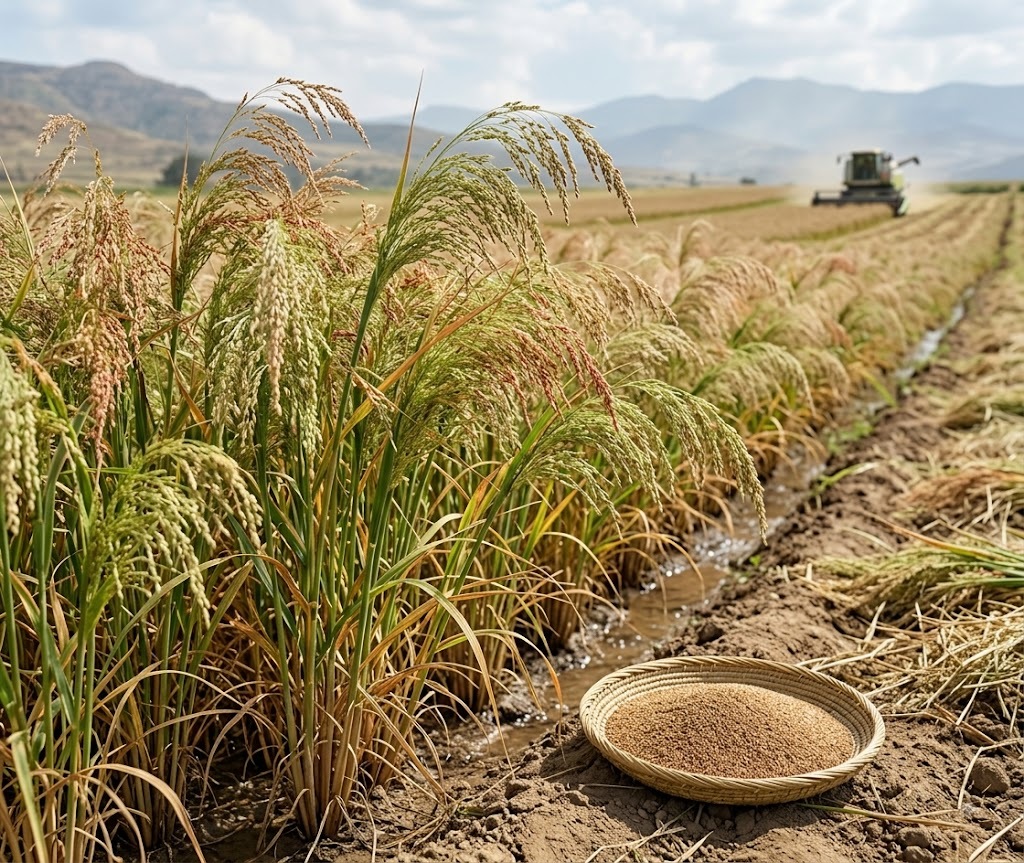
The USDA classifies teff as *Eragrostis tef* of the grass family, and the USDA-NRCS describes it as a summer annual herbaceous plant, explaining that sowing depth and the preparation of a firm seedbed are important due to the very small size of the seeds. ( USDA Plant Database )
Research literature listed in FAO AGRIS summarizes that teff is a grain native to Ethiopia and Eritrea, serving as a primary ingredient in traditional fermented foods such as injera in Ethiopia, and is used in the processing of various foods including whole grain flour, bread, and pasta. ( Agris )
Plant Identity
Basic fields | Teff registration criteria |
| Korean name | Tef |
| English name | Teff / Tef |
| Representative scientific name | Eragrostis tef (Zuccagni) Trotter |
| classification | Poaceae · Eragrostis |
| Edible parts | Mature seeds |
| Non-edible · Separate management | Stems, leaves, roots, straw, hay, sorting by-products |
| Major harvesting stages | Edible seed maturity / Seed maturity / Harvesting for forage and hay |
| Basic product form | Raw grain, refined grain, whole grain powder, milling raw materials, fermentation raw materials, puffed grain, processed products |
| Basic processing stage | Harvesting → Threshing → Drying → Sorting → Milling → Blending, Fermentation, Heat Treatment → Productization |
| Basic use | Whole grains, porridge, powder, fermented bread, baking, pasta, cereal, snacks, mixed grains, animal feed |
| Similarity Principle | Plant Entity separate from Millet, Sorghum, Quinoa, and Amaranth |
USDA Plants and APHIS identify the scientific name of teff as Eragrostis tef and use Teff, Tef, etc., as common names. ( ACIR )
Product Master
Product ID | Product type | Key Management Standards |
| TEF-P01 | Teff Original Song | Variety · Origin · Harvest Date · Moisture · Lot |
| TEF-P02 | Jeongseon Tef | Fine foreign matter, other seeds, damaged grains, uniformity |
| TEF-P03 | White teff | Actual variety, color, origin, lot |
| TEF-P04 | Brown and red teff | Color, variety, origin, processing suitability |
| TEF-P05 | Teff powder | Particle size, moisture, ash, microorganisms, Lot |
| TEF-P06 | Teff powder for fermentation | Particle size, absorbency, and fermentation suitability |
| TEF-P07 | Ingredients for confectionery and baking | Mixing, Dough, and Product Suitability |
| TEF-P08 | Ingredients for pasta and noodles | Particle size, mixing, and molding suitability |
| TEF-P09 | Puffed and cereal ingredients | Seed, Heat Treatment, and Puffing Characteristics |
| TEF-P10 | fermented dough | Raw Material Lot · Blending · Fermentation Time · Process |
| TEF-P11 | Injera type product | Fermentation, Heating, Packaging, Manufacturing Lot |
| TEF-P12 | HMR·PB ingredients | Buyer Spec · Cooking · Packaging |
| TEF-P13 | teff hay | Mowing time, moisture, drying, feed use |
| TEF-P14 | Fresh grass for animal feed | Harvest stage · Biomass · Moisture |
| TEF-P15 | Teff for seeds | Variety · Germination · Seed Purity · Seed Lot |
| TEF-P16 | finished product | Labeling · Raw Materials · Manufacturing Lot · Use-by Date |
Classification criteria | Subdivision type | Management principles |
| Plant classification | Eragrostis tef | Separated from Eragrostis species |
| Variety/Lineage | White, brown, and actual varieties | Do not estimate breed based on color alone |
| Seed uses | Edible / Seed | Seed Lot Separation |
| Harvesting stage | Mature seeds / Hay/Forage | Product Separation |
| production area | Domestic test cultivation / Import origin | Separation of Source and Lot |
| Distribution methods | Original Song · Selected Song · Powder | Separate Product ID |
| Processing form | Milling, fermentation, puffing, extrusion, baking | Create Process Lot |
| Final use | Fermented bread, confectionery, noodles, cereal, HMR, animal feed | Buyer RFQ Separation |
| Transaction type | Import · Domestic Production · Contract Farming · OEM · PB | The actual transaction is an NDA |
| Gluten management | Natural raw materials / Cross-contact with manufacturing facilities | Separation of product labeling and inspection |
Although teff is being studied as a grain that inherently lacks gluten proteins like wheat, barley, and rye, actual gluten-free product labeling requires separate verification of the raw material itself and any cross-contact during the manufacturing process . USDA research also explains that teff has been used in gluten-free foods. ( ARS )
step | Essential Dataset | Management purpose |
| Cultivation plan | Variety · End Use · Origin · Buyer | Market-based production |
| satellite | Variety · Germination · Seed Lot | Breed Traceability |
| Seed selection | Purity, fine particles, germination | Micrograin seed quality |
| Soil preparation | Soil, leveling, and seedbed | uniform budding |
| sowing | Sowing date, sowing quantity, depth, and method | Budding stability |
| budding | Budding rate and uniformity | Securing hair |
| Growth management | Plant height, tillering, heading, ripening | Production forecast |
| rising | Temperature, Precipitation, Wind Speed | Growth and lodging |
| Watering | Method, timing, and quantity | Moisture management |
| dispute | Fertilizer, Timing, and Amount | Production and uniform management |
| weeds | Occurrence and Control | Early growth |
| pests | Monitoring, outbreaks, and control | Quality and quantity |
| martial arts uniform | Date of occurrence, severity, and cause | Harvesting and Quality Control |
| Heading and ripening | Date and status | Harvest forecasting |
| Harvest judgment | Maturity, moisture, uniform, weather | Harvesting at the right time |
| harvest | Date, Equipment, Loss | Harvest Lot |
| threshing grain | Recovery of equipment, loss, and micro-seeds | Grain Lot |
| dry | Moisture, Time, Method | save |
| Jeongseon | Sieve, air separation, foreign matter | Food ingredient conversion |
| save | Moisture, temperature, humidity, pests | Maintaining quality |
| Milling | Particle size, yield, fractionation | Flour Product |
| fermentation | Ingredients, Water, Time, Temperature, pH | Fermented Product |
| Swelling and extrusion | Process conditions and yield | Cereals and snacks |
| packaging | Specifications/Packaging Date | Sales unit |
| shipment | Buyer · Lot · Delivery Date | RFQ Traceability |
The USDA-NRCS explains that teff seeds are very small, with approximately 1 million seeds per pound, and advises that shallow sowing and firm seedbeds are important. Since these figures are from the Iowa Cover Crop Technical Data, they are not directly applied as standard sowing values for edible teff in Korea. ( Natural Resources Conservation Service )
Lodging has been studied as one of the major cultivation problems for teff. Related international research indicates that severe lodging can occur alongside increased ear weight, demonstrating the need to manage variety, planting, fertilization, and weather data together. ( Agris )
Quality items | raw materials | Pre-treated products | processed goods | finished product | Public rating |
| Species | essential | succession | succession | tracking | Public |
| Variety/Lineage | essential | succession | tracking | If necessary | Member |
| origin | essential | succession | succession | Display/Tracking | Public/Verified |
| producer | ID | succession | succession | tracking | Verified |
| Lot | essential | New Lot | New Lot | Manufacturing Lot | Verified/NDA |
| Sowing and harvesting dates | Domestic products are essential. | succession | tracking | - | Verified |
| Seed color | record | Selection | Raw material specifications | By product | Member |
| appearance | check | core | Raw material specifications | Product Standards | Member |
| Seed uniformity | check | core | Raw material specifications | If necessary | Member |
| weight | record | record | record | mark | NDA |
| moisture | core | core | By product | By product | Verified |
| immature teeth | check | eliminate | tracking | - | Verified |
| Damaged lip | check | eliminate | tracking | - | Verified |
| alien substance | core | core | test | Compliance with standards | Verified |
| Mixing of other grains and seeds | check | core | tracking | Display management | Verified |
| pesticide residues | Required test | connection | By product | Related standards | Verified/NDA |
| microorganism | If necessary | core | By product | Food standards | Verified/NDA |
| Mold and toxins | Review by Raw Material | test | tracking | Related standards | Verified/NDA |
| Milling history | - | - | essential | tracking | Verified |
| Gluten cross-contact | Raw material supply | Check facilities and lines | Process verification | Mark verification | Verified/NDA |
| Fermentation history | - | - | Fermented Product Essential | tracking | Verified |
| packaging | record | record | Product packaging | Final packaging | Member |
| save | essential | essential | essential | Product Conditions | Verified |
| Expiration date | The relevant city | By product | By product | Labeling standards | Member |
| Shipment · Return · Claim | record | record | record | record | NDA |
| Repurchase | RFQ connection | connection | connection | Buyer Connection | NDA |
Lot Master Required Field
Lot ID · Item · Product Type · Scientific Name · Variety/Strain · Seed Color · Country of Origin/Origin · Producer · Seed Lot · Cultivation Method · Sowing Date · Heading Date · Harvest Date · Harvest Stage · Lodging History · Quality Indicators · Moisture · Weight · Dimensions · Grade · Immature Grains · Damaged Grains · Appearance · Pesticide Usage Records · Pesticide Residue · Microorganism · Mycotoxin Test Reports · Threshing · Drying · Storage History · Raw Material Lot · Sorting · Milling History · Fermentation · Puffing · Processing History · Gluten Cross-Contact Management · Packaging Date · Best Before Date · Shipper · Returns · Claims · Repurchase
Korean production structure
Domestic Teff Cultivation Area: To be entered after verification of official raw data
Domestic Teff Production Volume: To be entered after verification of official raw data
In the current v1.0 version, since the domestic exclusive cultivation area and production volume of teff based on nationally approved statistics could not be verified, cultivation cases and online sales volumes are not substituted with national production statistics.
Therefore, it is appropriate to manage domestic teff not as a “large-scale Korean production crop” but as a pilot crop to verify its domestic adaptability, cultivation suitability, processing capabilities, and import substitution potential .
Customers | Purchase criteria | Cooperation opportunities |
| Import and grain distribution companies | Country of origin, variety, color, moisture, price | stable procurement |
| Specialized grain distribution | Raw grain, powder, packaging | B2B supply |
| flour mill | Micrograin milling potential, particle size, and yield | Dedicated milling |
| Bakery | Powder, Compatibility, and Cross-Contact Management | Baking ingredients |
| Manufacturing of gluten-free products | Raw Materials · Facilities · Testing · Traceability | Specialized Product |
| fermented food companies | Fermentation suitability and powder specifications | Injera-type fermented products |
| cereal companies | Swelling and extrusion suitability | cereals |
| snack companies | Heat treatment, puffing, texture | Product Development |
| HMR | Cookability, Pre-processing, Packaging | Convenience food |
| food service companies | Fermented bread · Grain menu · Ingredient safety | Regular supply for the menu |
| School and public meals | Legal food ingredients, safety, and price | Pilot after verification |
| PB·Distribution | Origin, Differentiation, Small Packaging | PB |
| Domestic test cultivation farms | Varieties, Seeds, and Sales Channels | Contract Farming Pilot |
| Research Institute | Domestic adaptability, uniform, quality, and processing | joint research |
| Feed and Livestock | Hay, feed value, and price | Separate RFQ review |
step | Key variables | Operational judgment |
| Overseas production | Country, Crop Conditions, Quality | Source Risk |
| exporters | Variety, Lot, Processing Status | Supplier Verification |
| international procurement | Price · Freight · MOQ | Landed Cost |
| Import customs clearance | HS · Food Requirements · Quarantine | Compliance |
| Domestic storage | Moisture, pests, and inventory | Maintaining quality |
| Seongseon and Milling | Microparticle processing capability | Processor suitability |
| food processing | Blending, fermentation, and heat treatment | Product conformity |
| domestic cultivation | Production Cost, Quantity, Quality | Import Substitution Comparison |
| RFQ | Quality, Price, Delivery Time | Buyer Match |
| Repurchase | Quality, Sales, and Claims | Repeat trading |
Trade Management
The international customs classification of Teff may vary by country, and in this v1.0, since the current HSK of the Korea Customs Service could not officially confirm a Teff-only tariff code, no arbitrary HS Code is assigned.
item | Operating Principles |
| HS | Input later after official verification of the current HSK by the Korea Customs Service |
| Item Description | Check if Teff / Eragrostis tef exists |
| Original song | Distinction between edible and seed use |
| powder | Reviewed three times separately from the original song |
| Fermented and baked goods | Finished product, three separate items |
| Major suppliers | Input after verifying official trade data |
| Import volume | Further verification |
| Revenue | Further verification |
| Customs clearance unit price | Calculate after checking three times, unit, and product condition. |
| Quarantine | Quarantine verification by raw grain and seed status |
| FTA | Check Country of Origin, HS Code, and Rules of Origin |
| Food safety | Check standards related to imported food |
| distribution | Moisture-proof, pest-proof, packaging, and small-quantity procurement conditions |
Domestic Teff Import Volume, Value, Major Countries of Origin, and Customs Clearance Unit Price: To be entered later after verification of official raw data from the Korea Customs Service
The import volume included in other millet or other grain HS codes is not arbitrarily converted into a figure for teff alone.
Products and processes | Key conditions | RFQ conversion |
| Original song | Species · Varieties · Origin · Pollination | Import/Origin RFQ |
| Selected Songs | Fine foreign matter and foreign seeds | flour mill |
| Whole grain powder | Particle size, yield, color, moisture | Bakery · HMR |
| Fermentation powder | Particle size, absorption, and fermentation characteristics | fermented foods |
| fermented dough | Mixing, Time, Temperature, pH | Injera-type Product |
| Baking ingredients | Mixing, dough, texture | Bakery |
| Pasta and noodle ingredients | Mixing, molding, and cooking characteristics | Food manufacturing |
| Pyeonghwagok | Heat treatment and degree of expansion | cereals |
| Extruded snacks | Blending and Extrusion Conditions | Snack RFQ |
| Mixed grains | Mixing ratio · Origin | PB |
| HMR ingredients | Cooking, Pre-processing, and Storage | HMR |
| hay | Mowing, drying, moisture | Feed RFQ |
| Straw and residue | Contamination and moisture | Feed and Compost Review |
| Milling by-products | Safety and Ingredients | Food and feed verification |
| finished product | Labeling, packaging, and expiration date | Retail·Export |
A review listed in FAO AGRIS concludes that whole teff flour can be used in foods such as bread and pasta, and USDA research also demonstrates that research on the food processing of teff flour has been ongoing. ( Agris )
Possible areas for byproduct utilization review:
Feed · Hay · Compost · Fermentation · Food Materials · Biomaterials · Waste Reduction
The conversion of food, functional, pharmaceutical, and cosmetic materials into products is carried out after confirming official safety, legal usability, and research evidence .
PRP — Product Research Profile
PRP ID | Product Research Profile |
| PRP-TEF-01 | Adaptability of Teff varieties to the domestic climate |
| PRP-TEF-02 | Seed Size–Sowing Depth–Emergence Relationship |
| PRP-TEF-03 | Planting density–growth–lodging relationship |
| PRP-TEF-04 | Relationship between sowing date, heading, maturity, and yield |
| PRP-TEF-05 | Raw grain quality by variety and color |
| PRP-TEF-06 | Micrograin sorting and foreign matter removal technology |
| PRP-TEF-07 | Milling yield for ultra-fine grains |
| PRP-TEF-08 | Whole grain flour particle size – baking suitability |
| PRP-TEF-09 | Teff Fermentation Characteristics · Injera-type Product |
| PRP-TEF-10 | Pasta and noodle blending suitability |
| PRP-TEF-11 | Suitability for puffed and extruded snacks |
| PRP-TEF-12 | Gluten Cross-Contact Management Model |
| PRP-TEF-13 | Cost Gap Between Domestic Cultivation and Imported Raw Materials |
| PRP-TEF-14 | Comparison of Buyer Specs for Domestic and Imported Products |
| PRP-TEF-15 | Teff Hay & Feed Product Verification |
| PRP-TEF-16 | Buyer Spec – Variety – Processing Process AI Match |
PRP is operated as a Product Research Profile that verifies cultivation feasibility, selection, milling, fermentation, product suitability, and buyer procurement feasibility, rather than promoting 'superfoods' .
first of all | Execution item | Performance indicators |
| 1 | Species, Variety, Origin, Harvest Date, and Lot are mandatory. | Required field input rate |
| 2 | Separation of Raw Grain, Powder, Fermented, Puffed, and Hay Products | Product identification rate |
| 3 | Linking weather, growth, lodging, heading, and harvest data | Production connection rate |
| 4 | Datafication of quality, certificates, sorting, milling, and fermentation history | Traceability rate |
| 5 | Producer/Importer – Milling – Food Manufacturing – Buyer RFQ Connection | Match rate |
| 6 | Video AI Budding and Growth Assessment | Judgment accuracy |
| 7 | AI martial arts uniform risk prediction | gi prediction accuracy |
| 8 | Yield prediction | Expected-Real Return Error |
| 9 | Imaging and optical micrograin sorting | Foreign substance detection rate |
| 10 | Prediction of milling yield | Lot-specific error |
| 11 | Fermentation Runtime | pH, time, and product variation |
| 12 | Import–Domestic Production Arbitrage | Landed Cost Comparison |
| 13 | Inventory and Supply Forecast | Buyer Supply Gap |
| 14 | AI Buyer Match | Valid Match Rate |
| 15 | Traceability | Finished Product Traceability |
| 16 | Repurchase Runtime | Repurchase rate · Claim rate |
Problem group | Problem Definition | Required data |
| Lack of product awareness | Lack of industry information for Korean producers and buyers | Market·Buyer |
| No. 13 Adjacent Entity Validation | The item name preceding the Master sequence is undetermined in the current data. | Master Register |
| Seed supply shortage | Possibility of insufficient domestic verified seed sources | Seed·Supplier |
| Micrograin sowing | Uniform sowing is difficult due to the very small size of the seeds. | Seed size · Sowing |
| Sowing depth error | Risk of reduced emergence during deep sowing | Depth · Budding |
| Uneven hair growth | Influence of seed type, moisture, and sowing conditions | Soil·Emergence |
| martial arts uniform | Variety, density, fertilization, and weather influences | Lodging Dataset |
| Domestic cultivation adaptability | Lack of data on adaptability to the Korean climate by variety | Climate · Variety |
| Harvest loss | mechanical harvesting and threshing losses of small seeds | Harvest Loss |
| Jeongseon Nando | Separation of fine seeds and foreign matter | Equipment·Yield |
| Flour milling facility suitability | Applicability of existing grain milling facilities is unclear | Facility·PRP |
| Lack of food standards | Teff raw material specifications by buyer are not standardized | Buyer Spec |
| Gluten cross-contact | The characteristics of the raw materials and the manufacturing environment differ. | Facility·Test |
| Fermentation process deviation | Fermentation time, microorganisms, and differences in formulation | pH·Time·Batch |
| Lack of product suitability | Lack of data for domestic bread, noodles, and HMR applications | PRP |
| Absence of official domestic statistics | It is difficult to objectively assess the scale of production | National Statistics |
| HS subdivision unclear | Difficulty in analyzing the trade volume of TEF alone | Customs |
| dependence on imported raw materials | Domestic demand exposed to import prices and delivery times | Trade·Inventory |
| Contract farming risk | Sales channel risk when expanding production without a verified buyer | Contract·RFQ |
| Lack of inventory visibility | Difficulty verifying actual inventory of imported and domestic products | Inventory |
| Discontinuity of raw material-processing history | Lack of traceability for origin and raw material lots | Parent–Child Lot |
| Insufficient repurchase data | Lack of verification of repeat demand for new products | Sales · Repurchase |
Given that the USDA-NRCS separately emphasizes the importance of micro-seeds and shallow sowing for teff, Seed Size → Seedbed → Seeding Depth → Emergence → Stand Density constitutes a core problem relationship. ( Natural Resources Conservation Service )
In addition, as lodging in teff is repeatedly addressed as a major cultivation issue in international research, variety → planting density → fertilization → ear weight → lodging → harvest loss are managed as a separate runtime. ( Agris )
Problem group | Problem Definition | Required data |
| Lack of product awareness | Lack of industry information for Korean producers and buyers | Market·Buyer |
| No. 13 Adjacent Entity Validation | The item name preceding the Master sequence is undetermined in the current data. | Master Register |
| Seed supply shortage | Possibility of insufficient domestic verified seed sources | Seed·Supplier |
| Micrograin sowing | Uniform sowing is difficult due to the very small size of the seeds. | Seed size · Sowing |
| Sowing depth error | Risk of reduced emergence during deep sowing | Depth · Budding |
| Uneven hair growth | Influence of seed type, moisture, and sowing conditions | Soil·Emergence |
| martial arts uniform | Variety, density, fertilization, and weather influences | Lodging Dataset |
| Domestic cultivation adaptability | Lack of data on adaptability to the Korean climate by variety | Climate · Variety |
| Harvest loss | mechanical harvesting and threshing losses of small seeds | Harvest Loss |
| Jeongseon Nando | Separation of fine seeds and foreign matter | Equipment·Yield |
| Flour milling facility suitability | Applicability of existing grain milling facilities is unclear | Facility·PRP |
| Lack of food standards | Teff raw material specifications by buyer are not standardized | Buyer Spec |
| Gluten cross-contact | The characteristics of the raw materials and the manufacturing environment differ. | Facility·Test |
| Fermentation process deviation | Fermentation time, microorganisms, and differences in formulation | pH·Time·Batch |
| Lack of product suitability | Lack of data for domestic bread, noodles, and HMR applications | PRP |
| Absence of official domestic statistics | It is difficult to objectively assess the scale of production | National Statistics |
| HS subdivision unclear | Difficulty in analyzing the trade volume of TEF alone | Customs |
| dependence on imported raw materials | Domestic demand exposed to import prices and delivery times | Trade·Inventory |
| Contract farming risk | Sales channel risk when expanding production without a verified buyer | Contract·RFQ |
| Lack of inventory visibility | Difficulty verifying actual inventory of imported and domestic products | Inventory |
| Discontinuity of raw material-processing history | Lack of traceability for origin and raw material lots | Parent–Child Lot |
| Insufficient repurchase data | Lack of verification of repeat demand for new products | Sales · Repurchase |
Given that the USDA-NRCS separately emphasizes the importance of micro-seeds and shallow sowing for teff, Seed Size → Seedbed → Seeding Depth → Emergence → Stand Density constitutes a core problem relationship. ( Natural Resources Conservation Service )
RFQ Type | Public Registration | Verify/NDA |
| domestic test cultivation | Region, Variety, Purpose | Farms, Area, Seeds, Costs |
| contract farming | Variety, Region, Product Use | Area, Quantity, Unit Price |
| Seed supply | Species · Varieties | Seed Lot · Germination · Price |
| Imported original song | Country of Origin · Product | Volume, Price, Contract |
| Domestic original song sales | Variety, Origin, Harvest Season | Actual volume and unit price |
| Selected Songs | General Spec | Facility·Lot |
| Whole grain powder | Particle size and uses | Test Reports · MOQ |
| Fermentation powder | Product Use | Fermentation test · Price |
| Confectionery and baking ingredients | Powder and mixing uses | Sample and processing tests |
| Pasta and noodles | Raw material specifications | Mixing test |
| Cereal · Puffed | Product Type | Swelling test |
| HMR | Cooking and Product Concepts | Samples · Delivery Time |
| dining out | Fermented bread and grain menu | Actual supply |
| school meals | Product Safety | Test Report · Delivery Date |
| OEM·PB | Product concept | MOQ · Recipe · Contract |
| Hay and feed | Harvesting type and region | Quantity, Testing, Unit Price |
| export | Processed products · Country | HS · Certification · Price |
| Technology demonstration | Cultivation, sorting, and milling | Test Dataset |
| Research cooperation | Variety · Lodging · Processing · Fermentation | Confidential research materials |
| Comparison of Domestic and Imported Products | Product/Specifications | Cost · MOQ · Lead-time |
Verified/NDA: Actual Producer · Seed Supplier · Cultivated Area · Projected Production Volume · Importer · Milling Facility · Quantity · Actual Unit Price · MOQ · Certificate of Examination · Lot · Sample · Milling Yield · Fermentation Conditions · Contract Terms · Delivery Date · Claims · Repurchase
RFQ Runtime:
RFQ Registration → Supplier Verification → AI Match → Sample → Quality/Milling/Fermentation/Product Testing → Negotiation → Contract → Production/Import Securing → Lot → Processing → Delivery → Inspection → Performance Evaluation → Repurchase
① Need Products & Materials
Companies and institutions seeking necessary products, agricultural products, raw materials, and processed goods register purchasing demands. Registered requests are utilized to review cooperation with potential suppliers and producers based on the RFQ Intelligence Library.
Process:
RFQ Registration → Supplier/Product Review → Collaboration Connection → Future AI Matching
Register
② We are looking for production and manufacturing partners. (Need Suppliers & Manufacturers)
Register a request to find necessary production and supply partners, ranging from farms and producer organizations to processing companies, OEM, ODM, and private label manufacturers.
Process:
RFQ Registration → Review of Production & Manufacturing Capabilities → Collaboration Connection → Future AI Partner Matching
Register
③ We are looking for domestic and international buyers. (Need Buyers)
Farmers, producer organizations, and manufacturing companies are requesting cooperation with new buyers, such as domestic and international distributors, importers, brand companies, and food service and catering businesses.
Process:
RFQ Registration → Product & Supply Capability Review → Market & Buyer Connection → Future AI Buyer Matching
Register
Contact : mail@markethub.org
Version | Main contents | situation |
| v1.0 | Plant Identity · Seed · Production · Import · Milling · Fermentation · Product · RFQ Basic Structure Registration | complete |
| v1.1 | No. 13 Master Linkage and Verification of Domestic Production, HS, and Imported Raw Data | expected |
| v2.0 | Detailed quality standards by product type: raw grain, powder, fermented, bread, puffed, and feed | expected |
| v3.0 | Producer/Importer – Sorting/Milling – Food Manufacturing – Distribution – Buyer Verified Container Combination | expected |