

Judgment axis | Key judgment |
| Item Identity | Similar grains centered on Grain Amaranth among the plant group of the genus Amaranthus of the family Amaranthaceae |
| Key role | Whole grains, powder, puffed grains, cereals, snacks, confectionery and baking, mixed grains, food materials and varieties, raw materials for bio-research |
| Harvesting principle | Seed harvest is determined based on species, variety, sowing date, heading, maturity, weather conditions, and lodging, and separated from leafy vegetable types. |
| Product separation | Raw grains, selected grains, powders, puffed grains, sprouted grains, food processing raw materials, and finished products are managed as separate products. |
| Separation of similar items | It belongs to a different genus from quinoa, and even within the same amaranth, species such as A. hypochondriacus, A. cruentus, and A. caudatus are classified by species. |
| Domestic statistics | Official national statistics on nationwide amaranth exclusive cultivation area and production volume: To be entered after verification of official raw data. |
| Supply and demand risk | Lack of domestic commercial cultivation infrastructure, mixing of species and varieties, losses during sowing, sorting, and harvesting of ultra-small seeds, lodging, shortage of dedicated processing facilities, and competition from imported raw materials. |
| Operating Principles | Species–Seed–Production–Harvest–Cleaning–Processing–Product–Buyer Link RFQ to Lot |
| Final goal | Establishing a supply chain capable of repeat purchases by comparing test cultivation, Korean production, import procurement, and processed products of the same specifications |
In 2022, the Rural Development Administration announced the selection of seven amaranth resources with high potential for utilization from those held by the National Center for Agricultural Genetic Resources, evaluating amaranth as a candidate for a new income crop to address climate change and as a material for breeding and the bio-industry. At the same time, the data at the time described it as a crop for which a foundation for domestic commercial cultivation had not yet been sufficiently established. ( Rural Development Administration )
However, domestic adaptation trials and regional cultivation cases existed prior to that. In 2012, the Rural Development Administration tested the domestic adaptability of quinoa and amaranth and released test results indicating that the cultivation period required is approximately 4 to 6 months, with harvesting possible in September after seedling cultivation and transplanting around March to May . This technical data is based on test conditions at the time, such as high-altitude regions, and is not used as a national standard cropping system. ( Rural Development Administration )
Plant Identity
Basic fields | Amaranth Registration Criteria |
| Korean name | amaranth |
| English name | Amaranth / Grain amaranth |
| Representative scientific name | Amaranthus hypochondriacus L. |
| Species expansion | A. cruentus L., A. caudatus L., etc. are separate Species Entities |
| classification | Amaranthaceae · Amaranthus |
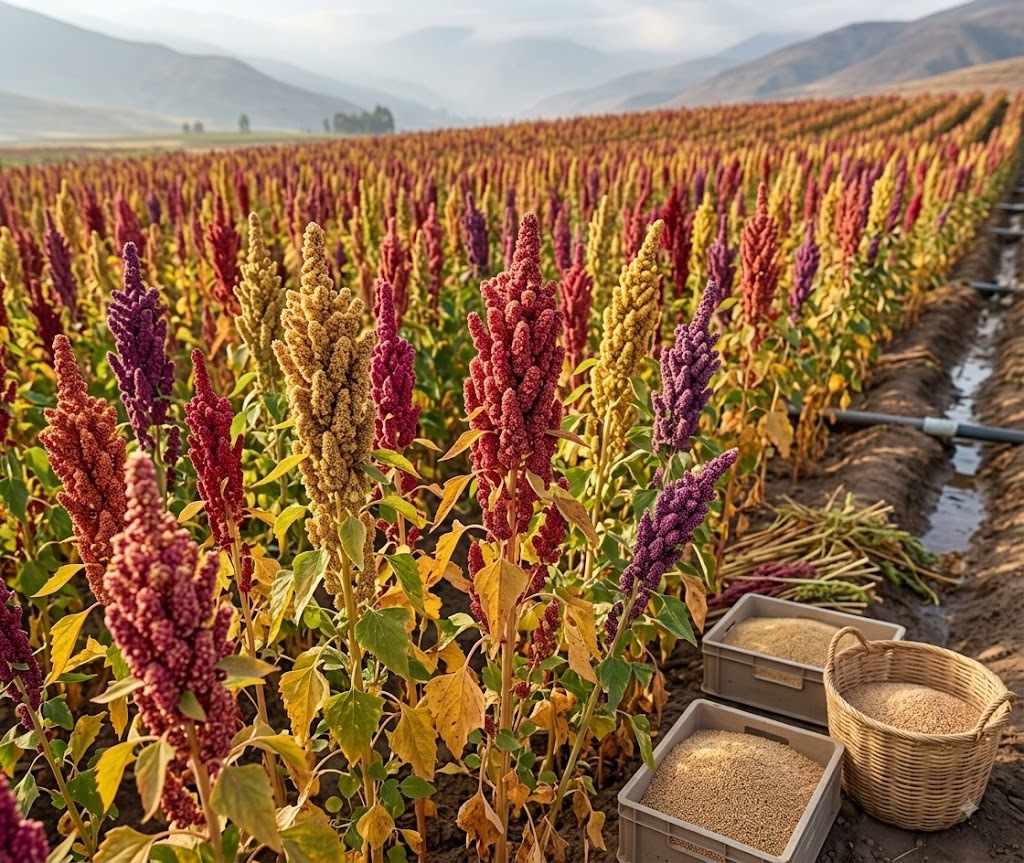
| Edible parts | Grain Amaranth is a mature seed |
| Non-edible · Separate management | Stems, roots, inflorescences, and sorting by-products. Edible leaves and young stems are sold separately. Product/Species |
| Major harvesting stages | Seed maturity stage / Seed maturity stage / Young stage for leafy vegetables |
| Basic product form | Raw grain, selected grain, whole grain, powder, puffed grain, germinated grain, processed raw material |
| Basic processing stage | Harvesting → Threshing → Drying → Sorting → Grinding, Puffing, Germination, Blending → Productization |
| Basic use | Mixed grains, powders, confectionery and baking, cereals, snacks, HMR, food ingredients, research materials |
| Similarity Principle | Separation of Quinoa, Edible Amaranthus, Other Amaranthus Species, and Entity |
At the Agricultural Genetic Resources Center, amaranth is registered under the family Amaranthaceae, with the scientific name *Amaranthus hypochondriacus*, and native and introduced resources from various origins, including China, are preserved as separate Seed Resources. ( Seed Bank )
Product Master
Product ID | Product type | Key Management Standards |
| AMA-P01 | Amaranth Original Song | Species · Variety · Origin · Harvest Date · Moisture · Lot |
| AMA-P02 | Jeongseon Amaranth | Fine foreign matter, immature grains, other seeds, uniformity |
| AMA-P03 | Edible whole grains | Selection · Safety · Moisture · Origin |
| AMA-P04 | White/Pale-colored Seed Product | Species · Varieties · Color · Lot |
| AMA-P05 | Black and colored seeds | Separation after verifying the actual species and variety |
| AMA-P06 | Amaranth powder | Particle size, moisture, microorganisms, raw material Lot |
| AMA-P07 | Puffed amaranth | Degree of puffing, heat treatment, texture, moisture |
| AMA-P08 | Germinating amaranth | Seed Lot · Germination Time · Hygiene · Drying |
| AMA-P09 | Raw materials for mixed grains | Mixing Ratio · Origin · Lot |
| AMA-P10 | Cereal and granola ingredients | Puffing, Heat Treatment, and Mixing Standards |
| AMA-P11 | Confectionery and baking ingredients | Powder particle size and mixing suitability |
| AMA-P12 | Snack ingredients | Swelling, extrusion, and coating suitability |
| AMA-P13 | HMR/Convenience Food Ingredients | Pre-processing, cooking, and packaging |
| AMA-P14 | Research · Food material raw materials | Species · Ingredients · Test Basis |
| AMA-P15 | Amaranth for seeds | Species · Varieties · Germination · Seed Lot |
| AMA-P16 | Leafy vegetable-type amaranth | Species · Harvesting Stage · Leaves · Stems Separate Product |
| AMA-P17 | by-product | Stem, leaf, inflorescence, and remnants of the stem |
| AMA-P18 | finished product | Raw materials · Processing Lot · Packaging · Use-by date |
Classification criteria | Subdivision type | Management principles |
| Plant classification | A. hypochondriacus·A. cruentus·A. caudatus, etc. | Species Separate Plant Entity |
| Lee Yong-hyung | For seeds / For leafy vegetables | Separation of edible parts and harvesting stage |
| Varieties and resources | Cultivation, introduction, and native resources | Connect Seed Resource ID |
| seed color | White, yellow, brown, black, etc. | Prohibition of Estimating Species/Breeds Based on Color Alone |
| Harvesting stage | Mature seeds / Seeds / Young leaves | Product Separation |
| Cultivation method | By domestic test, region, and sowing season | Sowing, heading, and maturity records |
| Distribution methods | Original, Selected, Powder, Puffed | Product ID Classification |
| Processing form | Grinding, puffing, germination, extrusion, mixing | Create Process Lot |
| Final use | Mixed grains, cereals, baked goods, snacks, HMR, research materials | Buyer Spec Connection |
| Transaction type | Domestic Production · Import · Contract Farming · OEM · PB | Quantity and Price NDA |
| origin | Domestic/Imported | Origin Lot Inheritance |
Internationally, grain amaranth includes multiple cultivated species. Therefore, rather than forcibly unifying Amaranth into a single scientific name, a two-tiered structure is used: Market Name = Amaranth / Plant Species = Individual Scientific Name . ( Agris )
Furthermore, since the Rural Development Administration explains that amaranth belongs to the same genus Amaranthus as the Korean purslane (*Chambireum*) consumed as a vegetable in Korea, existing domestic edible purslane varieties and Grain Amaranth must not be registered as the same product. ( Rural Development Administration )
step | Essential Dataset | Management purpose |
| Cultivation plan | Species·Varieties·Uses·Regions·Area·Buyer | Market-based production |
| satellite | Species · Varieties · Origin · Seed Lot | Breed Traceability |
| germination test | Germination rate · Inspection date | Seed Quality |
| Sowing and seedling cultivation | Sowing date, sowing method, and seedling conditions | Early growth |
| Formal/Direct Sowing | Cultivation method, date, density | Crop management |
| Budding and rooting | Budding and rooting rates | production stability |
| Growth management | Plant height, branching, inflorescence, heading, maturation | Harvest forecasting |
| rising | Temperature, Precipitation, Sunshine, Wind Speed | Growth and Lodging Analysis |
| Watering | Timing, Quantity, and Method | Moisture management |
| dispute | Fertilizer, Timing, and Amount | Quantity and Uniform Management |
| weeds | Occurrence and Control | Early competition management |
| pests | Monitoring, outbreaks, and control | Quality and quantity |
| martial arts uniform | Date of occurrence, severity, and cause | Harvest loss management |
| Maturity assessment | Inflorescence, seed color, pollination, shattering | Harvest decision |
| harvest | Harvest date, method, weather | Harvest Lot |
| threshing grain | Equipment, Conditions, and Recovery Rate | Securing micrograin seeds |
| dry | Moisture, Time, Method | Storage stability |
| Jeongseon | Sieve, balloon, micromaterial | Food ingredient conversion |
| purifying | Process records if necessary | food processing |
| smash | Particle size and yield | Flour Product |
| Swelling | Temperature, Time, and Degree of Swelling | Cereal Product |
| germination | Germination time, temperature, and hygiene | Sprouted Product |
| Extrusion | Temperature, pressure, and mixing | Snack Product |
| save | Temperature, humidity, and period | Maintaining quality |
| packaging | Specifications/Packaging Date | trading unit |
| shipment | Buyer · Lot · Delivery Date | Delivery tracking |
The Rural Development Administration reported in domestic adaptation trials in 2012 that it was possible to grow quinoa and amaranth seedlings and transplant them between March and May, and harvest them in September. At the time, the cultivation period was suggested to be approximately 4 to 6 months; however, since this value varied by region, species, variety, and test conditions, it is not fixed as the national standard cultivation period. ( Rural Development Administration )
In the 2021 characteristic evaluation case for a specific A. hypochondriacus resource at the National Center for Agricultural Genetic Resources, sowing was recorded as May 4, emergence as May 10, heading as July 16, and maturity as September 10. These are characteristic values for the **IT262688 single genetic resource and the corresponding test environment, and do not serve as a standard for the cropping viability of Amaranth as a whole. ( Seed Bank )
Quality items | raw materials | Pre-treated products | processed goods | finished product | Public rating |
| Species | essential | succession | succession | tracking | Public/Verified |
| Varieties and resources | essential | succession | tracking | If necessary | Member |
| Country of origin/country of origin | essential | succession | succession | tracking | Public/Verified |
| producer | ID | succession | succession | tracking | Verified |
| Lot | essential | new | new | Manufacturing Lot | Verified/NDA |
| Sowing date | Domestic record | succession | tracking | - | Verified |
| Harvest day | essential | succession | succession | tracking | Verified |
| seed color | record | Selection | Product Spec | By product | Member |
| appearance | check | core | Raw material specifications | Product specifications | Member |
| Seed uniformity | check | core | Raw material specifications | If necessary | Member |
| moisture | core | core | By product | By product | Verified |
| immature teeth | check | eliminate | tracking | - | Verified |
| Damaged lip | check | eliminate | tracking | - | Verified |
| alien substance | core | core | Process inspection | Compliance with standards | Verified |
| Contamination with other seeds | core | core | tracking | Markings and Standards | Verified |
| mold | check | test | By product | Related standards | Verified/NDA |
| pesticide residues | test | Linkage | Related standards | Related standards | Verified/NDA |
| microorganism | By product | If necessary | Key Points of Powders and Sprouted Products | Food standards | Verified/NDA |
| germination hygiene | - | The relevant city | Key points of sprouted products | Product Standards | Verified/NDA |
| Grinding history | - | - | essential | tracking | Verified |
| Puffing history | - | - | By Product | tracking | Verified |
| Processing history | - | record | essential | essential | Verified/NDA |
| packaging | Original song | Preprocessing | product | Final | Member |
| save | essential | essential | essential | Product Conditions | Verified |
| Expiration date | The relevant city | By product | By product | Labeling standards | Member |
| Shipment · Return · Claim | record | record | record | record | NDA |
| Repurchase | Buyer Connection | connection | connection | Buyer Connection | NDA |
Lot Master Required Field
Lot ID · Item · Product Type · Species · Scientific Name · Variety/Resource · Seed Color · Cultivation Type · Country of Origin · Origin · Cultivation Area · Producer · Seed Lot · Cultivation Method · Sowing/Planting Date · Heading Date · Maturity Date · Harvest Date · Lodging History · Quality Indicators · Moisture · Weight · Dimensions · Grade · Immature Grains · Damaged Grains · Appearance · Pesticide Use History · Pesticide Residue · Microbial Test Report · Threshing · Drying · Storage History · Raw Material Lot · Sorting History · Grinding · Puffing · Germination · Extrusion History · Packaging Date · Best Before Date · Shipper · Returns · Claims · Repurchase
Korean production structure
National Amaranth Cultivation Area: To be entered after verification of official raw data
National Amaranth Production Volume: To be entered after verification of official raw data
Data from the Rural Development Administration in 2022 described amaranth as a potential new income crop that is not yet cultivated on a large scale domestically. However, domestic adaptability studies from 2012 and cases of subtropical crop cultivation and trials in the Haenam region in 2016 do exist. Therefore, the existence of trial and pilot cultivation is distinguished from the scale of national commercial production , and regional pilot areas are not substituted for national production statistics. ( Rural Development Administration )
The approximately 6.9 hectares in the 2016 Haenam-gun data represents the combined cultivation area of various subtropical crops such as yam bean, okra, amaranth, and quinoa, and therefore cannot be used as the amaranth area. ( Rural Development Administration )
Customers | Purchase criteria | Cooperation opportunities |
| Domestic test cultivation farms | Species · Varieties · Seed · Sales Channels | Contract Farming Pilot |
| Producer organizations | Species · Origin · Expected Harvest | Joint cultivation and sorting |
| Import and grain distribution companies | Country of Origin · Species · Seed Color · Price | stable procurement |
| Specialized grain distribution | Selection, Packaging, and Origin | B2B supply |
| flour mill | Micrograin milling, particle size, and yield | Powder Product |
| Puffed food and cereal companies | Seed uniformity and puffing suitability | Cereal and Granola |
| Confectionery and Baking | Powder and mixing suitability | Processed Product |
| snack companies | Swelling and extrusion suitability | Product Development |
| Mixed grain manufacturer | Origin, Seeds, Mixing Ratio | Mixed grains |
| HMR · Meal Kit | Pre-processing, cooking, and packaging | Convenience food |
| food service companies | Cooked, Powdered, and Puffed Products | Menu development |
| PB·Distribution | Origin, Differentiation, Small Packaging | Premium PB |
| Research Institute | Genetic resources, Species, Composition, Adaptability | Research cooperation |
| Bio and food materials companies | Species · Ingredients · Safety · Extraction | PRP |
| Feed and Livestock | Plant body, seed, feed value | RFQ after separate verification |
As the Rural Development Administration has proposed seven superior amaranth genetic resources as candidates for breeding and bio-industry materials, it is worthwhile to separately manage demand sources under the Seed/Genetic Resource–Research–Product Research Profile , beyond the simple edible grain market. ( Rural Development Administration )
step | Key variables | Operational judgment |
| Overseas production | Species · Country · Quality | Source Risk |
| Import procurement | HS · Price · MOQ · Freight | Landed Cost |
| Seed procurement | Species · Breeds · Quarantine | Domestic Pilot-based |
| Domestic test production | Adaptability, Quantity, Cost | Import substitution judgment |
| Harvesting and threshing | Microparticle recovery rate and moisture | Product yield |
| Jeongseon | Fine foreign matter and foreign seeds | Food Grade |
| Milling | Particle size and yield | Processed raw materials |
| Swelling and extrusion | Fairness | Cereals and snacks |
| Storage and distribution | Quality, Stock, and Country of Origin | stable supply |
| RFQ · Repurchase | Spec · Price · Delivery · Evaluation | Repeat trading |
Trade Management
Since the applicability of sub-categories such as "other grains" or "seeds" to amaranth may vary depending on product condition and national commodity classification, a specific tariff code is not arbitrarily assigned without verifying the current HSK of the Republic of Korea.
item | Operating Principles |
| HS | Input later after official verification of the current HSK by the Korea Customs Service |
| Species description | Check for Amaranthus spp. |
| Edible grains | Distinguishing between seed use and other uses |
| Seed | Separate purposes for quarantine and seeds |
| powder | Review of HS separately from the original song |
| Puffed snacks | Separate HS code based on finished goods |
| Import volume | Subsequent verification of raw data by the Korea Customs Service |
| Revenue | Future official verification |
| major countries | Verification after HS finalization |
| Export volume | Verification by Product |
| Quarantine | Check Seed · Original Song Status |
| FTA | Three-step verification of origin rules |
| Customs clearance unit price | Based on the same HS code, unit, and product condition |
Amaranth Import Volume, Import Value, Major Countries of Origin, and Customs Clearance Unit Price: To be entered later after verification of official raw data from the Korea Customs Service.
Trade statistics for amaranth, quinoa, and other millets are not arbitrarily aggregated or divided.
Products and processes | Key conditions | RFQ conversion |
| Original song | Species · Varieties · Origin · Pollination | Production/Import RFQ |
| Selected Songs | Fine foreign matter and foreign seeds | Grain distribution |
| wailing | Origin, uniformity, and safety | Mixed grains |
| powder | Particle size, moisture, microorganisms | Confectionery and Baking |
| Pyeonghwagok | Temperature, Time, and Swelling Rate | Cereal and Granola |
| Germinating grain | Germination, hygiene, drying | food ingredients |
| Extrusion material | Formulation and Extrusion Suitability | snacks |
| Mixed grains | Mixing ratio · Origin | PB |
| Cereal ingredients | Puffing and heat treatment | Cereal |
| confectionery and baking | Powder/Mixing | Bakery |
| HMR | Pre-processing and cooking | Meal Product |
| food materials | Species · Ingredients · Test Data | PRP RFQ |
| Research materials | Genetic resources, Seeds, and components | Research cooperation |
| Stem and leaves | Harvesting stage and safety | Separate verification of whether it is vegetables or feed |
| Jeongseon by-products | Foreign matter, seeds, contamination | Feed and Compost Review |
| finished product | Labeling, packaging, and expiration date | PB·Distribution |
The Rural Development Administration's 2022 selection of genetic resources presented amaranth as a candidate for breeding and bio-industry materials, but individual products must not be labeled with disease treatment or prevention functions based on this research. ( Rural Development Administration )
Since FAO AGRIS contains accumulated diverse research on A. hypochondriacus seeds, germinated seeds, mixed powders, feed, etc., the research basis for each product is linked separately for processing and materialization. ( Agris )
PRP — Product Research Profile
PRP ID | Product Research Profile |
| PRP-AMA-01 | Grain Amaranth Species Identification System |
| PRP-AMA-02 | Selection of Species Adapted to Domestic Conditions and Genetic Resources |
| PRP-AMA-03 | Seed Size – Sowing Method – Budding Relationship |
| PRP-AMA-04 | Relationship between sowing date, heading, maturity, and yield |
| PRP-AMA-05 | Planting Density–Plant Height–Lodging–Yield Relationship |
| PRP-AMA-06 | Raw grain quality by seed color and species |
| PRP-AMA-07 | Micrograin seed sorting and recovery rate |
| PRP-AMA-08 | Whole grain milling and powder particle size optimization |
| PRP-AMA-09 | Relationship between puffing conditions, puffing rate, and texture |
| PRP-AMA-10 | Germinated Amaranth Hygiene and Product Suitability |
| PRP-AMA-11 | Amaranth powder confectionery and baking aptitude |
| PRP-AMA-12 | Extrusion, Cereal, and Snack Productization |
| PRP-AMA-13 | Grain–Vegetable Amaranth Product Classification |
| PRP-AMA-14 | Comparison of Specs and Costs of Domestic and Imported Raw Materials |
| PRP-AMA-15 | Genetic Resources – Food and Biomaterial Research |
| PRP-AMA-16 | Verification of utilization of by-products and plant matter |
| PRP-AMA-17 | Buyer Spec–Species–Process AI Match |
PRP is not a report summarizing the “efficacy of amaranth,” but a Product Research Profile that verifies Species → Seed → Domestic adaptability → Raw grain quality → Selection and processing capabilities → Product → Buyer procurement conditions .
first of all | Execution item | Performance indicators |
| 1 | Species·Variety·Origin·Harvest Date·Lot made mandatory | Required field input rate |
| 2 | Separation of Raw Grain, Powder, Puffed, Sprouted, and Leafy Vegetable Products | Product identification rate |
| 3 | Seed·Weather·Growth·Heading·Maturity·Harvest Connection | Production connection rate |
| 4 | Datafication of quality, certificates, sorting, grinding, and puffing history | Lot completion rate |
| 5 | Producer/Importer–Processor–Buyer RFQ Connection | Match rate |
| 6 | Video AI Budding and Growth Assessment | Analysis accuracy |
| 7 | Video AI Species · Species Color Selection Assistance | Classification accuracy |
| 8 | AI prediction of martial arts risk | gi prediction accuracy |
| 9 | Yield prediction | Error compared to actual yield |
| 10 | Ultra-fine optical sorting | Detection rate of foreign substances and other seeds |
| 11 | Prediction of milling yield | Yield error per lot |
| 12 | Prediction of puffing yield and product quality | Product conformity rate |
| 13 | Domestic Production–Import Arbitrage | Landed Cost Comparison |
| 14 | Inventory & Supply Runtime | Available Inventory Update Rate |
| 15 | AI Buyer Match | Effective recommendation rate |
| 16 | Traceability | Finished product → Raw material traceability |
| 17 | Repurchase Runtime | Buyer repurchase rate |
Problem group | Problem Definition | Required data |
| Mixed Species | Several species can be traded for Amaranth | Scientific name · Species |
| Mixed Grain and Vegetable | Confusion regarding the roles of seed-type and leafy vegetable-type | Edible parts · Harvesting stage |
| Confused with quinoa | Possibility of integration due to being similar grains/Amaranthaceae | Taxonomy |
| Seed supply system | Restrictions on domestically verified Seed Sources | Seed·Supplier |
| Domestic adaptability | Lack of nationwide data by crop type and variety | Climate·Production |
| Micrograin sowing | Difficulty in ensuring uniform sowing and germination | Seed Size · Emergence |
| Purity of varieties and resources | Other Amaranthus can be mixed in | Genetic Seed Lot |
| martial arts uniform | Plant height, nitrogen, planting density, and wind and rain influence | Growth, Weather, Fertilization |
| Optimal harvest time | Assessment of seed maturity, shattering, and pollination is necessary | Maturity |
| Harvest loss | mechanical recovery loss of micrograin seeds | Harvest Yield |
| Jeongseon Nando | Separation of fine foreign matter and seeds | Equipment |
| Storage moisture | Quality degradation due to poor drying | Moisture·Storage |
| Milling yield | Differences by Species | Milling Dataset |
| Panghwajeokseong | Influence of variety, moisture, and process conditions | Popping PRP |
| Safety of sprouted products | Germination process microbial risk | Microbiology |
| Lack of processing specifications | Domestic Buyer Spec Immature | Buyer RFQ |
| Lack of official production statistics | Constraints on determining commercial production scale | KOSIS·RDA |
| HS classification verification required | Constraints in analyzing the volume of standalone trade | Customs |
| dependence on imported raw materials | Exchange Rate, Freight, and Supplier Country Risks | Trade |
| Contract farming sales channel risk | Risk of expanding production without a buyer | Contract·RFQ |
| Discontinuity of raw material-processing history | Species · Lack of traceability to origin | Parent–Child Lot |
| Research-Commercialization Disconnect | Genetic resource research does not lead to Buyer Products | PRP·Buyer |
| Insufficient repurchase data | Lack of verification of recurring demand for new products | Delivery · Repurchase |
International agricultural research analyzing nitrogen fertilization and the growth and lodging of amaranth has reported that excessive nitrogen increases plant height and can be linked to lodging and delayed maturation. Therefore, the domestic field trial also uses fertilization → plant height → lodging → maturation → harvest loss as the verification dataset. ( Agris )
RFQ Type | Public Registration | Verify/NDA |
| domestic test cultivation | Species · Variety · Region · Purpose | Farm · Seed · Area · Cost |
| Procurement of raw materials from the source | Species · Region · Harvest Season | Actual volume and unit price |
| Imported original song | Species · Country of Origin · Product Type | Price · MOQ · Contract |
| sale | Product · Country of Origin | Stock and Price |
| purchase | Species · Seed Color · Specifications | Target Price · MOQ |
| Regular supply | Product · Supply Cycle | Quantity, Unit Price, Delivery Time |
| contract farming | Species · Varieties · Regions | Area, Quantity, Price |
| Seed supply | Species · Varieties | Germination · Seed Lot · Price |
| Selected Songs | General Quality/Country of Origin | Lot · Facilities · Price |
| Whole grain powder | Particle size and uses | Test Reports · MOQ |
| Puffing ingredients | Species · Product Use | Processing test/sample |
| sprouted raw materials | Food form | Hygiene Test · Lot |
| Mixed grains | Raw materials for blending | Mixing · Price |
| Cereal and Granola | Puffing and heat treatment type | Product Test |
| Confectionery and Baking | Powder Spec | Mixing test |
| snacks | Extrusion/Expanding Product | MOQ · Test |
| HMR · Meal Kit | Product form | Cooking/Delivery |
| Dining Out & School Meals | Product·Region | Physical quantity and safety |
| OEM·PB | Product concept | Recipe · MOQ · Contract |
| Research materials | Species·Genetic Resources | Material ID · Test Conditions |
| biomaterials | Research Purpose · Raw Materials | Ingredients, Process, NDA |
| export | Finished Products · Target Countries | HS · Certification · Price |
| Technology demonstration | Variety, Cultivation, Selection, Processing | Test Dataset |
| Research cooperation | Genetic resources, components, and processing | Confidential research materials |
Verified/NDA: Actual Producer · Seed Supplier · Cultivation Area · Estimated Production Volume · Importer · Processing Facility · Quantity · Inventory · Actual Unit Price · MOQ · Certificate of Examination · Lot · Sample · Processing Yield · Contract Terms · Process Conditions · Delivery Date · Claim · Repurchase
RFQ Runtime:
RFQ Registration → Supplier Verification → Species Confirmation → AI Match → Sample → Quality & Processing Testing → Negotiation → Contract → Production/Import Securing → Lot → Processing → Delivery → Inspection → Performance Evaluation → Repurchase
① Need Products & Materials
Companies and institutions seeking necessary products, agricultural products, raw materials, and processed goods register purchasing demands. Registered requests are utilized to review cooperation with potential suppliers and producers based on the RFQ Intelligence Library.
Process:
RFQ Registration → Supplier/Product Review → Collaboration Connection → Future AI Matching
Register
② We are looking for production and manufacturing partners. (Need Suppliers & Manufacturers)
Register a request to find necessary production and supply partners, ranging from farms and producer organizations to processing companies, OEM, ODM, and private label manufacturers.
Process:
RFQ Registration → Review of Production & Manufacturing Capabilities → Collaboration Connection → Future AI Partner Matching
Register
③ We are looking for domestic and international buyers. (Need Buyers)
Farmers, producer organizations, and manufacturing companies are requesting cooperation with new buyers, such as domestic and international distributors, importers, brand companies, and food service and catering businesses.
Process:
RFQ Registration → Product & Supply Capability Review → Market & Buyer Connection → Future AI Buyer Matching
Register
Contact : mail@markethub.org
Version | Main contents | situation |
| v1.0 | Plant Identity · Species · Genetic Resources · Production · Processing · Product · RFQ Basic Structure Registration | complete |
| v1.1 | Verification of official Korean production, region, HS, and import raw data | expected |
| v2.0 | Detailed quality standards for raw grains, powders, puffed products, sprouted products, cereals, and processed products by species | expected |
| v3.0 | Seed Supplier · Producer · Importer – Processing – Distribution – Buyer Verified Container Combination | expected |