


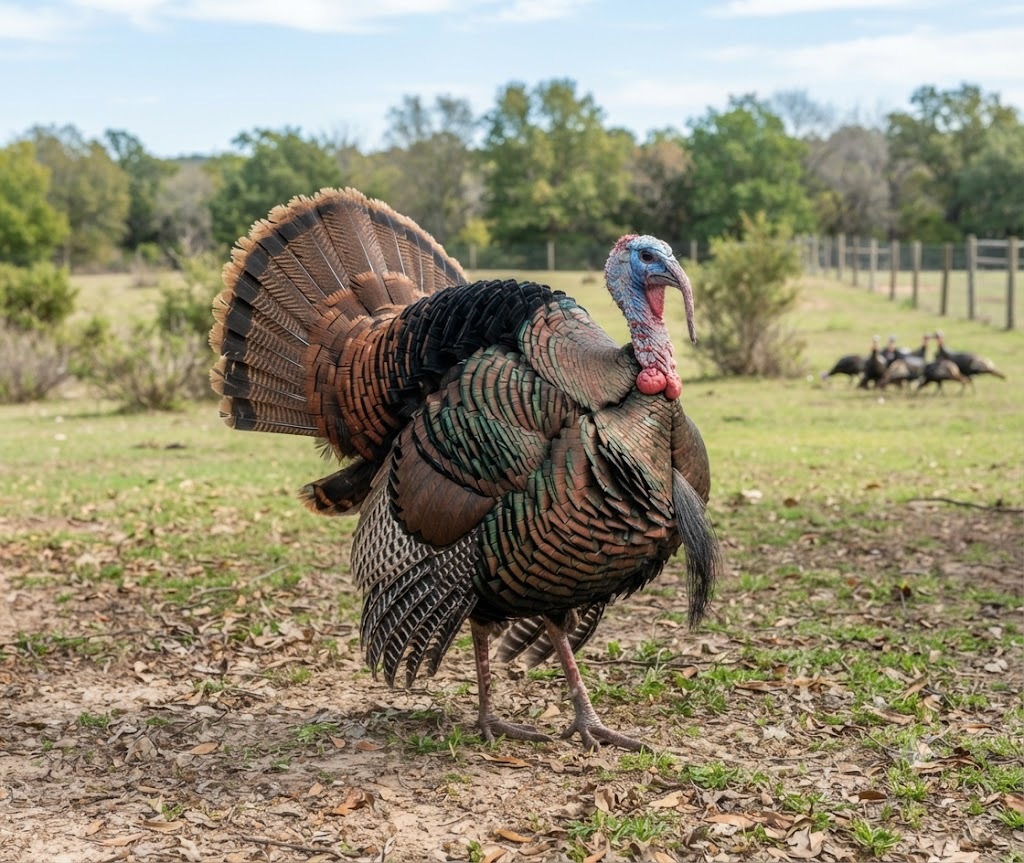
Turkeys are poultry for which large-scale meat industries have been established, primarily in North America and Europe, but they are not a common mainstay species in Korea like chickens or ducks. Therefore, rather than focusing on expanding large-scale domestic farming , it is more realistic to consider breeding stock and meat production technology, turkey meat import and processing, demand from food service and food buyers, and the global supply chain together.
MarketHub does not view turkey as simply imported meat. It manages the entire supply chain —from breeding stock → hatching eggs → hatching → poult → feed/raising → shipment → slaughter → turkey meat/processed products → buyer— as a single system, and manages diseases such as HPAI, as well as international prices and import/export conditions, as a runtime.
Judgment axis | Key points |
| production purpose | Meat and breeding stock |
| production core | Hatching eggs, hatching, feed, weight gain, mortality |
| Main Products | Live animals, hatching eggs, turkey meat |
| Key Risk | HPAI, poultry diseases, supply and demand fluctuations |
| Major markets | Large-scale meat market centered in the US and Europe |
| Utilizing Korea | Imported, processed, foodservice, and specialty meats |
| AX | Flock · Feed · Weight · Environment · Health |
| RFQ | Hatching eggs · Live meat · Meat · Processing · Buyer |
| Final goal | Connecting global production bases with domestic buyers |
The U.S. market serves as an important benchmark for understanding the global production base. In its August 2026 outlook, the USDA revised upward its forecasts for U.S. turkey production, exports, prices, and ending inventories to reflect recent data. This demonstrates that turkey is operating as an independent, large-scale poultry industry rather than merely a seasonal food. ( Economic Research Service )
Turkeys are large poultry domesticated from Meleagris gallopavo. In commercial production, meat strains improved for rapid growth and meat yield are central, and the breeding, egg, and hatching industries that supply them are located upstream.
The products can be subdivided not only into whole turkeys but also into breast meat, legs, boneless meat, and processed meat. Therefore, MarketHub separates the turkey itself from the final meat product and links breeding stock, hatching eggs, live animals, carcasses, and meat parts as Product Entities.
division | Main purpose | major products |
| breeding stock | breeding | fertilized eggs |
| fertilized eggs | hatching | Poult |
| meat | fattening | Livestock shipped |
| Dogye | Meat | conductor |
| Partial meat | food | chest, legs, etc. |
| process | Food manufacturing | Ham, slices, and processed meat |
The basic structure is Turkey → Breeding → Hatching Egg → Poult → Meat Production → Product → Buyer .
In the case of turkeys, it is more important to distinguish between breeding stock and commercial broiler strains than to list many breed names . For breeding stock, reproductive ability and egg and hatching performance are key, whereas for broiler strains, weight gain, feed efficiency, shipping weight, and carcass yield are important.
Furthermore, the target product varies depending on the buyer. Markets seeking whole turkeys and food companies requiring breast meat, cuts, or processed raw materials may have different requirements for shipping weight and processing specifications.
division | Key criteria | conjugation |
| breeding stock | Breeding/Hatching Eggs | Breeding |
| fertilized eggs | Fertilization, storage, and hatching | Hatchery |
| Poult | Health and uniformity | Standing |
| meat | Weight gain and feed efficiency | Meat |
| Partial meat | Part/Weight | Foodservice |
| processed meat | Specifications and machinability | Food Industry |
In MarketHub, the connection is made in the order of Production Purpose → Production Stage → Product Form → Buyer .
Since turkeys are larger and have a longer rearing period than broilers, feed, space, and environmental management tailored to each growth stage are crucial. Focusing solely on rapid weight gain can lead to health, skeletal, and gait issues; therefore, mortality and overall health status must be monitored alongside body weight and feed efficiency.
At the breeding stage, the number of eggs and fertilization and hatching performance determine subsequent production volume. In fact, in the United States, the number of eggs and poultry stocked in incubators is managed monthly using Turkey Hatchery statistics, which serve as a key leading indicator for predicting production volume several months in advance. ( Esmis )
Management area | Things to see at a farm |
| breeding stock | Laying, fertilization, hatching eggs |
| hatching | Hatching rate · Poult quality |
| feedstuff | Step-by-step salary and price |
| growth | Weight gain |
| efficiency | FCR · Shipment Age |
| health | Death, walking, disease |
| environment | Temperature, ventilation, density |
| expense | Feed, Energy, Labor |
The key is to connect the stages of hatching egg → poult → growth → shipment into a single productive unit, rather than viewing them as separate steps.
Since turkeys are poultry of the Galliformes order, just like chickens and quail, they are an important target for management in HPAI prevention. Domestic avian influenza SOPs also specify Galliform poultry, such as turkeys and quail, as targets for disease control, in addition to chickens. ( Mafra )
In the international industry as well, HPAI has a significant impact on actual production volume. The USDA is adjusting its production forecasts for 2026 to separately account for turkey losses due to HPAI; therefore, in turkey RFQs, disease conditions must be treated not merely as reference material, but as a Runtime Risk that directly affects supply capacity. ( Economic Research Service )
step | Key Management |
| breeding stock | Flock · Health · Breeding |
| fertilized eggs | Production Date · Lot · Storage |
| hatching | Hatchery·Poult Lot |
| upbringing | Feed, body weight, environment |
| Disinfection | HPAI·Entry·Disinfection |
| shipment | Farm, Vehicle, Job |
| Dogye | Conductor/Inspection |
| process | Product Lot · Buyer |
The representative traceability structure is Breeder Flock → Egg Lot → Hatchery → Poult Lot → Farm → Slaughter Lot → Product Lot → Buyer .
In Korea, turkeys are not a major livestock species for which large-scale, regular breeding statistics are disclosed, unlike chickens or ducks. Therefore, rather than arbitrarily estimating domestic breeding numbers or production volumes, it is reasonable to first identify the buyers who actually purchase turkey meat and processed meat, as well as the import supply chains.
Potential customers could include hotels, buffets, and foodservice companies, as well as some food processing firms and specialty meat distributors. Even if domestic production is considered, the scale of production must be determined after verifying the actual annual demand and purchase prices in this market.
Participants | Things needed | RFQ |
| production farms | Hatching eggs, feed, and sales channels | Producer |
| hatchery | Hatching eggs · Hatching | Hatchery |
| Poultry slaughter and processing | stable livestock | Processing |
| food companies | Meat parts and processed ingredients | Ingredient |
| Hotels and Restaurants | Standardized meat | Buyer |
| importing companies | overseas producers | Import |
| distribution company | Refrigerated and frozen meat | Distribution |
| local government | Feasibility of Specialized Livestock Farming | Pilot |
In the domestic market, the key is to research the buyer market first rather than the production market .
A structure that leverages the large-scale industrial infrastructure of producing countries is realistic for the international trade of turkey. In the case of the United States, the USDA separately manages turkey production, slaughter, pricing, and exports, and production is projected to reach approximately 5 billion pounds by 2026. ( Economic Research Service )
However, in international poultry trade, import conditions by country or region can change rapidly due to HPAI outbreaks. In fact, since Korea banned the import of Chilean poultry and related products following an HPAI outbreak at a Chilean poultry farm in March 2026, the latest quarantine status for turkey meat must also be reconfirmed before signing a contract. ( Mafra )
Breeding stock → Hatching eggs → Hatching → Broiler farm → Slaughter → Meat parts/processing → Refrigeration/Frozen storage → Import → Buyer
Transaction confirmation | Main contents |
| fertilized eggs | System, Quantity, Quarantine |
| Happy Birthday | Gender, Age, Health |
| meat | Whole meat · Parts |
| Product condition | Refrigeration, freezing, and processing |
| Quarantine | HPAI · Country of Origin |
| trade | HS·Customs·FTA |
| distribution | Cold Chain |
| Buyer | Specifications, Quantity, Delivery Date |
The HS Code is not fixed as a single code for turkey but is re-verified in the Korea Customs Service Tariff DB by category for live animals, meat, cuts, and processed products . ( Korea Customs Service )
Due to the large size of turkeys, the processing of specific cuts is crucial. By separating the meat into breast, leg, lean cuts, and ground meat, it can be supplied to different buyers, such as restaurants, processed food manufacturers, and deli meat suppliers.
In PRP, the producer does not determine the type of turkey to raise first. A method in which the buyer identifies the desired product type, cut, weight, and price, and then works backward to find the country of origin and supplier that meets those conditions, is particularly suitable for the Korean market.
product | Main uses |
| fertilized eggs | hatching |
| Poult | upbringing |
| Happy Birthday | Dogye |
| Whole Turkey | Foodservice and retail |
| Breast Meat | Food & Deli |
| Leg Meat | Foodservice and Processing |
| Ground Meat | processed foods |
| by-product | Food and Industry |
Key PRP questions include which parts are in actual demand, what the price difference is compared to imported chicken, whether buyers have a reason to pay a premium, whether year-round supply is available, and whether there are alternative suppliers in the event of a quarantine suspension .
Just like with chickens, it is more realistic to approach Turkey AX at the Flock level rather than on an individual basis. By linking feed, water, average body weight, mortality, temperature and humidity, and ventilation, early signs of reduced productivity or health abnormalities can be identified.
Particularly when comparing global suppliers, it is important to consider FCR, mortality, carcass yield, HPAI history, and stable production capacity together, rather than just unit prices. MarketHub AX includes not only farm automation but also Supplier Capability Intelligence .
Apply AX | Expected effects |
| environmental sensor | Temperature, humidity, and ventilation |
| Feed and drinking water | Anomaly detection |
| Automatic weight | growth curve |
| Flock record | Death and productivity |
| Shipment forecast | Production volume management |
| conductor data | Yield analysis |
| Disease Runtime | Supply Risk Alert |
| Buyer Matching | Demand-based production |
The basic flow is production data → supply capacity evaluation → risk analysis → buyer condition matching .
The primary problems facing the turkey industry are disease and fluctuations in production volume. In the United States alone, HPAI and avian metapneumovirus have impacted production, and while the USDA forecasts a recovery in 2026 following a decline in 2025, it continues to adjust production and hatching data. ( Economic Research Service )
In Korea, the issues of a small market size and a limited domestic production base are added to this. Therefore, rather than prioritizing the increase in domestic farms, it is necessary to verify the scale of buyers and the potential for import substitution.
problem | Verification data |
| HPAI | Occurrence/Slaughter |
| Poult supply | Hatching eggs · Hatching |
| productivity | Weight gain · FCR |
| feed costs | Grain Prices and Consumption |
| Dead | Disease and Environment |
| conductor yield | Weight/Processing |
| Suspension of imports | National Quarantine |
| exchange rate | Import cost |
| Market size | Buyer · Demand |
| outlet | Product/Price |
The basic solution structure is Buyer demand → Supplier comparison → Disease/Quarantine Risk → Small quantity market verification → Contract supply .
Turkey RFQs do not need to be limited to domestic farms. The value of utilizing international RFQs, which connect global breeding and meat producers, poultry slaughterhouses, and processors with domestic food and restaurant buyers, may be greater.
When considering domestic production, you must verify slaughter feasibility, feed costs, and buyer contracts before securing breeding stock and rearing techniques. It is risky to start producing specialty livestock when the sales channels are unclear.
RFQ Type | Collaboration Examples |
| breeding stock | broiler breeder chickens |
| fertilized eggs | For hatching |
| Poult | Farmhouse stocking |
| feedstuff | By growth stage |
| Happy Birthday | Dogyeyong |
| Partial meat | Chest and legs |
| process | Ham, Deli, OEM |
| import | Global suppliers |
| Buyer | Hotels, Restaurants, and Food |
| Pilot | Domestic experimental breeding |
Sensitive prices, supply quantities, and contract conditions are managed at the Verified/NDA stage.
In the MarketHub Livestock Library, the RFQ (Request First) principle is particularly important for turkeys. Since the domestic market is not as large as that for chicken, it is necessary to first verify the specific parts, quantities, and prices desired by the actual buyer before production or import.
Therefore, rather than gathering suppliers first, MarketHub approaches the process in the order of demand verification → supplier country search → quarantine and price verification → supplier matching .
① Find products/raw materials.
Need Products & Materials
Companies and institutions seeking necessary hatching eggs, poultry, live animals, turkey meat, cuts, and processed raw materials register their purchase demands. MarketHub reviews available producers and companies by verifying specifications, quantity, country of origin, delivery time, and quarantine conditions.
RFQ Registration → Supply Condition Review → Connecting Producers and Companies → AI Matching
Register
② We are looking for production and manufacturing partners.
Need Suppliers & Manufacturers
We are seeking necessary partners, including turkey farms, hatcheries, slaughterhouses, meat processing plants, OEMs, and ODM companies. We verify not only production capacity but also capabilities in disease prevention, quarantine, processing, and continuous supply.
RFQ Submission → Production & Manufacturing Capability Review → Partner Connection → AI Partner Matching
Register
③ We are looking for domestic and international buyers.
Need Buyers
Producers and processing companies seek new buyers, including hotels, restaurants, food service companies, and distribution firms. We verify product type, part, quantity, price, and delivery time to connect them with suitable buyers.
RFQ Submission → Product & Supply Capability Review → Buyer Connection → AI Buyer Matching
Register
Contact : mail@markethub.org
Since large-scale flock production is common for turkeys, it is more efficient to manage them in units of Breeder Flock, Poult Lot, Grow-out Flock, and Slaughter Lot rather than by individual birds . Using this structure also allows for the analysis of how a decrease in hatching egg supply affects production volume several months later.
In global RFQs, it is necessary to connect countries with suppliers. Stable procurement is possible only by verifying which companies in which production countries possess what level of production capacity and HPAI risk.
Dataset | Simply put |
| Master | Turkey and product standards |
| Entity | Flock · Farm · Processing Company · Buyer |
| Relationship | Hatching, rearing, processing, and trade |
| Runtime | Production, Price, Disease, Import/Export |
The representative structure is as follows.
Breeder → Egg Lot → Hatchery → Poult Lot → Grow-out Farm → Slaughter → Product Lot → Importer → Buyer
Here:
Country → HPAI Status → Quarantine → Supplier Capacity
Connects.
For turkeys, official data from global producing countries is more important than domestic official production statistics. In this edition, the structure was verified based on the latest 2026 USDA production, hatching, and export forecasts, as well as data from the Ministry of Agriculture, Food and Rural Affairs regarding HPAI prevention and import measures. ( Economic Research Service )
Furthermore, U.S. data should not be mistaken for the size of the Korean market. U.S. production volume and slaughter/export information should be used as a global production benchmark, while actual turkey import volume, prices, and buyer demand in Korea must be constructed as a separate Korean runtime dataset.
Evidence | source |
| A | USDA · Department of Agriculture · Quarantine Agency · Official Statistics |
| B | Papers · Research Institutes |
| C | Verified industry data |
| D | Company, Market, and Transaction Data |
| E | Additional verification needed |
Key factual basis
- The USDA manages turkeys as a separate poultry industry and continuously publishes data on production, hatching, slaughter, prices, and exports. ( Esmis )
- In the USDA August 2026 outlook, forecasts for turkey production, exports, prices, and ending inventories for 2026 were revised upward to reflect recent data. ( Economic Research Service )
- The USDA forecast for May 2026 projected U.S. turkey production at approximately 5.055 billion pounds , a 4.3% increase from 2025. ( Economic Research Service )
- HPAI is a key supply risk causing production losses in actual commercial turkey flock. ( Economic Research Service )
- Korea's AI disease control SOP includes turkeys in the category of poultry subject to disease control. ( Mafra )
- As Korea may suspend imports of poultry meat from countries affected by HPAI outbreaks at overseas poultry farms, it is essential to check the latest quarantine conditions during actual transactions. ( Mafra )
Version History
Version | Main contents | situation |
| v1.0 | First Registration of Global Production, HPAI, Processing, and RFQ Structures | complete |
| v1.1 | Enhancement of details on Korea's import volume, price, HS code, and quarantine | expected |
| v2.0 | Breeding Livestock, Hatching Eggs, Flock, and Carcass PRP Runtime Connection | expected |
| v3.0 | Global Supplier · Domestic Buyer Verified Matching | expected |