


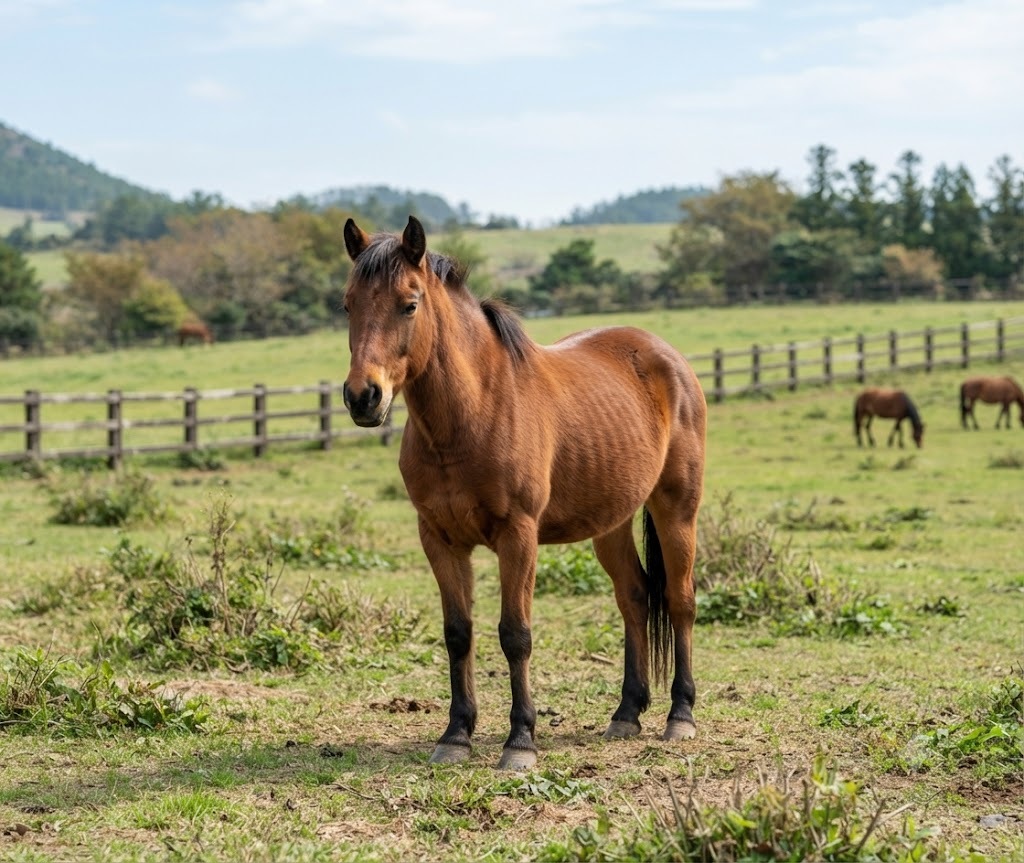
Unlike other livestock species, horses are a species where utilization industries such as racing, equestrianism, breeding, tourism, rehabilitation, and education account for a much larger proportion than meat or milk production . Therefore, in the horse industry, it is more important not simply to consider the number of horses raised, but rather which breed of horse is produced, raised, and trained for what purpose, and for what subsequent use it is.
According to the 2025 Survey on the Status of the Horse Industry, the domestic horse population stood at 27,165 , broken down by usage as follows: 13,087 for riding, 7,938 for racing, 4,253 for breeding, and 480 for meat. The survey found 2,648 domestic horse industry businesses and 475 equestrian facilities, demonstrating that the horse industry encompasses not only production but also horse racing, equestrian activities, and service sectors. ( National Agri-Food Statistics Service )
Judgment axis | Key points |
| Main types | Jeju horse, Thoroughbred, Riding horse, Breeding horse |
| production purpose | Racing, equestrian, breeding, meat, tourism, rehabilitation |
| production core | Bloodline, breeding, rearing, training, health, welfare |
| quality | Body type, ability, health, training, suitability for use |
| Major industries | Horse racing, equestrianism, breeding, tourism, and education |
| Major risks | Infectious diseases, injuries, welfare, and post-retirement utilization |
| AX | Individual · Exercise · Health · Training · Pedigree Data |
| RFQ | Stallion · Riding Horse · Racehorse · Training · Equestrian · Buyer |
| Final goal | Enhancing the lifetime value of horses from production to use and retirement |
MarketHub does not view horses merely as objects for trading, but connects them through the entire lifecycle : Breeding → Rearing → Training → Performance → Welfare → Use → Retirement/Conversion . The core principle is to regard the productive value of a horse not as ending at its birth or sale price, but as its use value throughout its entire life.
The domestic horse industry features a diverse range of horses, including Thoroughbreds, Jeju horses, Jeju-san horses, and Warmbloods. According to the 2025 survey, Thoroughbreds totaled 11,988 (44.1% of the total), Jeju horses 5,309, and Warmbloods 1,196, with the purposes of utilization varying by breed. ( National Agri-Food Statistics Service )
Horses should not be managed solely as products, unlike other livestock. Since the living horse itself is a core asset that generates services such as racing, equestrianism, breeding, tourism, and rehabilitation, the Animal Entity and Service/Product Entity must be managed together.
division | Main purpose | Major production and services |
| Jeju horse | Racing, riding cars, and local resources | Birthday celebrations, races, and experiences |
| Thoroughbred | Race · Breeding | Racehorses and stallions |
| saddle horse | Equestrian and Education | Horseback Riding · Experience · Sports |
| breeding horse | breed improvement | foal and semen |
| retired racehorse | Conversion of use | Passenger, Rehabilitation, Education |
| Six-horse | meat | horseflesh |
Therefore, MarketHub places horses as the Livestock Master and connects racehorses, riding horses, stud horses, foals, horse meat, and equestrian services as sub-entities.
In the horse industry, it is difficult to properly understand the industry without distinguishing between breeds and uses. Thoroughbreds are widely used for racing, Warmbloods have strengths in sports and riding, and Jeju horses are closely connected to the racing, equestrian, and cultural resources of the Jeju region.
Even for the same horse, standards for growth, training, and price evaluation vary depending on whether it is intended for racing, riding, or breeding. Therefore, in an RFQ, it is essential to first clearly define the intended use of the horse, rather than simply stating that you are "purchasing a single horse."
division | example | On-site management |
| livestock species | word | Horse |
| Variety/Lineage | Jeju horse, Thoroughbred, Warmblood, etc. | Bloodline/Trait |
| production purpose | Racing, equestrian, breeding, meat | Farm operation |
| production stage | foal · raising · training · utilization | Step-by-step management |
| service | Racing, Horse Riding, Rehabilitation, Experience | Usage performance |
| Buyer | Owners, riding stables, farms, institutions | Purchase conditions |
The basic structure is managed as follows: breed → production purpose → breeding → training → utilization → conversion/retirement .
A horse's productivity should be judged by its pedigree, health, physique, and the balance of growth and training, rather than simply by weight gain . Even a foal of good bloodline will find it difficult to achieve expected results in racing or riding if it develops health problems during its growth period or is not properly tamed and trained.
Feed management is also not the same for racehorses, riding horses, and breeding horses. The amount of roughage and concentrate feed must be adjusted according to the horse's age, activity level, and breeding status, and issues such as overweight, digestive problems, and lack of exercise must also be managed.
Management area | Things to see on site |
| breeding | pedigree, mating, pregnancy, childbirth |
| colt | Birth, Growth, and Acclimation |
| feedstuff | roughage, concentrate, and body shape |
| upbringing | Weight, Skeleton, Exercise |
| Training | Stages, Intensity, and Results |
| health | Disease, Injury, Hoof |
| facilities | Horse stables, playgrounds, and grazing |
| welfare | Rest, Transportation, and Decommissioning Management |
The Korea Racing Authority's job classification system divides horse production and rearing into breeding stock, horse rearing, and horse use, and views horse registration, pedigree information, rearing, management, and the conversion of retired horses as a single industrial operation. ( KRA )
The quality of a horse is not determined solely by its appearance or pedigree. Its value as a racehorse or riding horse can only be properly assessed by considering its health, athletic ability, level of training, behavioral tendencies, and actual utility.
Disease control is also crucial in the international movement and trade of horses. Since quarantine operations may involve testing for various diseases—such as equine infectious anemia, equine pyroplasmosis, equine infectious arteritis, and equine infectious uterine inflammation—depending on the import sanitary conditions of each country, it is essential to verify the latest quarantine conditions during the actual RFQ. ( Animal and Plant Quarantine Agency )
Management stage | Major records |
| birth | Individual · Parent · Date of Birth |
| lineage | Parents/Registration Information |
| upbringing | Weight, Growth, Feed |
| Training | Educational Stage · Momentum |
| health | Vaccine, disease, injury |
| movement | Farms, racetracks, and riding ranges |
| utilization | Racing, equestrian, and breeding results |
| Retirement | Transition, Recreation, and Welfare |
MarketHub links Horse ID → Pedigree → Health → Training → Performance → Owner/Facility → Next Use . History management is particularly important because a horse's ownership and purpose can change multiple times during its lifetime.
The Korean horse industry is a service industry that connects not only breeding farms but also racetracks, equestrian centers, horse training companies, tourism facilities, and educational institutions. According to the 2025 Survey on the Status of the Horse Industry, there were a total of 2,648 horse industry businesses and 475 equestrian facilities. ( National Agri-Food Statistics Service )
By 2026, the government is promoting a student equestrian support program for approximately 60,000 students at 206 equestrian facilities nationwide. This demonstrates that the demand for the horse industry is continuously expanding beyond horse racing to include recreational riding, education, and rural tourism. ( Mafra )
Participants | Things needed | Possibility of cooperation |
| production farms | Stud horses, breeding, and sales outlets | Breeding RFQ |
| Gyeongju Industry | Racehorses and training | Racing |
| equestrian facilities | safe riding horse | Riding RFQ |
| Training company | Development and rehabilitation | Training |
| tourist facilities | Horse riding experience | Tourism |
| educational institutions | Student Equestrian & Rehabilitation | Education |
| Research and Veterinary Institutions | Health and reproduction | R&D |
| local government | Tourism and local industries | Regional AX |
Therefore, in the horse industry, buyers differ from general livestock buyers. Entities that utilize horses —such as horse owners, riding stables, trainers, tourist facilities, schools, and local governments —can themselves become buyers.
The horse supply chain differs from that of general meat farming. Foals born on breeding farms undergo rearing and training before being utilized for racing, riding, or breeding; upon retirement, they can be transferred to other uses, such as conversion to riding vehicles or recuperation.
In international trade, the movement of live animals itself is the core element, making the quarantine inspections and health certifications required by the importing country crucial. Even past quarantine manuals categorized inspections for infectious anemia, pyroplasmosis, infectious arteritis, and infectious uterine inflammation by exporting country; therefore, it is necessary to reconfirm the country-specific requirements at the time of trade. ( Animal and Plant Quarantine Agency )
Breeding farm → Foal → Rearing → Training → Racing/Riding → Conversion → Retirement/Recreation
Confirmation area | Main contents |
| Happy Birthday | Breed, Gender, Age, Pedigree |
| use | Racing, equestrian, breeding |
| health | Disease, Injury, Examination |
| Quarantine | Country of Origin/Destination Conditions |
| transit | Exclusive transportation and welfare for horses |
| registration | Individual, lineage, ownership |
| transaction | Price, Delivery, Insurance |
| Buyer | Horse riding, riding stable, farm |
Since the trading of livestock products such as horse meat is subject to a completely different HS, food, and quarantine system than that of live animals, it is managed as a separate Product RFQ.
Horses have a higher proportion of service products than other livestock. Racing ability, suitability for riding, breeding capacity, and usability for tourism and experiential activities directly influence the economic value of a single horse.
It is appropriate to view PRP not merely as an evaluation of whether the breed is good, but as a process of verifying whether the horse is actually suitable for the intended purpose desired by the buyer . For example, for a horse desired by a riding stable, temperament, safety, training level, and health may be more important than racing speed.
Product/Service | Main uses |
| colt | Training, Racing, Equestrian |
| racehorse | racing |
| saddle horse | Sports and recreational horseback riding |
| stallion | Breeding and improvement |
| retired racehorse | Passenger, Rehabilitation, Education |
| Horse riding service | Experience, Tourism, Education |
| horseflesh | food |
| excretions | Composting and resource recovery |
Key PRP questions include which breed is suitable for the purpose, whether the level of training is sufficient, what the health and injury history is, whether it can be converted for riding, and whether it possesses the personality, physique, and capabilities desired by the buyer .
The key to Horse AX is not attaching many sensors, but connecting pedigree, health, exercise, training, racing, and riding performance to a single individual . Because horses command high individual prices and have long lifespans, the early detection of diseases or injuries alone holds significant economic value.
Wearable sensors or video analysis can be used to supplementarily record heart rate, activity level, gait, and training intensity. However, the actual assessment of a horse's health and athletic ability must be used in conjunction with the judgment of experts such as veterinarians and trainers, and it should not be stated that AI is replacing this.
Apply AX | On-site effects |
| pedigree data | Breeding and selection |
| Growth records | Training Management |
| motion sensor | Training intensity management |
| Walking video | Early detection of abnormalities |
| Health records | Disease and Injury Management |
| Racing and equestrian results | Competency assessment |
| Welfare history | Life Management |
| Buyer Matching | Transactions by Use |
The core structure is individual registration → growth and health records → training → ability evaluation → purpose matching → life management .
The problems facing the horse industry are not simply limited to a decrease in the number of horses raised. High breeding and training costs, the burden of managing riding facilities, the future use of retired racehorses, horse welfare, and a lack of specialized personnel and trading information are all interconnected.
The 2025 Horse Industry Survey also revealed that the number of equestrian facilities decreased by 11 compared to the previous year, and analysis indicated that temporary or permanent closures occurred primarily among facilities with poor business performance due to the burden of high prices and labor costs. Therefore, the Horse Industry Problem Bank must include issues of facility management and demand, in addition to production. ( National Agri-Food Statistics Service )
problem | Data to verify |
| Rearing costs | Feed, labor costs, and facilities |
| foal production | Reproduction, lineage, survival |
| Training fee | Period, Personnel, and Performance |
| injury | Exercise, medical treatment, and recreation |
| Equestrian center management | Users and operating costs |
| retired racehorse | Transition and Re-education |
| Malbokji | Rearing, transportation, rest |
| Transaction Information | Variety, Performance, Price |
| local demand | Tourism and Student Horse Riding |
| Data disconnection | Pedigree, Health, and Usage History |
The basic solution structure is problem discovery → verification of individual horse and facility data → cause analysis → demonstration of training, welfare, and business models → connection to new users .
The Horse RFQ is not solely for the sale of live animals. It can encompass the purchase of stallions, foals, racehorses, and riding horses, as well as training, rehabilitation, and retraining of retired horses, equestrian programs for students, tourism programs, and cooperation on excellent overseas genetic resources.
In particular, since the value of a horse varies significantly depending on its intended use, you must first check the Buyer conditions. Rather than trading based solely on pedigree or appearance, it is important to verify health, training, temperament, and usage history during the Verified stage.
RFQ Type | Collaboration Examples |
| Stallion · Breeding | Stallions and breeding mares |
| colt | Production and development |
| racehorse | Owner/Training |
| saddle horse | Equestrian Center · Education |
| Training | Basic and advanced training |
| retired horse | Passenger vehicle conversion and rehabilitation |
| riding | Students, Tourism, and Business |
| import | Live animals and genetic resources |
| export | Horse-related services |
| AX Pilot | Health, Exercise, History |
| Research cooperation | Reproduction, Welfare, Exercise |
MarketHub views the trading of horses not as the sale of a single horse , but as a combination of Horse + Purpose + Capability + Welfare + Buyer.
MarketHub Livestock Library is not merely a resource center for reading information about horses. The core of the RFQ is for farms, horse owners, equestrian facilities, and institutions to proactively request the horses or services they need, and then connect them with producers, trainers, and facilities.
Since service transactions account for a larger proportion of horse sales than meat production, not only the purchase of products and horses but also cooperation in training, equestrian activities, tourism, and conversion can be registered via RFQ.
① Find products/raw materials.
Need Products & Materials
Companies and institutions seeking necessary stallions, foals, racehorses, riding horses, and breeding resources register their purchase demands. MarketHub verifies breed, age, intended use, health, and training level to review potential partnerships with available producers.
RFQ Registration → Supply Feasibility Review → Connecting Producers/Institutions → AI Matching
Register
② We are looking for production and service partners.
Need Suppliers & Service Partners
We seek necessary production and service partners, such as horse breeding farms, training facilities, riding centers, and rehabilitation facilities. We evaluate collaboration possibilities by verifying actual capabilities in horse management, training, and welfare, rather than simply reviewing a list of facilities.
RFQ Submission → Production/Service Capability Review → Partner Connection → AI Partner Matching
Register
③ We seek domestic and international buyers and users.
Need Buyers & Users
Breeding farms and horse industry companies seek new buyers and users, such as horse owners, riding centers, tourist facilities, and educational institutions. After verifying the breed, health, training, and utilization capabilities of the horses, they are connected with suitable buyers.
RFQ Submission → Review of Entity/Service Capabilities → Buyer/User Connection → AI Matching
Register
Contact : mail@markethub.org
For horse datasets, the importance of individual life history is greater than for other livestock species. To manage health, welfare, and trade reliability together, it is necessary to connect everything from a horse's birth at a breeding farm, the training it received, its use in racing or riding, and its subsequent movement.
The government has also been pursuing systematic history management for the entire utilization process of horses as a policy objective, and in the 2025 Welfare Measures, it announced plans to legislate a mandatory horse registration system by 2026. Therefore, it is advisable for MarketHub to maintain a Horse ID-centric dataset to enable future integration with the official registration system. ( Mafra )
Dataset | Simply put |
| Master | Standards for variety, use, and service |
| Entity | Horses · Farms · Owners · Riding Stables · Buyers |
| Relationship | Bloodline, Ownership, Training, and Use Connection |
| Runtime | Changes in health, training, performance, and price |
The representative structure is as follows.
Breeding Farm → Horse → Pedigree → Growth → Health → Training → Racing/Riding → Ownership/Transport → Retirement/Repurposing
This structure must be established to analyze the Lifetime Value of a horse, rather than its short-term selling price.
The horse industry can be accurately understood by examining not only breeding statistics but also horse racing, equestrianism, welfare, training, and tourism together. This edition examines the latest industry structure based on the 2025 Survey of the Horse Industry, the Ministry of Agriculture, Food and Rural Affairs' 2025–2026 policies on the horse industry and welfare, and data from the Korea Racing Authority. ( National Agricultural and Food Statistics Service )
Disease and quarantine procedures do not apply outdated manuals directly under current conditions. Data from the Animal and Plant Quarantine Agency is used as a structural basis for determining which diseases may be subject to verification during trade, and when an actual RFQ for the import or export of live livestock is received, the latest sanitary conditions for each country are re-verified. ( Animal and Plant Quarantine Agency )
Evidence | source |
| A | Government, International Organizations, Official Statistics |
| B | Papers · Research Institutes |
| C | Korea Racing Authority · Association · Verification Industry Data |
| D | Corporate and Market Data |
| E | Additional verification needed |
Key factual basis
- 2025 Survey of the Horse Industry — 27,165 domestic horses, 2,648 horse industry businesses, 475 equestrian facilities, and breed and use structure. ( National Agri-Food Statistics Service )
- Ministry of Agriculture, Food and Rural Affairs 2026 Student Equestrian Program — Supporting approximately 60,000 students across 206 equestrian facilities nationwide. ( Mafra )
- Ministry of Agriculture, Food and Rural Affairs Comprehensive Measures for Horse Welfare — Promotion of legislation for mandatory horse registration, Protection Monitoring Center, Welfare Certification, Expansion of conversion of retired racehorses into riding horses. ( Mafra )
- 3rd Comprehensive Plan for the Promotion of the Horse Industry (2022–2026) — Expansion of equestrian activities, improvement of domestic riding horses, and advancement of horse traceability management and distribution systems. ( Mafra )
- Korea Racing Authority Sustainability Report 2025 — Life Cycle Horse Welfare System Including Racehorse Rehabilitation, Retired Racehorse Conversion to Riding Cars, and Welfare Fund. ( KRA )
- Animal and Plant Quarantine Agency Quarantine Operations Data — Inspection Structure by Country for Equine Infectious Anemia, Pyroplasmosis, Infectious Arteritis, Infectious Endometritis, etc., for Live Horse Imports. ( Animal and Plant Quarantine Agency )
Version | Main contents | situation |
| v1.0 | First registration based on the latest data on the horse industry, welfare, and equestrianism for 2025–2026 | complete |
| v1.1 | Reinforcement of Runtime for Transaction Prices, Production, Imports, Exports, and Quarantine by Variety | expected |
| v2.0 | Pedigree, Health, Training, Performance PRP Connection | expected |
| v3.0 | Production Farms · Training · Equestrian Facilities · Buyer Verified Matching | expected |