


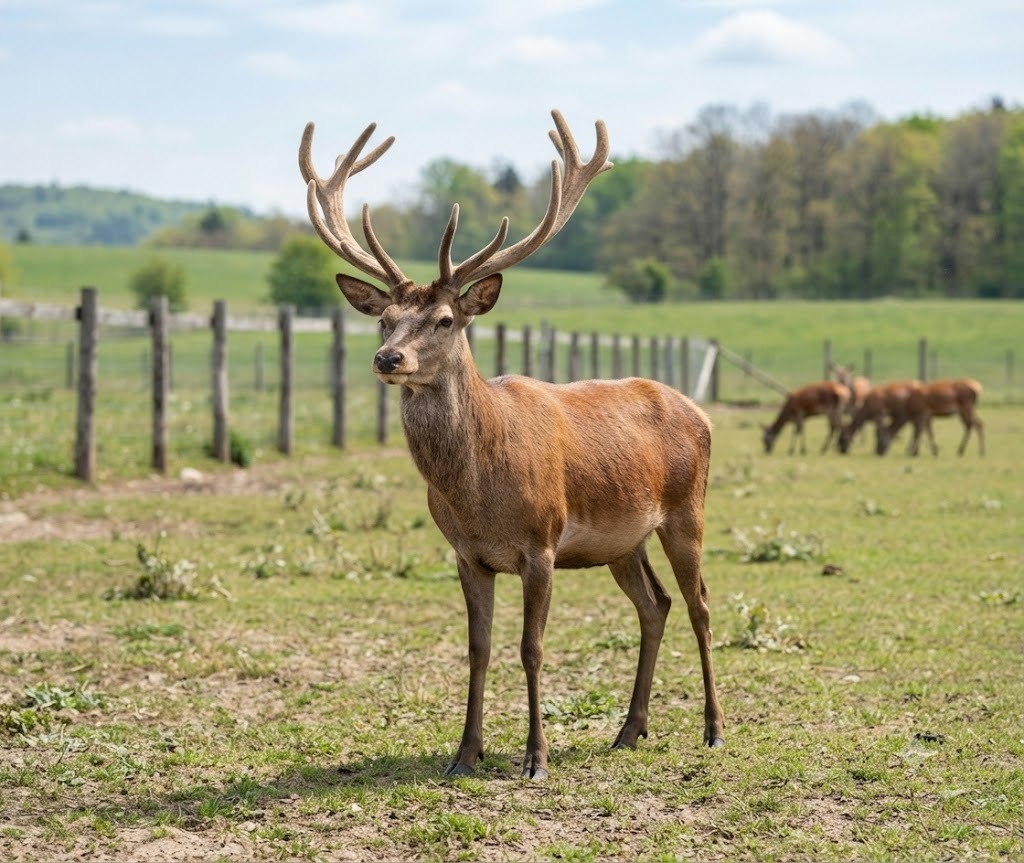
Deer are primarily raised in Korea, mainly focusing on sika deer, red deer, and elk. Unlike other livestock species, they are characterized by the fact that velvet antler production is a very important industrial objective. While meat production and breeding are also possible, the growth of male deer's velvet antlers, the timing of antler cutting, and feed and health management are of great importance in the production management of domestic deer farms.
MarketHub does not view deer merely as livestock that produce velvet antler raw materials. It connects the entire process—breeding → juvenile deer management → feed → growth → velvet antler growth → antler cutting/processing → distribution → buyer— and manages live animals, velvet antlers, meat, and breeding resources as distinct trading units. The National Institute of Animal Science also currently operates deer as a separate field of practical livestock technology, providing technologies related to animal husbandry, feed nutrition, and velvet antler production. ( National Institute of Animal Science )
Judgment axis | Key points |
| Main types | Sika deer, red deer, elk |
| production purpose | Deer antlers, breeding, meat |
| production core | Breeding, larval survival, feed, and stag management |
| core products | Fresh deer antlers, processed deer antlers, livestock, meat |
| quality | Breed, Age, Cutting Time, and Antler Condition |
| Major costs | Forage, supplementary feed, facilities, labor |
| AX | Individual, weight, antler growth, feed, and breeding data |
| RFQ | Breeding stock · Live livestock · Deer antlers · Processed · Buyer |
| Final goal | Stable deer antler production and reliable trading connections |
For deer, it is more important to identify individual productivity differences than to simply increase production scale . As the National Institute of Animal Science continues to oversee research on improving deer antler productivity and developing genomic markers at the Animal Genetic Resources Center in 2026, there is a possibility that the deer industry will shift from experience-based rearing to management based on genetic and production data. ( National Institute of Animal Science )
Deer is not a single breed but an industrial classification encompassing various deer species. In domestic breeding operations, sika deer, red deer, and elk are the main types treated, and body size, antler size, feed requirements, and reproductive characteristics can vary depending on the breed or species.
The most distinctive product of deer is velvet antler. Since breeding stock, young deer, deer meat, and hides can be linked to this, MarketHub does not treat deer and velvet antler as the same item and separates Livestock and Product.
division | Main purpose | major products |
| Flower deer | Deer antlers · Propagation | Deer antlers and antlers |
| Red Deer | Deer antlers, meat antlers, breeding | Deer antlers, live livestock, meat |
| moose | Deer antlers · Propagation | Large deer antlers and breeding stock |
| breeding stock | Improvement and breeding | Breeding mothers · Breeding females |
| by-product | Food and Industry | Meat, leather, etc. |
In other words, the basic structure is managed as follows: Deer → Breed/Species → Production Purpose → Deer Antler/Live Livestock/Meat → Buyer .
In the case of deer, it is particularly necessary to clearly distinguish between breeds/species and production purposes. Since sika deer and elk differ in body size and antler production characteristics, it is difficult to compare their quality or productivity based solely on the name "deer antler."
Furthermore, even among male deer of the same species, the yield and appearance of velvet antlers can vary depending on age, nutritional status, the timing of antler harvesting, and the rearing environment. In fact, the National Institute of Animal Science separately covers technologies specific to each breed and production stage, such as the feeding of concentrate feed for sika deer and the yield of elk based on the timing of antler harvesting. ( National Institute of Animal Science )
division | example | On-site management |
| livestock species | deer | Deer |
| Varieties/Species | Sika deer, red deer, elk | Production characteristics |
| production purpose | Deer antlers, meat antlers, breeding | Farm operation |
| production stage | Deer antlers, rearing, breeding, velvet antler production | Step-by-step management |
| product | Fresh deer antlers, processed deer antlers, live animals | Standards and quality |
| Buyer | Processing, distribution, raw materials, breeding stock | Purchase conditions |
The basic flow is Species/Type → Production Purpose → Production Stage → Product → Buyer .
Productivity in a deer farm begins with breeding. Since offspring must be born and grow healthy to become the next generation's breeding stock or antler-producing animals, the timing of birth, the health of the offspring, and growth management after weaning are crucial.
Feed is also directly linked to velvet antler production. The National Institute of Animal Science is treating the level of concentrate feed provided to sika deer during their velvet antler growth period (March to August) as a separate technical task, and identifies the types of roughage and the palatability of supplements as factors affecting the productivity and economic viability of the deer. ( National Institute of Animal Science )
Management area | Things to see at a farm |
| breeding | Mating, pregnancy, and childbirth |
| Record | Birth, nursing, growth, death |
| feedstuff | roughage, concentrate, and supplementary feed |
| growth | Weight, age, and growth |
| velvet | Growth period, cutting date, production volume |
| health | Disease, Trauma, Parasites |
| facilities | Pens, drive devices, and fixed facilities |
| expense | Feed, labor costs, facilities, and processing |
Field techniques suggest that late-born or weak larvae may be at a high risk of mortality and require separate management. Therefore, it is crucial for deer farms to manage the entire process —from birth and larvae survival to growth and adult productivity— as a single unit, rather than focusing solely on breeding success. ( National Institute of Animal Science )
In the deer industry, quality control is not limited to the size of the antlers. To demonstrate product quality and trade reliability, the process must extend to the specific species and individual from which they were produced, the time of harvesting, and how they were frozen, thawed, and processed after harvesting.
In particular, the storage and processing management of deer antlers after cutting are also crucial. Data from the National Institute of Animal Science explains that most domestic deer antlers are traded in the form of frozen raw antlers, and separately presents thawing and packaging management techniques to minimize loss of marketability during the cutting process. ( National Institute of Animal Science )
step | Key Management |
| birth | Individual · Parent · Date of Birth |
| upbringing | Weight, Feed, Health |
| breeding | Mating, pregnancy, and childbirth |
| Deer antler growth | Growth period/condition |
| Temple | Item · Date · Weight |
| custody | Freezing, Temperature, Period |
| process | Thawing, Slicing, Packaging |
| circulation | Product Lot · Buyer |
The key to MarketHub is connecting Animal ID → Antler Lot → Processing Lot → Buyer . This is necessary to recirculate farm-specific productivity and final deer antler quality back to the production site.
The domestic deer industry is closer to the specialized livestock sector centered on velvet antler production, processing, and the raw material market, rather than a large-scale meat supply industry like Hanwoo or pork. Therefore, it is important to consider individual farms' velvet antler production capacity, breed, quality, and buyer demand together, rather than simply the number of deer raised.
The market connects not only deer farms but also companies involved in the collection, distribution, and processing of velvet antlers, as well as raw material suppliers and importers. Since domestic velvet antlers compete with imported ones, the ability to clearly explain their origin, quality, and traceability information increases the potential for differentiation.
Participants | Things needed | Possibility of cooperation |
| deer farm | Breeding Livestock, Feed, and Sales Outlets | Producer RFQ |
| livestock breeding farms | Excellent individuals | Breeding |
| Deer antler distribution | Origin, Quantity, Quality | Product RFQ |
| processing company | Stable deer antler raw materials | Processing |
| raw material companies | Specifications · Lot · Safety | Material RFQ |
| importer | Overseas deer antlers and quarantine | Import RFQ |
| Research Institute | Genetics and productivity | R&D |
| local government | Specialized Livestock Farming and Farm Income | Regional AX |
As the exact latest number of farms, livestock, and velvet antler production volumes of the domestic deer industry have not been sufficiently verified in this survey until the latest integrated official statistics for 2026, arbitrary figures are not included. It is appropriate to leave these values as "Verification Required" and supplement them by securing official raw data in the future.
The supply chains for deer and velvet antlers vary depending on the form of trade. When trading live or breeding animals, individual health and quarantine are critical, whereas for velvet antlers, cutting, freezing, processing, packaging, and origin management are key.
In international trade, live deer, velvet antlers, venison, and other by-products may be subject to different quarantine and customs clearance standards. Therefore, MarketHub RFQs do not determine trade conditions based solely on the species name "deer"; instead, they verify the actual Product Form, country of origin, and destination, and then re-verify the latest quarantine conditions.
Deer Farm → Severing → Freezing/Storage → Processing → Raw Materials/Products → Distribution → Buyer
Confirmation area | Main contents |
| Happy Birthday | Species, Age, Gender, Health |
| velvet | Origin, Individual, Cutting Date |
| Product form | Fresh deer antlers, frozen, sliced, etc. |
| Quarantine | Country, Product Type, and Hygiene Conditions |
| trade | HS·Customs·FTA |
| process | Storage, Slicing, Packaging |
| Buyer | Specifications, Quantity, Delivery Time |
In the actual import RFQ, the Origin + Product Form + Quarantine + HS + Buyer Specification must be verified again at the time of transaction.
While velvet antler is the most important processed deer product, raw velvet antler itself is not the final product. Since quality and intended use can change during freezing, slicing, packaging, and raw material processing, it is important to maintain the Parent Lot.
PRP does not merely evaluate the fact that the antlers are numerous or large. The key is to determine which individual produced them under which feed and rearing conditions, and at what point they are harvested to achieve the quality and specifications desired by the buyer .
product | Main uses |
| Deer and breeding stock | Breeding and improvement |
| Fresh deer antler | Raw materials and processing |
| Frozen deer antler | Storage and distribution |
| Sliced deer antlers | Raw materials and products |
| deer meat | Meat |
| leather and other by-products | industrial materials |
| excretions | Composting and resource recovery |
Key PRP questions include which breed and age group yields high antler productivity, how feed during the antler growth stage affects production volume, when the optimal time for cutting is, how quality loss can be minimized during freezing, thawing, and processing, and whether the country of origin and specifications desired by the buyer can be reliably supplied .
The first thing needed for Deer AX is not to install complex automated facilities in every farm. It is more realistic to start by creating basic data that records individual breeding, weight, feed, antler growth, and antler cutting volume, and allows for the comparison of performance by farm.
By applying video or sensor technologies, it is possible to supplementarily observe antler growth, activity levels, feed intake, and abnormal behaviors. In particular, since the National Institute of Animal Science is currently conducting research on improving deer antler productivity and genomic markers as of 2026, there is significant value in connecting genetic information with productivity data in the future. ( National Institute of Animal Science )
Apply AX | farm effect |
| Object records | Production history management |
| Automatic weight | Check growth status |
| breeding data | Improvement of Jarok production |
| Historical records | Comparison of Production Costs and Deer Antler Production |
| Deer antler video recording | Checking the growth process |
| Angle data | Production volume comparison |
| Genome analysis | Selection of superior individuals |
| Buyer Matching | Expansion of sales channels |
The key is individual record → farm comparison → discovery of superior individuals → improvement of rearing methods → improvement of deer antler quality → connection to buyers .
The problem with the deer industry is not simply the low number of animals raised. It involves a combination of factors, including variations in individual productivity, high-cost feed, management of young deer, standardization of antler quality, processing and distribution history, and competition from imported products.
Furthermore, in the deer antler-centered industry, it is crucial to have a structure where the final buyer's evaluation returns to the farm's production management. If it is impossible to know which individuals from which farms received good evaluations, productivity improvements will inevitably become dependent on experience.
problem | Data to verify |
| Jarok Abandoned | Birth, Nursing, Health |
| Productivity deviation | Breed, Age, Weight |
| feed costs | roughage and supplementary feed |
| Deer antler production volume | Individuals · Feed · Cuts |
| quality deviation | Cutting, storage, and processing |
| Facility safety | Mowing, Fixing, Work |
| Trust in origin | Domestic/Imported Lot |
| outlet | Quality · Price · Buyer |
| Data shortage | Individual, Production, and Transaction History |
The basic structure operates as follows: problem discovery → comparison of individual and farm data → cause analysis → breeding and processing demonstration → quality improvement → buyer evaluation .
For deer farms, the RFQ does not refer solely to the sale of velvet antlers. Acquiring breeding stock, offspring, and feed, as well as collaborating with velvet antler processors, distributors, raw material buyers, and research institutions, can all be subject to the RFQ.
In particular, a joint RFQ, where producer organizations or regional units aggregate deer antler lots and production periods for supply, can be more effective than small-scale farms finding buyers individually. Sensitive information such as price, production volume, and individual performance is managed at the Verified or NDA stage.
RFQ Type | Collaboration Examples |
| breeding stock | Sika deer, red deer, elk |
| Record | Standing sales |
| feedstuff | roughage and supplementary feed |
| Fresh deer antler | Origin · Season · Volume |
| Frozen deer antler | Storage and regular supply |
| process | Sliced pieces · Packaging |
| deer meat | Slaughter and meat |
| import | Deer antlers, live livestock, products |
| Buyer | Raw materials, processing, and distribution |
| AX Pilot | Individual and Antler Productivity |
| Research cooperation | Genome, feed, breeding |
MarketHub operates by connecting farms → deer antler lot → processing companies → buyers, while verifying the variety, production time, quality, and country of origin together.
MarketHub Livestock Library is not merely a resource center for reading information about deer and velvet antlers. It is a transactional intelligence library where farmers and companies first register their requirements regarding breeding stock, velvet antlers, processing, and buyer conditions, and then review the feasibility of actual supply.
Since the number of deer farms is relatively small and products are concentrated on velvet antlers, it is particularly important to accurately connect producers with specialized buyers .
① Find products/raw materials.
Need Products & Materials
Companies and institutions seeking necessary breeding stock, young deer, fresh velvet antlers, frozen velvet antlers, deer meat, and raw materials register their purchase demands. MarketHub reviews available farms and companies by verifying basic conditions such as breed, origin, product type, and quantity.
RFQ Registration → Supply Feasibility Review → Connecting Producers and Companies → AI Matching
Register
② We are looking for production and manufacturing partners.
Need Suppliers & Manufacturers
We seek necessary production and supply partners, such as deer farms, producer organizations, velvet antler processing companies, and packaging firms. We review production capacity, raw material history, and processing conditions to assess the potential for cooperation.
RFQ Submission → Review of Production/Processing Capabilities → Partner Connection → AI Partner Matching
Register
③ We are looking for domestic and international buyers.
Need Buyers
Deer farms and processing companies seek new buyers, including raw material suppliers, distributors, and importers. We verify breed, origin, antler type, and supply volume to connect them with suitable buyers.
RFQ Submission → Product & Supply Capability Review → Buyer Connection → AI Buyer Matching
Register
Contact : mail@markethub.org
For the deer dataset, it is important to link the origin of velvet antlers with individual productivity. Rather than simply recording "X kg of velvet antlers produced this year," farmers need to know which individual produced how much at which age and on what feed to improve future production.
The same method applies to the processing stage. By connecting which farm or individual the cut deer antlers came from, how they were frozen, thawed, and processed, and to which buyer they were supplied, you can increase both quality and trust in the origin.
Dataset | Simply put |
| Master | Deer Species, Products, and Processing Standards |
| Entity | Farms, Deer, Processing Companies, Buyers |
| Relationship | Connecting individual products, deer antlers, processing, and distribution |
| Runtime | Information on changes in weight, volume, price, etc. |
The representative structure is as follows.
Farm → Deer → Breeding/Feed → Growth → Velvet Antler → Antler Cutting Lot → Processing Lot → Buyer
In the future, genomic information can be linked here to analyze superior individuals → offspring productivity → deer antler productivity .
Since the latest official market statistics for the deer industry are more limited than those for cattle and pigs, it is important not to fill in the data with unverified estimates. In this edition, instead of arbitrarily entering the latest market size, the production structure was verified based on the deer rearing management and velvet antler technologies currently provided by the National Institute of Animal Science, as well as the research framework for 2026. ( National Institute of Animal Science )
However, some field technical data consists of outdated materials registered in 2016. These materials are not intended to serve as a basis for explaining market conditions in 2026, but are used solely as technical background data regarding deer rearing and velvet antler production techniques ; they will be replaced or supplemented once the latest research results are confirmed. ( National Institute of Animal Science )
Evidence | source |
| A | Government, International Organizations, Official Statistics |
| B | Papers · Research Institutes |
| C | Association/Verification Industry Data |
| D | Corporate and Market Data |
| E | Additional verification needed |
Key factual basis
- National Institute of Animal Science Collection of Practical Deer Livestock Technologies — Provides 33 technical resources covering rearing facilities, breeding, velvet antlers, feed, and offspring management. ( National Institute of Animal Science )
- Feeding Techniques for Concentrated Feed During the Growth Period of Sika Deer Antler Velvet — Necessity of Feed Management Before and After Antler Growth. ( National Institute of Animal Science )
- Freezing storage and thawing/packaging technology for domestic deer antlers. ( National Institute of Animal Science )
- Velvet Antler Production and Appearance Management Techniques by Elk Trimming Season. ( National Institute of Animal Science )
- National Institute of Animal Science, Animal Genetic Resources Center — Responsible for research on improving deer antler productivity and developing genomic markers as of 2026. ( National Institute of Animal Science )
Version | Main contents | situation |
| v1.0 | First registration based on precise investigation of deer and velvet antler production structure | complete |
| v1.1 | Supplementing official statistics on domestic livestock numbers, farm counts, deer antler production, and prices | expected |
| v2.0 | Individual · Deer Antler Production · Genome · PRP Runtime Connection | expected |
| v3.0 | Farms · Processing Companies · Buyer Verified Matching | expected |