

Judgment axis | Key judgment |
| Item Identity | According to the USDA ARS standards, chia is Salvia hispanica and is a crop whose seeds have traditionally been consumed in Mesoamerica. ( ARS ) |
| Key role | Whole seeds, ground seeds, partially defatted powder, oil, and viscous ingredients used in cereals, bakery products, beverages, yogurt, HMR, etc. |
| Harvesting principle | Connect Cultivar/Accession, Sowing Date, Photoperiod, Flowering Date, Seed Maturity, Harvest, Drying, and Threshing to a Lot |
| Product separation | Manage Whole Seed·White/Dark Seed·Ground Seed·Partially Defatted Powder·Oil·Mucilage as separate products |
| Separation of similar items | No. 134 Sesame and No. 135 Perilla are both seed-bearing plants, but they differ in species, seed coat characteristics, water absorption, and processing uses. |
| Domestic production statistics | South Korea's exclusive commercial cultivation area and production volume of chia: To be entered after verification of official raw data. |
| Domestic food management | It can be confirmed that chia and chia seeds are subject to domestic food management as they are listed as examples of agricultural products in the contaminant guidelines on Food Safety Korea. ( Food Safety Korea ) |
| Overseas safety data | In 2019, EFSA concluded that chia seeds are safe under the evaluated usage conditions and assessed that partially defatted chia seed powder also poses no safety concerns. ( European Food Safety Authority ) |
| Heat processing management | As EFSA has separately evaluated the safety of high-temperature heat-treated chia seeds, it is necessary for PRP to manage heat processing conditions for each product. ( European Food Safety Authority ) |
| Seed characteristics | The USDA ARS cites the protein, omega-3 fatty acid, complex carbohydrate, and moisture-retaining properties of chia seeds as the background for global food interest. ( ARS ) |
| Mucilage | Research data indicates that the mucilage of tooth seed coat is released upon contact with moisture, and its potential as an ingredient for controlling food viscosity, stability, and texture has been studied. ( FAO AGRIS ) |
| Supply and demand risk | Potential for domestic import dependency · Country of origin · Crop year · Seed color mixing · Moisture · Foreign matter · Microorganisms · Rancidity · Oil oxidation · Quality changes during processing |
| Operating Principles | Species–Origin–Crop Year–Seed Lot–Cleaning–Processing–Safety–Buyer RFQ Connection |
| Final goal | Connecting overseas Producers, Exporters, Importers, domestic Processing Companies, and Distributors/Buyers, all the way to repurchase data |
The USDA ARS introduces chia as a historical food crop of Mesoamerica, and in the modern food industry, not only the seed itself but also the stickiness formed by moisture absorption and seed components are utilized as key characteristics in product development. ( ARS )
Basic fields | detail |
| Korean name | Chia / Chia Seeds |
| English name | Chia / Chia Seed |
| Representative scientific name | Salvia hispanica L. ( ARS ) |
| classification | Lamiaceae, Salvia genus |
| Edible parts | Whole mature seed |
| Non-edible · Separate management | Stems, leaves, inflorescences, threshing by-products, etc. |
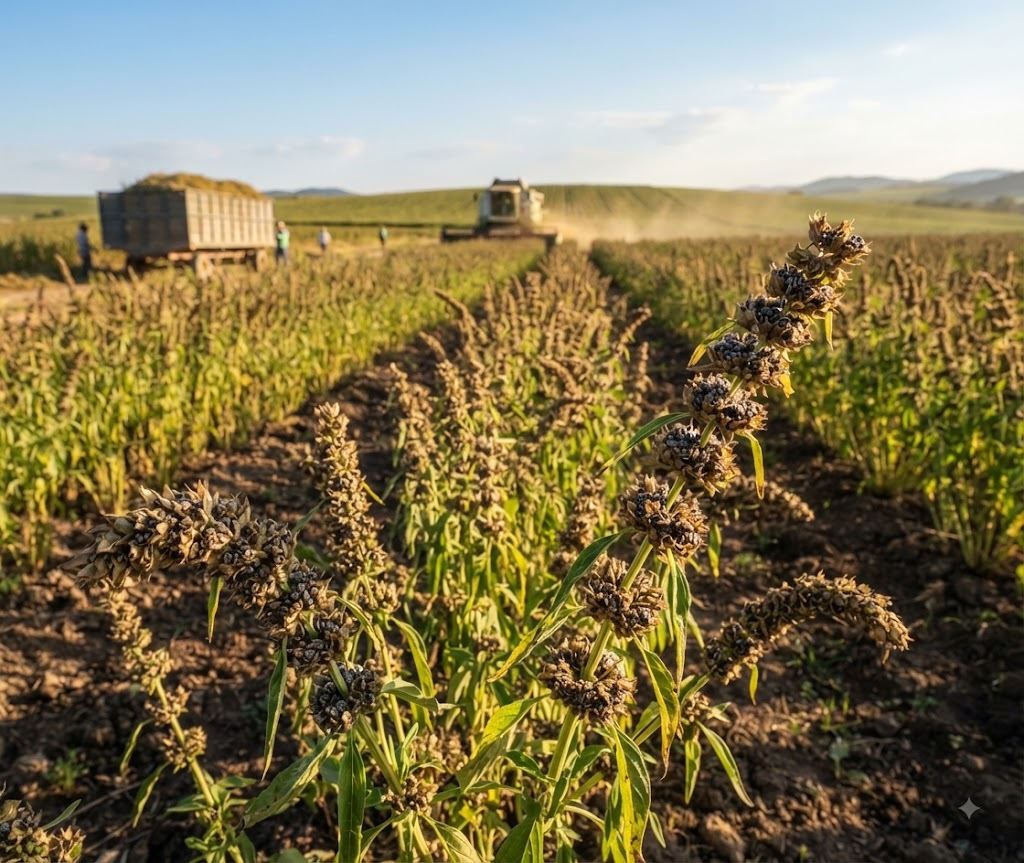
| Major harvesting stages | Vegetative growth → Flowering → Seed formation → Maturation → Harvesting/Threshing |
| Basic product form | Whole Seed·White/Dark Seed·Ground Seed·Powder·Partially Defatted Powder·Oil·Mucilage |
| Basic processing stage | Drying, threshing, sorting, washing, grinding, pressing, partial degreasing, and separation of viscous materials |
| Basic use | Cereals, Granola, Bakery, Beverages, Yogurt, Salads, HMR, Food Ingredients |
| Principle of similar items | It must be separated from other Salvia species, and a separate plant entity must be maintained from sesame and perilla. |
The USDA ARS uses Salvia hispanica as the representative scientific name for chia and clarifies that the seeds are the primary edible part. ( ARS )
Product Master
Product ID | Actual product form | Key Management Standards |
| CHIA-P01 | seeds for cultivation | Species·Accession/Cultivar·Seed Lot·Germination Rate |
| CHIA-P02 | Seeds immediately after harvest | Maturity, moisture, foreign matter |
| CHIA-P03 | dried chia seeds | Moisture, Color, Foreign Matter, Crop Year |
| CHIA-P04 | Jeongseon Whole Chia Seed | Purity, seed color, damage, foreign matter |
| CHIA-P05 | White Chia Seed | Seed color, uniformity, and origin |
| CHIA-P06 | Dark/Mixed Chia Seed | Color ratio, uniformity, and origin |
| CHIA-P07 | Washed and food-grade chia seeds | Washing, drying, microorganisms |
| CHIA-P08 | Ground Chia | Particle size, moisture, oxidation |
| CHIA-P09 | Chia Powder | Particle size, fat, and moisture |
| CHIA-P10 | Partially Defatted Chia Powder | Residual fat, particle size, and safety |
| CHIA-P11 | Chia Oil | Pressing, purification status, and oxidation stability |
| CHIA-P12 | Chia Mucilage Ingredients | Viscosity, moisture absorption, microorganisms |
| CHIA-P13 | Bakery Ingredient | Whole/Ground · Thermal Processing Suitability |
| CHIA-P14 | Beverage/Yogurt Ingredient | Gel formation and dispersibility |
| CHIA-P15 | Granola/Cereal Ingredient | Whole Seed · Mixing Stability |
| CHIA-P16 | PB · Finished Products | Ingredient traceability, formulation, labeling, and expiration date |
Classification criteria | Subdivision type | Management principles |
| Plant classification | Salvia hispanica | Plant Master |
| Other Salvia | Other Salvia spp. | Species separation |
| Cultivar/Accession | Cultivation Selection · Varieties · Seed Source | Cultivar/Accession ID |
| Seed color | White·Dark·Mixed | Product Attribute |
| production site | Country·Region·Farm | Origin Entity |
| Crop Year | Harvest year | essential |
| Harvesting stage | Immature, Mature, and Drying Rooms | Harvest Stage |
| Distribution methods | Raw · Cleaned · Food Grade | Product Separation |
| Processing form | Whole·Ground·Defatted Powder·Oil·Mucilage | Product ID |
| Final use | Beverage·Bakery·Cereal·Yogurt·HMR·Ingredient | Buyer Spec |
| Transaction type | Import Procurement · Bulk · Regular Supply · Ingredient · OEM/PB | Contract NDA |
step | Essential Dataset | Management purpose |
| Cultivation plan | Cultivar/Accession · Area · Buyer's Use | Production plan |
| satellite | Seed Lot · Germination Rate · Origin | breed tracking |
| sowing | Sowing date, sowing rate, planting density | Production Runtime |
| germination | Germination rate · Hair emergence | Early growth |
| Growth | Plant height, branching, leaf area | Yield Forecast |
| Gwangju | Photoperiod and flowering response | Flowering prediction |
| rising | Temperature, rainfall, sunshine, frost | Crop Risk |
| Watering | Soil moisture and irrigation amount | Growth stability |
| dispute | Input amount and timing of nitrogen, etc. | Production history |
| weeds | Occurrence and Control | Early growth |
| pests | Occurrence and Control | Quality and quantity |
| flowering | Flowering date and number of inflorescences | Harvest Forecast |
| Seed formation | Attachment/Fillingness | Yield |
| Maturity assessment | Seed color and inflorescence dryness | Optimal harvest time |
| harvest | Date · Machine/Handmade | Harvest Lot |
| dry | Time and moisture | Threshing and storage |
| threshing grain | Seed recovery/loss | Raw Yield |
| Jeongseon | Foreign matter, immature grains, damage | Grade |
| purifying | If necessary | Food Grade |
| Reconstruction | Moisture after washing | Storage stability |
| save | Temperature, humidity, oxygen, period | Oxidation and microorganisms |
| smash | Ground/Powder | Ingredient |
| pressure | Chia Oil | Oil Yield |
| Partial degreasing | Defatted Powder | Ingredient |
| Mucilage extraction | Hydration, separation, and drying | Food Material |
| packaging | Whole/Powder/Oil | Shelf-life |
| export shipment | Export Lot·Container | Trade |
| Incoming inspection | Origin·Lot·Safety | Import Lot |
| shipment | Buyer · Delivery Date | Delivery |
Quality items | Whole Seed | Powder and Pretreatment | Oil/Mucilage | finished product | Public rating |
| Species | essential | succession | succession | tracking | Public |
| Cultivar/Accession | check | succession | tracking | tracking | Verified |
| Origin | essential | succession | succession | tracking | Public |
| Crop Year | essential | essential | succession | tracking | Verified |
| Farm/Supplier | ID | succession | tracking | tracking | Verified |
| Lot | essential | new | new | new | Verified/NDA |
| Harvest day | essential | succession | tracking | - | Verified |
| Seed color | core | Raw material characteristics | - | Product Standards | Member |
| appearance | core | Raw Material Evaluation | - | Product Standards | Member |
| water | core | succession | - | Product Standards | Verified |
| weight | raw materials | Input and Output | Yield | Display amount | Member |
| alien substance | essential | essential | Process Management | essential | Verified |
| immature teeth | check | eliminate | - | - | Verified |
| Broken lip | check | Raw Material Evaluation | - | - | Verified |
| moisture | core | core | By product | Product Standards | Verified |
| Moisture absorption · Gel | Product Characteristics | Powder | Mucilage Core | By use | Verified |
| pesticide residues | Compliant with standards | succession | check | Legal standards | Verified/NDA |
| microorganism | importance | core | core | Product Standards | Verified/NDA |
| pollutants | Check standards | succession | check | Legal standards | Verified/NDA |
| fat content | Raw material characteristics | Powder core | Oil Yield | By product | Verified/NDA |
| Partial degreasing rate | - | Defatted core | - | standard | NDA |
| Entry to the island | - | core | - | Product specifications | Verified |
| viscosity | Sign language | Ground | Mucilage Core | By use | Verified/NDA |
| Oxidation and rancidity | save | core | Oil core | core | Verified/NDA |
| heat treatment | The relevant city | core | The relevant city | tracking | NDA |
| Processing history | - | essential | essential | essential | NDA |
| packaging | Bulk | By product | Shading and oxygen management | Labeling packaging | Member |
| save | dry | By product | Oil Star | By product | Verified |
| Expiration date | By product | Test-based | Test-based | mark | Verified |
| Shipment | record | record | record | record | Verified |
| Returns and Claims | record | record | record | record | NDA |
| Repurchase | connection | connection | connection | connection | NDA |
As chia and chia seeds are listed in the agricultural product contaminant guidelines on Food Safety Korea, the latest contaminant standards and specifications for the relevant food type must be verified for domestically distributed lots. ( Food Safety Korea )
The EFSA conducted separate safety assessments for chia seeds and partially defatted powder, and also separately reviewed heat-processed chia seeds. Therefore, instead of automatically transferring the test reports for Whole Seed to Powder and Heat-treated Products, processing history and test evidence must be maintained for each product. ( European Food Safety Authority )
Lot Master Required Field
Lot ID · Item · Product Type · Species · Scientific Name · Cultivar/Accession · Seed Color · Crop Year · Country of Origin · Origin · Farm · Producer · Seed Lot · Sowing Date · Photoperiod · Flowering Date · Harvest Date · Seed Weight · Moisture · Purity · Grade · Immature Grains · Broken Grains · Foreign Matter · Pests · Pesticide Use History · Pesticide Residue · Microorganisms · Contaminant Report · Drying · Storage History · Raw Material Lot · Washing · Grinding · Partial Degreasing · Pressing · Mucilage Process History · Particle Size · Fat Content · Oil Yield · Viscosity · Packaging Date · Best Before Date · Shipper · Returns · Claims · Repurchase
Customers | Purchase criteria | Cooperation opportunities |
| Seed importer | Origin · Crop Year · Purity | Import RFQ |
| Grain and seed distributors | Whole Seed · Color · Moisture · Foreign Matter | Bulk Supply |
| Large-scale distribution | Origin, Safety, Packaging | Retail/PB |
| Online distribution | Whole Seed · Small Package | Commerce |
| Cereal and granola manufacturing | Whole Seed · Mixed Aptitude | Ingredient |
| Bakery | Whole/Ground · Thermoworkability | B2B |
| Beverage manufacturing | Moisture absorption, gel, and dispersibility | Beverage |
| Yogurt and Dessert | Whole Seed·Gel Characteristics | Dairy/Dessert |
| HMR · Salad | Whole/Ground | Ingredient |
| Powder manufacturing | Particle size, moisture, fat | Powder RFQ |
| Oil manufacturing | Oil Content · Pressing Suitability | Oil RFQ |
| food ingredient companies | Mucilage · Viscosity · Dispersibility | Material PRP |
| PB·OEM | Chia Seed, Powder, Drink | Manufacturing cooperation |
| Research and testing institutions | Safety, oxidation, and processing characteristics | Validation |
step | Key variables | Operational judgment |
| Overseas production | Country · Crop Year · Crop Conditions | Supply Forecast |
| Seed harvest | Maturation and moisture | Raw Quality |
| Drying and threshing | Moisture loss | Seed Yield |
| Jeongseon | Purity and foreign matter | Food Grade |
| Contract procurement | Origin·Spec·Crop Year | Procurement |
| export shipment | Exporter·Freight·Lead Time | Landed Cost |
| Import customs clearance | HS · Origin · Inspection | Import Lot |
| Domestic storage | Moisture, rancidity, microorganisms | Inventory |
| Dividing and packaging | Foreign matter, weight, and labeling | Retail |
| smash | Particle size and oxidation | Powder |
| pressure | Oil Yield | Oil |
| Partial degreasing | fat content | Functional Ingredient |
| Mucilage processing | Viscosity · Yield | Food Material |
| Distribution and supply | Safety and Delivery | Buyer Evaluation |
| RFQ · Repurchase | Quality · Price · Claim | Supplier Ranking |
Import and export management
item | Management principles |
| Chia Seed HS | Registration in 2026 after verifying the actual import declaration commodity classification in the Korea Customs Service HSK. |
| Whole Seed | Three direct checks of the royal family's condition |
| Ground Seed | Verification of item classification based on whether it is ground |
| Defatted Powder | Check HS codes separately by degree of processing and composition |
| Chia Oil | Check oils and fats separately three times. |
| Mucilage | Verification of item classification based on extraction and processing form |
| Korea's import volume | Input after verification of raw data by the Korea Customs Service for 2025/2026 |
| Korean import value | Input after official verification of raw data |
| Major suppliers | Enter after verifying HS, base year, quantity, and amount |
| Customs clearance unit price | Compare only identical Product State and HS |
| FTA | Agreement Tariff Rates by Origin, HS, Processing Status, and Criteria for Origin |
| Incoming inspection | Latest KFDA Standards by Food Ingredient and Processing Form |
| distribution | Crop Year·Exporter·Container·Import Lot connection |
Products and processes | Key conditions | RFQ conversion |
| Raw Chia Seed | Origin · Crop Year · Moisture | Import RFQ |
| Cleaned Whole Seed | Purity, foreign matter, microorganisms | Retail/B2B |
| White Chia | Color and uniformity | Premium Product |
| Dark/Mixed Chia | Color composition and purity | General Ingredient |
| Ground Chia | Particle size and oxidation | Bakery |
| Chia Powder | Particle size, moisture, fat | HMR |
| Partially Defatted Powder | Residual oil content and particle size | Food Ingredient |
| Chia Oil | Compression and oxidation stability | Oil RFQ |
| Chia Mucilage | Extraction yield, viscosity, microorganisms | Food Material |
| Hydrated Chia Base | Water absorption and viscosity | Beverage/Dessert |
| Bakery Ingredient | Whole/Ground · Thermal Processing | Bakery RFQ |
| Beverage Ingredient | Gel formation and dispersion | Drink RFQ |
| Granola/Cereal | Whole Seed · Uniformity | Regular Supply |
| Press Cake | Residual oil content and safety | Powder conversion verification |
| Selected items | Check for foreign matter, mold, and contamination | Food supply chain exclusion |
Chia musilage is a viscous substance released upon hydration on the surface of seed coats and has been studied as a material for controlling viscosity, stability, and texture in food. However, its actual application as a food additive or raw material is subject to separate verification of its legal status on a product- and country-by-country basis. ( FAO AGRIS )
Product Research Profile (PRP)
PRP area | Key question |
| Species | Is it confirmed that the actual ingredient is S. hispanica? |
| Accession/Cultivar | What are the differences in seed color, growing period, and yield? |
| Gwangju | How do production region and sowing time affect flowering and harvesting? |
| harvest | What is the balance between seed shattering loss and maturity? |
| Jeongseon | How much can purity, foreign matter, and contamination by other seeds be reduced? |
| moisture | What effect does it have on storage, microorganisms, and grinding quality? |
| Hydration | Do the gel characteristics after moisture absorption match the buyer's intended use? |
| Mucilage | What are the extraction yield, viscosity, and stability? |
| smash | What is the relationship between particle size and oxidation rate? |
| Partial degreasing | How do protein, fiber, and particle size characteristics change after oil removal? |
| Oil | What are the actual compression yield and oxidation stability? |
| heat processing | Is quality and safety maintained under processing conditions such as bakery and extrusion? |
| Buyer | What are the effects of Origin, Purity, Hydration, and Processing Performance on repurchase? |
first of all | Execution item | Performance indicators |
| 1 | Species·Origin·Crop Year·Seed Lot become mandatory values | Required value completion rate |
| 2 | Separation of Whole·Ground·Defatted·Oil·Mucilage Product | Product identification rate |
| 3 | Weather, Photoperiod, Flowering, Seed Maturation, Harvest Connection | Production Trace Rate |
| 4 | Datafication of quality, certificates, drying, storage, and processing history | Traceability rate |
| 5 | Producer–Exporter–Importer–Processor–Buyer RFQ connection | RFQ Match Rate |
| 6 | Video AI sorting for seed color, foreign matter, and other seeds | Automatic classification accuracy |
| 7 | Moisture and Purity Risk Scoring | Non-conforming Lot Detection Rate |
| 8 | Production volume and harvest time forecast | Forecast Error |
| 9 | Revenue, Inventory, and Lead Time Forecasting | Out of stock rate |
| 10 | Prediction of Hydration and Gel Characteristics | Buyer Spec Conformity Rate |
| 11 | Mucilage Yield Prediction | Error compared to the actual |
| 12 | Oil Yield Forecast | Error compared to the actual |
| 13 | Prediction of Oxidation Risk After Grinding | Claim and disposal rates |
| 14 | Heat Processing Product Suitability Analysis | Product specification compliance rate |
| 15 | AI Supplier/Buyer Match | Sample→Contract Conversion Rate |
| 16 | Traceability | Farm → Finished Product Traceability |
Problem group | Problem Definition | Required data |
| Unclear domestic production base | Official verification of commercial cultivation scale required | Domestic Production |
| dependence on imports | Affected by overseas crop conditions and logistics | Origin·Import |
| Species contamination | Can be confused with other Salvia species and ingredient names | Scientific Name |
| Cultivar unmanaged | Differences in color, quantity, and flowering characteristics not reflected | Cultivar |
| Photoperiod risk | Variation in flowering and harvesting seasons by region | Day Length |
| Harvest loss | Shatter of small seeds and harvest loss | Harvest |
| Foreign matter contamination | Quality issues regarding the sorting of fine seeds | Purity |
| Mixed seed colors | White/Dark Product Spec Discrepancy | Seed Color |
| Moisture management | Storage, Microorganisms, Quality Variation | Moisture |
| Microbial safety | Whole Seed and Powdered Products Require Management | Microbiology |
| Discontinued raw material–powder traceability | Difficulty tracing the origin of ground products | Lot Relationship |
| oxidation | Quality degradation after grinding and oil extraction | Oxidation |
| Gel deviation | Lot variation in hydration characteristics | Hydration |
| Mucilage deviation | Unstable performance of food materials | Viscosity |
| Heat processing deviation | Differences in processing conditions, such as bakeries | Thermal History |
| Management of unclear HS | Statistical distortion by product condition is possible | HS |
| Dispersion of test reports | Disconnection between Import Lot and Inspection Data | Certificate |
| Repurchase not reflected | Buyer processing performance is not reflected in Supplier evaluation | Evaluation·Reorder |
RFQ Type | Public Registration | Verify/NDA |
| Whole Chia Seed Procurement | Origin · Crop Year · Seed Color | Producer · Quantity · Unit Price |
| White Chia | Seed color, purity, moisture | Lot · Actual Price |
| Dark/Mixed Chia | Color composition and purity | MOQ · Price |
| Food-grade Chia | Foreign matter, moisture, safety | Report |
| Regular income | Origin·Product Type | Contract Volume · Freight |
| Ground Chia | Particle size and moisture | Processing Conditions · MOQ |
| Chia Powder | Entry to the island/region | B2B Price |
| Defatted Powder | Residual oil content and particle size | Processing Contract |
| Chia Oil | Pressing, refining, oxidation | Oil RFQ |
| Chia Mucilage | Viscosity · Yield | Food Material |
| Bakery Ingredient | Whole/Ground · Thermal Processing | Manufacturer RFQ |
| Beverage Ingredient | Hydration·Gel | Beverage RFQ |
| Yogurt/Dessert | Whole Gel Characteristics | Regular Supply |
| Granola/Cereal | Whole Seed · Purity | Ingredient |
| HMR | Whole/Ground | Product Development |
| PB·OEM | Seed·Powder·Drink | Manufacturing conditions |
| domestic test cultivation | Species·Seed Source·Photoperiod | Farms, Quantity, Quality |
| Technology demonstration | AI Screening · Sign Language · Mucilage | Pilot conditions |
| Research cooperation | Variety · Cultivation · Processing · Oxidation | Dataset·IP |
① Need Products & Materials
Companies and institutions seeking necessary products, agricultural products, raw materials, and processed goods register purchasing demands. Registered requests are utilized to review cooperation with potential suppliers and producers based on the RFQ Intelligence Library.
Process:
RFQ Registration → Supplier/Product Review → Collaboration Connection → Future AI Matching
Register
② We are looking for production and manufacturing partners. (Need Suppliers & Manufacturers)
Register a request to find necessary production and supply partners, ranging from farms and producer organizations to processing companies, OEM, ODM, and Private Label manufacturers.
Process:
RFQ Registration → Review of Production & Manufacturing Capabilities → Collaboration Connection → Future AI Partner Matching
Register
③ We are looking for domestic and international buyers. (Need Buyers)
Farmers, producer organizations, and manufacturing companies are requesting cooperation with new buyers, such as domestic and international distributors, importers, brand companies, and food service and catering businesses.
Process:
RFQ Registration → Product & Supply Capability Review → Market & Buyer Connection → Future AI Buyer Matching
Register
Contact : mail@markethub.org
Version | Main contents | situation |
| v1.0 | Plant Identity · Imported Seeds · Whole Seed · Powder · Partial Degreasing · Oil · Mucilage · Safety · RFQ Basic Structure Registration | complete |
| v1.1 | Domestic Production Status · 2025/2026 Import Volume · Origin · Current HSK · FTA · Verification of Market Official Raw Data | expected |
| v2.0 | Cultivar · Photoperiod · Seed Color · Purity · Hydration · Mucilage · Defatted Powder · Oil · Thermoprocessing Quality Standard Subdivision | expected |
| v3.0 | Seed Supplier–Producer–Exporter–Importer–Processor–Beverage/Bakery Manufacturer–Buyer Verified Container combination | expected |