

Judgment axis | Key judgment |
| Item Identity | According to the National Institute of Forest Science standards, the Korean pine (Pinus koraiensis) is one of Korea's major native tree species. ( NIFOS ) |
| Key role | As a representative domestic nut forest product, it serves as an ingredient for shelled pine nuts, shelled pine nuts, white pine nuts, yellow pine nuts, roasted pine nuts, crushed nuts, powder, oil, Korean food, and confectionery. |
| Harvesting principle | Connect Stand, Age, Conifer Fruiting, Harvesting Date, Conifer Lot, Pine Nut Lot, and Shell Lot |
| Product separation | Cones, shelled pine nuts, shelled raw pine nuts, white pine nuts, yellow pine nuts, roasted pine nuts, powder, paste, and oil are managed as individual products. |
| Separation of similar items | Its plant classification, harvesting, and processing systems are completely different from those of hardwood nuts such as pecans and Brazil nuts. |
| Domestic statistics | Pine nuts are an independent survey item among nuts under the National Approved Forest Product Production Survey. The survey covers 145 items of 14 species nationwide, investigating production volume and value. ( KOFPI ) |
| Domestic production value | A recent official press release from the Korea Forest Service indicates the annual production value of pine nuts as approximately 13.5 billion KRW . The detailed base year and source table for this figure will be further verified and entered into Runtime. ( Korea Forest Service ) |
| Major production areas | The Korea Forest Service explains that Gapyeong-gun is a major production area accounting for more than 30% of Korea's pine nut production. ( Korea Forest Service ) |
| 2024 Official Statistics | The 2024 Forest Product Production Survey was published in October 2025, and pine nuts are included as target items under the tree and nut category. The nationwide production volume and value of pine nuts alone will be entered after verification of detailed raw data. ( NIFOS ) |
| Production risk | Seed-damaging pests, such as the pine sac bug, can affect pine nut production. The Korea National Arboretum explains that these pests impact pine nut production by causing damage during the seed formation stage. ( Korea Forest Service ) |
| Storage and processing risks | Due to the high fat content of the seeds, oxygen, temperature, moisture, and storage period must be managed on a lot-by-lot basis after shelling, and specific values must be verified through product testing. |
| Operating Principles | Forest Stand–Producer–Cone Lot–In-shell Seed Lot–Kernel Lot–Processing–Buyer RFQ Connection |
| Final goal | Connecting forest farmers, forestry cooperatives, processing companies, distributors, food service providers, Korean food vendors, confectionery shops, and PB buyers to repurchase |
Pine nuts are independently surveyed as one of 15 nut items in the Korea Forestry Promotion Institute's Forest Product Production Survey , and their production volume and value are managed as policy supply and demand data. ( KOFPI ) The Korea Forest Service designates Gapyeong as a representative production area, explaining that it accounts for over 30% of the nation's production; therefore, for the Pine Nut RFQ, it is important to connect not only national-level statistics but also major production areas such as Gapyeong, forest households, forest stands, cones, shelling yield, and buyers . ( Korea Forest Service )
Basic fields | detail |
| Korean name | Pine nut / Pine tree |
| English name | Korean Pine / Korean Pine Nut |
| Representative scientific name | Pinus koraiensis ( NIFOS ) |
| classification | Pinaceae, Pinus genus |
| Edible parts | Kernel with the seed coat removed from inside the cone |
| Non-edible · Separate management | cone scales, hard seed coat, leaves, branches, wood, etc. |
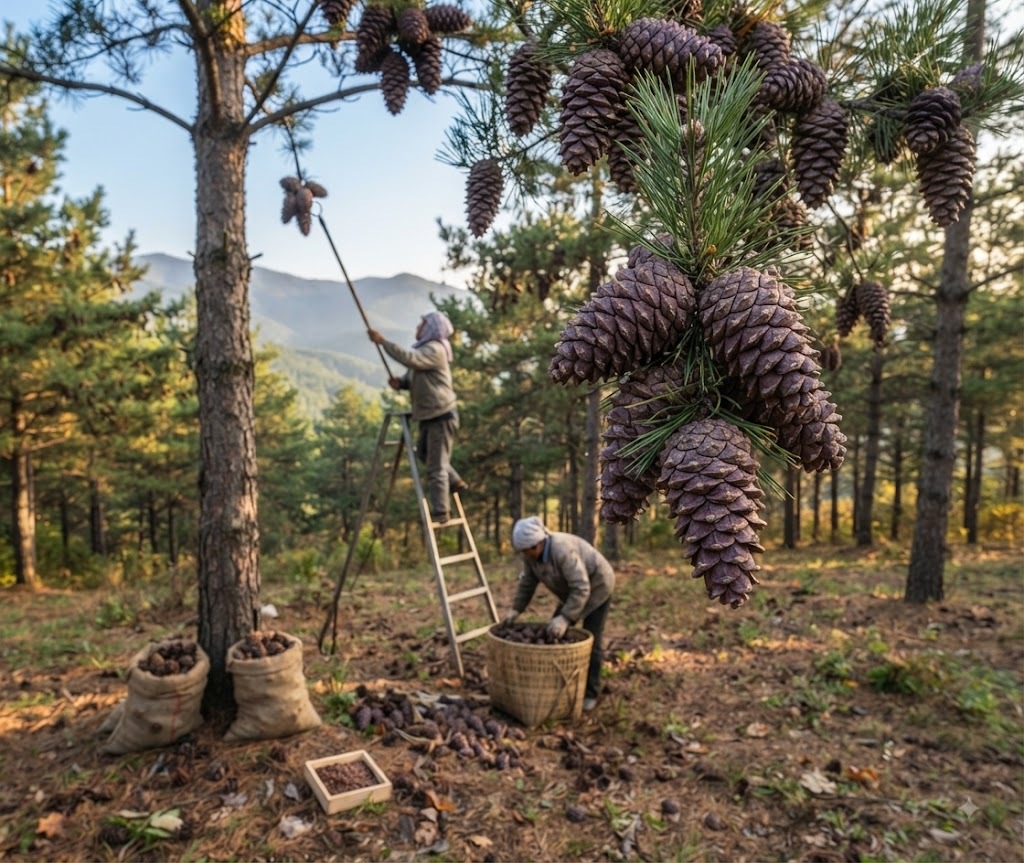
| Major harvesting stages | Cone formation → Seed maturation → Cone harvesting → Drying/shattering → Shelling → Shell removal |
| Basic product form | Cones · Shelled pine nuts · Raw pine nuts · White pine nuts · Yellow pine nuts · Roasted pine nuts · Crushed pine nuts · Powder · Paste · Oil |
| Basic processing stage | Cone drying, shattering, sorting, shelling, peeling, washing, drying, roasting, grinding, oil extraction |
| Basic use | For direct consumption · Porridge · Rice cakes · Hangwa · Sujeonggwa · Cooking garnishes · Confectionery · Bakery · Sauces · Oils |
| Principle of similar items | You must distinguish the Pine Nut of other Pinus spp. and the Species/Origin. |
The National Institute of Forest Science designates the scientific name of the Korean pine tree as Pinus koraiensis. Therefore, if imported pine nuts are produced from a different Pinus species, they are not grouped as the same plant entity as the domestic P. koraiensis solely based on the trade name "jat" (pine nuts). ( NIFOS )
Product Master
Product ID | Actual product form | Key Management Standards |
| PINENUT-P01 | Korean pine saplings | Species·Seed Source·Nursery |
| PINENUT-P02 | Korean pine cones | Stand, date of collection, maturity, weight |
| PINENUT-P03 | Cones separated pine nuts | Moisture, size, fullness, foreign matter |
| PINENUT-P04 | Dried pine nuts | Moisture, seed coat, storage conditions |
| PINENUT-P05 | Shelled raw pine nuts | Kernel color, damage, moisture |
| PINENUT-P06 | White pine nuts | Peeling condition, color, and whole ratio |
| PINENUT-P07 | Yellow pine nuts | Product Definition, Processing Method, Color, Scent |
| PINENUT-P08 | Roasted pine nuts | Roast Level · Aroma · Color |
| PINENUT-P09 | Pine nut powder | Grain size, breakage, rancidity |
| PINENUT-P10 | Pine nut powder | Particle size, moisture, fat, oxidation |
| PINENUT-P11 | Pine nut paste | Particle size, viscosity, and oil separation |
| PINENUT-P12 | Pine nut oil | Pressing, purification status, and oxidation stability |
| PINENUT-P13 | Pine Nut Porridge · Korean Food Ingredients | Whole · Broken · Hygiene · Delivery Time |
| PINENUT-P14 | Ingredients for confectionery and traditional Korean sweets | Size, color, and processing suitability |
| PINENUT-P15 | Local specialties · Private brand | Origin, raw material traceability, and labeling |
| PINENUT-P16 | Pine nuts for export | Species·Origin·Quarantine·Buyer Spec |
Classification criteria | Subdivision type | Management principles |
| Plant classification | Pinus koraiensis | Domestic Pine Nut Plant Master |
| Other Species | Other Pinus Pine Nut | Separation of Species and Entities |
| Seed Center | Seed source, seed orchard, and seed stand | Source Management |
| production site | City/Province/City/County/Forest/Stand | Origin Entity |
| Harvesting stage | Cones, pine nuts, dried pine nuts, shells, Kernel | Product Separation |
| Forest forms | Actual verification of natural forests, artificial forests, production forests, etc. | Forest Type |
| Distribution methods | Cones, shelled pine nuts, shelled pine nuts, small packages | SKU separation |
| Processing form | White pine nuts, yellow pine nuts, roasted, powder, paste, oil | Product ID |
| Final use | Raw food, Korean food, porridge, Korean sweets, confectionery, private brand, export | Buyer Specification |
| Transaction type | Source procurement · Harvesting contracts · Regular supply · Processing · OEM · PB | Contract NDA |
step | Essential Dataset | Management purpose |
| Production plan | Stand · Species · Age · Estimated Fruit Volume | Supply forecast |
| Seeds and seedlings | Seed Source · Nursery | Tracking genetic resources |
| Food ingredients | Planting Year · Stand ID | production base |
| growth | Height, Diameter, Crown | productivity |
| rising | Temperature, rainfall, frost, drought, heavy snow | Production risk |
| soil | Soil, moisture, and drainage | growth |
| Flowering and pollination | Pollen and flowering season | Fruit prediction |
| cone formation | Conifer · Size | Yield Forecast |
| Seed enlargement | fidelity | Product Forecast |
| pests | Pine wilt disease, seed pests, etc. | Forest and water conservation |
| Harvest judgment | Conifer maturity | Timely collection |
| Collection of cones | Date · Stand · Worker | Harvest Lot |
| Cones transport | Collection site → Collection point | Traceability |
| Drying cones | Time and Method | Opening of messengers |
| Seed detachment | Pine nut recovery amount | Raw Yield |
| Jeongseon | Incomplete lip/foreign body | Grade |
| purifying | If necessary | hygiene |
| dried pine nuts | Moisture/Period | Zhejiang Province |
| Pizza storage | Temperature, humidity, and period | Quality maintenance |
| peeling | Kernel retrieval/damage | Key Yield |
| Kernel screening | Whole·Broken·Color | Buyer Grade |
| peeling | By product | White pine nuts · Others |
| purifying | Kernel Hygiene | Food Grade |
| Kernel drying | Moisture management | save |
| stir-fry | Time and temperature | Snack |
| smash | Powder · Paste | Ingredient |
| milking | Oil Yield | Oil Product |
| packaging | Vacuum, gas filling, etc. | Oxidation management |
| save | Oxygen, Temperature, Light, Period | Rancidity management |
| shipment | Buyer · Lot · Delivery Date | Delivery |
Quality items | Cones and pine nuts | Shelled pine nuts | processed goods | finished product | Public rating |
| Species | essential | succession | succession | tracking | Public |
| mountainous district | essential | succession | succession | tracking | Public |
| Stand | essential | succession | tracking | tracking | Verified |
| Producers and extractors | ID | succession | tracking | tracking | Verified |
| Lot | essential | new | new | new | Verified/NDA |
| Collection date | essential | succession | succession | tracking | Verified |
| Conifer maturation | core | Raw material history | - | - | Verified |
| Pizza size | core | Kernel Size Connection | Raw material specifications | - | Member |
| fidelity | core | core | Raw Material Evaluation | - | Verified |
| appearance | cones and seed coats | Kernel color | core | Product Standards | Member |
| weight | Cones and pine nuts | Kernel | Input and Output | Display amount | Member |
| Descarburization rate | - | core | Cost linkage | - | NDA |
| Whole ratio | - | core | Raw material specifications | Product Standards | NDA |
| Broken ratio | - | core | Product Branch | Product Standards | Verified |
| Unfaithful | core | eliminate | - | - | Verified |
| Pest damage | core | core | Decision of non-conformity | - | Verified |
| mold | essential | essential | essential | Product Standards | Verified |
| alien substance | essential | essential | essential | essential | Verified |
| Seed coat contamination | - | essential | essential | Product Standards | Verified |
| moisture | Drying core | core | By product | Product Standards | Verified |
| pesticide residues | The relevant city | Conformity to standards | check | Legal standards | Verified/NDA |
| microorganism | If necessary | core | core | Product Standards | Verified/NDA |
| peeling | - | By product | History inheritance | Product Standards | NDA |
| stir-fry | - | corresponding | core | tracking | NDA |
| Island | - | Broken | Powder/Paste | Product Standards | Verified |
| Oxidation and rancidity | save | core | Powder/Paste/Oil | core | Verified/NDA |
| Processing history | - | essential | essential | essential | NDA |
| packaging | Bulk | B2B | By product | Labeling packaging | Member |
| save | dry | By product | By product | By product | Verified |
| Expiration date | The relevant city | By product | Test-based | mark | Verified |
| Shipment | record | record | record | record | Verified |
| Returns and Claims | record | record | record | record | NDA |
| Repurchase | connection | connection | connection | connection | NDA |
Lot Master Required Field
Lot ID · Item/Product Type · Species/Scientific Name · Seed Source/Stage · Origin/Collection Site · Producer/Collectionist · Age/Stage Info · Conifer Fruiting Info · Collection Date · Conifer Weight/Maturity · Shelled Pine Nut Weight/Size/Fillness/Grade · Pests/Mold/Appearance Check · Drying History · Raw Material Lot · Shelling Date · Kernel Weight · Shelling Yield · Whole/Broken Ratio · Color/Shelling Status · Pesticide Residue/Microbiological Report · Storage History · Roasting/Crush/Powder/Paste/Extraction History · Packaging Date · Best Before Date · Shipper · Returns/Claims · Repurchase
Customers | Purchase criteria | Cooperation opportunities |
| Forestry and Producer Organizations | Stand, Conifer Quantity, Harvesting Date | Joint shipment |
| Forestry Cooperative | Origin · Pine Nuts · Shelled Amount | Collection and processing |
| Local pine nut processing company | Pine nut moisture and shelling yield | Processing RFQ |
| traditional food manufacturers | White pine nuts, yellow pine nuts, Whole | Regular supply |
| Porridge specialty store | Whole/Broken · Safety | Foodservice |
| manufacturing of Korean traditional sweets and rice cakes | Pine Nut Size, Color, and Scent | Ingredient |
| Confectionery and Bakery | Whole · Powder | B2B |
| Sauce and paste manufacturing | Powder · Paste | Ingredient |
| School and public meals | Country of origin, safety, and standards | Contract Supply |
| food service companies | White pine nuts, powdered pine nuts, oil | Regular Supply |
| Large-scale distribution | Domestic · Origin · Small Packaging | Retail/PB |
| Online · Direct from the farm | Harvest Year, Origin, Packaging | Commerce |
| Local specialty product business operator | Regional brands such as Gapyeong | Local PB |
| Health Foods · Nut Mix | Whole Kernel · Origin | Premium Mix |
| exporters | Species·Origin·Quarantine·Packaging | Export RFQ |
| Research and technology institutions | Stand, cone, pest, hull, storage | Joint Pilot |
step | Key variables | Operational judgment |
| Korean pine forest production | Stand, Age, Weather, Fruit | Domestic Supply |
| extraction contract | Forest owner, forest household, and fruit quantity | Procurement |
| Collection of cones | Harvest Day · Manpower · Safety | Harvest |
| Drying and detachment of cones | Pizza yield | Raw Yield |
| Pine nut selection | Fidelity, moisture, pests | Grade |
| Pizza storage | Temperature, humidity, and period | Shipment control |
| peeling | Kernel Yield · Damage | Processing Economics |
| Kernel screening | Whole/Broken · Color | Buyer Grade |
| Peeling and washing | Product form | White pine nuts, etc. |
| Roasting and grinding | Scent, particle size, and yield | Value-add |
| milking | Oil Yield | Premium Product |
| Distribution and supply | Origin, Delivery Time, Safety | Buyer Evaluation |
| RFQ · Repurchase | Quality · Price · Claim | Supplier Ranking |
Import and export management
item | Management principles |
| Pine Nut HS | Register after directly checking the detailed item description for Pine Nut/Other Nuts in the current 2026 Korea Customs HSK. |
| Pizzeria | Check In-shell status three times |
| Shelled pine nuts | Check Shelled Kernel three times |
| Roasted and processed pine nuts | Separate HS codes available for fresh and dried raw materials |
| Pine Nut Oil | Check oils and fats separately three times. |
| Import volume | Input after verification of raw data from the 2025/2026 Korea Customs Service Import/Export Trade Statistics |
| Export volume | Input after official verification of raw data |
| major countries | Enter after verifying Species, HS, Country, Quantity, and Amount |
| FTA | Agreement Tariff Rates and Origin Determination Criteria by HS and Origin |
| Quarantine | Check conditions for plant-based products such as seeds, seedlings, and cones |
| Customs clearance unit price | Separate calculation of In-shell, Shelled, and Prepared products |
| Comparison of domestic products | Isolation of P. koraiensis species from domestic pine nuts and imported pine nuts |
Products and processes | Key conditions | RFQ conversion |
| Cones | Origin, Maturity, Harvest Date | Raw Forest RFQ |
| Pizzeria | Moisture, fullness, pests | In-shell RFQ |
| Dried pine nuts | Storage capacity and moisture | Processor RFQ |
| Raw Kernel | Whole · Color · Moisture | Kernel RFQ |
| White pine nuts | Peeling · Color · Whole | Premium Food |
| Yellow pine nuts | Product Definition · Processing Process | Traditional Food |
| Roasted pine nuts | Roast · Aroma · Color | Snack |
| Broken Kernel | Safety suitability | Foodservice |
| Buntae | Particle size and color | Bakery/Hangwa |
| pine nut powder | Particle size, moisture, oxidation | Soup/Porridge |
| Pine Nut Paste | Viscosity, particle size, and oil separation | Sauce/Dessert |
| Pine nut oil | Milking and oxidation stability | Premium Oil |
| Pine nut porridge ingredients | Whole/Broken · Hygiene | HMR |
| Conifer by-products | Pollution, Collection, Drying | Biomaterials are verified separately |
| testa | Separation from food kernel | Materials and Fuel Review |
| Incomplete or pest-damaged seeds | Food supply chain exclusion | Disposal of waste and non-food items |
Product Research Profile (PRP)
PRP area | Key question |
| Stand | Which mountain region or stand has stable cone productivity? |
| receipt | What is the relationship between tree age, canopy, and cone yield? |
| rising | What are the weather factors that affect fruit set and seed fullness? |
| pest | What is the impact of seed damage, such as by the pine waist bug, on the actual marketable yield? |
| harvest | When is the optimal cone maturation stage? |
| evasion | What is the recovery rate of pine nuts relative to the weight of the cones? |
| Pine nut quality | What is the ratio of solid to unsolid grains? |
| peeling | What is the actual kernel recovery rate compared to pizza? |
| Whole Yield | What is the whole kernel ratio after exfoliation? |
| White pine nuts and yellow pine nuts | What are the differences in color, aroma, and yield depending on the processing method? |
| stir-fry | What are the conditions that satisfy aroma, color, and oxidation stability? |
| powder | What are the oxidation, aggregation, and storage properties after grinding? |
| Paste | How are the viscosity, oil separation, and fragrance stability? |
| Oil | What are the actual milking yield and oxidation stability? |
| Buyer | How do origin, harvest year, shelling yield, and quality affect repurchase? |
first of all | Execution item | Performance indicators |
| 1 | Species, Stand, Age, Collection Date, Lot required values | Required value completion rate |
| 2 | Separation of cones, shell pine nuts, kernels, white pine nuts, yellow pine nuts, powder, and oil products | Product identification rate |
| 3 | Linking weather, cone fruiting, pests and diseases, harvesting, and shipment data | Production forecasting accuracy |
| 4 | Datafication of quality, certificates, drying, dehulling, storage, and processing history | Traceability rate |
| 5 | Forest Farmers – Forestry Cooperatives – Processing Enterprises – Distribution – Buyer RFQ Connection | RFQ Match Rate |
| 6 | Drone and video-based estimation of cone yield | Error compared to the actual |
| 7 | Video AI Pizza Fidelity & Defective Sorting | Automatic judgment accuracy |
| 8 | Pest AI Monitoring | Early detection rate |
| 9 | Cone production forecast | Forecast Error |
| 10 | Prediction of optimal harvesting time | Quality conformity rate |
| 11 | Prediction of cone → pine nut yield | Error compared to the actual |
| 12 | Prediction of descarburization yield from pine nuts to Kernel | Error compared to the actual |
| 13 | Kernel Whole/Broken AI Screening | Grade Accuracy |
| 14 | Prediction of storage rancidity risk | Claim and disposal rates |
| 15 | Price and supply forecast | Procurement planning error |
| 16 | AI Supplier/Buyer Match | Sample→Contract Conversion Rate |
| 17 | Traceability | Forest Stand → Finished Product Traceability |
Problem group | Problem Definition | Required data |
| Fruit yield variation by stand | Variations in cone production even within the same region | Forest Stand |
| Production cycle fluctuations | Changes in fruit yield by year | Crop Year |
| extreme weather | Effects on flowering, fruiting, and cone maturation | Climate |
| Pine wilt disease risk | Potential damage to the production base of the pine forest itself | Forest Health |
| Seed pests | Decrease in cone and seed fullness and yield | Pest |
| Shortage of extraction personnel | Burden of forest high-altitude work and extraction costs | Labor |
| Variation in harvest time | Mix of unripe and overripe cones | Maturity |
| Cones → Pine Nut Yield Variation | Difference between raw material weight and actual seed quantity | Recovery Yield |
| Unfaithful | Decrease in edible kernel yield relative to pine nut weight | Filled Seed Rate |
| Descarburization yield variation | Difference in actual raw material costs | Kernel Yield |
| Kernel breakage | Whole Grade reduction | Broken Rate |
| Mixed origins | Need to distinguish between domestic and imported raw materials | Origin |
| Storage rancidity | High-fat Kernel quality degradation | Storage |
| Mold and foreign matter | Deterioration of food safety and marketability | Quality Test |
| Unmanaged processing yield | Cost of white pine nuts, yellow pine nuts, powder, and oil is unclear | Processing Yield |
| Price fluctuations | Impact of domestic crop conditions and import competition | Market |
| Dispersion of test reports | Disconnection between Lot and Inspection Data | Certificate |
| Repurchase not reflected | Buyer evaluations are not fed back into forest price, stand, or processing conditions | Evaluation·Reorder |
RFQ Type | Public Registration | Verify/NDA |
| Cone procurement from production areas | Region · Harvesting Season · Species | Rental price, quantity, unit price |
| Pizza sales | Origin, Harvest Year, Moisture | Lot · Actual Price |
| Pizza purchase | Size, fullness, moisture | MOQ · Price |
| Regular supply | Product · Supply Period | Contract volume |
| Forest production contract | Stand and estimated cone yield | Landowner/Contract Terms |
| Local specialties such as Gapyeong | Origin/Product Type | Actual Supplier |
| Shelled pine nuts supply | Whole/Broken · Color | Descarburization yield · price |
| White pine nuts | Peel condition, color, and size | Lot·MOQ |
| Yellow pine nuts | Processing method, color, scent | Processing conditions |
| Roasted pine nuts | Roast Level · Scent | Regular supply |
| Pine nut powder | Particle size and color | Bakery/Hangwa |
| pine nut powder | Moisture, particle size, rancidity | Foodservice |
| Pine Nut Paste | Viscosity and particle size | Sauce/HMR |
| Pine nut oil | Pressing and refining | Oil RFQ |
| Pine Nut Porridge · HMR | Kernel Grade · Hygiene | OEM/PB |
| School and public meals | Country of Origin/Certification | Delivery conditions |
| Korean food · Dining out | Whole/Broken · Packaging | Regular Supply |
| export | Species · Origin · Quarantine | Contract |
| Technology demonstration | AI yield, sorting, and dehulling | Test conditions |
| Research cooperation | Stands, pests and diseases, storage, and processing | Dataset·IP |
① Need Products & Materials
Companies and institutions seeking necessary products, agricultural products, raw materials, and processed goods register purchasing demands. Registered requests are utilized to review cooperation with potential suppliers and producers based on the RFQ Intelligence Library.
Process:
RFQ Registration → Supplier/Product Review → Collaboration Connection → Future AI Matching
Register
② We are looking for production and manufacturing partners. (Need Suppliers & Manufacturers)
Register a request to find necessary production and supply partners, ranging from farms and producer organizations to processing companies, OEM, ODM, and private label manufacturers.
Process:
RFQ Registration → Review of Production & Manufacturing Capabilities → Collaboration Connection → Future AI Partner Matching
Register
③ We are looking for domestic and international buyers. (Need Buyers)
Farmers, producer organizations, and manufacturing companies are requesting cooperation with new buyers, such as domestic and international distributors, importers, brand companies, and food service and catering businesses.
Process:
RFQ Registration → Product & Supply Capability Review → Market & Buyer Connection → Future AI Buyer Matching
Register
Contact : mail@markethub.org
Version | Main contents | situation |
| v1.0 | Plant Identity · Domestic Forest Product Production System · Korean Pine Forest · Cones · Shell Pine · Kernel · White Pine · Yellow Pine · Processing · RFQ Basic Structure Registration | complete |
| v1.1 | 2024·2025 Production Statistics·Major Production Areas by Region·Current HS·Imports/Exports·Forest Stand Official Raw Data Verification | expected |
| v2.0 | Tree Stand · Age · Conifer Fruiting · Pests and Diseases · Conifer → Shelled Pine Nut · Shelling Yield · White Pine Nut · Yellow Pine Nut · Powder · Oil Quality Standards Subdivision | expected |
| v3.0 | Seed Source–Forest Stand–Forest Owners/Families–Forestry Cooperatives–Shelling/Processing Facilities–Distributor–Buyer Verified Container Combination | expected |