


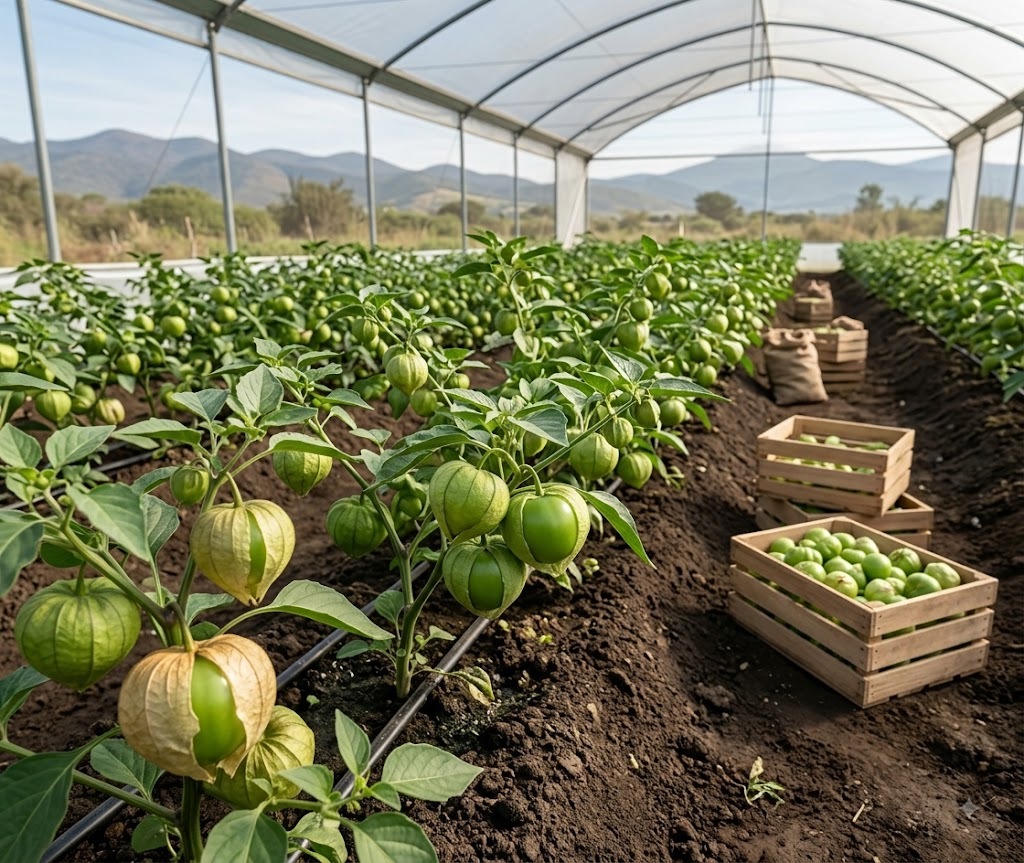
Judgment axis | Key judgment |
| Item Identity | A husk-covered fruit crop of the genus Physalis in the family Solanaceae. The basic Master Entity is P. philadelphica |
| Key role | Specialty Vegetables/Fruits with higher utility in processing and the food service industry, such as salsa verde, sauces, purees, roasting, pickles, and HMR, than fresh fruit. |
| Harvesting principle | Manage skin color, husk fullness, firmness, acidity, and ripeness according to the Buyer's Recipe. |
| Product separation | Husk-on, husk-off, processed green fruit, ripe fruit, roasted fruit, puree, salsa, frozen, and pickled are managed as separate products. |
| Separation of similar items | Tomato, Goldenberry, and other Physalis products are not treated as the same. |
| Domestic statistics | Official national statistics on nationwide cultivation area and production volume of Tomatillo alone: To be entered after verification of official raw data. |
| Domestic industrial basis | Past cases of agri-food technology commercialization and investment support by 'Tomatillo Korea' are confirmed in Nongsaroo data, but this is not used in domestic production statistics. |
| Supply and demand risk | Lack of domestic market, mixing of species/varieties, harvest maturity, calyx removal, refrigerated distribution, shortage of specialized buyers, competition from imported products |
| Operating Principles | Seed/Taxon–Plant–Fruit–Harvest Stage–Husk Removal–Processing–Buyer RFQ Connection |
| Final goal | First, secure Latin American buyers for the foodservice, sauce, and HMR sectors, then work backward from their required acidity, ripeness, and processing specifications to calculate production. |
The USDA ARS describes tomatillos as an ingredient native to Mexico, noting that locals prefer green, slightly unripe fruit for salsa . Therefore, for tomatillos, the key is the Harvest Stage that fits the final recipe , rather than the general fruit standard that "the riper, the better." ( USDA ARS Online Magazine )
Plant Identity
Basic fields | Tomatillo Registration Criteria |
| Korean name | Tomatillo |
| English name | Tomatillo / Mexican husk tomato |
| Representative scientific name | Physalis philadelphica Lam. |
| Related Taxon | Physalis ixocarpa Brot. ex Hornem. — Verified as a separate accepted species |
| classification | Solanaceae · Physalis |
| Edible parts | Fruit inside the calyx (husk) |
| Non-edible · Separate management | calyx, stem, leaf, root, diseased fruit, sorting residue |
| Major harvesting stages | Green / For processing / Edible / Ripe / Fully ripe / Overripe / For seed production |
| Basic product form | Husk-on fresh fruit · Husk-off fresh fruit · Washed fruit · Sliced · Roasted · Puree · Salsa · Frozen |
| Basic processing stage | Husk removal → Washing → Cutting → Roasting/Heating → Grinding → Puree/Salsa → Refrigeration/Freezing/Bottling |
| Basic use | Salsa verde · Sauce · Stew · Mexico · Latin America · Dining · HMR · PB |
| Similarity Principle | Separate from tomatoes, goldenberries (P. peruviana), and other ground cherries |
Kew manages Physalis philadelphica as an accepted species of Solanaceae, and USDA data also uses this scientific name as the host plant name for the Mexican groundcherry/tomatillo. ( Plants of the World Online )
On the other hand, there are instances in USDA-related studies where the tomatillo is described as Physalis ixocarpa. Therefore, the two species are not arbitrarily merged based solely on the trade name of commercial seeds. ( ARS )
Product Master
Product ID | Product type | Key Management Standards |
| TOMT-P01 | Husk-on tomatillos immediately after harvest | Taxon · Variety · Harvest Date · Ripeness · Lot |
| TOMT-P02 | Green saliva usage negligence | Color, Hardness, Acidity, and Husk Condition |
| TOMT-P03 | Edible ripe fresh fruit | Size, color, appearance, and hardness |
| TOMT-P04 | Fully ripened | Color change · Dangsan · Buyer use |
| TOMT-P05 | Husk-off raw material | Removal of calyx · Surface condition · Hygiene |
| TOMT-P06 | Wash Tomatillo | Washing water, surface residue, microorganisms |
| TOMT-P07 | Retail small packaging | Uniformity, Weight, Freshness |
| TOMT-P08 | Bulk for food service | Standards, ripeness, and daytime delivery |
| TOMT-P09 | Tomatillo with cut | Cutting size · Microorganisms · Refrigeration |
| TOMT-P10 | Roasting ingredients | Degree of ripeness, size, and heating suitability |
| TOMT-P11 | Roasted Tomatillo | Heating time, surface browning, and yield |
| TOMT-P12 | Salsa Verde ingredients | Acidity, ripeness, and heat suitability |
| TOMT-P13 | Tomatillo puree | Solid content, viscosity, color, acidity |
| TOMT-P14 | Salsa Base | Ingredients before blending of puree and spices |
| TOMT-P15 | Finished Product Salsa Verde | Blending · Heat Treatment · pH · Labeling · Use-by Date |
| TOMT-P16 | Frozen Whole | Pretreatment, Freezing, and Thawing Quality |
| TOMT-P17 | Frozen Cut | Cut/Frozen state |
| TOMT-P18 | Pickled tomatillos | Acidity, salinity, and hardness |
| TOMT-P19 | HMR Sauce Ingredient | Puree · Heating · Packaging |
| TOMT-P20 | Non-standard processed raw materials | Safety, defects, and suitability for processing |
| TOMT-P21 | Fruit for seed production | Taxon · Variety · Maturity |
| TOMT-P22 | satellite | Species · Accession · Germination · Purity |
| TOMT-P23 | Husk by-products | Review of generation volume, safety, and non-food utilization |
| TOMT-P24 | Finished Product PB | Raw Material Lot · Manufacturing Batch · Buyer Spec |
Classification criteria | Subdivision type | Management principles |
| Plant classification | P. philadelphica / P. ixocarpa, etc. | Connect the seeds to the official Taxon |
| Variety · Accession | Actual varieties such as green and purple | Prohibition of confirming Species based solely on color |
| Harvesting stage | Green for processing · Ripe · Fully ripe · Overripe | Product Separation |
| Husk status | Incomplete, full, ruptured, dry | Harvest/Quality Field |
| Fruit color | Green, yellowish-green, purple, etc. | Separate records from Variety |
| Fruit size | Actual measurements of weight and diameter | Buyer Spec |
| Distribution methods | Husk-on · Husk-off · Wash · Cut · Refrigerate | Product Separation |
| Processing form | Fresh · Roasted · Puree · Salsa · Frozen · Pickled | Process Lot |
| Final use | Specialty Food Service · Sauces · HMR · PB · Retail | Buyer separation |
| Transaction type | In-kind · Regular supply · Contract farming · OEM · PB | Contract |
| origin | Domestic/Imported | Traceability |
Although tomatillos and goldenberries/Physalis peruviana belong to the same genus Physalis, they are different species with distinct palatability, ripeness, and market roles; therefore, they are never classified as the same product. The USDA ARS also manages P. peruviana separately as Cape gooseberry/goldenberry. ( ARS )
step | Essential Dataset | Management purpose |
| Cultivation plan | Species · Varieties · Target Buyer · Product | demand-based production |
| satellite | Taxon · Variety · Seed Lot · Germination | Species Traceability |
| Seedling cultivation | Sowing date, seedling age, temperature, growth | Tomb quality |
| Transplanting and Sowing | Date, density, and cultivation type | Production schedule |
| survival | Missing plants/early growth | Supply forecast |
| Growth management | Plant height, branching, number of leaves | Growth prediction |
| rising | Temperature, Precipitation, Solar Radiation | growing environment |
| Watering | Soil moisture and irrigation amount | Fruit quality |
| dispute | Soil testing, fertilizer, and timing | Production Management |
| flowering | Flower ID · Blooming Date | Fruit set prediction |
| Pollination and fertilization | Pollination | Fruit Set |
| Fruit set | Fruit ID · Fruit Set Date | Harvest Prediction |
| Husk development | Size, fullness, and rupture | Accommodation assessment |
| Excessive negligence | Diameter, Weight, Color | Harvest forecasting |
| pests | Occurrence, Diagnosis, and Control | Quality and Safety |
| Harvest judgment | Husk · Color · Hardness · Acidity · Buyer Uses | Product Branch |
| harvest | Fruit ID · Date · Weight | Harvest Lot |
| Selection | Size, color, wounds, and diseases | Grade |
| Remove Husk | Removal Date · Status · Yield | Processing |
| purifying | Surface, water quality, microorganisms | Food Safety |
| cutting | Shape and size | HMR |
| Roasting | Time, Temperature, Yield | Salsa Product |
| smash | Particle Size · Batch | Puree |
| heating | Time and temperature | Sauce |
| freezing | Whole/Cut · Freeze | Year-round supply |
| pickles | Acidity, salinity, and time | Pickled Product |
| packaging | Fresh/Processed | circulation |
| save | Temperature, humidity, and period | Shelf-life |
| shipment | Buyer · Lot · Delivery Date | Delivery |
Quality items | Fresh fruit | Pre-treated products | processed goods | finished product | Public rating |
| Species | essential | succession | succession | tracking | Public |
| varieties | essential | succession | tracking | tracking | Public/Verified |
| mountainous district | essential | succession | succession | mark | Public |
| producer | ID | succession | tracking | - | Verified |
| Lot | essential | new | Process Lot | Manufacturing Lot | Verified/NDA |
| Sowing and planting dates | record | succession | - | - | Verified |
| Fruit setting date | record | succession | - | - | Verified |
| Harvest day | core | succession | succession | tracking | Verified |
| Harvesting stage | Green, ripe, hard-boiled | essential | Raw material specifications | tracking | Verified |
| Husk status | Filling, rupture, dryness, etc. | Record before removal | - | - | Member |
| Fruit color | core | Selection | Color | By product | Member |
| diameter | Actual measurements | Selection | Batch | If necessary | Member |
| weight | Actual measurements | Batch | Input | By product | Verified |
| hardness | core | Selection | Fabrication aptitude | By product | Verified |
| acidity | Measure if necessary | Raw Material Spec | Sauce Key Points | By product | Verified |
| Sugar and acid | If necessary | Raw Material Spec | Quality Control | By product | Verified |
| appearance | Wounds, heat, and contamination | Selection | - | - | Member |
| disease and decay | exception | exception | Food conversion ban | - | Verified |
| alien substance | check | purifying | Compliance with standards | Compliance with standards | Verified |
| pesticide residues | test | succession | Compliance with standards | Compliance with standards | Verified/NDA |
| microorganism | If necessary | Fresh-cut key | Processed product core | Compliance with standards | Verified/NDA |
| Husk removal yield | - | core | Cost reflection | - | NDA |
| Roasting yield | - | - | core | Cost reflection | NDA |
| Puree yield | - | - | core | By product | NDA |
| pH | - | - | Salsa and Sauce Essentials | Final product | Verified |
| heat treatment | - | - | Process records | finished product | NDA/Verified |
| packaging | Fresh | Preprocessing | Processing and packaging | Final | Member |
| save | essential | cold storage | By product | By product | Verified |
| Expiration date | The relevant city | Fresh-cut | processed goods | Labeling standards | Member |
| Returns and Claims | record | record | record | record | NDA |
| Repurchase | Buyer Connection | connection | connection | connection | NDA |
Lot Master Required Field
Lot ID · Item · Product Type · Species · Taxon Authority · Variety · Accession · Cultivation Type · Origin · Growing Area · Producer · Seed Lot · Sowing/Planting Date · Flowering Date · Fruit Set Date · Harvest Date · Harvest Stage · Husk Condition · Fruit Color · Diameter · Weight · Hardness · Acidity · Sugar-Acid Ratio (when measured) · Check for Wounds · Diseases · Spoilage · Pesticide Use Records · Pesticide Residue · Microbiological Test Report · Raw Material Lot · Husk Removal · Washing History · Cutting · Roasting · Grinding · Pureeing · Heating · Freezing · Pickling History · Process pH · Packaging Date · Best Before Date · Shipper · Returns · Claims · Repurchase
Customers | Purchase criteria | Cooperation opportunities |
| Specialized distribution of Latin American ingredients | Species · Green · Ripeness · Size | Specialty Product |
| Mexican restaurant | Acidity, Hardness, and Weekly Supply | Salsa Verde |
| Latin American food service companies | Fresh·Roasted Product | Regular delivery |
| Hotel · Restaurant | Uniformity, Freshness, Story | Premium |
| Salsa manufacturers | Ripness, Acidity, Roasting Suitability | contract farming |
| sauce manufacturer | Puree · pH · Color · Solids | B2B Ingredient |
| HMR manufacturers | Puree/Sauce Base | Meal Solution |
| Meal kit | Fresh Fruit · Small Packaging · Recipe | B2C |
| school meals | Safety, Cooking Method, Standards | Pilot |
| Online specialty mall | Husk-on · Small packaging | Specialty Retail |
| PB | Domestic · Region · Recipe | Salsa/Pickle |
| Pickle preparation | Hardness and size | Processing RFQ |
| Refrigeration company | Whole/Cut · Thawing Quality | Year-round supply |
| Seed company | Species · Varieties · Germination | Seed RFQ |
| Research Institute | Regional adaptation, variety, harvest maturity | PRP |
| importer | Fresh/Frozen/Sauce | Comparison of domestic products |
It is reasonable to view the primary market for tomatillos as centering on Salsa Verde and Latin American culinary uses . The USDA explains that in Mexico, green, slightly underripe tomatillos are used as the main base for spicy salsa. ( USDA ARS Online Magazine )
Therefore, the first demand source for the domestic Pilot is not general supermarkets.
Mexico/Latin America Dining → Specialized Imported Food Ingredient Supplier → Salsa/HMR Manufacturer → Private Brand (PB)
Verify first in order.
step | Key variables | Operational judgment |
| satellite | Species · Varieties · Origins | production base |
| domestic production | Region/Harvest Parking | Supply Forecast |
| Import procurement | Fresh/Frozen/Sauce | Supply Gap |
| harvest | Saturation · Husk · Acidity | Product Decision |
| Selection | Size, Hardness, Color | Buyer Grade |
| Remove Husk | Labor and yield | Processing Cost |
| cold storage | Product temperature and delivery time | Fresh Supply |
| Roasting | Yield, Color, Scent | Salsa |
| Puree | Solid content and acidity | Ingredient |
| Finished product processing | Mixing, Heating, and Bottling | Retail |
| freezing | Whole/Cut | inventory |
| Distribution and supply | Fresh/Processed | Buyer SLA |
| RFQ | Species · Ripeness · Product Type | Match |
| Repurchase | Acidity, Cooking, Delivery Time | Repeat trading |
HS·Trade Management
Tomatillo does not arbitrarily determine a single HS because the HS may vary depending on the product status.
Product | HS Operating Principles |
| Fresh and refrigerated tomatillos | Confirmation of the current Korea Customs Service HSK fresh vegetable sub-classification official |
| Frozen tomatillos | Frozen vegetables HS code separate |
| Tomatillo puree | HS Verification by Processing Status |
| Salsa Verde | Sauces and preparations are sold separately three times. |
| Pickled tomatillos | Verification of prepared vegetable classification |
| satellite | Separate classification of seeds for sowing |
Products and processes | Key conditions | RFQ conversion |
| fresh Husk-on fruit | Sukdo · Husk · Weight | Fresh RFQ |
| fresh husk-off fruit | Removal, cleaning, and hardness | dining out |
| Cutting and | Size · Microorganisms | HMR |
| Roasting ingredients | Green ripeness/size | Salsa company |
| Roasting fruit | Heating, Yield, Color | Foodservice |
| Puree | Solid content, acidity, viscosity | Sauce |
| Salsa Base | Pre-purée, salt, and spice stage | OEM |
| Salsa Verde | pH · Heating · Recipe | PB·Retail |
| Frozen Whole | Freezing and thawing | dining out |
| Frozen Cut | Cutting and freezing | HMR |
| pickles | Hardness, acidity, and salinity | Pickle |
| Non-standard health and | Safety and maturity | Puree · Roasting |
| Husk | Generation Amount · Safety | Compost and Non-Food Research |
| satellite | Species · Varieties | Seed RFQ |
| Disease and Decay Division | Food supply chain exclusion | waste/compost |
Product Conversion Principles
Non-standard appearance + Food safety compliant + Processing maturity compliant
→ Review conversion to Roasting, Puree, or Salsa Base
Buyer Recipe Unsuitable Due to Overripe
→ Re-evaluate with a Different Recipe or Processing Suitability
Disease, spoilage, or safety non-compliance
→ Exclusion from food products
PRP — Product Research Profile
PRP ID | Product Research Profile |
| PRP-TOMT-01 | P. philadelphica–P. ixocarpa Taxonomy Mapping |
| PRP-TOMT-02 | Variety · Accession – Color · Size |
| PRP-TOMT-03 | Domestic regional cultivation adaptation |
| PRP-TOMT-04 | Flowering, Pollination, and Fruit Set Rate |
| PRP-TOMT-05 | Husk development – Harvest time |
| PRP-TOMT-06 | Ripness – Hardness · Acidity |
| PRP-TOMT-07 | Green Harvest – Salsa Aptitude |
| PRP-TOMT-08 | Ripeness – Fresh/Processing Difference |
| PRP-TOMT-09 | Husk-on Zhejiang Province |
| PRP-TOMT-10 | Husk-off Washing · Shelf-life |
| PRP-TOMT-11 | Roasting – Yield, Aroma, Color |
| PRP-TOMT-12 | Puree – Solids content · Viscosity |
| PRP-TOMT-13 | Salsa pH · Heat Treatment Process |
| PRP-TOMT-14 | Freeze-Thaw Quality |
| PRP-TOMT-15 | Pickling suitability |
| PRP-TOMT-16 | Domestic–Imported Fresh Cost Gap |
| PRP-TOMT-17 | Comparison of Domestic and Imported Salsa Bases |
| PRP-TOMT-18 | Standard Surgery Product Recovery |
| PRP-TOMT-19 | Dining Out Buyer Recipe Spec |
| PRP-TOMT-20 | Harvest Stage–Recipe–Buyer AI Match |
first of all | Execution item | Performance indicators |
| 1 | Species, Variety, Origin, Harvest Date, and Lot are mandatory. | Required input rate |
| 2 | Husk-on/Husk-off/Fresh/Salsa Product Separation | Product identification rate |
| 3 | Connection between weather, growth, flowering, fruit setting, and Husk development | Runtime connection rate |
| 4 | Data conversion of quality, certificates, storage, and processing history | Lot completion rate |
| 5 | Farm–Restaurant–Sauce Processing–Buyer RFQ Connection | Match rate |
| 6 | Video AI Flower and Fruit Detection | Detection accuracy |
| 7 | AI Husk Fullness Judgment | Accommodation classification accuracy |
| 8 | Fruit size and weight prediction | Actual measurement error |
| 9 | Harvest maturity prediction | Buyer non-conformity rate |
| 10 | Weekly production forecast | Forecast Error |
| 11 | Pest and disease AI diagnosis | Early detection rate |
| 12 | Automatic Husk Removal Review | Working time per kg |
| 13 | Roasting and Puree Yield Prediction | Input–Output Error |
| 14 | Salsa ingredient batch standardization | Batch deviation |
| 15 | Fresh→Processing Transition AI | Product Recovery Rate |
| 16 | AI Buyer Match | Sample approval rate |
| 17 | Traceability | Salsa→Farm traceability rate |
| 18 | Repurchase Runtime | Buyer repeat purchase rate |
Problem group | Problem Definition | Required data |
| Lack of domestic production statistics | National production scale unclear | National and Regional Statistics |
| Mixed Species | Conflicting spellings of philadelphica and ixocarpa | Taxonomy |
| Lack of variety information | Lack of connection between distributed seeds and actual species | Seed |
| Lack of market awareness | It is difficult for general consumers to understand the intended use of the product. | Demand |
| Lack of professional buyers | Latin American dining-centered limited market | Buyer |
| Misjudgment of harvest maturity | Green fruit can be identified as immature or defective. | Harvest Stage |
| Husk lacks judgment | Unaccumulated relationship between Husk development/rupture and marketability | Husk Dataset |
| Fruit size variation | Buyer Recipe · Processing Yield Impact | Fruit Size |
| Acidity variation | Affects salsa quality | Acidity |
| Pollination and fertilization problems | Changes in fruit set | Pollination |
| pests | Management of common and unique diseases of the Solanaceae family is necessary. | Disease |
| Lack of selection criteria | Domestic Grades Not Yet Established | Quality |
| Husk removal labor | Processing pretreatment costs | Processing |
| Cleaning Management | Surface care after husk removal | Hygiene |
| Fresh Cold Chain | Lack of system due to low volume of specialized distribution | Storage |
| Salsa ingredient specifications are lacking | Maturity, acidity, and roasting specifications not standardized | PRP |
| Processing yield deviation | Difference in roasting and puree yield | Processing Yield |
| Competition from imported products | Competition with Fresh, Sauce, and Puree in Cost | Trade |
| HS identification problem | Verification of whether it is independent three times is necessary. | Customs |
| Lack of contract farming | Risk of production expansion without buyers | Contract |
| Standard surgical treatment | Processing paths for Fresh products excluded from processing are not yet established. | Recovery |
| Recipe dependency | Acidity and ripeness requirements vary by buyer | Buyer Spec |
| Insufficient repurchase data | Possibility of one-time specialty sales | Repurchase |
RFQ Type | Public Registration | Verify/NDA |
| Tomatillo source | Species · Variety · Region · Shipping Date | Farm, Volume, Unit Price |
| Husk-on fresh fruit sales | Ripness, Size, Color | Lot · Price |
| Buying fresh fruit | Species · Ripeness · Diameter | MOQ · Actual Unit Price |
| Regular supply | Product Cycle | Weekly volume and price |
| contract farming | Variety · Ripeness · Target Recipe | Area, Quantity, Price |
| Mexican dining | Green color, acidity, size | Delivery cycle |
| Latin American ingredients | Variety · Freshness | actual demand |
| Ingredients for Salsa | Ripness, acidity, and hardness | Processing yield |
| For roasting | Size · Aptitude | Sample |
| For puree | Solid content and acidity | Yield · MOQ |
| Salsa Base | pH·Puree Spec | Formula/NDA |
| freezing | Whole/Cut | Thawing test |
| pickles | Hardness and acidity | Processing test |
| HMR | Sauce Base | Manufacturing conditions |
| Meal kit | Fresh small packaging | Recipe · Delivery Time |
| PB Salsa | Domestic/Origin | MOQ · OEM |
| satellite | Species · Varieties | Seed Lot · Germination |
| import substitution | Fresh/Purée/Sauce | Cost·HS |
| export | Product · Target Country | Quarantine and price |
| Technology demonstration | Variety, Ripeness, and AI Sorting | Dataset |
| Research cooperation | Taxonomy · Processing · Diseases | PRP |
① Need Products & Materials
Companies and institutions seeking necessary products, agricultural products, raw materials, and processed goods register purchasing demands. Registered requests are utilized to review cooperation with potential suppliers and producers based on the RFQ Intelligence Library.
Process:
RFQ Registration → Supplier/Product Review → Collaboration Connection → Future AI Matching
Register
② We are looking for production and manufacturing partners. (Need Suppliers & Manufacturers)
Register a request to find necessary production and supply partners, ranging from farms and producer organizations to processing companies, OEM, ODM, and private label manufacturers.
Process:
RFQ Registration → Review of Production & Manufacturing Capabilities → Collaboration Connection → Future AI Partner Matching
Register
③ We are looking for domestic and international buyers. (Need Buyers)
Farmers, producer organizations, and manufacturing companies are requesting cooperation with new buyers, such as domestic and international distributors, importers, brand companies, and food service and catering businesses.
Process:
RFQ Registration → Product & Supply Capability Review → Market & Buyer Connection → Future AI Buyer Matching
Register
Contact : mail@markethub.org
Version | Main contents | situation |
| v1.0 | Taxonomy·Plant Identity·Husk·Raturity·Fresh·Roast·Purée·Salsa·RFQ Basic Structure Registration | complete |
| v1.1 | Verification of official raw data for domestic production, variety, region, market, HS, and import | expected |
| v2.0 | Species · Variety · Ripness · Acidity · Roasting · Puree · Salsa Product Specification Subdivision | expected |
| v3.0 | Producer–Food Service–Sauce & HMR Processing–Distribution–Buyer Verified Container Combination | expected |