


Analysis Area: Ulsan Metropolitan City
Core Areas: Buk-gu finished vehicle production zone · Ulju-gun automotive parts, research, and industrial complex zones
Agenda: Determine whether investment in electrification production leads to value transformation for SDV, AI, robots, parts companies, and local employment
Golden Time Type: Production Investment + Software Value Migration Risk
Reference Date: 2026.08.28
Version: Regional AX Golden Time Intelligence v3.2 Enhancement Standard
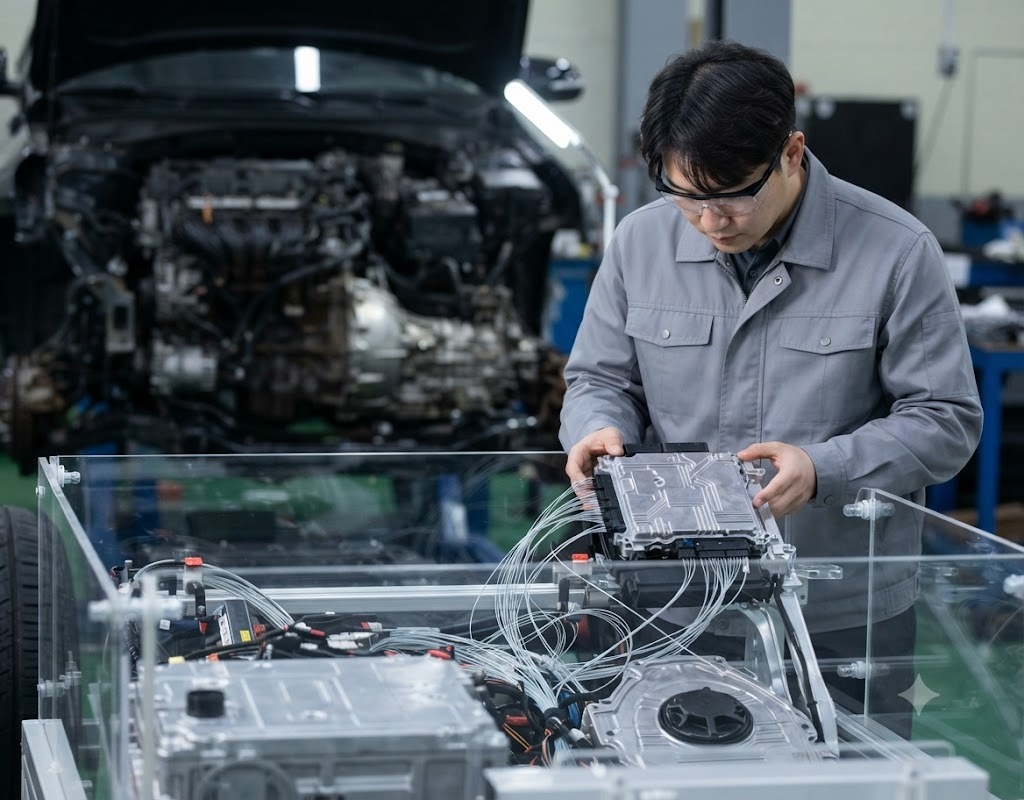
In Buk-gu, Ulsan, Hyundai Motor is proceeding with the construction of a new dedicated electric vehicle (EV) plant, while the existing Ulsan plant is also expanding its production systems for EVs and eco-friendly vehicles. The production base of the automotive industry is shifting from mass production of multiple internal combustion engine models to dedicated electrification facilities and flexible production. However, there is no confirmed public evidence linking the production capacity, robotics, and AI application of the new plant with the future vehicle sales, employment, and supply transition of local Ulsan parts suppliers based on a single supply chain. If the EV production system becomes fixed between 2026 and 2028, internal combustion engine parts suppliers that fail to transition could simultaneously lose facilities, technology, and clients. While Ulsan's status as an electrification production hub is strengthening, the transition of the entire regional automotive ecosystem remains unconfirmed.
The Ministry of Trade, Industry and Energy is providing 49.5 billion won in support for 14 new projects in the AI future vehicle sector by 2026, including autonomous driving AI models, SDV standard platforms, and automotive semiconductors. The center of automotive competition has shifted from bodywork, engines, and production volume to a structure where software, data, semiconductors, and AI models continuously transform vehicle value. However, the proportion of Ulsan companies in these projects, standards, and platforms, as well as local software sales and workforce, are not confirmed in publicly available data. If the authority over SDV platforms and vehicle data becomes entrenched in the capital region, headquarters, and global technology companies over the next two to three years, Ulsan could be excluded from the region accumulating software value, even if it produces vehicles. The greatest risk to Ulsan's automotive industry is assessed to be a structure where vehicle value shifts out of the production city, rather than a decrease in production volume.
Approximately 620 companies participated in automotive industry-related events held in Ulsan in 2026, covering sectors such as automotive manufacturing and parts, autonomous driving, connected cars, electrification, lightweighting, digital transformation, and next-generation mobility. The scope of Ulsan's automotive ecosystem has expanded from finished vehicles and mechanical parts to include telecommunications, software, sensor, semiconductor, and robotics companies. However, among the participating firms, no publicly disclosed outcomes linking Ulsan-based companies, finished vehicle supply contracts, joint development, or future vehicle sales have been identified. If the networking activities from 2026 to 2028 remain centered on exhibitions and consultations, the increase in the number of companies will not lead to a substantial transformation of the regional supply chain. While Ulsan has secured contact points with future vehicle companies, the transaction density of the new value chain within the region is deemed unverified.
Hyundai Motor Company is utilizing real-time vehicle quality inspection robots at its production plants, and the application of manufacturing AI and robots is expanding to the areas of inspection, logistics, assembly, and safety. Automobile factories are shifting from being centered on automated equipment to human-robot collaborative factories where AI analyzes quality and operations. However, no publicly available data comparing defects, downtime, productivity, industrial accidents, or job changes at the regional level has been found before and after the application of AI and robots at the Ulsan plant. After the reorganization of equipment and job functions in the new and existing plants between 2026 and 2028, the cost of reversing flawed automation structures and disconnected data from suppliers will increase. The " Golden Time" for Ulsan's automotive industry lies not in the completion of the electric vehicle (EV) plant, but in the next two to three years, during which SDVs, AI, and robots become established as regional value-added and part of the supply chain.
Golden Time Thesis — The survival of Ulsan's automotive industry depends not on the number of electric vehicles produced, but on how much of the value of a single car—including software, AI, semiconductors, data, and robotics production technology—remains with Ulsan companies and the workforce.
Ulsan's automotive industry consists of finished vehicle factories in Buk-gu, parts suppliers, logistics and export infrastructure, and research, testing, and corporate support facilities. The industrial structure is a vertical supply chain centered on finished vehicle assembly, where numerous parts suppliers meet delivery deadlines and quality standards. However, a modern common baseline distinguishing between companies dependent on internal combustion engines (such as engines, transmissions, and exhaust systems) and those in the fields of electrification, electronics, and software among Ulsan's automotive businesses and employees has not been identified. As the proportion of electric vehicle production rises between 2026 and 2028, the risk of demand decline will accumulate, starting with companies whose dependency is currently unknown. While the scale of Ulsan's automotive industry is large, the denominator of companies exposed to transition risks remains unidentified.
Hyundai Motor’s Ulsan plant possesses long-accumulated capabilities in mass production, quality, and export, and has recorded a cumulative production of 100 million units. While production assets represent Ulsan’s strongest competitive advantage, in SDVs, software updates and data services create additional value after vehicle delivery. The scale of employment and revenue generated in Ulsan for vehicle software, cloud, and data is not confirmed in publicly available data. If EV production increases in Ulsan over the next two to three years while software revenue is concentrated in the Seoul metropolitan area and overseas subsidiaries, the production volume and value added of the regional industry will become disconnected. Although Ulsan is strong in terms of finished vehicle production volume, its regional share of revenue from the vehicle lifecycle remains unconfirmed.
The establishment of a dedicated electric vehicle (EV) factory expands demand not only for body, paint, and assembly lines but also for battery, power electronics, thermal management, and software inspection processes. Ulsan's production structure is shifting from a single system centered on internal combustion engines to a multi-system where electrification and internal combustion engines coexist. However, the number of existing parts suppliers that are mass-producing EV components or have been incorporated into the new factory's supply chain remains unconfirmed. Once initial vendors become fixed between 2026 and 2028, parts companies that have failed to transition will be excluded from the regional impact of increased finished vehicle production. While the scale of the EV factory is confirmed, the extent of its integration into the regional parts ecosystem is determined by a data gap.
Ulsan City is promoting support for internal combustion engine parts companies transitioning to future vehicles, as well as for companies involved in lightweighting, safety components, electrification, and autonomous driving. The scope of corporate support has been expanded from prototype production to testing, certification, and business transformation. However, there is no publicly available data confirming the long-term tracking of supported companies regarding their future vehicle sales share, new customers, mass production contracts, or employment changes. If only the number of supported companies accumulates over two to three years, the gap between technological development and actual supply chain transformation becomes obscured. While the scale of support in Ulsan exists, the economic scale of the transitioning companies is deemed unconfirmed.
Finished vehicle factories, automotive parts companies, testing and business support agencies, and universities and research institutes form the physical agglomeration of Ulsan's automotive industry. In the future vehicle sector, the structure shifts to a convergence ecosystem where companies in machinery, electronics, telecommunications, AI, semiconductors, and software participate in the same product development cycle. However, there is no confirmed public evidence linking software-hardware joint development, joint patents, vehicle integration, and recurring revenue among Ulsan-based companies. Even if the existing mechanical parts agglomeration is maintained between 2026 and 2028, the value density of the regional ecosystem will decrease if the software supply chain is formed externally. Although Ulsan is an automotive manufacturing cluster, it is difficult to conclude that it has been established as an SDV convergence ecosystem.
Support for the transition to future vehicles provides technology development, prototypes, testing, and corporate assistance, and approximately 620 companies participated in related events in 2026. The scope of the industry has expanded from regional parts networks to include companies involved in electrification, autonomous driving, connected cars, and digital transformation. However, the percentage of participating companies in these events and support programs that have actually entered the market as finished vehicle vendors or SDV platform suppliers remains unconfirmed. Even if the number of contact points increases over two to three years, ecosystem growth remains confined within the events and support programs if supply contracts are not formed. While corporate contact points for future vehicles have expanded, the transition rate to the mass production ecosystem remains unconfirmed.
Hyundai Motor Company’s utilization of quality inspection robots and national AI robot demonstrations demonstrate the intelligentization of production lines. The automation ecosystem is shifting from the supply of robot hardware to a service-based structure that combines vision, AI, data, and maintenance software. However, cases of Ulsan-based robot and AI suppliers expanding to other regions or overseas plants following demonstrations at finished vehicle factories, as well as their revenue, are not publicly disclosed. If robot technology becomes concentrated within finished vehicle manufacturers or large external suppliers between 2026 and 2028, Ulsan will remain a user of robots but will fail to serve as a supply ecosystem. While demand for Ulsan’s intelligent factory ecosystem has been confirmed, the growth of local suppliers remains unproven.
The Future Automotive Parts Industry Transition Promotion System designates specialized future vehicle parts companies equipped with technological, sales, and R&D capabilities and supports their demonstration. The system has shifted from the uniform protection of internal combustion engine parts to the selection and transition of competitive future vehicle companies. However, the number of specialized companies designated in Ulsan, the transition rate of existing internal combustion engine companies, and sales performance after designation are not verified in publicly available regional statistics. If the gap between specialized companies and non-transitioned companies widens between 2026 and 2028, parts of the existing supply chain will be simultaneously pushed out of access to policy, finance, and talent. While Ulsan's institutional ecosystem has been established, transition performance by company group is deemed unconfirmed.
In SDV, vehicle functions are not fixed at the time of delivery but continuously change through software updates, subscriptions, and data services. The automotive value chain extends from design–production–sales to design–production–data–update–service. The proportion of Ulsan-based companies participating in post-delivery software and data revenue is unconfirmed. If the SDV platform and app/service ecosystem become centered around specific companies or regions between 2026 and 2028, Ulsan's revenue will be limited to the production stage. The greatest structural change in Ulsan's automotive industry is the shift from vehicle production to vehicle lifecycle value, and local participation remains unconfirmed.
Electric vehicles reduce the demand for engines, transmissions, and exhaust components, while expanding the demand for batteries, motors, inverters, thermal management, power semiconductors, and electronic controls. The structure of the parts industry is shifting from a focus on mechanical processing to a convergence of electrical, electronic, and software technologies. The dependence of Ulsan parts companies on internal combustion engines by product category and the conversion rate of sales to future vehicles have not been disclosed. If the production of finished electric vehicles expands over the next two to three years, sales declines for companies with slower transition speeds may occur before the growth of new electrification companies. For the Ulsan parts industry, a time-related risk is identified in the transition of product structure prior to the shift in production.
AI manufacturing is shifting from automation that repeats fixed programs to autonomous manufacturing that learns equipment, quality, and logistics data to modify working conditions. The Ministry of Trade, Industry and Energy is promoting the development of an autonomous manufacturing SDM platform that links heterogeneous IT and OT data. However, manufacturing data standards and the reuse rate of AI models between finished vehicle manufacturers and parts suppliers in Ulsan remain unconfirmed. If proprietary data structures become entrenched by 2026–2028, the costs of optimizing quality and delivery times across the entire supply chain will increase. The structural gap in Ulsan's manufacturing AI is identified more in inter-company data interoperability than in the number of robots.
AI robots and humanoids are expanding the scope of application to non-standard assembly, logistics, inspection, and hazardous tasks that were difficult for stationary robots to perform. The introduction of robots is shifting from facility investment to simultaneous changes in work design, safety, skills, and labor structure. No publicly available data linking job reduction, job transfers, safety accidents, and productivity before and after the introduction of robots at the Ulsan plant has been confirmed. If robot deployment expands over the next two to three years, personnel who are slow to retrain will be exposed to job risks regardless of increased production. The robot transition in Ulsan is assessed to be structured in a way that creates a significant gap between the speed of production technology and labor transitions.
Automotive semiconductors and on-device AI are becoming core components for vehicle control, autonomous driving, and security. The automotive supply chain has expanded from steel and mechanical parts to semiconductor design, sensors, and computing platforms. The scale of automotive semiconductor design, verification, packaging, and software companies within Ulsan is not confirmed in publicly available data. If the architecture and key suppliers become fixed between 2026 and 2028, the structure will become one where Ulsan consumes large quantities of semiconductors, but the added value remains external. Product AX of Ulsan's future vehicles is assessed as having low Readiness within the automotive computing value chain.
Ulsan City supports internal combustion engine parts companies in transitioning to future vehicles and developing components for safety, lightweighting, electrification, and autonomous driving. The scope of the policy has shifted from maintaining existing automobile production to product diversification and technology acquisition. However, no public cohort linking the companies' revenue structures prior to support with their future vehicle sales and mass production contracts following support has been identified. If technical support for the 2026–2028 period concludes with prototypes, the transition achievements will remain as project performance records rather than supply contracts. While Ulsan’s response to future vehicles has reached the technology development stage, the transition to the mass production market remains unconfirmed.
Ulsan City is providing administrative support, including site selection, permits, and infrastructure, for Hyundai Motor's establishment of a dedicated electric vehicle (EV) plant. The response has shifted from maintaining existing plants to securing local reinvestment in next-generation production facilities. However, public outcomes—including the local procurement rate, the inclusion rate of local parts suppliers, and the creation and reduction of new and reduced job roles for the new plant—have not been verified. Once facilities and supply contracts are finalized within two to three years, the room for late entry by local parts suppliers becomes limited. While attracting the dedicated plant is an achievement in defending the industrial base, its impact on the transformation of the local supply chain remains unproven.
The 14 national AI future vehicle projects and 49.5 billion won investment for 2026 support autonomous driving AI, SDV platforms, and automotive semiconductors. The national response has expanded from individual vehicle technologies to a structure that combines products, platforms, and semiconductors. The project participation, technology ownership, standardization contributions, and commercialization achievements of Ulsan companies are not confirmed in publicly available regional data. Once the national platform is commercialized between 2026 and 2028, initial participation will determine subsequent supplier status. Ulsan's level of inclusion in the national SDV response is determined to be unconfirmed.
Ulsan City has included AX for SMEs, the activation of regionally specialized manufacturing data, and the nurturing of AI companies in its new strategic directions for 2026. The process transition policy has shifted from equipment support to a structure that includes the utilization of data and AI. However, the funds allocated to automotive parts companies and the actual improvements in processes, productivity, and defect rates resulting from AI application have not been separately disclosed. If the manufacturing data project is operated as a common industry initiative for two to three years, the specific characteristics of SDV and electrification within the automotive supply chain may not be fully reflected. While the response to AX in the automotive parts sector has begun, industry-specific production outcomes remain unconfirmed.
Global automotive competition has expanded from electric vehicle sales volume to competition in SDV platforms, autonomous driving AI, batteries, semiconductors, and robot productivity. As a global automaker, Hyundai Motor maintains a large-scale production base in Ulsan. However, data comparing the number of automotive software, semiconductor, and AI suppliers in the Ulsan region, as well as their revenue, with global production cities is unavailable. If the proportion of software in product value increases between 2026 and 2028, it will become difficult to explain Ulsan's global standing based solely on production volume. Ulsan is judged to be a global hub for finished vehicle production, but incomparable in the regional SDV ecosystem.
The government plans to support 14 new projects in autonomous driving AI, SDV, and semiconductors by 2026, and promote field demonstrations of AI robots and humanoids. Domestic future vehicle policy has shifted from the widespread adoption of electrification to the simultaneous transition to AI products and processes. The proportion of projects, standards, demonstrations, and patents secured by Ulsan in national projects is not disclosed. If R&D centers in the Seoul metropolitan area and parts clusters in other regions preempt national projects over the next two to three years, Ulsan may remain merely a provider of production sites. Ulsan's relative position within the domestic market is assessed as superior in manufacturing sites, but unconfirmed regarding the ownership of core national technologies.
The specialized future automotive parts company system selects transitioning companies based on future vehicle sales and R&D capabilities. Domestic parts competition is being restructured from a focus on existing supply histories to centers around companies equipped with future vehicle technology, sales, and patents. The designation rate of specialized companies in Ulsan and its proportion relative to the national total are not currently confirmed. If companies designated between 2026 and 2028 secure funding, R&D, and demonstration projects, the transition costs for non-designated Ulsan companies will increase. The domestic competitiveness of Ulsan's parts industry is judged by a "data gap" in the proportion of future vehicle specialized companies rather than the total number of companies.
Global automotive factories respond to model changes and production fluctuations by combining digital twins, AI quality control, autonomous logistics, and collaborative robots. The Ulsan plant also possesses intelligent automation capabilities, such as quality inspection robots. However, publicly available data comparing model changeover times, defects, equipment downtime, and robot utilization rates with global factories is limited. If volatility in electric vehicle demand persists between 2026 and 2028, factory flexibility, rather than production volume, will determine locational competitiveness. While the Ulsan plant demonstrates strong global readiness in terms of scale, its flexible production outcomes are deemed unconfirmed.
Hyundai Motor’s cumulative production of 100 million units demonstrates Ulsan’s manufacturing capabilities but does not directly reflect its future competitiveness in the SDV era. Past production volume represents assets in quality, supply chains, and export capabilities, while future value is added through revenue from software, data, and services. Data linking cumulative production with regional software revenue is not available. If production volume indicators continue to represent industrial performance from 2026 to 2028, the decline in regional value added per vehicle is obscured. The numerical risk of Ulsan’s automotive industry is determined by the non-equivalence between production volume and future value.
New national support for AI-driven future vehicles amounts to 49.5 billion won across 14 projects, and approximately 620 companies participated in related industry events. Even when linking the number of projects with the number of participating companies, it is impossible to calculate opportunities per firm, and the distinction between local and external firms remains unclear. The actual number of orders, standards, patents, and mass production contracts secured by Ulsan companies cannot be verified. If participation in events is mistaken for industry participation over the next two to three years, the gap in technology ownership for Ulsan companies is obscured. While the scale of corporate contact points can be confirmed, the magnitude of technology and revenue conversion remains unconfirmed.
Connecting the establishment of dedicated EV factories with the existing internal combustion engine supply chain means that the new production facilities represent a growth investment, while posing a demand substitution risk to existing parts suppliers. However, the number of existing parts suppliers experiencing a reduction in product lines, shifting to electrification items, or pursuing both simultaneously is not disclosed. If only EV production volume increases between 2026 and 2028, changes in net employment and net sales within the supply chain are obscured by the average values. Consequently, it is determined that the investment effects of dedicated factories and the transition losses of the existing supply chain are not being measured together.
Even if AI quality inspection robots reduce defects, the overall effect can only be calculated by linking them with inspection personnel, rework, line stoppages, and quality costs incurred by suppliers. While the utilization of technology is confirmed in currently available evidence, specific figures for the Ulsan plant are not available. The causal relationship between the number of robots and productivity has also not been disclosed. If only the number of equipment introductions accumulates over two to three years, it becomes difficult to distinguish between existing automation and the additional effects of AI robots. In Ulsan, the number of robot conversions is determined to be unmeasured in process outcomes rather than in terms of installation volume.
The transition to electric vehicles, SDVs, and AI robots represents changes in products, software, and production technology, respectively, but in reality, they are combined within the same vehicle cost and supply chain. No publicly available data linking the investment, companies, talent, and sales of these three sectors to a single regional Automotive AX account has been confirmed. The structure makes it impossible to view the aggregation of individual policy outcomes as a comprehensive industrial transformation. If sector-specific projects become entrenched between 2026 and 2028, overlapping support and weak linkages will remain simultaneously. The largest numerical gap in the Ulsan Automotive AX is determined to be the absence of an integrated account for the three transformation axes.
The first gap is the absence of a baseline for dependence on internal combustion engines . Although Ulsan is promoting support for the transition to future vehicles, no publicly available data compiling the proportion of internal combustion engines in each company's sales, product lines, or customers has been confirmed. Consequently, there is no denominator for identifying high-risk companies. If demand for internal combustion engines declines between 2026 and 2028, the selection of support recipients may be determined more by whether or not they apply than by their actual exposure. The biggest gap in Ulsan's automotive industry lies in the lack of precise knowledge regarding transition risks prior to the transition support.
The second gap is the lack of regional connectivity in the SDV value chain . Although Ulsan is a production hub for finished vehicles, no local companies or revenues related to operating systems, vehicle software, semiconductors, cloud services, or data services have been identified. The structure is such that hardware production and software revenue are located in different areas. If the SDV platform is finalized within two to three years, the cost of late entry for Ulsan companies will rise sharply. Ulsan's product readiness is assessed to be lower in software value capture than in electric vehicle assembly.
The third gap is the lack of tracking regarding the transition from PoC to mass production for parts suppliers . While support for technology development, prototypes, and testing exists, the percentage of companies that secured mass production contracts with automakers and recurring revenue is not disclosed. Project completion and industrial transition are separated. Even if the number of supported companies increases between 2026 and 2028, if the number of mass production suppliers does not rise, the policy outcomes will remain merely as technological assets. The transition readiness of Ulsan's parts industry remains unconfirmed in mass production contracts rather than in demonstration.
The fourth gap is the lack of confirmed manufacturing data standards between automakers and their suppliers . The effectiveness of AI manufacturing increases as equipment, quality, and delivery data are connected across the entire supply chain. However, regional standards encompassing data rights, security, model liability, and common IDs have not been disclosed. As automakers' proprietary systems become more sophisticated over the next two to three years, small and medium-sized enterprises (SMEs) will have to handle the differing data demands of multiple clients. In Ulsan, the structural gap in manufacturing AX is greater in inter-company connections than in internal automaker networks.
The fifth gap is the disconnect between robots and labor transition . While the demonstration of quality inspection robots and humanoids is expanding, regional data linking job reduction, new roles, retraining, safety, and wage changes is not being confirmed. Production technology and labor policy operate under separate systems. If robot deployment outpaces job transition between 2026 and 2028, a shortage of skilled labor and a reduction in the roles of existing personnel will occur simultaneously. Ulsan's robot readiness is assessed to be lower in the reallocation of field personnel than in equipment introduction.
Dedicated EV factories, existing finished vehicle plants, automotive parts industrial infrastructure, and testing and corporate support facilities constitute the future vehicle production infrastructure. The physical production base is expanding from a system dedicated to internal combustion engines to one that parallels electrification. However, there is no publicly available data integrating the local supply and testing capacity for batteries, power semiconductors, SDV verification, and AI robots. If production facilities begin operation between 2026 and 2028, the external procurement structure for core components and software will become entrenched as the initial standard. While Ulsan’s production infrastructure is strong, the local completeness of core technologies is deemed unconfirmed.
Ulsan possesses UNIST, local universities and research institutions, and a corporate education infrastructure. Automotive job functions have expanded from machinery and production management to a structure that includes software, data, robotics, electronic control, and cybersecurity. An open runtime connecting majors, curricula, and graduates with the new job demands of local companies has not been identified. If the demand for SDV personnel increases over the next two to three years, reliance on external recruitment increases due to mismatches in job functions, wages, and company size, even if local talent is available. Talent Readiness is determined to be unconfirmed in the supply of SDV jobs rather than in the presence of educational institutions.
Finished vehicle and parts factories generate large-scale data regarding equipment, quality, processes, and vehicles. Future vehicle data extends from internal production information to vehicle operation, updates, and services. However, the structure for combining manufacturing data and vehicle lifecycle data into regional industrial analysis has not been disclosed. If data ownership, cloud computing, and security structures become fixed between 2026 and 2028, accessibility for local public and SMEs will decrease further. Data infrastructure exists within companies but is assessed as having limited utility within the regional ecosystem.
The system for promoting the transition to the future automotive parts industry and Ulsan City's corporate support provide an institutional foundation for technology development, specialized enterprises, and demonstration support. Industrial support has shifted from a structure focused on general automotive parts to one that selects companies possessing future vehicle technologies. However, no public disclosure system has been identified to track business restructuring, workforce reallocation, or the risk of closure for companies that fail to transition. If support centered on successful companies becomes entrenched for two to three years, companies at high risk of failure could rapidly shrink outside of policy statistics. The system is assessed as having reached the level of support for growth companies but failing to achieve the early detection of companies at risk of transition.
Ulsan City operates a system for future vehicle technology development, testing, and corporate support, and promotes the utilization of manufacturing data through the SME AX. The scope of policy targets has been expanded from finished vehicle manufacturers to local parts suppliers and SMEs. However, the future vehicle sales, mass production contracts, productivity, and employment performance of beneficiary companies have not been disclosed. Even if support is expanded between 2026 and 2028, if companies' revenue structures do not change, the policy may have reached the field but will not lead to industrial transformation. Corporate expansion is confirmed by participation in the program, but remains unconfirmed in terms of economic outcomes.
Dedicated electric vehicle factories generate demand for construction, equipment, parts, logistics, and services. The benefits for local companies are sustained through long-term mass production supply and maintenance contracts rather than participation in factory construction. Local procurement rates and the entry rate of new vendors for Ulsan parts companies have not been disclosed. If the initial supplier composition remains fixed for two to three years, the gap between temporary revenue during the construction phase and long-term revenue during the mass production phase widens. Regarding the effect of dedicated factories on local companies, investment generation is confirmed, but sustained revenue is deemed unconfirmed.
While AI and robots can reduce hazardous tasks and repetitive inspections, they also alter the roles and skill values of existing workers. The effects of industrial transition on residents manifest not only in the number of jobs but also in wages, safety, job security, and retraining. No public cohort linking job changes and robot application among Ulsan's automotive workers has been identified. As facility transitions proceed between 2026 and 2028, new software roles and reduced production roles will occur simultaneously, but the net effects will be confirmed later. The impact on worker diffusion remains unassessed regarding job transition outcomes compared to productivity effects.
While the electric vehicle and SDV industries have the potential to attract high-wage professionals and high-value-added companies, the employment effect for young people in Ulsan is limited if research and software functions are located outside the region. There is no confirmed data linking recruitment for automotive software positions in Ulsan with the employment of local university graduates. If an employment structure centered on production jobs is maintained for two to three years, young people may not choose Ulsan as a city for research and software careers, even if the future vehicle industry grows. The impact of future vehicles on residents is judged to be unconfirmed in terms of the retention of high-value-added jobs in the region rather than in production employment.
Buk-gu is a region where finished vehicle production and adjacent parts and logistics are concentrated, making it a direct area for the effects of EV factory investment. While parts companies in Ulju-gun and other industrial complexes are connected to finished vehicle manufacturers, they differ in company size, technology, workforce, and data capabilities. Data on companies transitioning to future vehicles, sales, employment, and AI application rates by district and county have not been disclosed. If the growth of the anchor factory in Buk-gu between 2026 and 2028 boosts the Ulsan average, the decline in demand for parts companies in the outskirts will be masked. There is a risk that the spatial gap in Ulsan’s automotive AX will widen due to the disparity between the location of finished vehicle manufacturers and the distribution of parts companies.
Automobile assembly plants in Buk-gu are well-positioned to introduce AI robots and SDV production inspections due to their dedicated networks, specialized personnel, and large-scale investments. Small-scale parts factories, however, face greater constraints regarding data collection, security, robot investment, and specialized personnel costs. No regional data comparing AI adoption rates and payback periods by company size has been confirmed. If technology standards centered on large corporations become entrenched over the next two to three years, small and medium-sized enterprises (SMEs) must replace both their production facilities and data systems simultaneously. The actual cause of this spatial disparity is determined to be the difference in transition costs based on company size, rather than administrative boundaries.
Ulju-gun’s industrial complexes house automotive, machinery, and materials companies as well as research and testing infrastructure, possessing the potential for the demonstration and mass production of future vehicle components. However, physical proximity to finished vehicle factories does not automatically translate into integration with SDV and AI technologies. Joint development, data linkage, and mass production contracts between finished vehicle manufacturers and Ulju parts companies have not been publicly integrated. If the electrification supply chain is formed around external companies between 2026 and 2028, the advantage of the existing location will be reduced to merely logistics distance. Ulju-gun’s future vehicle readiness is assessed as unconfirmed in terms of its inclusion in new value chains rather than its industrial location.
The losses resulting from the transition of the automotive industry first manifest in residential areas where specific parts companies and workers are concentrated. Even if average employment is maintained, regions with a high concentration of engine, transmission, and exhaust system companies may experience a faster decline in sales and employment. Public risk maps linking company locations by product category with workers' residences and job functions are not available. If only average industrial statistics are managed over a period of two to three years, regional employment shocks become apparent only after unemployment and commercial decline have occurred. The "Golden Time" gap within Ulsan is determined to be unmeasured in the spatial distribution of companies dependent on internal combustion engines.
The establishment of a dedicated electric vehicle (EV) factory in Ulsan and the development of an electrification production system will concretize the supply chain, facilities, and workforce structure between 2026 and 2028. This is the period during which initial mass-production items and vendors are finalized. The rate of Ulsan parts companies' inclusion in new supply chains and their dependence on internal combustion engines have not yet been confirmed. Once supply contracts are fixed, entering new vendors requires a longer verification period, even if technology development is completed. The first "Golden Time" is determined to be before the initial supply chain is stabilized, rather than before the EV factory's facilities are completed.
In 2026, the government provided 49.5 billion won in new funding for 14 projects related to SDV, autonomous driving AI, and automotive semiconductors. The period from 2026 to 2028 is when platforms, data, semiconductor architectures, and initial standards are formed. The level of participation by Ulsan companies in projects, standards, and software has not been confirmed. Once standards are finalized, it will be difficult to regain platform dominance based solely on the scale of production facilities. The second "Golden Time" is determined to be before Ulsan becomes entrenched as a region purchasing SDV technology.
Field demonstrations of AI robots and humanoids expand the scope of automation to include non-routine tasks. The period from 2026 to 2028 is a time when technology demonstrations and factory deployments proceed in parallel, leading to changes in work design and job composition. Outcomes regarding worker retraining, job mobility, and safety have not been disclosed. If labor transitions are designed after robot deployment is complete, the gap between existing skills and new roles widens. The third "Golden Time" is determined to be before the reconfiguration of work and skills becomes fixed, rather than after robot installation.
The specialized future vehicle parts system and Ulsan's transition support have established a structure for selecting and supporting transitioning companies. The period from 2026 to 2028 is the initial phase in which the revenue gap between successful and non-transitioning companies widens. Transition risks and mass production contract outcomes for each company are not yet confirmed. Once the revenue decline of non-transitioning companies shifts to a financial crisis, the costs of business restructuring and employment adjustments become greater than those for technology development. The fourth "Golden Time" is determined to be the final intermediate period for identifying risky internal combustion engine companies, while simultaneously increasing the number of future vehicle companies.
12-1. Golden Time Application Case in Basic Local Governments ① — Buk-gu
Buk-gu is home to a concentration of Hyundai Motor's Ulsan plant, a dedicated electric vehicle (EV) factory, and automotive parts and logistics companies. The industrial structure is shifting from mass production of internal combustion engines to one where EVs and intelligent production systems coexist. However, the public outcomes combining the local parts procurement rate for EV factories, SDV inspection and AI robot processes, and job transitions have not been confirmed. Once production facilities and suppliers are finalized between 2026 and 2028, Buk-gu's competitiveness in future vehicles will be determined not by factory size, but by the local integration rate of the initial supply chain. While Buk-gu is a leading region in terms of electrification production infrastructure, the local retention of SDV, AI, and parts value is deemed unconfirmed.
It is highly likely that AI quality inspection, autonomous logistics, and robotic operations will be applied first to finished vehicle production lines. Technological changes alter worker roles, supplier quality standards, and data requirements, separate from increased production volume. Job mobility among workers in Buk-gu and the data response rates of suppliers have not been disclosed. If the internal AX of finished vehicle manufacturers is advanced first over the next two to three years, the transition time for local suppliers and existing skilled personnel will be shorter. Buk-gu's "Golden Time" is assessed to be before the gap widens between the anchor company's AX speed and the local ecosystem's adaptation speed, rather than during factory construction.
12-2. Golden Time Application Cases in Basic Local Governments ② — Ulju-gun
Ulju-gun is home to automotive parts, materials, and machinery companies, as well as industrial complexes and research and testing infrastructure. The transition to electric vehicles, lightweight materials, electronic components, and manufacturing AI is a stage where the actual expansion of the supply chain to companies outside of finished vehicle factories is assessed. However, data linking Ulju-gun companies' dependence on internal combustion engine sales, designation as specialized future vehicle companies, and new mass production contracts has not been confirmed. If the electric vehicle supply chain becomes fixed between 2026 and 2028, companies that are slow to transition will lose demand regardless of the increase in finished vehicle production in Buk-gu. Ulju-gun serves as a representative region to determine whether the transition achievements of Ulsan's automotive industry are spreading beyond large conglomerates.
While parts manufacturers in Ulju-gun possess production sites close to finished vehicle manufacturers, the value chains for SDVs, AI, and automotive semiconductors are connected by technology, data, certification, and standards rather than physical distance. The structure is such that existing supply relationships do not guarantee the status of a new technology supplier. Data regarding local companies' joint development, patents, software personnel, and participation in standards cannot be verified. If the physical and digital supply chains become separated over the next two to three years, Ulju-gun will remain merely a traditional parts production site, while the high added value of future vehicles will shift externally. Ulju-gun’s "Golden Time" is the period to determine whether the advantages of its factory location have been transformed into a status for technology and data supply chains.
If Ulsan parts companies are excluded from the initial supply contracts for the dedicated electric vehicle factory, subsequent new entrants will be required to undergo verification regarding quality, safety, delivery time, and price. The current regional inclusion rate is unconfirmed. Once the mass production system is fixed between 2026 and 2028, the regional impact of the investment in the dedicated factory may be limited to factory employment and some logistics. The first loss is determined not by electric vehicle production volume, but by the stake of local companies in the new supply chain.
If SDV platforms, automotive semiconductors, and autonomous driving AI are designed in external regions, Ulsan will be unable to secure revenue from post-delivery data, updates, and services even if vehicles are produced there. Although 14 national projects have commenced, Ulsan's level of participation remains unconfirmed. If technology, standards, and talent networks remain fixed for two to three years, it becomes difficult for latecomer software companies to enter the production base. The second loss is judged to be the time it takes for the high added value of the finished vehicle industry to shift out of the production city.
If companies dependent on internal combustion engines are not identified, transition risk becomes apparent only after a decline in sales occurs. Although Ulsan possesses transition support systems, the baseline exposure for individual companies has not been confirmed. If the decline in demand between 2026 and 2028 leads to a financial crisis, funds for technology development will be replaced by operating funds and employment adjustments. The third loss is not the number of parts suppliers, but the cash flow and skilled workforce available for the transition.
If the introduction of AI robots is separated from job transitions, productivity may increase, but the value of existing workers' skills and job security could be weakened. The outcomes regarding job duties, wages, and retraining before and after the application of robots are not verified. Once facility deployment is completed within two to three years, field personnel move from limited options after the production system is finalized. The fourth loss is not the simple number of jobs, but the time required for Ulsan's manufacturing skills to remain an asset in the era of SDV and AI.
Ulsan possesses large-scale finished vehicle factories, investments in dedicated electric vehicle plants, parts suppliers, export and logistics infrastructure, and research and testing capabilities. Production demand and demonstration sites for the transition to future vehicles coexist in the same region. However, individual company transition risks and integration into new supply chains have not yet been linked. There is still room for existing manufacturing assets to transition into future vehicle mass production references before supply chains are finalized between 2026 and 2028. Currently, the opportunity lies in determining the integration rate of future vehicles into the existing production ecosystem, rather than in the development of new automotive clusters.
The 14 national projects in SDV, autonomous driving AI, and automotive semiconductors, along with the demonstration of AI robots and humanoids, provide simultaneous channels for technology and finance. Ulsan is structured to provide actual vehicles and factories as verification environments. However, the participation, technology ownership, and contributions to standards by local companies have not been confirmed. There remains the possibility of leveraging the strengths of production sites to secure core technology status before the national technology structure stabilizes over the next two to three years. Currently, Opportunity is a period to determine the regional share of technology ownership, going beyond merely providing production facilities as test sites.
The Future Vehicle Parts Transition Support and the SME AX & Manufacturing Data projects serve as a foundation for supporting technological and process changes at local parts manufacturers. The current gap lies not in the absence of policy measures, but in the lack of tracking mass production results following support. Transition support and initial procurement for dedicated factories will take place concurrently between 2026 and 2028. Currently, the opportunity is assessed as a limited period where technical support and actual vendor selection overlap in time.
Hyundai Motor’s global production, sales, and software strategies provide a corporate foundation that enables the comparison and replication of data from the Ulsan plant with overseas plants. If AI robot, quality, and logistics technologies verified in Ulsan spread to other plants, the market for local AI suppliers could expand. However, the intellectual property, recurring revenue, and overseas expansion of local suppliers have not been confirmed. If the technology remains entrenched as an internal asset of the finished vehicle manufacturer for two to three years, the industrial ripple effect for Ulsan companies will be limited. The current opportunity represents the period during which the Ulsan plant can be established as a commercial reference for global manufacturing technology, rather than just a production base.
Changes to observe | Apply AX | Industry judgment | Verification indicators |
| Automobile companies and items | Automotive Transition Registry | High-risk/Transition Company Assessment | Sales share of internal combustion engines and future vehicles |
| Electric vehicle dedicated factory | EV Supply-chain Graph | Decision on inclusion in the regional supply chain | Local Procurement · New Vendor Rate |
| SDV platform | Software Value-chain Map | Technology, Standards, and Investment Assessment | Local companies, patents, and sales |
| Automotive semiconductors | Automotive Compute Graph | Supply Chain Risk Assessment | Regional Design, Verification, and Procurement |
| Component technology development | PoC-to-Mass Production Tracker | Judgment on mass production/termination | Prototype → Certification → Contract |
| Factory AI | Manufacturing AI Runtime | Fair diffusion judgment | Defect · Stop · Lead Time |
| industrial robots | Human–Robot Work Graph | Fairness and job placement judgment | Productivity, Safety, and Job Change |
| Finished vehicle – Supplier | Manufacturing Data Fabric | Joint judgment on quality and delivery | Data Linkage, Errors, Delivery Dates |
| Future car talent | SDV Talent Runtime | Decision on the allocation of education and recruitment | Employment, Long-term Service, Job Transfer |
| Policy and finance | Transition Portfolio Ledger | Decision on support, suspension, and redistribution | Support → Mass Production → Sales |
| Regional shock | Automotive Risk Map | Early Risk Assessment | Changes in companies, employment, and commercial districts |
| Industry Outcome | Golden Time Dashboard | Survival/Transition Decision | Production volume, value added, employment |
Automotive AX Runtime
Company/Product Baseline → Transition Risk → Technology/Process PoC → EV/SDV Mass Production Contract → AI/Robot Productivity → Regional Sales/Employment → Supplier Expansion → Vehicle Lifecycle Value Added
Production Asset Strength + Software Value-chain Risk
Ulsan's automotive industry has a strong production base and investment in electrification.
The regional value chains of SDV, AI, semiconductors, and robots have not been identified.
The dependence of local parts companies on internal combustion engines and the transition rate to mass production of future vehicles were also not measured.
The current risk is not the demise of automobile production, but rather the structure in which the high added value generated from automobiles shifts out of the Ulsan production site.
The final assessment is Production Asset Strength + Software Value-chain Risk.
- Number of automobile-related businesses and employees in Ulsan
- Dependence on Internal Combustion Engine Sales by Company
- Number of companies related to engines, transmissions, and exhaust systems
- Number of companies mass-producing electric vehicle components
- Number of companies designated as specialized future vehicle parts companies
- Regional procurement rate for dedicated electric vehicle factories
- New vendor inclusion rate of Ulsan companies
- Prototype → Testing → Certification → Mass Production Conversion Rate
- Sales share of future vehicles of supported companies
- New customers and repeat sales of supported companies
- Number of Ulsan companies related to SDV
- Vehicle Software Regional Sales and Employment
- Participation in SDV standards, patents, and national projects
- Automotive Semiconductor Local Companies and Procurement Share
- Local participation in autonomous driving AI projects
- Manufacturing AI Application Rate by Factory
- Defect and rework rates before and after AI application
- Equipment downtime before and after AI application
- Production Lead Time Before and After AI Application
- Processes applying AI robots and humanoids
- Safety accidents before and after robot application
- Changes in job duties and wages before and after the application of robots
- Retraining and job transfer rates of existing workers
- Employment and retention rates of local talent in future vehicle roles
- Ulsan region's added value relative to production volume
Data GAP: In public evidence, the Ulsan Automotive AX Runtime, which connects internal combustion engine-dependent companies → future vehicle technology development → electric vehicle/SDV supply contracts → AI/robot production lines → regional sales/employment → vehicle software/data service value added with the same company, item,/process ID and Timeline, is not confirmed.
Runtime Chain
Dependence on internal combustion engines → Technology and product transition → Mass production of electric and SDVs → AI and robot productivity → Regional supply chain → Employment and value added → Vehicle life cycle revenue
Source · Verification
- Ulsan Metropolitan City, Fostering the Automotive Industry and Supporting the Transition to Future Vehicles
- Ulsan Metropolitan City, Administrative Support for Hyundai Motor’s Dedicated Electric Vehicle Plant in Ulsan
- Ulsan Metropolitan City, 2026 Future Mobility Company and Technology Exchange
- Ulsan Metropolitan City to Promote AX and Manufacturing Data for Local SMEs by 2026
- Hyundai Motor Company's Ulsan Plant Produces 100 Million Units
- Hyundai Motor, AI quality inspection robots in production plants
- Ministry of Trade, Industry and Energy, AI Future Vehicle, AI Robot, and Autonomous Navigation Industry Strategy
- Ministry of Trade, Industry and Energy, Future Automotive Parts Industry Transition Promotion System
- Ministry of Trade, Industry and Energy, AI Autonomous Manufacturing SDM Platform Technology Development
- Ulsan Metropolitan City Attracts Investment for Future Mobility Companies
Structural insights remaining from this analysis
The number of parts and mechanical complexity of internal combustion engine vehicles created the thickness of regional supply chains. SDV electric vehicles reduce some mechanical parts while increasing the value of software, semiconductors, data, and updates. Even if finished vehicle production volume is maintained, the types of value produced in the region and the regions to which it belongs may change.
In this structure, attracting an EV factory demonstrates the survival of a production base but does not guarantee the survival of the entire automotive industry. Even if Ulsan companies supply electrification components, if revenue from SDV platforms, semiconductors, AI models, and vehicle data remains external, the regional value added per vehicle decreases. It is a structure where production volume and industrial value are separated.
Therefore, a single structural insight into Ulsan's automotive industry is that protecting factories is different from protecting the automotive value chain . If Ulsan fails to secure a stake in software, AI, semiconductors, and data while maintaining production volume, the outward appearance of a world-class automobile manufacturing city and a hardware subcontracting-based regional economy could coexist.
Golden Time Thesis — The period from 2026 to 2028 for Ulsan's automotive industry is not a time to verify whether electric vehicles can be produced. It is a period to determine the proportion of value remaining in Ulsan as the value of a single vehicle shifts from hardware to SDV, AI, semiconductors, and data. If this proportion is not measured, the regional value of the industry will quietly decline, even if production volume is maintained.
Version | Reference Date/Revision Date | Major changes |
| v1.0 | 2026.08.28 | No. 062 Initial Analysis Written. It was organized into 19 chapters in accordance with the Regional AX Golden Time Intelligence v3.2 reinforcement criteria. It verified the cumulative production of 100 million units at Hyundai Motor's Ulsan plant, the establishment of a dedicated electric vehicle factory, 14 new national AI future vehicle projects totaling 49.5 billion won, field demonstrations of AI quality inspection robots and humanoids, the participation of over 620 companies related to future vehicles, the specialized future automotive parts enterprise system, and support for AX and manufacturing data for SMEs in Ulsan. Chapters 9 through 14 were limited to assessments of readiness level, diffusion, time risk, and irreversibility, while AX response was placed only in Chapter 15. The final assessment was determined to be Production Asset Strength + Software Value-chain Risk, and the structural insight was confirmed as "Protecting the factory is different from protecting the automotive value chain, and production volume and regional value added can be separated." |
