


Analysis Region: Changwon, Geoje, Sacheon, Gimhae, Yangsan, Haman, Tongyeong, and Goseong, Gyeongsangnam-do (Manufacturing Industry Sector)
Core Areas: Shipbuilding, Defense, Aerospace, Machinery, Automotive, and Nuclear Power Systems, as well as Tier 1, 2, and 3 SME Suppliers
Agenda: Are investments by large conglomerates in Gyeongnam regarding Smart Yards, AI Factories, Digital Twins, and Autonomous Manufacturing spreading to suppliers' productivity, profitability, and data capabilities, or are they widening the gap in technology, information, and value acquisition between prime contractors and suppliers?
Golden Time Type: Supply-chain Integration Opportunity + Dual-speed AX Risk
Reference Date: August 28, 2026
Version: Regional AX Golden Time Intelligence v3.2 Enhanced Criteria
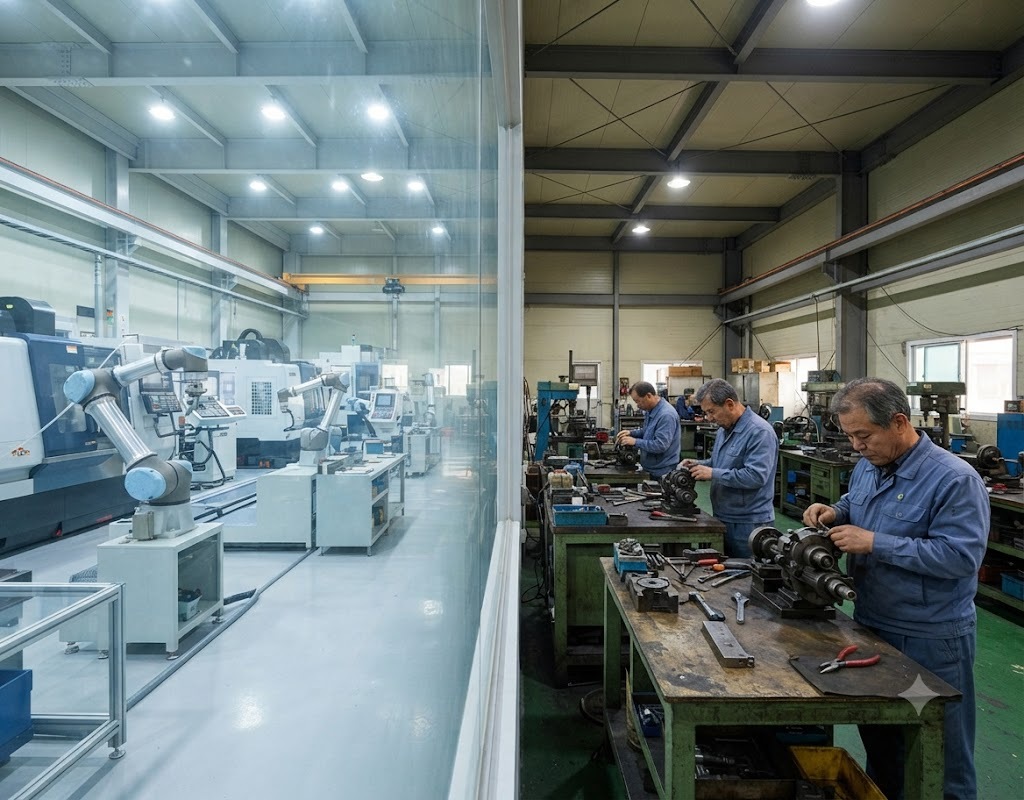
The manufacturing industry in Gyeongnam is structured so that a small number of large system companies and numerous subcontractors jointly produce a single product. Companies such as Hanwha Aerospace, Hyundai Rotem, KAI, Hanwha Ocean, Samsung Heavy Industries, Doosan Energy, and Hyundai Wia lead in order acquisition, design, and final assembly, while small and medium-sized enterprises (SMEs) handle materials, processing, casting, welding, electrical systems, equipment, inspection, and maintenance. The competitiveness of AX has also shifted to a stage where it is determined by the slowest processes in the supply chain rather than by individual factories.
AX investments by major conglomerates have materialized. Hanwha Ocean proposed a 150 billion won investment plan for smart yard facilities by 2026 as it transforms its Geoje plant into a big data and robot-based smart yard. In Changwon, led by Doosan Enerbility and Hyundai Wia , the Smart Green AX Demonstration Industrial Complex worth 22.2 billion won and the AI Factory for power generation gas turbine maintenance processes worth 7 billion won are being pursued by 2028. ( Hanwha Ocean Disclosure , Changwon Manufacturing AI Plan )
The adoption rate of smart factories among small and medium-sized manufacturing enterprises (SMEs) and mid-sized companies nationwide was 19.5% in 2024 , while that of SMEs was 18.6% . 75.5% of the adopted smart factories were in the basic stage, and the adoption rate of manufacturing AI stood at a mere 0.1%. AI production control by large corporations and the digitization of production information by many SMEs coexist within the same supply chain. ( Ministry of SMEs and Startups )
The productivity gap has also widened. In the analysis by firm size released in 2026, the labor productivity of small and medium-sized manufacturing companies stood at **29.5%** of that of large corporations, marking the lowest level since 34.4% in 2014. While large corporations increased their investment in AI and automation, the investment capacity and productivity catch-up of SMEs did not move at the same pace. ( Productivity Gap by Firm Size )
The disparity in Gyeongnam's defense supply chain has been confirmed by the numbers. The operating profit of six defense system integrators in the region increased by 445% from 469.2 billion won in 2022 to 2.557 trillion won in 2024. During the same period, the operating profit of 23 partner companies increased by merely 26%, from 73.1 billion won to 91.8 billion won . While the order boom spread in terms of volume, profits and reinvestment capacity did not expand at the same rate. ( Status of Win-Win Cooperation in Gyeongnam's Defense Industry )
The shipbuilding supply chain also features a dual-speed structure. While major shipbuilders operate their own digital production centers and smart yards, Gyeongnam is separately pursuing a Smart Production Innovation Project for Small and Medium-sized Shipbuilders worth 18 billion won by 2027. If prime contractors and subcontractors had already reached the same AX level, there would be no policy demand for separate data connectivity and process innovation projects. ( Gyeongnam Shipbuilding Industry Promotion Plan )
Support for smart factories in Gyeongnam is also continuing. In 2026, Gyeongnam Technopark re-announced the Smart Factory Infrastructure Establishment Project targeting small and medium-sized enterprises (SMEs) and middle-sized companies. This serves as evidence that even as national investment in manufacturing AI has shifted to the Physical AI stage, many companies remain at the initial stage of digitizing production information. ( Gyeongnam Technopark )
AX delays for partner companies are not solely a matter of equipment purchase costs. Low operating profits, unit prices, short-term contracts, a shortage of data personnel, outdated facilities, systems differing by prime contractor, ownership of production data, and cybersecurity costs all operate simultaneously. Connecting to a large corporation's system and a partner company increasing productivity by utilizing its own data are two different stages.
From 2026 to 2028, the order volume of large system enterprises and the physical AI, smart yard, and AX demonstration projects in Gyeongnam will expand simultaneously. If supplier data is connected only for prime contractor delivery management during this period and is not fed back into the suppliers' process improvement, profitability, or proprietary technology, supply chain AX will reinforce control asymmetry rather than joint innovation.
Therefore, the current Golden Time for Gyeongnam's manufacturing supply chain is determined to be Supply-chain Integration Opportunity + Dual-speed AX Risk .
- Prime Contractor Smart Factory ≠ Supply Chain Smart Factory
- Partner Data Connection ≠ Partner Data Capability
- Increase in production volume ≠ Improvement in profitability
- Building a smart factory ≠ Manufacturing AI
- Prime Contract Delivery Visibility ≠ Joint Productivity
- Supply Chain AX ≠ Value Allocation AX
In 2024, the Changwon National Industrial Complex had 3,216 tenant companies , employed 120,289 people , and generated 62.223 trillion won in production value . Large finished product manufacturers and thousands of small and medium-sized enterprises form supply chains for machinery, defense, nuclear power, automobiles, and electrical and electronics. ( Yonhap News )
Hanwha Ocean, Samsung Heavy Industries, and shipbuilding subcontractors are located in Geoje; KAI and aerospace parts companies are in Sacheon; and processing, casting, mold, automotive, and machinery parts companies are distributed across Gimhae, Yangsan, and Haman. While prime contractor sites are concentrated in a few cities, the actual production network spans multiple cities and counties.
Large corporations possess long-term order backlogs, in-house R&D capabilities, IT organizations, and the capacity for facility investment. Partner companies, on the other hand, are exposed to fluctuations in prime contractor volumes and delivery schedules, and bear the costs of smart factories, operational personnel, and security expenses from their own revenue.
The current structure is determined to be a wide-area supply chain type for production, and a system enterprise-centered type for AX investment and data authority .
The operating profits of six defense system companies in Gyeongnam increased by 445% from 2022 to 2024, while those of the 23 surveyed partner companies increased by 26%. The difference in growth rates between the system companies and the partner companies is approximately 17 times. ( Status of Win-Win Cooperation in the Gyeongnam Defense Industry )
According to the nationwide defense industry outlook, the operating profit margin for large corporations in 2024 was 14.3%, while that of SMEs was 7.2%. The expansion of exports and mass production by large corporations did not translate equally into profit margins for their suppliers. These low profit margins further limit partner companies' investment capacity in sensors, robots, AI, and security. ( Profitability of Large and SMEs in the Defense Industry )
In the shipbuilding and machinery industries, comparative profitability data by company is not disclosed as much as in the defense industry. While the performance and smart yard investments of major shipbuilders are disclosed, the AX investments and operating profits of external partners are not aggregated on the same supply chain basis.
The current status is determined as follows : improvement in prime contractor performance is confirmed / co-producer's profit and AX reinvestment are partially confirmed or Data GAP.
The first change is that the prime contractor's management unit has shifted from delivery results to real-time processes. When data on materials, work-in-process, equipment status, quality, and delivery dates are linked, the prime contractor identifies the subcontractor's production status in advance.
The second change is that supplier evaluation criteria have expanded from price and quality to data responsiveness. If production history, carbon emissions, material origins, quality inspections, and cybersecurity information cannot be provided in real time, the cost of entering the supply chain increases, even if technological capabilities are available.
The third change is that AX costs have shifted from one-time equipment purchases to ongoing operating expenses. Costs for cloud, licenses, sensor maintenance, security, AI model updates, and dedicated personnel are incurred annually. At low profit margins, maintaining operations becomes a greater bottleneck than implementation.
The fourth change is that data has shifted from a process byproduct to a transactional asset. Data on subcontractors' processing conditions, causes of defects, and production capacity is used to optimize the prime contractor's supply chain, but the distribution structure regarding data usage rights and improvement results is not disclosed.
The Gyeongnam supply chain is moving from product delivery relationships to data connection relationships, but it is determined to be a stage where authority, costs, and performance distribution remain in the existing subcontracting structure .
The government has applied a cost-sharing structure to large-to-small enterprise (SME) win-win smart factories, with the government contributing 30%, large corporations 30%, and adopting companies 40%. Supply chain-linked smart factories are designed so that five or more companies connect data to jointly manage materials, orders, production, and distribution. Policy tools exist to connect supply chains beyond individual factories. ( Ministry of SMEs and Startups )
Gyeongnam is operating the 2026 Smart Factory Foundation Construction Project, Productivity Improvement for Defense SMEs, Win-Win Cooperation Partners for the Shipbuilding Industry, and the Manufacturing AI Convergence Project. The structure ensures that support for industry-specific partner companies continues as separate initiatives. ( Gyeongnam Technopark , Gyeongnam Smart Factory Support )
Defense systems companies also proposed measures for mutual growth. Hanwha Aerospace announced support for partner companies' R&D and indirect costs, as well as a 150 billion won co-growth fund ; Hyundai Rotem announced development cost and financial support; and KAI announced emergency operating funds and unit price increases. Partner companies requested priority allocation for smart factory projects and the establishment of a joint testing and evaluation infrastructure. ( Gyeongnam Defense Industry Win-Win Cooperation )
The shipbuilding industry will invest 18 billion won by 2027 to support data connectivity and production innovation between shipyards and partner companies. Data linkage between prime contractors and partner companies has been included in the official project goals. ( Gyeongnam Shipbuilding Industry Promotion Plan )
The current level of response is assessed as confirmed for finance, R&D, smart factory, and data connectivity projects, and unconfirmed for the reduction of productivity and profit gaps by company .
South Korea's manufacturing robot density ranks first in the world, with 1,220 units per 10,000 workers projected for 2024. However, the adoption rate of smart factories in SMEs was 18.6%, while the adoption rate of manufacturing AI was 0.1%. The level of national automation and the level of AI in SMEs cannot be explained by the same indicators. ( International Federation of Robotics , Ministry of SMEs and Startups )
Labor productivity in small and medium-sized manufacturing companies has fallen to 29.5% of that of large corporations. This is evidence that high robot density has not led to productivity convergence across firm sizes. As automation investment becomes concentrated in large corporations, the national average rises, which may also widen internal disparities within the supply chain.
Gyeongnam is a region where shipbuilding, defense, aerospace, and machinery system companies and their suppliers are concentrated, and the gap between large and small AX companies directly affects product delivery times and exports. On the other hand, no publicly available data comparing the smart factory stages and productivity gaps of suppliers by prime contractor has been found.
The current position is assessed as being among the world's top in Large-firm Automation Readiness and in the early stages of Supply-chain-wide AI Readiness .
The operating profit of six defense system companies in Gyeongnam increased from 469.2 billion won to 2.557 trillion won .
The growth rate is **445%**.
The operating profit of 23 partner companies increased from 73.1 billion won to 91.8 billion won .
The growth rate is **26%**.
In 2024, the operating profit margin of large defense companies was 14.3% , while that of small and medium-sized enterprises was 7.2% .
The labor productivity of small and medium-sized manufacturing companies is **29.5%** of that of large companies.
The adoption rate of smart factories in small and medium-sized enterprises is **18.6%**.
**75.5%** of adopted smart factories are in the basic stage.
The adoption rate of AI in manufacturing is **0.1%**.
Although there are 3,216 tenant companies in the Changwon National Industrial Complex , the operational model for Changwon's 2028 AX Demonstration Industrial Complex has been initially set at three smart factories . There is a significant disparity in scale between large-scale demonstrations and the entire supply chain. ( Changwon Manufacturing AI Plan )
The bottleneck revealed by the numbers is not that partner companies do not recognize AX.
It is determined that the structure requires the same AX speed as large corporations for companies with low profit, manpower, and data bases .
The first gap is investment capability . Prime contractors execute AX investments ranging from tens of billions to hundreds of billions of won using internal funds, but subcontractors bear the setup and operating costs even after receiving support from the government and prime contractors.
The second gap is data-driven . While large corporations have integrated ERP, MES, PLM, and digital twins, many partner companies are still in the stage of digitizing production information or managing it manually. AI models are also not applied to processes that lack data.
The third gap is manpower . While large corporations possess dedicated organizations for AI, data, and automation, in SMEs, production and quality managers often double as smart factory operators. The nationwide manufacturing AI adoption rate of 0.1% demonstrates the lack of dedicated capabilities.
The fourth gap is profit recirculation . Even if suppliers reduce the prime contractor's inventory and risk costs by providing delivery and quality data, there is insufficient evidence that the value saved has been recirculated into unit prices, long-term contracts, or joint IP.
The fifth gap is data rights . There are no confirmed disclosure standards regarding who stores production data, for what purpose it is reused, and how it is utilized for supplier evaluation and unit price negotiation.
Currently, the largest Readiness GAP is determined to be the asymmetry in cost, authority, and performance distribution arising from data connectivity, rather than the gap in technology adoption .
In Gyeongnam, there are the Manufacturing DX Support Center, the Manufacturing AI Open Lab, the Smart Factory Support System, and industry-specific productivity improvement projects. The foundation for partner companies to access external technology, equipment, and consulting has been confirmed.
However, support for smart factories for SMEs has been announced as remaining in the foundational establishment phase for 2026. In regions where physical AI and autonomous manufacturing have already begun, groups of companies newly initiating the digitization of production information exist simultaneously. ( Gyeongnam Technopark )
A regional disclosure system specifying common data standards, sharing of system change costs, liability for cyber incidents, data export rights, and data processing methods after the transaction is concluded between large corporations and their suppliers has not been identified.
Current conditions indicate that technical support infrastructure exists, and supply chain data governance is determined to be Data Gap.
Defense system companies in Gyeongnam proposed development costs, financing, unit price adjustments, and a shared growth fund, and the operating profits of 23 partner companies also increased by 26% from 2022 to 2024. It is not as if there has been no mutual support or volume effect at all.
However, the difference between the 445% growth rate in operating profit of system companies and the 26% growth rate of partner companies is direct evidence that the speed of performance diffusion differs. The existence of support systems does not prove the accompanying distribution of value.
While the shipbuilding smart production innovation is pushing for data connectivity by 2027, the number of connected companies, supplier productivity, and proprietary data utilization rates have not yet been disclosed. Similarly, the AX diffusion rates by prime contractor in the machinery and aerospace supply chains have not been separately verified.
The current level of diffusion is assessed as confirmed for volume and partial support, while the co-diffusion of profitability and AI capabilities is unconfirmed .
Changwon is home to a concentration of major defense, nuclear power, and machinery companies, as well as AI demonstration infrastructure. Geoje is home to large-scale smart yard investments, while Sacheon houses KAI and an aerospace manufacturing base.
External processing, equipment, block, and parts suppliers are located in Gimhae, Haman, Yangsan, Tongyeong, and Goseong. The further a company is from the prime contractor's site, the higher the access costs for shared equipment, AI personnel, and on-site support.
While some AX investment amounts by large companies in Changwon, Geoje, and Sacheon have been confirmed, there is no evidence comparing the smart factory stages and AI application rates of partner companies in surrounding cities and counties on the same map.
Currently, the spatial gap is determined between the AX infrastructure of the prime contractor's city and the actual implementation capacity of the supplier distribution area .
The order backlog for the defense, shipbuilding, and aerospace sectors will be converted into production volume for 2026–2028. Prime contractors have entered a phase of expanding data connectivity with partner companies to manage delivery times, quality, and costs in real time.
Gyeongnam’s Physical AI, Smart Yard, AX Demonstration Industrial Complex, and Supply Chain Smart Production Innovation will also be promoted during the same period. The interface between the prime contractor system and the subcontractor system will be fixed as a de facto standard during this period.
If the prime contractor's AI procurement and production management standards become more advanced while partner companies remain at the basic smart factory level, entry costs increase thereafter. The cost of simultaneously changing equipment, data, and security systems is lower when supply chain standards are established than after the transaction has taken place.
The period from 2026 to 2028 is determined to be a timeframe in which the AX gap between prime contractors and subcontractors may narrow or become entrenched as a supplier selection criterion .
12-1. Golden Time Application Case in Basic Local Governments ① — Changwon City
Many of the six defense system companies are located in Changwon, and 3,216 companies are located in the Changwon National Industrial Complex. While the profits of defense system companies increased by 445% over two years, the number of surveyed partner companies increased by 26%.
At the same time, the Physical AI, AX Demonstration Industrial Complex, and DX Support Center are being promoted in Changwon. While the increase in prime contractor profits and public AX investment exist at the same time, the rate of in-house AI investment by partner companies is not disclosed.
If the operating profits of partner companies and the advancement of smart factories do not go hand in hand within two to three years, AX assets will remain concentrated in system companies even after the defense and machinery export boom.
Changwon is assessed as High AX Investment + High Value-distribution Gap .
12-2. Golden Time Application Cases in Basic Local Governments ② — Geoje, Tongyeong, and Goseong
Large shipbuilders in Geoje are expanding their smart yards and digital production centers. Block, equipment, and processing suppliers are located in Tongyeong and Goseong, and the Smart Production Innovation Project for Small and Medium-sized Shipbuilders will be carried out until 2027.
It is not disclosed to what extent production planning, block, and quality data from large yards are bidirectionally connected with MES and equipment data from external partners. The connection where the prime contractor verifies the partner's processes is a different stage from the connection where the partner optimizes its own processes using the prime contractor's demands and design changes.
If the connection is fixed in a unidirectional manner, the Geoje large yard becomes intelligent, and a structure remains in which the Tongyeong and Goseong subcontractors only bear the cost of responding to the prime contractor's data demands.
Geoje, Tongyeong, and Goseong are determined to have Smart-yard Progress + Supplier Reciprocity Data GAP .
The first time risk is supply chain exit . Suppliers who fail to provide real-time quality, delivery, carbon, and security data will find it difficult to pass the prime contractor's digital procurement standards, even if they possess the technical capabilities.
The second time risk is the compounding effect of the investment gap . Large corporations reinvest the profits generated by AI back into automation, while partner companies remain focused on maintaining basic systems due to low margins. The difference in reinvestment occurring each year accumulates the productivity gap.
The third time risk is data dependency . If a supplier's production data accumulates on the prime contractor's platform and their right to use or transfer it is restricted, it becomes difficult to change suppliers and develop independent AI.
The fourth time risk is the loss of skills . If the processing, welding, and inspection experience of older skilled workers at partner companies is not digitized before they retire, the quality assets of the entire prime contractor supply chain disappear.
The fifth time risk is the substitution of suppliers from outside the region . If prime contractors select suppliers from the Seoul metropolitan area or overseas that possess high digital responsiveness, Gyeongnam's existing trading relationships cannot be maintained solely through regional agglomeration.
Currently, irreversibility is determined to be that the prime contractor's AX standards become entrenched first without the participation of subcontractors, rather than subcontractors adopting AI late .
The Gyeongnam supply chain simultaneously encompasses the order backlogs of large corporations, the actual production processes of partner companies, national manufacturing AI projects, smart factory support, and industry-specific win-win initiatives. It is not a phase where systems are merely established without any production volume.
The outcome of supply chain connectivity is not determined solely by the prime contractor's delivery visibility. It is classified as a joint AX only when the supplier's productivity, operating profit, defect rate, utilization of internal data, and diversification of business partners change together.
Once this change is confirmed, large corporations' AI models combine with partner companies' field data to improve delivery times, quality, and costs across the entire supply chain. If it is not confirmed, the amount of connected data increases, but the gap in productivity and profitability between companies widens as well.
The currently achievable profit is determined not by the simple visualization of the supply chain, but by the joint productivity asset between the prime contractor and the subcontractor .
Observation target | Apply AX | On-site judgment | Verification indicators |
| Prime contractors and subcontractors | Supply-chain AX Registry | Maturity classification by firm | AX step distribution |
| Trading volume | Order-to-Supplier Tracker | Decision on spread of orders | Prime Contractor Order → Subcontractor Volume |
| Profitability | Shared Value Dashboard | Separation of volume and profit | Operating profit margin by company |
| Supply unit price | Cost-sharing Intelligence | AX Cost Reflection Determination | Investment and operating cost reflection rate |
| Production data | Federated Data Space | Ownership retention link | Data Usage and Mobility Rights |
| Design change | Shared Engineering Runtime | Reduction of rework risk | Change notification time |
| quality | Joint Quality AI | Joint tracking of causes and outcomes | Defect and rework rates |
| Delivery date | Capacity Twin | Early detection of bottlenecks | Delivery compliance rate |
| smart factory | Maturity Tracker | Distinction between construction and advancement | Basic to Advanced Conversion Rate |
| Manufacturing AI | SME AI-as-a-Service | Reducing the initial cost gap | Actual AI operating rate |
| cybersecurity | Supply-chain Zero Trust | Assessment of connection risk | Authentication, Incident, and Recovery Time |
| skilled technology | Supplier Knowledge Vault | Prevention of the extinction of tacit knowledge | Number of data conversion processes |
| mutual growth support | Outcome-linked Fund | Connecting support and results | Productivity and profit improvement rate |
| regional disparities | Supplier AX Gap Map | Check disparities by city and county | Readiness by Region |
Gyeongnam Supply-chain AX Runtime
Prime Contract Order → Design & Production Planning → Subcontractor Volume → Materials & Process → Quality & Delivery → Prime Contractor Assembly → Export & Delivery → Profit Sharing → Subcontractor Reinvestment → Next AX
Shared Productivity Chain
Data Integration → Bottleneck Identification → Process Improvement → Cost & Delivery Reduction → Value Measurement → Unit Price & Profit Recirculation → Supplier Reinvestment → Supply Chain Advancement
Supply-chain Integration Opportunity + Dual-speed AX Risk
The danger in Gyeongnam is not that the large corporation AX is slow.
It is not as if there are absolutely no support programs for partner companies.
The current risk is that two manufacturing eras coexist within a single supply chain as the prime contractor's AX speed outpaces the subcontractor's speed of profitability, data, and workforce readiness .
If data connectivity leads to joint productivity and profit recirculation between 2026 and 2028, Gyeongnam will transform into a manufacturing hub where the entire supply chain becomes AX.
If this does not continue, the structure will become entrenched where large corporations move toward autonomous manufacturing while partner companies remain in basic smart factories, resulting in only increased data provision and investment costs.
Currently, Golden Time is determined by Supply-chain Integration Opportunity + Dual-speed AX Risk .
- Number of registered subcontractors by prime contractor
- Distribution of 1st, 2nd, and 3rd tier suppliers
- Sales and employment by partner company
- Sales dependency by prime contractor
- Subcontractor volume compared to prime contractor orders
- Operating profit margin of prime contractors and subcontractors
- Labor productivity by firm size
- Supply unit price adjustment rate
- Raw material and labor cost reflection rate
- Prime contractor's share of AX implementation costs
- Unit price reflection rate of AX operating expenses
- Number of companies using the Shared Growth Fund
- Equipment investment rate after financial support
- Smart factory adoption rate among partner companies
- Basic, intermediate, and advanced stages
- Smart factory actual utilization rate
- Manufacturing AI adoption rate
- AI Model Actual Utilization Rate
- Partner robot density
- Data connection rate of aging facilities
- Prime Contractor/Subcontractor MES Connection Rate
- Number of companies connected to real-time production data
- Bidirectional data utilization rate
- Data ownership contract specification rate
- Data transferability rate after transaction completion
- Design change notification time
- Delivery compliance rate
- Defect and rework rates
- Unplanned equipment downtime
- Productivity before and after AX adoption
- Operating profit before and after the introduction of AX
- AI and data personnel from partner companies
- Dedicated organization retention rate
- Skilled technology data conversion rate
- Supply chain cybersecurity certification rate
- Duplicate investment amount in the system required by the prime contractor
- Self-investment rate after smart factory support
- System retention rate after support ends
- AX gap among subcontractors by prime contractor
- Changwon, Geoje, Sacheon, Gimhae, Haman, Tongyeong, Goseong GAP
- Trade termination case due to AX non-response
- External/Overseas Supplier Substitution Rate
- Partner return rate of saved value
- The correlation rate between prime contractor productivity and subcontractor productivity
Data GAP: Although prime contractor disclosures, government smart factory statistics, and industry-specific win-win projects exist, a public runtime connecting prime contractor orders → partner company volume → AX investment → data connection → productivity → cost reduction → unit price → operating profit → reinvestment within the same supply chain unit is not confirmed.
Runtime Chain
Order Win → Supply Chain Allocation → AX Investment → Data Connectivity → Productivity Outcome → Value Distribution → Partner Reinvestment → Gap Shift → Next Order
The structural insight of Gyeongnam Supply Chain AX is singular: data connectivity can reduce the production gap, but it can also widen the gap in trading power.
Supply chain risks are reduced when the prime contractor monitors subcontractors' inventory, equipment, defects, and delivery data in real time. However, if subcontractors do not have the same level of access to the prime contractor's demand forecasts, design changes, and quality analysis, the data flow becomes unidirectional surveillance rather than two-way collaboration.
In this structure, a higher connection rate does not necessarily equate to the success of AX. While the prime contractor reduces inventory and delivery costs, subcontractors bear the costs of system implementation, security, and data provision, and may not receive any return on the savings. This is a paradox where a technically connected supply chain becomes economically more unbalanced.
Golden Time Thesis — The golden time for Gyeongnam's manufacturing industry is not the period of connecting more supplier data to prime contractor platforms, but rather the period between 2026 and 2028 when data ownership, two-way access, cost sharing, and the recirculation of saved value are established as supply chain standards. Once this structure is formed, AX extends the intelligence of large corporations to their suppliers. If it is not formed, a structure becomes entrenched where large corporations monitor suppliers' factories in real time, yet suppliers are unable to become stronger companies even with their own data.
Version | Reference Date/Revision Date | Major changes |
| v1.0 | 2026.08.28 | This report was initially drafted based on the enhanced criteria of Regional AX Golden Time Intelligence v3.2. It cross-verified the 445% increase in operating profit of six defense system companies in Gyeongnam from 2022 to 2024 and the 26% increase of 23 partner companies, the operating profit margin of large defense companies at 14.3% and that of SMEs at 7.2%, the labor productivity of SME manufacturing at 29.5% compared to large companies, the smart factory adoption rate of SMEs at 18.6%, 75.5% at the basic stage, and 0.1% for manufacturing AI, and the data connection project for shipbuilding partner companies and support for the basic establishment of smart factories in Gyeongnam. The Golden Time was identified as Supply-chain Integration Opportunity + Dual-speed AX Risk, and the structural insight was condensed into a single statement: "Data connection can reduce the production gap, but it can also widen the gap in transaction power." |
