


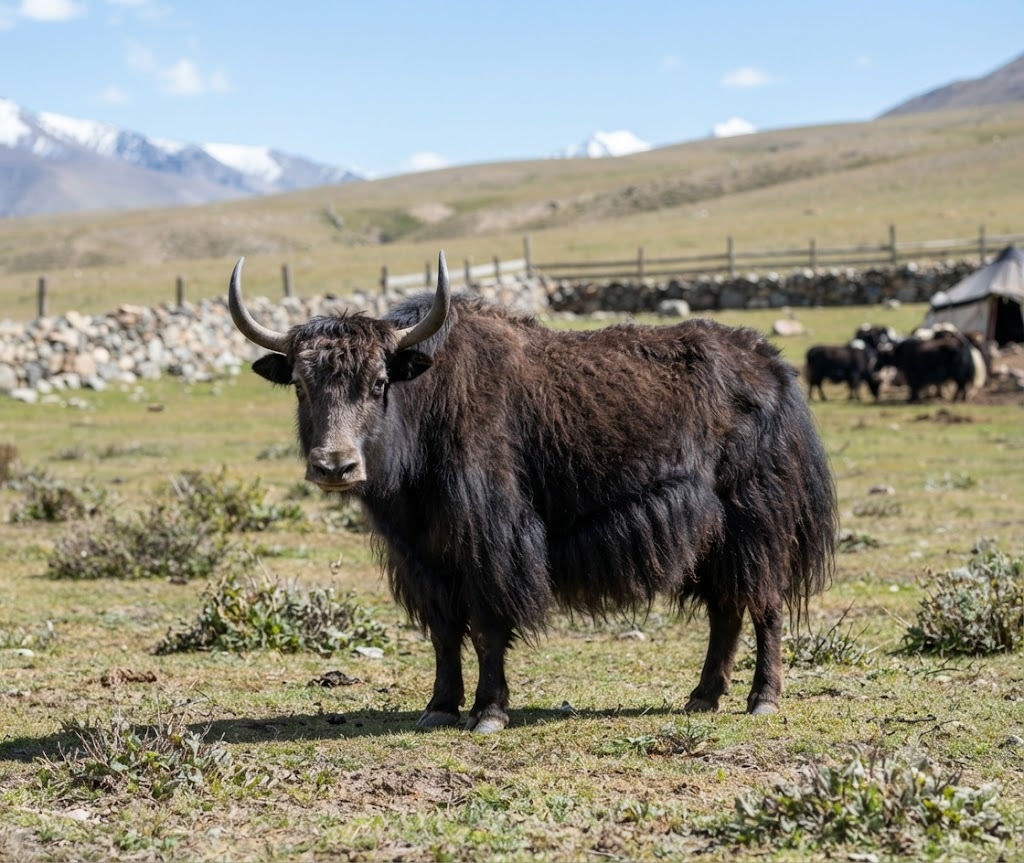
Yaks are a representative alpine livestock resource that provides milk, meat, fiber, and transportation in high-altitude and cold regions such as the Himalayas, the Tibetan Plateau, and Central Asia. They play an important role in local livelihoods and food supply because they can be raised even in low-temperature and low-oxygen environments where ordinary cattle find it difficult to be productive.
MarketHub views yaks not as a livestock species to be immediately expanded in Korea, but as a special livestock RFQ item that connects high-altitude production resources with global food and fiber buyers . In particular, yak milk, yak meat, hair, and fibers can be linked to premium raw materials if the production region and buyer are clearly identified.
Judgment axis | Key points |
| major regions | Tibetan Plateau, Himalayas, Central Asia |
| production purpose | Useful, meat, fiber, transportation, breeding |
| production core | Alpine adaptation, feed, breeding, milk production, growth |
| Main Products | Yak milk, yak meat, wool, breeding stock |
| Major risks | Alpine environment, disease, long-distance logistics |
| market | Local foods, premium meat, dairy products, and fiber |
| AX | Individual, grazing, milk production, weight, and location data |
| RFQ | Livestock, breeding stock, dairy products, meat, fiber |
| Final goal | Connecting high-altitude production sites with specialized buyers |
Yaks are a livestock species where survival ability adapted to the environment and resource utilization capabilities are more important than productivity itself. Therefore, they should not be evaluated solely on the same milk yield and weight gain standards as other cattle, but must also take into account the feed, climate, transportation, and market conditions of high-altitude regions.
The yak is a high-altitude ruminant animal centered around the Bos grunniens. It has long been utilized for milk, meat, wool, and transportation resources in western China, the Tibetan Plateau, Nepal, Bhutan, northern India, Mongolia, and parts of Central Asia.
The industrial value of yaks lies not merely in meat production. Because a diverse range of products and services—including milk and dairy processing, meat, wool and fibers, leather, transportation, and tourism—are generated, MarketHub manages each as a separate entity.
division | Main purpose | major products |
| Useful yak | dairy | Yak milk and dairy products |
| meat yak | meat | Livestock and yak meat |
| breeding stock | breeding | Breeding mothers · Breeding females |
| For textiles | Hair and fiber | Yak Down · Fur |
| For transportation | High mountain transportation | Transportation services |
| by-product | Industry and Agriculture | Leather and manure |
The basic structure is managed as Yak → Production Purpose → Product/Service → Buyer .
Yaks possess different lineages and production traits depending on the region. Since regional adaptability is crucial in alpine regions, an individual should not be judged as superior simply because of its large size or high milk yield.
The purpose of production must also be clearly distinguished. While milk production and quality are important for utility yaks, growth and shipping weight are more important for meat, hair quantity and quality for fiber, and physical strength and adaptability for transport.
division | example | On-site management |
| livestock species | yak | Yak |
| Regional system | Systematics by alpine region | adaptability |
| production purpose | Useful, Meat, Fiber, Transportation | Rearing methods |
| production stage | Self-celebration, rearing, breeding, milking | Step Management |
| product | Milk, meat, and wool | Quality and Standards |
| Buyer | Food, Dairy, Textiles, Tourism | Purchase conditions |
In an RFQ, you must not simply enter the Yak, but also verify the Origin + Purpose + Product + Production System .
In yak farming, alpine pastures and seasonal changes directly affect productivity. Since winter feed shortages and prolonged dry and cold seasons can impact growth and reproduction, regional pasture management and supplementary feed strategies are crucial.
Although yaks have lower milk yields than ordinary dairy cows, the fact that they can produce milk in extreme environments is of significant value in itself. Therefore, when comparing farms, one must consider maintenance costs, survival rates, breeding performance, and product value relative to high-altitude environments, rather than just absolute milk yield.
Management area | Things to see at a farm |
| breeding | Mating, pregnancy, and childbirth |
| Self-celebration | Birth, Growth, Death |
| grazing | Grassland, Altitude, Movement |
| feedstuff | Natural pastures, hay, and supplementary feed |
| Oil production | Daily milk production and milk quality |
| growth | Weight gain |
| health | Disease, Parasites, Nutrition |
| expense | Feed, Labor, Transportation |
Since yaks are often raised in regions with a high proportion of migratory grazing, it is more important to record grazing area and seasonal migration data together compared to conventional barn-style livestock farming.
Since yaks belong to the same Bovidae family as cattle, they may share disease control risks with some cattle. In the international trade of live and breeding animals, it is essential to verify the animal disease status, such as foot-and-mouth disease, and quarantine conditions of the country of origin.
Furthermore, since access to veterinary services may be limited in mountainous regions, prevention, observation, and mobility management are more important than treating diseases after they occur. MarketHub manages disease and health information using the latest runtimes by country and region, rather than leaving it as static descriptions.
step | Key Management |
| birth | Individual · Parent · Date of Birth |
| grazing | Location, Season, Movement |
| growth | Weight, Feed, Health |
| breeding | Mating, pregnancy, and childbirth |
| milking | Milk Lot |
| health | Examination, Disease, Treatment |
| slaughter | Individual · Conductor · Lot |
| circulation | Product · Country of Origin · Buyer |
The main connection is Animal ID → Pasture/Location → Health → Milk/Meat Lot → Buyer .
Since yaks are not a common livestock species in Korea, the domestic population or market size should not be arbitrarily estimated. A realistic approach for MarketHub is to first verify actual buyer demand for yak milk, meat, and fiber, and then examine supply possibilities with overseas producing countries.
In particular, yak products have the potential to be approached as premium products or special raw materials linked to high altitudes, natural grazing, and local culture, rather than in the mass-market, low-price sector. However, whether this image translates into actual marketability must be verified through buyers and pricing.
Participants | Things needed | Possibility of cooperation |
| food companies | Yak meat/raw materials | Product RFQ |
| Dairy processing company | Yakyu | Dairy RFQ |
| food service companies | Special meat | Buyer RFQ |
| textile companies | Yak hair | Material RFQ |
| importing companies | overseas producers | Import |
| tourism companies | Alpine and cultural content | Service |
| Research Institute | Genetic resources and alpine adaptation | R&D |
| local government | New industry potential | Pilot |
If you are considering domestic production, you must first verify the climate, feed, animal welfare, quarantine, and the buyer .
The global supply chain for yaks primarily originates from producers in high-altitude regions. Due to the prevalence of shifting grazing and small-scale production, collection, processing, and cold chain logistics can significantly impact quality and export potential.
In international trade, conditions vary depending on the form of the product. Since live animals, meat, dairy products, and wool and textiles may be subject to different quarantine and customs clearance systems, they should not be consolidated under a single HS or quarantine condition.
Meat supply chain
Gosan Farm → Collection → Slaughter → Processing → Refrigeration/Frozen → Export → Buyer
Dairy Supply Chain
Farm → Milking → Milk Collection → Processing → Refrigeration/Frozen → Buyer
Confirmation area | Main contents |
| Happy Birthday | Age, Gender, Health, Origin |
| Yakyu | Oil quality/processing form |
| Yak meat | Cuts · Refrigerated · Frozen |
| hair | Fiber Grade/Processing |
| Quarantine | Country/Disease Status |
| trade | HS·Customs·FTA |
| distribution | Collection and refrigeration in mountainous areas |
| Buyer | Quality, Quantity, Delivery Time |
In the actual RFQ, the Origin + Product Form + Quarantine + Logistics are verified again at the time of transaction.
The product value of yaks is broadly divided into milk, meat, and fiber. Yak milk can be used in dairy processing to produce cheese and butter, while yak hair has the potential to be utilized as a raw material for high-quality fibers.
PRP does not assume a premium based solely on the story of "high-altitude raised yaks." It is necessary to verify business viability by comparing actual production costs, quality, transportation costs, processing yield, and the price the buyer is willing to pay .
product | Main uses |
| Livestock and breeding stock | Breeding and production |
| Yak Milk | Drinking and Dairy Products |
| Yak Meat | Food & Dining |
| Yak Fibre | Textiles and clothing |
| leather | industrial materials |
| excretions | Fuel and compost |
| transit | Alpine region movement |
Key PRP questions include which region's yaks are suitable for a specific product, whether production costs are competitive relative to milk yield and weight gain, whether cold logistics are feasible in high-altitude regions, and whether the origin and quality desired by the buyer can be verified .
Yak AX must take into account the nomadic grazing environment of alpine regions. In many cases, connecting GPS, mobile records, location, health, milk production, and weight data is more realistic than using large, fixed facilities.
Location and activity data are particularly valuable in environments with large pastures where it is difficult for humans to monitor every individual daily. However, what takes precedence over technology is a fundamental data system that accurately identifies individuals and production lots .
Apply AX | Farm and business effects |
| Object registration | Production history |
| GPS | Grazing and movement management |
| weight record | Growth confirmation |
| Oil production records | Selection of superior individuals |
| Health records | Early response to disease |
| grassland data | Feed resource management |
| Product Lot | Origin and quality tracking |
| Buyer Matching | Expansion of sales channels |
The core structure is location and individual records → productivity comparison → problem identification → breeding improvement → product and buyer connection .
In the yak industry, pastures, climate, winter feed, and veterinary services are important in production regions, whereas logistics, quarantine, buyers, and prices are more critical in the import market. Therefore, issues in producing countries and consuming countries should not be treated in the same way.
Furthermore, expanding the yak industry solely on the grounds that they are "livestock resistant to climate change" is dangerous. Environmental and economic issues, such as the destruction of alpine grasslands, overgrazing, reduced productivity, and long-distance logistics costs, must be considered together.
problem | Data to verify |
| Winter feed shortage | Pastures, Hay, Climate |
| Self-congratulatory death | Birth and Health |
| Growth deviation | Weight · Feed |
| Oil production deviation | Season, feed, individual |
| Grazing | Grassland, Density, Movement |
| disease | Region, Testing, Treatment |
| refrigerated logistics | Distance, Temperature, Cost |
| Quarantine | Country, Product, Disease |
| Buyer shortage | Market and Price |
| Data shortage | Production and transaction history |
The basic solution structure from the Korean perspective is: Buyer demand verification → Comparison with production country → Quarantine and logistics verification → Small-scale import test → Marketability evaluation .
For Yak RFQs, the structure connecting producers in overseas high-altitude regions with Korean buyers may be more important than connecting them with domestic producers. Since yak milk, yak meat, and fiber may have different suppliers, supplier capability must be verified separately for each product.
Even when considering a domestic pilot, importing breeding stock first is not an appropriate approach. Instead, one should first verify the rearing environment, demand, animal welfare, quarantine, and processing feasibility, and then approach the issue through small-scale demonstrations.
RFQ Type | Collaboration Examples |
| breeding stock | Breeding and genetic resources |
| Happy Birthday | Production and fattening |
| Yakyu | Dairy raw materials |
| Yak meat | Food Service & Food |
| yak hair | fiber raw materials |
| import | Country/Product |
| process | Dairy products and meat |
| Domestic Pilot | experimental rearing |
| Research cooperation | Alpine adaptation and genetics |
| Buyer | Food, Textiles, and Foodservice |
Price, production volume, contract conditions, etc. are managed at the Verified/NDA stage.
In the MarketHub Livestock Library, it is appropriate to view yaks as an item that connects global production resources with actual buyer demand before domestic production information . Before producing or importing a product, one must first identify who needs what.
For products not commonly available domestically, such as yak oil, yak meat, and yak hair, we do not approach them under the assumption that they have market potential. We first verify the buyer's specifications, quantity, price, quarantine, and processing conditions.
① Find products/raw materials.
Need Products & Materials
Companies and institutions seeking necessary breeding stock, live animals, yak milk, yak meat, yak hair, etc., register their purchase demands. MarketHub reviews available producers and companies by verifying origin, product type, quantity, quality, and quarantine conditions.
RFQ Registration → Supply Condition Review → Connecting Producers and Companies → AI Matching
Register
② We are looking for production and manufacturing partners.
Need Suppliers & Manufacturers
We are seeking necessary supply partners, including yak farms, milk collectors, slaughterhouses, dairy and meat processors, and textile companies. We verify production capacity, processing, logistics, and the feasibility of a sustainable supply.
RFQ Submission → Review of Production/Processing Capabilities → Partner Connection → AI Partner Matching
Register
③ We are looking for domestic and international buyers.
Need Buyers
Yak producers and processing companies seek new buyers from the food, dairy, restaurant, and textile industries. We verify product specifications, country of origin, quantity, and price conditions to connect them with suitable buyers.
RFQ Submission → Product & Supply Capability Review → Buyer Connection → AI Buyer Matching
Register
Contact : mail@markethub.org
In yak datasets, it is important to manage region, altitude, and pasture conditions together. This is because even the same yak can vary significantly in feed conditions, growth, milk yield, and production costs depending on the altitude and pasture where it is raised.
Furthermore, due to the prevalence of shifting production systems, it is difficult to describe the production environment based solely on a farm address. Pasture/Seasonal Location must be linked as a relationship to analyze actual productivity.
Dataset | Simply put |
| Master | Yak/Product Standards |
| Entity | Producer · Yak · Processing Company · Buyer |
| Relationship | Grazing, Production, Processing, Trade |
| Runtime | Changes in location, weight, oil production, and price |
The representative structure is as follows.
Region/Altitude → Producer → Yak → Grazing/Feed → Health/Growth → Milk/Meat/Fibre Lot → Processing → Buyer
Add Country → Quarantine → Logistics to global transactions .
Yaks are a livestock species for which data from global producing countries is far more important than official Korean statistics. Therefore, the principle is not to arbitrarily estimate the size or demand of the domestic market, but to manage production and supply chains within the scope where official data from producing countries and international organizations such as the FAO can be verified.
The up-to-date nature of disease, quarantine, and import conditions is also crucial for each product. When an actual RFQ arises, live livestock, yak meat, dairy products, and textiles are classified separately, and the latest conditions of the country of origin and destination are re-verified.
Evidence | source |
| A | FAO · WOAH · Government · Official Statistics |
| B | Papers · Research Institutes |
| C | Verified producer association and industry data |
| D | Corporate and Market Data |
| E | Additional verification needed |
Key factual basis
- The yak, also known as Bos grunniens, is a representative livestock of high-altitude regions such as the Tibetan Plateau, the Himalayas, and Central Asia.
- The main products are milk, meat, wool, and hides, and in some regions, they are also used for transportation and local life.
- Yaks are considered a livestock species adapted to low-temperature and low-oxygen environments, but productivity varies significantly depending on breed, pasture, season, and feeding conditions.
- In international trade, disease and quarantine conditions related to bovine livestock must be checked up to date at the time of transaction.
- Official statistics representing the latest commercial breeding and market size in Korea are not found in this registration and are managed separately as Verification Required.
Version History
Version | Main contents | situation |
| v1.0 | First registration of a global highland livestock, product, and supply chain base | complete |
| v1.1 | Enhanced with the latest production statistics by country, including China, Nepal, and Mongolia | expected |
| v2.0 | Pasture · Altitude · Milk Production · Meat Yield · PRP Runtime Connection | expected |
| v3.0 | Producer · Processing Company · Korea Buyer Verified Matching | expected |