


Judgment axis | Key judgment |
| Item Identity | A vining fruit vegetable of the Cucurbitaceae family. Managed as Sechium edule in domestic agricultural data. |
| Key role | Fresh fruit, stir-fry, soup, pickles, school meals, dining out, pre-processed, frozen, HMR ingredients |
| Harvesting principle | Harvesting based on fruit size, skin condition, tissue hardness, ripeness, and seed development required by the buyer |
| Product separation | Fresh fruit, peeled fruit, sliced fruit, shredded ingredients, frozen fruit, pickled fruit, processed products, young shoots, and roots are separated into separate products. |
| Separation of similar items | Separation of Cucurbitaceae items such as winter melon, bitter melon, gourd, and loofah, and Plant Entity |
| Domestic statistics | Latest national statistics on nationwide chayote exclusive cultivation area and production volume: To be entered after verification of official raw data |
| Domestic cultivation basis | The Rural Development Administration officially presented stable production technologies for the central region, including open-field planting and shading during high-temperature periods. |
| Cultivation risks | Summer wilting and death caused by high temperatures in the central summer along with low temperatures and frost, excessive growth, staking and training, harvesting labor, and lack of market formation |
| Market Risk | Official studies also state that economic analysis is difficult because the domestic market is not sufficiently established. |
| Operating Principles | Connect Propagation–Plant–Fruit–Harvest–Processing–Buyer RFQs and first verify actual demand for each product. |
| Final goal | Establish a regionally adapted production, pre-processing, processing, and repurchase structure by first securing buyer demand by specifications and week rather than expanding production. |
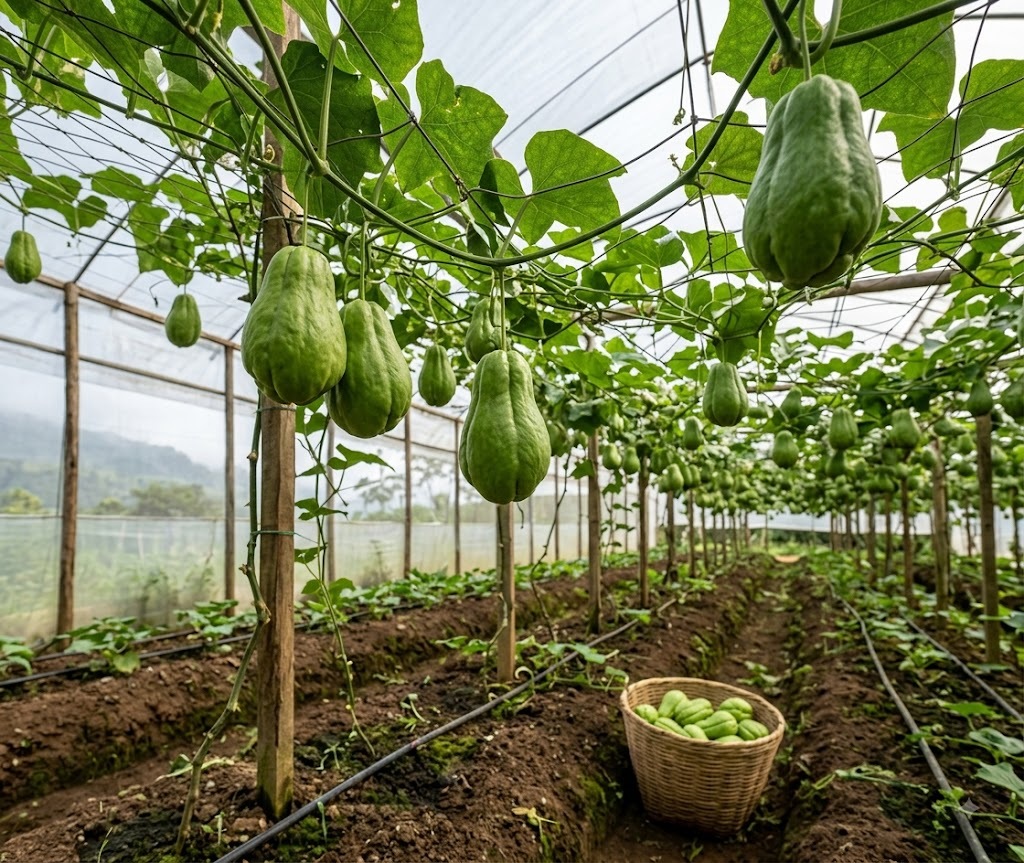
The Rural Development Administration's *Nongsaroo* classifies chayote as a subtropical crop and suggests the optimal planting period for open-field cultivation in the central region as May 2–12 , reporting that productivity in the relevant trials was 15–16% higher compared to planting on June 1. It suggests sowing and growing seedlings 21–25 days prior to the scheduled planting date, allowing for harvesting until early November after transplanting. These figures are limited to the specific trial conditions in the central region and are not applicable as a universal cropping calendar nationwide. ( Nongsaroo )
Plant Identity
Basic fields | Chayote Registration Criteria |
| Korean name | Chayote |
| English name | Chayote |
| Operational Scientific Name | Sechium edule (Jacq.) Sw. |
| Taxonomic Authority Note | Kew POWO accepted name: Sicyos edulis Jacq.; Sechium edule is a synonym |
| classification | Cucurbitaceae |
| Edible parts | Mainly fruit |
| Separate edible parts | Young shoots, stems, roots, etc. are managed as a separate product as there are instances of their consumption. |
| Non-edible · Separate management | Aged stems, leaves, diseased parts, sorting by-products, etc. |
| Major harvesting stages | Young edible fruit / Marketable fruit / Overripe fruit / Fruit for propagation/seed |
| Basic product form | Fresh fruit, peeled, cut, shredded fruit, frozen, pickled, cooking ingredients |
| Basic processing stage | Washing → Peeling → Cutting → Blanching, Freezing, Pickling, Heating, Puree, etc. |
| Basic use | Stir-fries, Soups, Salads, Pickles, School Meals, Eating Out, HMR |
| Similarity Principle | Winter melon, gourd, cucumber, zucchini, bitter melon, and a separate Plant/Product Entity |
The USDA APHIS manages Sechium edule as an independent taxon of Cucurbitaceae. ( ACIR )
The Kew POWO currently accepts Sicyos edulis Jacq. as the accepted name and treats Sechium edule as a synonym for the species. Therefore, the MarketHub Scientific Name Dataset includes two fields: Name Used in Agricultural Practice and Current Taxonomic Authority . ( Plants of the World Online )
In FAO/Codex data, there are instances where not only the fruit but also the roots, young stems, and shoots of the chayote are included in the classification of edible parts. Therefore, the fruit, shoots, and roots are not combined into a single product. ( FAOHome )
Product Master
Product ID | Product type | Key Management Standards |
| CHY-P01 | Chayote immediately after harvest | Variety · Origin · Harvest Date · Ripeness · Lot |
| CHY-P02 | Young edible fruit | Size, peel, tissue hardness, seed development |
| CHY-P03 | General Product Fresh Fruit | Weight, size, shape, scratches, hardness |
| CHY-P04 | Premium selection and | Uniformity, Appearance, Texture |
| CHY-P05 | Fresh fruit for dining out | Size, shell, cooking suitability, delivery cycle |
| CHY-P06 | Fresh fruit for school meals | Safety, Standards, and Regular Supply |
| CHY-P07 | Washing Chayote | Washing process, microorganisms, product temperature |
| CHY-P08 | Peeling Chayote | Peeling yield, flesh color, hygiene |
| CHY-P09 | Quarter Cut | Cut to size · Remove seeds · Refrigerate |
| CHY-P10 | Cube | Size, Heating Suitability, and HMR Standards |
| CHY-P11 | Slice | Thickness, texture, cooking use |
| CHY-P12 | Shredded chayote | Thickness, moisture, pickling, and stir-frying suitability |
| CHY-P13 | Fresh-cut Product | Washing, cutting, microorganisms, refrigeration |
| CHY-P14 | Blanching ingredients | Time, temperature, color, and texture |
| CHY-P15 | Frozen chayote | Freezing, Thawing, and Texture |
| CHY-P16 | Pickle and pickling ingredients | Size, hardness, salt, and acid suitability |
| CHY-P17 | Pickled finished products | Salt, acidity, aging, packaging |
| CHY-P18 | Puree | Heating, crushing, and viscosity |
| CHY-P19 | Soup and stew ingredients | Tissue retention after heating |
| CHY-P20 | HMR ingredients | Cutting type · Refrigerated/Frozen |
| CHY-P21 | young shoots | Harvesting stage, length, tenderness, hygiene |
| CHY-P22 | Edible roots | Verification of plant age, harvest stage, specifications, and legal food use |
| CHY-P23 | Breeding fruit | Maturity · Germination Status · Planting Lot |
| CHY-P24 | by-product | Peel, seed, cutting residue |
| CHY-P25 | Non-standard processed raw materials | Cause of defect, safety, and suitability for processing |
| CHY-P26 | PB finished products | Raw Material Lot · Processing Batch · Labeling · Use-by Date |
Classification criteria | Subdivision type | Management principles |
| Plant classification | Sechium edule / Sicyos edulis Taxonomy Relationship | Authority records |
| Varieties and resources | Actual resources such as green, white, and U-shape | Prohibition of determining breed based solely on appearance |
| Edible parts | Fruit, young shoots, roots | Separation of Product Entity |
| Harvesting stage | Young fruit, marketable fruit, overripe fruit, for propagation | Harvest Stage required |
| Negligence | Actual measurements of ovate, pear-shaped, etc. | Buyer Spec |
| surface | Smoothness, wrinkles, presence or absence of spines, etc. | Variety Attribute |
| Fruit color | Green tones, pale tones, etc. | Varieties and separation |
| Cultivation method | Open fields, shaded open fields, facilities, etc. | Production Dataset |
| Distribution methods | Fresh fruit · Washing · Peeling · Cutting · Refrigeration · Freezing | Product Separation |
| Processing form | Pickling, Blanching, Freezing, Puree, Heating | Process Lot |
| Final use | Dining Out · School Meals · Meal Kits · HMR · Pickles · Private Brands | Buyer RFQ |
| Transaction type | In-kind · Regular supply · Contract farming · OEM · PB | Contract |
| origin | Domestic/Imported | Lot Traceability |
step | Essential Dataset | Management purpose |
| Cultivation plan | Variety · Cultivation Type · Region · Buyer | demand-based production |
| Breeding and securing | Fruit Source·Ripeness·Lot | Propagation Traceability |
| Seedling cultivation | Sowing date, germination, and seedling growth | Formal preparation |
| formula | Official date, number of weeks, planting distance | Production schedule |
| survival | Rooting rate · Early growth | Production stability |
| Installation of supports and poles | Structure, height, area | Vine and Fruit Management |
| invitation | Main point, geodetic, manned day | Space Management |
| Vesting and stopping | Geodesy, aging, work day | Lighting and Fruit Set |
| rising | Temperature, Precipitation, Solar Radiation, Wind Speed | Climate adaptation |
| High temperature management | Maximum temperature and occurrence | Growth stability |
| sunshade | Shading rate · Installation · Removal date | High temperature protection |
| Watering | Soil moisture, quantity, and time | Growth management |
| dispute | Type, Quantity, and Time | Growth and yield |
| flowering | Female flowers, male flowers, blooming date | Fruit set prediction |
| correction | Nature and pollination | Fruit Set |
| Fruit set | Fruit ID · Fruit Set Date | Harvest forecasting |
| Excessive negligence | Size, Weight, Color | Production volume forecast |
| pests | Disease symptoms, pests, and control | safe production |
| Harvest judgment | Size, color, skin, hardness, and seed development | Product Classification |
| harvest | Harvest Date · Fruit ID | Harvest Lot |
| Selection | Size, shape, wounds, and diseases | Grade |
| Product temperature control | Temperature and time after harvest | Freshness |
| purifying | Water quality, time, and method | hygiene |
| peeling | Peeling rate/Yield | Processing |
| Seed removal | Seed development and removal amount | Artificiality rate |
| cutting | Cube·Slice·Julienne | Buyer Spec |
| Blanching | Time and temperature | Freezing pretreatment |
| freezing | Freezing method · Temperature | Year-round supply |
| pickles | Salinity, acidity, and time | Pickle |
| heating | Time and temperature | HMR |
| save | Temperature, humidity, and period | Quality maintenance |
| packaging | Packaging materials/units | circulation |
| shipment | Buyer · Lot · Delivery Date | Delivery |
Quality items | Fresh fruit | Pre-treated products | processed goods | finished product | Public rating |
| Taxon | essential | succession | succession | tracking | Public |
| Varieties and resources | essential | succession | tracking | If necessary | Public/Verified |
| mountainous district | essential | succession | succession | mark | Public |
| producer | ID | succession | tracking | - | Verified |
| Production Lot | essential | succession | tracking | - | Verified |
| Harvest Lot | essential | succession | New Process Lot | tracking | Verified/NDA |
| Official date | record | succession | - | - | Verified |
| Fruit setting date | record | succession | - | - | Verified |
| Harvest day | core | succession | succession | tracking | Verified |
| Harvesting stage | essential | core | Raw material specifications | tracking | Verified |
| Fruit color | record | Selection | By product | If necessary | Member |
| Negligence | record | Selection | By use | - | Member |
| Surface condition | Wrinkles, thorns, wounds | Selection | - | - | Member |
| weight | Object/Lot | Batch | Amount of raw materials | By product | Verified |
| Length and width | Actual measurements | Selection | Cutting material | If necessary | Member |
| Tissue hardness | core | core | Fabrication aptitude | By product | Verified |
| Seed development | Accommodation assessment | Check when cutting | Removal/Tracking | - | Verified |
| Pretense | Sample | Measurement after peeling | transference number | - | Verified/NDA |
| Wounds/Compression | test | Selection | Processing status | - | Verified |
| corruption | exception | exception | Food conversion ban | - | Verified |
| Disease | test | exception | Assessment of suitability | - | Verified |
| alien substance | check | purifying | Compliance with standards | Compliance with standards | Verified |
| pesticide residues | test | succession | Compliance with standards | Compliance with standards | Verified/NDA |
| microorganism | When fresh fruit is needed | Fresh-cut key | processed goods | Compliance with standards | Verified/NDA |
| Peeling yield | - | core | Cost reflection | - | NDA/Verified |
| Cutting yield | - | core | Cost reflection | - | NDA |
| Blanching | - | The relevant city | Freezing core | tracking | Verified |
| pickles | - | - | Saltiness, acidity, and aging | Product Standards | Verified |
| freezing | - | - | Freeze-thaw quality | Product Standards | Verified |
| packaging | Fresh fruit | Preprocessing | processed goods | finished product | Member |
| save | essential | cold storage | By product | By product | Verified |
| Expiration date | The relevant city | Fresh-cut | processed goods | Labeling standards | Member |
| Shipment | record | record | record | record | NDA |
| Returns and Claims | record | record | record | record | NDA |
| Repurchase | Buyer Connection | connection | connection | connection | NDA |
Lot Master Required Field
Lot ID · Item/Product Type · Operational Scientific Name · Taxonomic Authority · Variety/Resource · Edible Part · Cultivation Type · Origin/Cultivation Area · Producer · Propagation Fruit ID · Nursery Lot · Planting Date · Flowering Date · Fruit Set Date · Harvest Date · Harvest Stage · Fruit Color/Shape/Surface Characteristics · Length/Width/Weight · Tissue Hardness · Seed Development · Edible Yield · Check for Wounds/Diseases/Spoilage · Pesticide Use Records · Pesticide Residue/Microbiological Test Report · Post-Harvest Product Temperature/Storage History · Raw Material Lot · Washing/Peeling/Seed Removal/Cutting/Blanching/Freezing/Pickling History · Packaging Date · Best Before Date · Shipper · Returns/Claims · Repurchase
Customers | Purchase criteria | Cooperation opportunities |
| Specialized vegetable distribution | Size, appearance, texture, and freshness | Specialty Product |
| Multicultural food ingredient distribution | Variety, Size, Ripening | Specialty market |
| Latin American and Asian dining | Fresh fruit, cooked food, regular supply | Restaurant RFQ |
| Korean dining out | Radish and zucchini substitute cooking properties | Menu Pilot |
| Hotel · Restaurant | Uniformity and Pretreatment | Premium Foodservice |
| School and public meals | Safety, Standards, and Cooking Methods | New Ingredient Pilot |
| institutional meals | Cube · Slice · Regular Supply | Preprocessing B2B |
| Meal kit | Peeling, cutting, and small packaging | Meal Kit |
| HMR | Cube · Frozen · Stew Ingredients | Processor RFQ |
| Pickle and pickling company | Texture hardness and pickling suitability | Pickled Product |
| frozen vegetable company | Pretreatment, Blanching, Freezing | Year-round supply |
| Online specialty mall | Small packaging · Origin · Recipe | B2C |
| PB | Domestic · Region · Product Story | Specialty PB |
| Rural experience · Local food | New crops and local cultivation | Local Product |
| Seed and breeding institutions | Variety, Cultivation Adaptation, High Temperature Response | Variety Research |
| Research Institute | Climate adaptation, cultivation methods, storage, and processing | PRP |
step | Key variables | Operational judgment |
| breeding materials | Variety/Fruit Source | production base |
| Seedling cultivation | Germination and seedling status | Supply Schedule |
| Korean production | Region · Planting Date · Expected Harvest | Supply Forecast |
| Import procurement | Fresh/Frozen/Processed | Supply Gap |
| harvest | Maturity, Size, Texture | Product Decision |
| Origin sorting | Size, Appearance, and Flaws | Buyer Grade |
| refrigerated distribution | Product temperature · Lead-time | Fresh quality |
| Peeling and amputation | Edible parts · Workability | Foodservice |
| freezing | Blanching and freezing | Year-round supply |
| pickles | Raw material hardness, acidity, and salinity | Processed Product |
| Distribution and supply | Packaging and Period | Buyer SLA |
| RFQ | Product·Spec·Shipping | AI Match |
| Repurchase | Cookability, Defect Rate, Delivery Time | Repeat trading |
HS·Trade Management
For chayote, check the tariff classification by product type separately.
Product | Operating Principles |
| Fresh/Chilled Chayote | Check current Korea Customs Service HSK official product classification |
| young shoots | Verification of whether fresh vegetables are classified separately |
| Edible roots | Separate HS verification for each root/tuber product |
| Frozen chayote | Frozen vegetables HS code separate |
| Pickles | Prepared vegetables HS separate |
| Puree · HMR | Check three times for each processed product |
| Breeding fruit | Distinction between edible and quarantine/use |
Products and processes | Key conditions | RFQ conversion |
| Fresh fruit | Variety, ripeness, size, and hardness | Fresh RFQ |
| Selection and | Appearance and uniformity | Retail |
| Washing and | Water quality, temperature, and hygiene | Foodservice |
| Peeling | Peeling yield · Flesh condition | Preprocessing |
| Failed to reverse | Seeds and flesh condition | dining out |
| Cube | Size and heating suitability | School Meals · HMR |
| Slice | Thickness and shape | Eating Out · Stir-fry |
| Shredded Product | Cutting thickness · moisture | Stir-frying and pickling |
| Fresh-cut | Microorganisms · Refrigeration | convenience food |
| Blanching | Time, temperature, and hardness | freezing |
| Frozen Cube | Thawing quality and shape retention | HMR |
| Pickle ingredients | Size and hardness | Pickling RFQ |
| Pickled finished products | Acidity, salinity, and aging | PB |
| Soup and stew ingredients | Long-term heating characteristics | HMR |
| Puree | Crushing, heat treatment, viscosity | Food Ingredient |
| young shoots | Harvest length, year, and hygiene | Specialty Vegetable |
| Edible roots | Harvest time, pretreatment, and basis for food use | Separate PRP |
| pericarp | Washing and pesticide history | By-product research |
| seed | Maturity and Use | Seed/Research |
| cutting residue | Generation Amount · Safety | Review of compost, animal feed, etc. |
| Non-standard health and | Causes of defects and safety | Processing conversion |
| Disease and Decay Division | Food supply chain exclusion | Review of waste and compost |
In the FAO's "Fresh-Cut Tropical Fruits and Vegetables" resource, chayote is described as a vegetable used as an ingredient in soups, stews, and the like. ( Open Knowledge FAO )
Principle of separate edible parts and by-products
Although there is international data indicating that various parts of the chayote plant are edible, MarketHub does not immediately register it as a single domestic food product.
Fruit → Basic Public Food Product
Young Shoots → Product after verification of food ingredients and pesticide residue standards
Roots → Separate verification for food use, quarantine, pesticides, and cultivation cycle
Pericarp, Seeds, Stems → By-product or Research Entity
Divided into. ( Agris )
PRP — Product Research Profile
PRP ID | Product Research Profile |
| PRP-CHY-01 | Sechium edule–Sicyos edulis Taxonomy Mapping |
| PRP-CHY-02 | Variety·Resource–Fruit Color·Fruit Shape Mapping |
| PRP-CHY-03 | Fruit Propagation – Germination and Seedling Cultivation |
| PRP-CHY-04 | Central planting date – harvest period |
| PRP-CHY-05 | High temperature – Summering phenomenon – Shading effect |
| PRP-CHY-06 | Comparison of Open-Field and Greenhouse Productivity |
| PRP-CHY-07 | Flowering and fruit setting – Fruit growth |
| PRP-CHY-08 | Harvest maturity – Hardness · Edible yield |
| PRP-CHY-09 | Fruit Size – Peeling/Cutting Yield |
| PRP-CHY-10 | Fresh Fruit Refrigerated Distribution · Shelf-life |
| PRP-CHY-11 | Fresh-cut microorganisms and storage |
| PRP-CHY-12 | Cube/Slice HMR Heating Suitability |
| PRP-CHY-13 | Processing suitability for pickling and pickling |
| PRP-CHY-14 | Freeze-Thaw Texture |
| PRP-CHY-15 | Soup and Stew Heating Durability |
| PRP-CHY-16 | Youngsun Product Research |
| PRP-CHY-17 | Edible Root Product Research |
| PRP-CHY-18 | Standard Surgery Product Recovery |
| PRP-CHY-19 | Cost Comparison of Domestic vs. Imported Products |
| PRP-CHY-20 | Buyer Spec–Harvest Stage AI Match |
first of all | Execution item | Performance indicators |
| 1 | Taxon, Variety, Cultivation Type, Origin, Harvest Date, and Lot are mandatory. | Required input rate |
| 2 | Separation of Fruit, Shoot, and Root Product | Identification rate of edible parts |
| 3 | Separation of Fresh·Cut·Frozen·Pickle Products | Product identification rate |
| 4 | Connecting weather, growth, high temperature, flowering, fruit setting, and harvest | Runtime connection rate |
| 5 | Data conversion of quality, certificates, storage, and processing history | Lot completion rate |
| 6 | Farm – Pre-processing – Foodservice/Tutoring – Buyer RFQ Connection | Match rate |
| 7 | Video AI Vine and Fruit Detection | Fruit Detection Accuracy |
| 8 | Estimation of AI Fault Size and Weight | Actual measurement error |
| 9 | Harvest timing prediction | Harvest date error |
| 10 | High Temperature/High Temperature Risk Alert | Reduction in withering and growth cessation |
| 11 | Light Shading Runtime Optimization | Product quantity relative to shading period |
| 12 | Weekly yield prediction | Prediction error |
| 13 | Prediction of peeling and edible portion rates | Actual measurement error |
| 14 | Automation of cutting standards | Cutting uniformity |
| 15 | Fresh–Frozen–Pickle conversion decision | Product Recovery Rate |
| 16 | AI Buyer Match | Sample approval rate |
| 17 | Traceability | Finished Product → Production Lot Traceability |
| 18 | Repurchase Runtime | Buyer repurchase rate |
Problem group | Problem Definition | Required data |
| Lack of up-to-date production statistics | The size of the nationwide chayote industry is unclear. | National and Regional Statistics |
| Market not formed | Economic analysis is difficult even in official studies | Buyer/Sales |
| Mixed varieties and resources | Lack of connection between domestic trade names and actual resources | Variety |
| Taxonomy changes | Conflicting Sechium/Sicyos spellings | Taxonomic Authority |
| Specificity of the reproductive system | Information on sowing and seedling cultivation at the fruit unit level is needed | Propagation |
| Low temperature risk | Planting and frost risk of subtropical crops | Climate |
| high temperature and | Growth cessation and wilting in the central region during midsummer | Temperature |
| Shading management | Relationship between installation timing, shading rate, and productivity | Shade Dataset |
| Vine growth | Increase in incentives, installation of barriers, and labor | Growth·Labor |
| Fruit set deviation | Environmental and modification status influence | Flower/Fruit |
| Harvest season concentration | Continuous fruit production and labor concentration | Harvest Forecast |
| Deviation in negligence standards | Various sizes and shapes | Quality |
| Seed development deviation | Effects of ripeness and cooking quality | Maturity |
| Peeling | Labor costs for dining out and catering | Processing Yield |
| Artificiality rate | Buyer's actual cost unclear | Edible Yield |
| Fresh lack of recognition | Immature general consumer market | Consumer Demand |
| Lack of awareness of recipes | The use case is unclear to the Buyer | Recipe/Product |
| Lack of meal standards | Lack of standard cutting and cooking specifications | Foodservice |
| Frozen Product Shortage | Inadequate year-round supply structure | Processor |
| Undeveloped pickled products | Immature storage and processing market | Pickling |
| Lack of comparison between domestic and imported products | Lack of data for economic feasibility assessment | Trade·Cost |
| Young shoots Product unseparated | Negligence and identical transaction risk | Edible Part |
| Lack of verification of root products | Verification of food, cultivation, and legal standards is required | Regulatory |
| Pesticide standards | Management by edible part is necessary | Pesticide |
| Contract production shortage | Risk of expanding cultivation without buyers | Contract |
| Repurchase not reflected | Lack of accumulated actual cooking and delivery evaluations | Evaluation |
RFQ Type | Public Registration | Verify/NDA |
| Chayote source sourcing | Variety, Region, Shipment Date | Farm, Volume, Unit Price |
| Fresh fruit sales | Fruit shape, color, and ripeness | Lot · Price · Inventory |
| Buying fresh fruit | Size, Hardness, and Use | Target Price · MOQ |
| Regular supply | Product · Period · Cycle | Weekly Volume and Unit Price |
| contract farming | Variety, Cultivation Type, Region | Area, Quantity, Price |
| For dining out | Fresh fruit, peeled, standard | Delivery cycle |
| Multicultural ingredients | Variety, Size, Ripening | actual demand |
| For school meals | Safety and Standards | Reports · Weekly Volume |
| peeling ingredients | Flesh/Yield | Artificiality rate |
| Cube | Cutting size | Working and refrigeration conditions |
| Slice | Thickness · Cooking Use | Sample |
| Shredded Product | Thickness/Texture | Delivery cycle |
| Fresh-cut | Refrigeration and microorganisms | Expiration date |
| freezing | Cube/Whole | Blanching and thawing quality |
| Pickles | Size and hardness | Recipe and processing test |
| HMR | Pretreatment and heating suitability | MOQ · Processing Conditions |
| young shoots | Harvesting stage/specifications | Safety and volume |
| Edible roots | Separate Product Information | Domestic food usage and lot verification |
| Breeding fruit | Variety · Ripening | Germination · Source Lot |
| OEM·PB | Product concept | Recipe · MOQ · Contract |
| import | Fresh/Frozen/Processed | HS · Country of Origin · Unit Price |
| export | Product · Target Country | Quarantine, Price, and Volume |
| Technology demonstration | Planting, Shading, and AI Harvesting | Test Dataset |
| Research cooperation | Climate adaptation, varieties, processing | PRP |
① Need Products & Materials
Companies and institutions seeking necessary products, agricultural products, raw materials, and processed goods register purchasing demands. Registered requests are utilized to review cooperation with potential suppliers and producers based on the RFQ Intelligence Library.
Process:
RFQ Registration → Supplier/Product Review → Collaboration Connection → Future AI Matching
Register
② We are looking for production and manufacturing partners. (Need Suppliers & Manufacturers)
Register a request to find necessary production and supply partners, ranging from farms and producer organizations to processing companies, OEM, ODM, and private label manufacturers.
Process:
RFQ Registration → Review of Production & Manufacturing Capabilities → Collaboration Connection → Future AI Partner Matching
Register
③ We are looking for domestic and international buyers. (Need Buyers)
Farmers, producer organizations, and manufacturing companies are requesting cooperation with new buyers, such as domestic and international distributors, importers, brand companies, and food service and catering businesses.
Process:
RFQ Registration → Product & Supply Capability Review → Market & Buyer Connection → Future AI Buyer Matching
Register
Contact : mail@markethub.org
Version | Main contents | situation |
| v1.0 | Plant Identity · Taxonomy · Domestic Adaptation · Fruit · Pretreatment · Freezing · Pickling · RFQ Basic Structure Registration | complete |
| v1.1 | Verification of official raw data on Korea's production, region, variety, market, HS, and import/export | expected |
| v2.0 | Detailed quality standards by Fruit, Shoot, Root, and Fresh, Cut, Frozen, and Pickle Products | expected |
| v3.0 | Producer – Pre-processing · Freezing · Pickling – Catering · Foodservice – Buyer Verified Container Combination | expected |