


Analysis Area: Ulsan Metropolitan City
Core Areas: Mipo-Onsan National Industrial Complex, Nam-gu, Dong-gu, Buk-gu, Ulju-gun
Agenda: Readiness Level of Power, Computing, Data, Communications, and Security Infrastructure for Industrial AI
Golden Time Type: Infrastructure–Access Mismatch Risk
Reference Date: 2026.08.28
Version: Regional AX Golden Time Intelligence v3.2
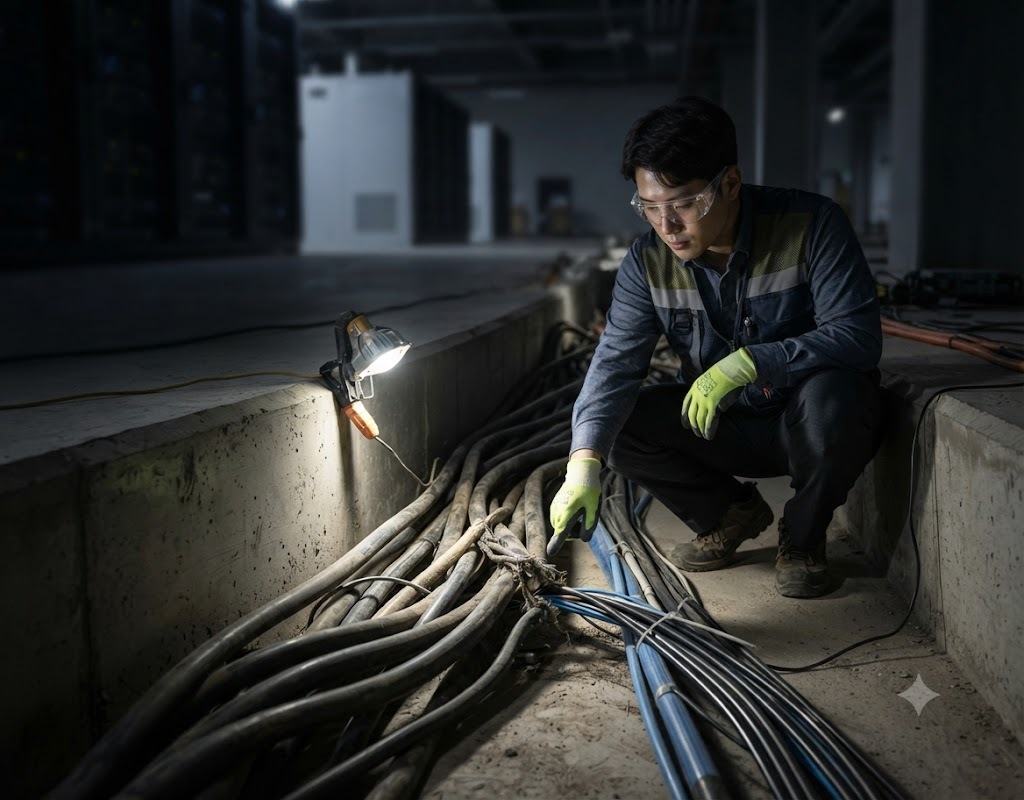
Ulsan was designated as a specialized distributed energy region in 2025 and presented a business structure combining a 300MW combined heat and power (CHP) plant with the attraction of a 100MW-class global AI data center. Although the power infrastructure has shifted from being used for factory production to a structure that accommodates AI computing, data centers, and industrial electrification, the schedules for confirmed data center investments, grid connection, and commercial operation have not been finalized in the publicly available data. Unless connection capacity and demand contracts for 2026–2028 are confirmed, industrial AI projects will rely on computing resources from external regions. While Ulsan is a city that has planned an AI power base, it is not an industrial AI power hub with confirmed operation.
UNIST was designated as a National Center for High-Performance Computing in 2022 and is conducting supercomputing-based AI research. While research computing infrastructure exists, the plan for Ulsan City to secure additional state-of-the-art GPU servers for joint use with local companies, universities, and schools was mentioned only as a proposal for 2025. If the capacity, price, and latency of shared GPUs for constant industrial use are not finalized over the next two to three years, the gap in AI development speeds between large corporations and SMEs will widen further. While Ulsan's research computing capabilities have been confirmed, computing access for the entire regional industry remains unconfirmed.
The Ulsan Distributed Power Special Zone was designed with a structure that directly supplies electricity from SK Multi-Utility's 300MW combined heat and power (CHP) plant to petrochemical companies and AI data centers. Although power supply has shifted from a single purchase by KEPCO to direct transactions between local power generators and demand companies, contracted power volume, electricity rates, system costs, and finalized figures for demand companies have been disclosed only on a limited basis. If direct transactions are not actually implemented by 2028, the gap between the designation of the Distributed Power Special Zone and cost reductions for industrial AI will remain. Institutional access to electricity has been opened, but economic access has not yet been verified.
Ulsan has proposed a model that utilizes the -162°C cold energy generated from LNG terminals for cooling AI data centers. While competition among data centers has expanded from securing electricity to combining cooling energy with waste heat and cold energy, there is a lack of confirmed evidence regarding cold energy supply volume, pipeline distance, operating rates, and cooling cost savings. Unless data center sites and cold energy supply networks are established within two to three years, technological differentiation will not translate into actual locational competitiveness. Cold energy integration is a differentiating asset for Ulsan, but its business feasibility remains unverified.
The 11th Basic Plan for Electricity Supply and Demand incorporated AI data centers, high-tech industries, and the electrification of transportation and hydrogen into additional electricity demand, projecting a target demand of 129.3 GW for 2038. Although the structure involves a simultaneous expansion of electricity demand from existing industrial production to AI computation and electrification, the additional industrial AI demand for the Ulsan region in 2028 and the connection capacity of each substation have not been disclosed. If only national plans exist for two to three years while regional grid verification is delayed, power cannot be supplied to desired sites even if there is sufficient generation capacity. Ulsan's electricity gap refers to the available connection capacity at a specific point in time and at a specific site, rather than the total generation capacity.
Ulsan already has a concentration of large-scale power demand from industries such as oil refining, petrochemicals, automobiles, shipbuilding, and non-ferrous metals. While the electrification of existing industries and the addition of a 100MW data center will make peak load, voltage quality, and emergency supply conditions stricter than average usage, relevant regional simulations have not been disclosed. If industrial recovery and AI demand increase simultaneously between 2026 and 2028, the lead time for grid reinforcement will be longer than the project launch schedule. Although Ulsan has a strong power industry base, it has not been confirmed that it will unconditionally accommodate the additional industrial AI load.
The distributed special zone is a structure in which local power companies trade directly with industrial firms to provide competitive electricity rates. Although power competitiveness has shifted from grid connection status to long-term pricing and variability management, actual contract rates and savings rates compared to KEPCO rates have not been disclosed. If price superiority is not verified within two to three years, AI data centers will choose other regions where access to power, telecommunications, and customers is already established. Ulsan's electricity price competitiveness is institutionally feasible but remains unconfirmed in the market.
The initial power source for the distributed special zone is a 300MW combined heat and power (CHP) plant, and a phased transition to zero-carbon power based on renewable energy and green hydrogen has been proposed. While AI data center customers require not only power capacity but also RE100 commitments and carbon intensity as location criteria, the hourly proportion of zero-carbon power supplied by Ulsan has not been verified. Unless low-cost and low-carbon power are secured simultaneously by 2028, the conditions for attracting global AI companies will not be met. Although Ulsan is a candidate location for stable power, it is not judged as a zero-carbon AI power hub.
UNIST possesses a specialized center for supercomputing and AI research capabilities, conducting large-scale data analysis in the shipbuilding, medical, and science and technology sectors. While computing resources are expanding from university research to industry-specific AI development, the number of GPUs, usage fees, and allocated hours available to local small and medium-sized enterprises (SMEs) are not disclosed. Unless shared enterprise infrastructure is established within two to three years, partner companies will rely on commercial cloud costs or small-scale equipment. Ulsan's computing capabilities are strong at the institutional level, but their sufficiency as a regional common resource is low.
UNIST’s massive 40.3 billion KRW industrial AI research project in the shipbuilding sector encompasses multimodal models, industrial data learning platforms, synthetic data, process optimization, and on-device AI. While computing demand has surged from individual prediction models to the training of industrial foundation models, funding for permanent GPU operations following the project and capacity for regional expansion remain unconfirmed. If large-scale research projects overlap with corporate demand between 2026 and 2028, resource allocation will be concentrated on leading projects. Ulsan’s industrial AI computing has expanded on a project basis and remains incomplete as a permanent infrastructure.
Automotive, shipbuilding, and petrochemical plants generate massive amounts of data regarding design, quality, equipment, maintenance, and logistics. While the volume of data is sufficient, it is fragmented by company, factory, and supplier, and standards, permissions, and export rules that enable collaborative learning are not publicly available. If data remains isolated within companies for two to three years, regional industrial AI learns only from the scope already possessed by each company and fails to identify bottlenecks across the entire supply chain. Ulsan is not a city lacking industrial data; rather, it is a city lacking usable industrial data.
UNIST’s massive AI project on shipbuilding is building datasets and training platforms based on actual data from HD Hyundai Heavy Industries and HD Korea Shipbuilding & Offshore Engineering. While instances of industrial data being linked to research models and field validation have been confirmed, the scope of its reuse across other shipbuilding companies, subcontractors, and the automotive and chemical sectors has not yet been verified. If datasets become fixed to specific corporate projects by 2028, they will accumulate as corporate-exclusive assets rather than as shared regional assets. The utilization of industrial data has begun, but its diffusion among companies remains limited.
The Ulsan Smart Green Industrial Complex Integrated Control Center established an integrated industrial complex management platform, including 3D spatial information and service linkages, between 2022 and 2025. While the management unit has expanded from individual factories to the industrial complex's spaces and facilities, the scope of real-time integration of production processes, energy, logistics, and safety data is not disclosed. If spatial visualization and operational control are separated over the next two to three years, the platform will remain as a control screen and be used for industrial optimization only on a limited basis. Although the Ulsan Industrial Complex Digital Twin has been built, its basis for autonomous operation remains unverified.
Ulsan City has established a digital twin search service combining generative AI and spatial information at a scale of 1 billion won. While the search and visualization of public spatial data have advanced, evidence linked to corporate OT and production data has not been verified. If public digital twins and industrial digital twins are separated by 2028, the joint optimization of urban infrastructure and factory operations will become impossible. A foundation for public data exists, but connectivity with industrial operational data is low.
Industrial AI learns competitive corporate information such as design drawings, process conditions, causes of defects, and equipment status. Although the scope of data utilization has expanded from in-house analysis to collaborative learning with universities, cloud services, and model providers, the storage locations, model rights, and reuse standards for Ulsan's industrial data remain undisclosed. If reliance on external platforms increases over the next two to three years, companies that provided the data may fail to secure the right to use the learning outcomes. The gap in Ulsan's data infrastructure lies more in the absence of industrial data sovereignty rules than in storage capacity.
As OT systems in the automotive, shipbuilding, and petrochemical industries become increasingly connected to AI and external networks, the impact of cyberattacks expands from data leakage to production stoppages and safety accidents. OT security monitoring at the regional industrial complex level and the security standards of partner companies are not publicly disclosed in an integrated manner. If connectivity grows faster than security capabilities between 2026 and 2028, the most vulnerable partner companies will become intrusion pathways into the processes of large corporations. The readiness level of supply chain OT security has not been verified in comparison to the speed of industrial AI diffusion.
Ulsan possesses or is pursuing 300MW of distributed power generation, a 100MW data center plan, LNG cold energy, UNIST supercomputing, and the Smart Green Industrial Complex digital twin. While the components of power, cooling, computing, and spatial data exist, there is no confirmed track record of operating them as a single industrial AI infrastructure. If the operating entities and data for each project remain separated for two to three years, the sum of these individual assets cannot be translated into regional competitiveness. The readiness level of the elemental infrastructure is high, but the readiness level for integrated operation is below average.
Large corporations possess their own data centers, cloud, and AI platforms, as well as networks with global technology companies. In contrast, access conditions for GPU, data, and security infrastructure for local SMEs are not disclosed. If a shared access system is not established by 2028, the average regional level of preparedness will be overestimated by the infrastructure performance of large corporations. While large corporations are highly prepared, the readiness of the entire industrial ecosystem remains uneven.
The designation of Ulsan as a distributed special zone has opened a channel for direct electricity trading between power generation companies and demand firms. While the system has expanded to industrial complexes, the actual number of contracted companies, trading volume, rate savings, and supply reliability are not disclosed. If direct trading does not lead to commercial operation within two to three years, the effect of the designation remains merely a legal exception. The electricity trading system has expanded, but its widespread adoption in actual use remains unconfirmed.
The 300MW combined heat and power (CHP) project targets both existing industrial facilities and a 100MW AI data center. While supply facilities have been presented, peak load simultaneity, backup supply, alternative power during maintenance periods, and substation capacity have not been disclosed. Unless N-1 level supply stability is verified by 2028, the condition for uninterrupted operation of the AI data center will not be met. Power capacity plans exist, but AI-grade power quality and resilience have not been assessed.
UNIST's supercomputing and industrial AI research is being applied to high-difficulty fields such as shipbuilding and healthcare. While the scope of computing applications has expanded, the number of companies utilizing shared GPU services—which are constantly accessed by local SMEs—and their throughput remain unconfirmed. If usage remains centered on university and large enterprise projects for two to three years, the AI experimentation cycles of partner companies will lengthen. Although the spread of high-performance computing research has been confirmed, the expansion of its access to the industrial ecosystem remains unconfirmed.
Commercial clouds provide immediate computing but entail issues regarding the export of manufacturing data, costs, latency, and security. The distribution of on-premises, regional center, and commercial cloud usage among companies in Ulsan is not disclosed. Without selectable shared infrastructure by 2028, computing methods will be fixed based on company size. While computing accessibility is technically open, economic and security accessibility is uneven.
Research on AI for the shipbuilding mega-industry has entered the stage of building a platform that combines actual shipyard data with synthetic data. While data utilization has been confirmed in large-scale projects within a single industry, there is no evidence of common standards spreading to the automotive, chemical, and hydrogen sectors, as well as to partner companies. If industry-specific data islands persist for two to three years, the reusability of Ulsan-type industrial AI will decrease. The utilization of industrial data is currently at the stage of industry-specific leading projects, not the stage of regional common infrastructure.
The Smart Green Industrial Complex Integrated Control and Ulsan Digital Twin connect spatial and facility data. While public data has expanded, corporate data regarding equipment, quality, energy, and logistics remains separated due to trade secrets and security concerns. If data combination rules are not established by 2028, the optimization of the entire industrial complex will remain at the simulation level. The diffusion of public data is high, whereas the diffusion of corporate data combination is low.
The Ulsan Distributed Special Zone, the 100MW Data Center, the Shipbuilding Ultra-Massive AI, and the Industrial Complex Digital Twin are scheduled to proceed simultaneously from 2026 to 2028. While individual project schedules exist, a common milestone for the integrated verification of power, computing, data, and security has not been identified. If even one element is delayed for two to three years, the utilization rates and return on investment for the remaining facilities will decrease. The time risk for Ulsan's Industrial AI lies in the mismatch in completion times between infrastructures, rather than delays in individual projects.
While licensing and construction for power grids, substations, and data centers take years, the performance and power density of AI models and semiconductors change at a much shorter cycle. It is unclear whether power and cooling specifications designed for completion in 2028 will meet the requirements of the latest GPUs at the time of completion. If technological changes outpace facility construction, new infrastructure immediately becomes a target for expansion. The risk for Ulsan over the next two to three years is not only a shortage of infrastructure but also a mismatch in specifications at the time of completion.
The location of an AI data center involves a combination of power grid connection, communication networks, cooling, customer contracts, and equipment investment, resulting in significant relocation costs once finalized. If major operators secure power connections in other regions between 2026 and 2028, the opportunity to attract the center will not be immediately restored even if Ulsan meets the necessary conditions thereafter. The competition for data center locations is an irreversible market where the initial grid and customer contracts remain fixed for a long period.
The performance of industrial AI models improves as actual process data and user feedback accumulate. If data from Ulsan companies is accumulated in external clouds and model companies while no training infrastructure remains in the region, the source of data production and the source of AI value will be separated. In two to three years, dependence on external models and transition costs will increase together. Delayed computing access is not a short-term cost, but an irreversible risk that fixes the attribution of industrial data value to external entities.
AX axis | 2026~2028 Executioner | Judgment indicators |
| Power AX | AI Power Demand Digital Twin by Site and Time of Day | Available MW · Reinforcement Period |
| Variance AX | Direct transaction operation between power generation companies and data centers | Contract Companies, Transaction Volume, and Rates |
| Computing AX | Regional shared GPU and on-device resource pools | GPU Time · Latency · Usage Companies |
| Data AX | Data Spaces and Rights Rules by Industry | Reusable datasets · Participating companies |
| Cooling AX | LNG Cold Energy – Data Center Heat Balance Verification | PUE · Cooling Cost · Operating Rate |
| Twin AX | Digital Twin Connection between Public Spaces, Industrial Complexes, and Factories | Real-time linked process and prediction accuracy |
| Security AX | Large Corporation – Partner Company OT Joint Control | Detection Time · Recovery Time · Certification Companies |
| Carbon AX | Tracking power carbon intensity by time of day | Carbon-free electricity share and carbon cost |
Compression judgment: Before 2028, power accessible, actually available GPUs, industrial data with established rights, and supply chain OT security must be verified as a single operating system for Ulsan's elemental infrastructure to be transformed into industrial AI competitiveness.
Ulsan is judged to be strong in element assets such as industrial power, distributed generation, LNG cold energy, supercomputing, industrial data, and digital twin, but incomplete in AI - dedicated power contracts, shared GPU access, inter-enterprise data usage rights, and integrated OT security .
The fact that there is power does not guarantee AI power, the fact that there is a lot of data does not guarantee trainable data, and the fact that there is a supercomputer does not guarantee computing access for local companies.
Ulsan's industrial AI infrastructure is assessed as having a structure where possession is strong but access and integration are weak, rather than a dichotomy of scarcity and sufficiency.
Golden Time Judgment: Industrial Infrastructure Strength + Access–Integration Mismatch Risk
Evaluation axis | score | verdict |
| Industrial power base | 82 | Strength |
| AI Power Connection Confirmation | 56 | Partial verification |
| Electricity price competitiveness | 58 | Unverified |
| carbon-free power | 42 | Vulnerability |
| cooling infrastructure | 66 | Unverified differentiation and business viability |
| High-performance computing | 72 | Institution-centered |
| SME GPU access | 39 | Vulnerability |
| Holding industrial data | 91 | Very strong |
| Data sharing | 43 | Vulnerability |
| digital twin | 69 | Construction/Partial Linkage |
| OT Security | 45 | Unidentified |
| Overall score | 60 | Strength in factor assets · Weakness in access and integration |
Evidence Sources
- Ministry of Climate, Energy and Environment Designates Ulsan as Specialized Distributed Energy Region
- Ministry of Trade, Industry and Energy, 11th Basic Plan for Electricity Supply and Demand
- Korea Power Exchange EPSIS, power generation by region
- Ministry of Trade, Industry and Energy, Energy System Transition Using AI
- UNIST, AI Research for the Mega-industry of Shipbuilding
- Ulsan Metropolitan City, Smart Green Industrial Complex Integrated Control Center
- Ulsan Metropolitan City, AI Spatial Information Convergence Search Service
- NIA Analyzes Server, Cloud, and Security Infrastructure for Generative AI Adoption
Structural Insight — The competitiveness of industrial AI infrastructure is determined by access time, not quantity.
Power, GPUs, and data all reside in Ulsan. Large-scale power generation facilities and industrial data are located in factories, supercomputing is at universities, and digital twins are on public platforms. However, assets from different institutions do not constitute a single industrial AI infrastructure simply because they are located in the same region.
The moment a company discovers an AI issue, it must successively pass power connection, GPU allocation, data usage approval, and security reviews. If this process takes several months, the actual supply experienced by the company is virtually close to zero, even if the total infrastructure capacity is sufficient. It is a structure where the physical distance is short, but the institutional and contractual distance is long.
Large corporations can reduce this time through their own clouds and data permissions, but partner companies wait for external providers and support services. When access times vary by company size despite having the same regional infrastructure, shared assets function as assets that accelerate leading companies rather than alleviate the gap.
Therefore, the structural question for Ulsan is not how much power, data, or GPUs are available. What determines the actual sufficiency of its industrial AI infrastructure is whether the access time from the moment a company's on-site problem arises to training and verification is shorter than that of competing regions.
Version | Reference date | Reflection details |
| v3.2 | 2026.08.28 | Reflecting plans for a 300MW distributed special zone and a 100MW AI data center |
| v3.2 | 2026.08.28 | UNIST Incorporates AI into Supercomputing and Shipbuilding Mega-industries |
| v3.2 | 2026.08.28 | Chapters 9–14: Power, Computing, and Data Proliferation and Determining Time Risk |
| v3.2 | 2026.08.28 | Reflecting the structural gap between infrastructure ownership and enterprise access time |
