


Analysis Area: Ulsan Metropolitan City
Key Areas: Buk-gu Automotive Industry Zone, Dong-gu Shipbuilding Industry Zone, Nam-gu Petrochemical Industry Zone
Agenda: Alignment between the AI City Declaration and Productivity, Quality, Safety, and Energy Outcomes in Manufacturing Sites
Golden Time Type: Infrastructure Acceleration + Factory Transformation Evidence GAP
Reference Date: 2026.08.28
Version: Regional AX Golden Time Intelligence v3.2 Enhancement Standard
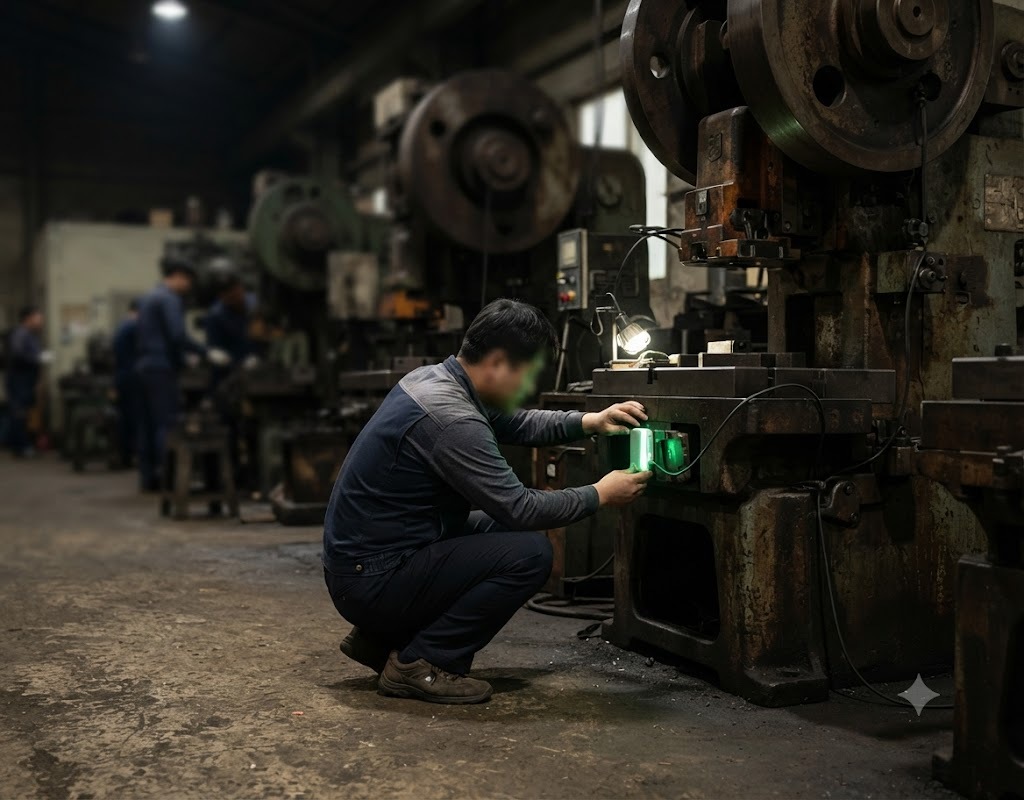
Ulsan attracted a 7 trillion won AI data center project by SK–AWS in 2025 and placed "Ulsan, the AI Capital" at the forefront of its municipal administration in 2026. The city's AI strategy shifted from a focus on education and research to an industrial city-type AI model that combines large-scale computing infrastructure with the manufacturing industry. However, there is no confirmed public evidence linking data center investment to improvements in AI adoption rates, productivity, defect reduction, safety, or energy efficiency at Ulsan's automotive, shipbuilding, and petrochemical plants. If data center construction and factory AI projects proceed along separate paths between 2026 and 2028, Ulsan may succeed in establishing AI infrastructure, but the transition of industrial sites could become dependent on external cloud demand. While Ulsan's declaration of being an AI city is confirmed in terms of infrastructure investment, it is judged to remain unconfirmed in terms of factory outcomes.
In 2026, Ulsan allocated a budget of 117.8 billion won for fostering SMEs and promoting innovation, a 26.0% increase from the previous year, and included the SME AX program. The scope of AI policy application is expanding from a focus on large corporations and research institutions to include local SMEs and partner companies. However, publicly available data does not confirm the number of supported companies that have moved beyond Proof of Concept (PoC) to permanently apply AI to actual production lines, nor does it reveal changes in productivity, sales, and employment. If support remains at the consulting, equipment, and demonstration stages from 2026 to 2028, the gap in data, manpower, and processes between large corporations and their partner companies will widen further. While the diffusion policy for Ulsan Manufacturing AX is confirmed, the conversion rate at SME production sites is deemed unconfirmed.
Ulsan has set targets for the next five years to cultivate 500 industrial convergence AI talents, conduct 150 field demonstrations centered on large corporations, and foster 500 deep tech startups, while the UNIST Novatus Graduate School plans to train approximately 100 AI specialists annually. The industrial AI ecosystem has expanded into a structure that combines talent development, startups, and large-corporation demonstrations. However, the transition criteria—ranging from 150 demonstrations to production line application, paid contracts, recurring revenue, and expansion to partner companies—have not been disclosed. If the goals remain fixated on talent, startups, and demonstration numbers for the next two to three years, the actual changes in factories will be obscured by the ecosystem's inputs. While Ulsan's industrial AI foundation is being formed, evidence of its transition to production is lacking.
The Ministry of Trade, Industry and Energy has expanded the 2026 Industrial AX budget to 1.1347 trillion won, a 100.8% increase from the previous year, and raised the budget for the AI Factory project to 220 billion won. The period from 2026 to 2028, when the expansion of national investment in Manufacturing AX converges with Ulsan's automotive, shipbuilding, and petrochemical industrial structures, is a time when large-scale external funding will flow in. However, public runtime data integrating the securing of national leading projects and the application performance by process at Ulsan plants has not been verified. If factory data standards, performance baselines, and a diffusion structure for partner companies are not established during this period, the expanded national budget will be exhausted by individual demonstration projects. The Golden Time for Ulsan's manufacturing sector is not when the AI budget is insufficient, but rather the next two to three years to determine the transition rate between demonstration and production.
Golden Time Thesis — The unit for determining whether Ulsan is a global AI city is not the amount of data center investment or the number of AI demonstration projects. The unit of judgment is how much AI has changed factory downtime, defects, costs, energy, and safety accidents, and whether those changes have spread to partner companies.
Ulsan is a manufacturing city where the automotive industry in Buk-gu, shipbuilding in Dong-gu, and petrochemical and energy industries in Nam-gu and Ulju-gun are concentrated. The scope of AI application is not limited to a single process, but encompasses the entire value chain extending from design, procurement, production, quality, logistics, facilities, safety, and energy. However, an official baseline comparing the number of factories, processes, facility data conversion rates, and AI application rates across the three major industries using the same criteria has not been confirmed. Furthermore, if business operations by sector expand separately between 2026 and 2028, the conversion rate for all factories in Ulsan cannot be calculated retrospectively. While Ulsan's industrial scale is clear, the denominator of the AI transition is deemed unconfirmed.
Hyundai Motor's Ulsan plant, HD Hyundai Heavy Industries, and large-scale petrochemical facilities are anchor companies possessing a foundation for large-scale automation, sensors, and production management. Ulsan's manufacturing sector has shifted from manual labor-centered factories to a structure combining highly automated plants with large-scale cooperation networks. However, the scope of disclosure regarding the percentage of processes transitioning from existing automation to AI-based prediction and autonomous control, as well as the resulting performance, varies by company. If automation equipment and AI processes are not distinguished over the past two to three years, existing digital investments are double-counted as new AX achievements. While the digital foundation of the Ulsan plant is strong, the scale of its AI transition cannot be assessed separately.
The SK–AWS AI data center was introduced as an investment in the 7 trillion won range and was included in Ulsan City’s Top 5 for 2025. Ulsan’s AI assets have expanded from demonstrations by local universities and the public sector to the large-scale computing infrastructure of global cloud providers. However, no publicly available data distinguishes the effects of the investment on local procurement, local employment, computing utilization by local manufacturing companies, electricity, water, and tax revenue. Even if construction investment proceeds between 2026 and 2028, if local factories do not become actual customers, the scale of investment and the scale of industrial transformation remain separate. While the economic scale of the AI data center is confirmed, the scale of its industrial connection with Ulsan factories is deemed unconfirmed.
The Ulsan Smart City Plan presented 21 projects, including AI spatial information and digital twins, with a total project cost of 294.2 billion won for the period 2022–2026. The application of urban data has expanded to include transportation, safety, and spatial management. However, a structure for jointly analyzing smart city data with industrial complex and corporate process data is not confirmed in the publicly available evidence. If the Urban AX and Industrial AX are advanced into separate platforms over the next two to three years, the mutual influence between transportation, logistics, disaster management, energy, and factory operations will be omitted. While the scale of AI in Ulsan has expanded in both urban and industrial sectors, the connection between the two systems is deemed unconfirmed.
AI data centers, UNIST, Ulsan Technopark, R&D and production facilities of large corporations, and support programs for SMEs demonstrate the concentration of AI assets in Ulsan. The AI ecosystem has grown into a structure that hosts research, talent, computing, and manufacturing demands within a single region. However, the conversion rate—from research outcomes entering factory Proof of Concepts (PoCs) to production line contracts and startup revenue—is not publicly disclosed. Even if the number of institutions and projects increases between 2026 and 2028, if this conversion rate remains low, this concentration will remain merely a parallel list of assets. While Ulsan possesses the components of industrial AI, a functioning commercial ecosystem has not yet been verified.
Over the next five years, 150 field demonstrations led by large corporations will create large-scale touchpoints that allow startups and research institutions to enter actual manufacturing sites. Technology development is shifting from laboratory verification to field verification utilizing industrial data and equipment conditions. However, public criteria for evaluating production contracts, replication in other factories, application to partner companies, and maintenance revenue following the demonstration remain unconfirmed. If the number of demonstrations accumulates rapidly between 2026 and 2028, it will become impossible to distinguish between completed PoCs and production in operation. While Ulsan's field touchpoints are expanding, the gap between the demonstration ecosystem and the production ecosystem remains.
UNIST Novatus Graduate School is pursuing the training of approximately 100 AI specialists annually, while Ulsan City has set a target of 500 industry-convergence AI talents over five years. Talent policy has shifted from general AI education to fostering industry-convergence talent capable of understanding automotive, shipbuilding, and energy processes. However, no public cohort linking graduates' employment at Ulsan companies, long-term tenure, field projects, or contributions to productivity has been verified. If only the number of graduates accumulates over two to three years, local talent becomes separated from external turnover, and educational outcomes become disconnected from factory performance. While a talent development ecosystem exists, the professional competencies remaining at Ulsan factories are deemed unconfirmed.
Ulsan City’s 50 billion won Regional Growth Fund and the goal of 500 deep tech startups connect funding for commercialization following technology development. The industrial AI ecosystem is expanding from a focus on subsidy programs to an investment and scale-up structure. However, publicly tracking data on the sales of fund-invested companies at their Ulsan factories, follow-up investments, survival rates, and local settlement is still in its early stages. Even if the number of startups increases between 2026 and 2028, companies may relocate to the Seoul metropolitan area or overseas markets if securing manufacturing customers is delayed. While the foundation for startup funding is confirmed, the commercial connection with local manufacturing demand is deemed unverified.
Manufacturing AI is shifting from individual applications such as quality inspection, predictive maintenance, and demand forecasting to autonomous manufacturing where equipment, robots, and production planning are integrated. The Ministry of Trade, Industry and Energy has also proposed a direction to establish more than 500 autonomous manufacturing AI factories by 2030. However, the number of factories in Ulsan where AI controls production conditions in a closed-loop manner, going beyond process recommendations, has not been disclosed. If investments centered on individual models become entrenched between 2026 and 2028, the cost of expanding to the full automation of the entire process will increase. While there are signs of application demonstration for manufacturing AI in Ulsan, the stage of autonomous manufacturing is deemed unconfirmed.
The automotive industry is shifting from a focus on internal combustion engines to an industry that combines electric vehicles, SDVs, robots, batteries, and data services. The scope of AI has expanded beyond process efficiency to include data competition across vehicle software and the entire product lifecycle. Evidence regarding the regional industrial ecosystem, linking production data from the Ulsan plant with vehicle operation and service data, is not being disclosed. If factory AI and product AI are separated over the next two to three years, Ulsan may remain a production hub while high-value-added software becomes concentrated in external regions. It is assessed that the gap in Ulsan’s automotive AX is larger in the integration of product and process data than in production automation.
The shipbuilding industry faces simultaneous challenges involving the complexity of design, production, welding, painting, logistics, and commissioning, as well as a shortage of skilled labor. AI and robots are shifting from the automation of individual equipment to integrated optimization that connects ship design with yard operations. However, there are no publicly available metrics confirming how much the application of AI at Ulsan shipyards has changed project schedules, rework, productivity, and safety accidents. If a response centered on temporary workers and outsourcing becomes entrenched in handling the order backlog from 2026 to 2028, data from the boom period will not be accumulated as long-term automation assets. While the application opportunities for AX in Ulsan shipbuilding are significant, there is a lack of evidence linking the boom period with structural transformation.
Facing global oversupply, carbon regulations, and cost pressures, the petrochemical industry is shifting from simple production volume expansion to high-value-added products, energy efficiency, safety, and carbon optimization. The role of AI is also expanding from predictive maintenance of equipment to the simultaneous optimization of process yield, energy, emissions, and safety. However, the public runtime for the joint utilization of process data and energy, piping, and safety data among companies in the Ulsan Petrochemical Complex has not been verified. If optimization is conducted only on a company-by-company basis for two to three years, the synergistic effects regarding energy, raw materials, and safety across the entire complex will be limited. The Ulsan Petrochemical AX is judged to have lower readiness in joint industrial complex optimization compared to application to individual companies.
Ulsan City is pursuing an AI city strategy based on the AI Capital Promotion Headquarters and the Ulsan Artificial Intelligence Committee, integrating large-scale data centers with industrial AI. The response framework has expanded from individual informatization projects to AI Governance at the city government level. However, a dashboard that integrates and publicly discloses industry-specific productivity baselines, factory adoption rates, supplier diffusion rates, and AI return rates has not been found. Even if organizations, committees, and projects increase between 2026 and 2028, the gap between the declaration and factory transformation cannot be measured unless industrial outcomes are fixed as common indicators. While Ulsan's governance response has been strengthened, the manufacturing outcome management system is deemed unconfirmed.
The 2026 budget of 117.8 billion won for fostering SMEs and promoting innovation includes support for SME AX and the startup ecosystem. The response to SMEs has shifted from general financial and sales channel support to a structure that encompasses AI and digital innovation. However, the actual AX allocation, beneficiary companies, companies undergoing production transformation, and productivity improvements within the total budget are not clearly separated in the publicly available data. If the large total budget over two to three years is perceived as AX performance, the actual resources and effects invested in manufacturing transformation may be overestimated. While the direction of the SME response is confirmed, the connection between AX financing and outcomes remains unconfirmed.
The Smart Green Industrial Complex Integrated Control Center established a foundation for industrial complex safety management by investing 13 billion won from December 2022 to November 2025. The response to industrial complexes has shifted from safety inspections of individual companies to a structure that integrates the monitoring of underground pipelines and risks within the complex. However, publicly available data does not confirm how accident detection times, leakage detection times, shutdown times, and joint response capabilities have changed since the center began operations. Once the construction achievements for 2026–2028 are concluded with the completion of facilities, the utilization of safety data for factory operations will be restricted. Although the infrastructure for industrial complex data response has been completed, the actual risk reduction outcomes are deemed unconfirmed.
Ulsan’s goals of 500 deep tech startups, 500 industrial convergence AI talents, and 150 field demonstrations place startups, talent, and demonstrations into a single strategy. The response structure has expanded from individual support programs to a full-cycle startup ecosystem. However, the entire chain—in which a single startup undergoes demonstration at a large corporation, expands to small and medium-sized partner companies, and secures recurring revenue—has not been disclosed. If performance results for each target from 2026 to 2028 are managed separately, the full-cycle strategy is separated into three independent achievements. While Ulsan’s full-cycle response has been designed, its operational feasibility is deemed unverified.
The Ministry of Trade, Industry and Energy expanded the Industrial AX budget to 1.1347 trillion won for 2026 and increased the AI Factory budget to 220 billion won. Ulsan possesses industrial clusters in the automotive, shipbuilding, and petrochemical sectors, which will serve as direct demand centers for the expansion of the national Manufacturing AX. However, no integrated regional data has been found regarding the number of projects selected for Ulsan, investment amounts, or production line application rates within the national AI Factory program. As competition for national projects intensifies between 2026 and 2028, Ulsan's leading position cannot be guaranteed solely by industrial clusters. While Ulsan demonstrates high structural compatibility with the national AX policy, its actual business share and outcomes remain unconfirmed.
The national goal is to have over 500 autonomous manufacturing AI factories by 2030, with 26 projected for 2024. This marks the initial phase of the domestic manufacturing AI industry transitioning from limited leading factories to a large-scale diffusion stage. There is no official comparative data available regarding where Ulsan factories stand within these 26 locations or the projected 500. If other manufacturing regions secure common platforms and suppliers within the next two to three years, Ulsan could fall behind in the autonomous manufacturing ecosystem, despite the scale of its large corporate factories. Ulsan's domestic position is assessed as a leader in terms of industrial scale, but a "Data Gap" in terms of the number of autonomous manufacturing factories.
Leading global manufacturing companies build their competitiveness through the combination of process data standards, digital twins, industrial software, and on-site personnel, rather than through AI models. Ulsan also possesses automation capabilities for large enterprises, industrial complex control systems, and an AI talent base. However, no data has been found comparing inter-company process data interoperability, model reuse, and joint standards among partner companies with those of leading international regions. If monopolistic corporate systems are strengthened between 2026 and 2028, only the internal AX of individual large enterprises will advance, rather than the regional collaborative ecosystem. Ulsan's global competitiveness is judged to be separated between the internal capabilities of large enterprises and the diffusion capabilities of the entire region.
The AI data center, valued at over 7 trillion won, serves as a strong leading signal regarding the scale of regional AI infrastructure investment. The participation of global cloud providers connects computing, network, and energy infrastructure with the international market. Conversely, usage conditions, costs, security, protection of national core technologies, and data export standards for local manufacturing companies have not been publicly finalized. If the data center establishes an operational structure centered on external AI demand over the next two to three years, actual accessibility for Ulsan factories could be restricted regardless of the investment scale. Ulsan is judged to be a leader in AI infrastructure location but remains unconfirmed regarding its manufacturing data utilization system.
When linking the 7 trillion won investment in AI data centers with the 117.8 billion won budget for SME support in 2026, the capital scale of Ulsan's AI strategy shows a significant disparity between large-scale infrastructure and support for local enterprises. Although the two figures cannot be directly compared by ratio due to differences in nature and timeframe, they reveal a structural gap between infrastructure investment and factory expansion. The pathway by which data center investment translates into reduced computational costs, data access, and AI productivity for SMEs remains unidentified. If this connection is not established between 2026 and 2028, large-scale investment and local enterprise AX will remain separate policies. The numerical gap of Ulsan's AI city lies between the amount of infrastructure investment and the amount of factory conversion.
Connecting the goals of 500 industrial convergence AI talents, 500 deep tech startups, and 150 field demonstrations does not automatically guarantee field demonstration opportunities and talent placement for each startup. Since the target periods and subjects differ, mechanical ratio calculations are also invalid. No data has been found linking talent, companies, demonstrations, and production contracts as a single project. If only performance results for each goal are accumulated over two to three years, a mismatch occurs where talent is produced and companies are established, but factory clients cannot be secured. While the scale of Ulsan's ecosystem goals has been presented, the connection density is judged to be unmeasured.
UNIST’s goal of training approximately 100 AI specialists annually aligns arithmetically with its target of 500 over five years. While the educational supply plan is confirmed, it is not linked to the specific job demands of Ulsan’s automotive, shipbuilding, and petrochemical industries. Furthermore, data on graduates’ local employment, tenure, and project performance are not disclosed. If industrial demand changes faster than the curriculum between 2026 and 2028, shortages in specific job roles will persist even if the personnel targets are met. The Ulsan AI talent plan is judged to possess quantitative consistency, but its suitability for factory job roles remains unconfirmed.
The 13 billion won allocated to the Smart Green Industrial Complex Integrated Control Center and the 294.2 billion won to the Smart City Plan demonstrate that funding has already been invested in urban and industrial complex data infrastructure. Ulsan’s AX initiative had been underway in the form of control, digital twins, and spatial information even prior to the official declaration. However, public outcomes linking investment amounts with reduced accidents, energy savings, and equipment downtime have not been verified. If new AI investments are added over the next two to three years, redundant functions may arise without the actual return on past digital investments being assessed. While the total volume of AI investment in Ulsan is increasing, the productivity of existing investment assets remains a "data gap."
Linking the goal of 150 field demonstrations with AX support for SMEs creates the potential for the results of large enterprise demonstrations to spread to partner companies. However, indicators such as the number of participating partner companies per demonstration, the number of replica factories, paid contracts, and recurring revenue have not been disclosed. Since the number of demonstrations represents technological touchpoints and the number of diffusions represents industrial changes, they are not identical. If these two figures are not distinguished between 2026 and 2028, the increase in PoCs is overestimated as the diffusion of factory AX. The largest numerical gap in Ulsan's manufacturing AI lies between the number of demonstrations and the number of production processes.
The first gap is the absence of a Factory Baseline . Although Ulsan possesses three major industries and large-scale factories, the proportion of each stage—data collection, AI analysis, automatic recommendation, and autonomous control—within the overall process is not disclosed. It is a structure without a denominator for the transition. As demonstration and implementation projects increase between 2026 and 2028, it becomes difficult to distinguish between processes with overlapping applications and those without. The biggest gap in Ulsan Manufacturing AX is determined to be the lack of an actual application rate relative to the total factory, rather than the number of AI projects.
The second gap is the lack of tracking the transition from PoC to Production . Although Ulsan presented a goal of 150 field demonstrations, the actual production line operations and paid contract criteria after the demonstrations concluded were not disclosed. Technology verification and industrial outcomes are separated into distinct stages. If the number of demonstrations becomes the fixed performance indicator for two to three years, the difference between lessons learned from failed demonstrations and commercialized models disappears. Industrial AI Readiness is judged as unconfirmed based on the production conversion rate rather than the number of demonstration opportunities.
The third gap lies in the data boundary between large corporations and their suppliers . While anchor companies possess facilities, personnel, data, and security capabilities, suppliers face greater challenges in data collection costs and a shortage of specialized personnel. Although quality, delivery times, and costs within the same supply chain are interconnected, AI systems remain separate for each company. If large corporations advance their AX capabilities first between 2026 and 2028, suppliers may be unable to meet the higher data and quality demands. The gap in Ulsan's industrial ecosystem lies between internal optimization within large corporations and the optimization of the entire supply chain.
The fourth gap is the lack of connectivity between AI data centers and manufacturing sites . While large-scale computing infrastructure has been established, conditions regarding factory data security, cost, latency, protection of core technologies, and model operation are not publicly verified. Even if data centers and factories are located in the same region, they do not automatically form a single AI ecosystem. If contract and operational structures remain fixed around external demand for two to three years, the accessibility requirements for local manufacturing companies are relegated to a lower priority. Infrastructure readiness is high, but industrial application readiness is deemed unverified.
The fifth gap is the lack of disclosure regarding factory outcomes . The results of AI application are reflected in productivity, defects, equipment downtime, energy consumption, safety, and delivery times. While individual figures may be limited due to trade secrets, anonymous and index-based regional statistics are also unavailable. If performance data for 2026–2028 remains undisclosed, policies will be evaluated solely based on the number of supported companies and pilot projects. Although changes in Ulsan's factories may be occurring within individual companies, they remain unconfirmed through city-wide evidence.
The SK–AWS AI data center and existing infrastructure in industrial complexes and smart green industrial complexes are expanding the foundations for computing, networking, and control. Ulsan’s technology infrastructure has shifted to a structure where global cloud and city/industrial complex platforms coexist with individual factory servers. However, the actual utilization rates, service costs, latency, and security ratings of local factories remain unconfirmed. Once the data center operating model is finalized between 2026 and 2028, initial usage conditions will become fixed as long-term industrial accessibility. The computing infrastructure is assessed as being in a large-scale construction phase, while accessibility for local manufacturing is deemed to be in an unconfirmed state.
The goal of recruiting 500 industry-convergence AI talents with UNIST Novatus establishes a foundation for supplying specialized personnel. Talent education has shifted from general data analysis to an industry-convergence model that addresses manufacturing process issues. However, demand by job function in the automotive, shipbuilding, and petrochemical sectors, as well as the regional retention of graduates, have not been disclosed. If large corporations, data centers, and startups compete for the same talent over the next two to three years, the labor shortage in small and medium-sized enterprises (SMEs) will worsen first. While supply plans for the talent infrastructure are confirmed, distribution by industry and regional retention are deemed unconfirmed.
Automotive, shipbuilding, and petrochemical processes include national core technologies, trade secrets, and safety information. Industrial data is shifting from expanded openness to a collaborative learning structure within limited trust zones. Ulsan's standards for inter-company data standards, authority, pseudonymization, federated learning, and model accountability are not confirmed in public evidence. If independent systems by individual companies become entrenched between 2026 and 2028, securing training data for common regional AI models will become difficult. Data readiness is judged to be high within large corporations but low in terms of regional joint utilization.
The AI Capital Promotion Headquarters, the Artificial Intelligence Committee, the SME AX Plan, and the Startup Strategy serve as the institutional foundation for implementation. Ulsan's AI administration has expanded from individual departments to dedicated organizations and a public-industry-academic implementation system. However, open governance that integrates and manages project-specific discontinuation criteria, performance verification, data rights, labor transitions, and safety responsibilities has not been confirmed. As projects increase over the next two to three years, the ambiguity of responsibility boundaries—rather than the number of institutions—transforms into an operational risk. It is determined that while institutional readiness has been achieved in establishing an implementation framework, it has not yet reached an industrial AI responsibility framework.
The support budget for SMEs in 2026 is 117.8 billion won, a 26.0% increase from the previous year, and AX has been included in the support direction. The target of the policy has been expanded from large corporations and research institutions to regional SMEs. However, the number of companies, processes, productivity, employment, and sales that received AX support were not disclosed separately. If only the total support budget for 2026–2028 increases, the actual transition to AI production lines will be mixed with financial, sales channel, and general innovation support. While the expansion targeting SMEs is confirmed within the policy scope, it remains unconfirmed in terms of factory outcomes.
The 150 field demonstrations centered on large corporations serve as a pathway for startups and AI suppliers to access actual process data. Technology companies gain the conditions to transition from beneficiaries of research projects to problem-solving suppliers for manufacturing companies. However, conditions regarding the burden of demonstration costs, intellectual property rights, data access, follow-up purchases, and expansion to other customers were not disclosed. If free demonstrations tailored to large corporations are repeated for two to three years, suppliers may accumulate technology but fail to secure recurring revenue. While startup expansion is confirmed at the point of contact with the field, it is deemed unverified in terms of market formation.
Factory AI affects workers' tasks and risk exposure by altering equipment shutdowns, safety accidents, energy consumption, and quality. The resident effects of Industrial AX manifest not only in corporate productivity but also in occupational safety, job changes, and employment stability. Public data from Ulsan linking accidents, skilled jobs, employment, and retraining before and after the application of AI has not been confirmed. As automation expands between 2026 and 2028, productivity gains and job transition costs will appear in separate statistics. The AX effects on workers remain unassessed as safety, job functions, and employment are not considered together.
Investments in AI data centers and manufacturing AI expand local demand for electricity, water, construction, and services. The effects on residents and businesses manifest not only in local employment and tax revenue but also in burdens on the power grid, environment, and living infrastructure. However, integrated public data regarding local employment, electricity, water, tax revenue, and environmental costs associated with data centers is not available. If facility investment proceeds over a period of two to three years, initial expected benefits remain fixed, while operating costs may become apparent after completion. While the regional expansion of large-scale AI infrastructure is confirmed by investment amounts, the net local value is deemed unconfirmed.
The automotive industry zone in Buk-gu is characterized by large-scale finished vehicle factories connected to parts and logistics networks, while the shipbuilding industry zone in Dong-gu features massive shipyards and a multi-layered cooperation and outsourcing structure. In the petrochemical zone of Nam-gu and Ulju-gun, continuous processes, piping, energy, and safety are interconnected among companies. This structure makes it difficult to measure the transition of these three industries using a single manufacturing AI policy. A common Ulsan dashboard distinguishing process units and outcome criteria by industry sector has not been identified. Comparing the same number of demonstration projects between 2026 and 2028 distorts the difficulty and diffusion effects by industry. The AX disparity within Ulsan is determined to be due to the absence of measurement standards that reflect regional differences in industrial structure.
Buk-gu, Dong-gu, and Nam-gu, where large corporate sites are concentrated, differ from Ulju-gun, where SMEs and industrial complexes are distributed, in terms of capabilities for data, manpower, and facility investment. While AI for anchor companies can be implemented through internal investment, small-scale businesses rely heavily on public support and shared infrastructure. Data comparing AI adoption rates, investment amounts, and performance by manufacturing companies across districts and counties is unavailable. If performance driven by large corporations drives up the Ulsan average over the next two to three years, the gap for non-adopting SMEs becomes obscured. It is determined that the Ulsan average AX is at risk of being overestimated by the performance of large corporations.
While AI data centers and research and startup infrastructures are located in specific regions, manufacturing demand is dispersed across various industrial sectors. Even if physical distances are short, disparities in utilization arise if access to data security, networks, contracts, and specialized personnel differs. The usage time and costs of AI infrastructure by companies in each region have not been disclosed. If initial customers and partners become fixed between 2026 and 2028, the productivity gap between connected and unconnected companies will be prolonged. It is determined that AI accessibility within Ulsan is asymmetrical due to company size and data authority rather than distance.
The Smart Green Industrial Complex Integrated Control System monitors common risks within the complex, but its purpose and data differ from individual factory production AI. The structure involves industrial complex-level safety AX and internal company production AX proceeding in parallel. A public runtime linking the alerts, equipment status, and maintenance schedules of the two systems is not available. If separate systems become entrenched for two to three years, the time lag between assessing complex risks and determining factory operations widens. The AX in the Ulsan industrial space is determined to be fragmented between the complex and the factories.
Investment in the SK–AWS AI data center is being pursued, and the AI Capital Promotion System was fully launched in 2026. The period from 2026 to 2028 is when the design, construction, and operational conditions of the data center, as well as the utilization structure of local manufacturing companies, will be concretized. Standards regarding local factory utilization rates, security, costs, and shared services have not yet been confirmed. Once the initial operating model is finalized, the cost of re-reflecting local manufacturing demand from a lower priority will increase. The first Golden Time is determined to be before the relationship between large-scale computing infrastructure and factory demand is fixed by contract.
The Ministry of Trade, Industry and Energy's budget for Industrial AX has expanded to 1.1347 trillion won by 2026, and the budget for AI Factories has also increased to 220 billion won. National Manufacturing AX has entered a large-scale diffusion phase, moving from a limited pilot project to a large-scale expansion phase. However, the regional runtime connecting Ulsan's selected projects, production processes, and the expansion of partner companies has not been confirmed. If other regions preempt industry-specific standards, suppliers, and references between 2026 and 2028, Ulsan's advantage in industrial agglomeration could turn into a burden of existing non-automated facilities. The second Golden Time is the next two to three years, during which National AX resources will become fixed as initial industry standards.
Ulsan aims for 150 field demonstrations, 500 industrial convergence AI talents, and 500 deep tech startups over the next five years. The period from 2026 to 2028 marks the execution of the initial half of these goals and the stabilization of the performance evaluation method. Criteria for production conversion, recurring revenue, and factory outcomes have not been disclosed. If the initial evaluation becomes fixed around the number of demonstrations, education, and startups, it will be difficult to later shift the focus to commercialization. The third "Golden Time" is determined to be before the unit of industrial AI performance becomes fixed as demonstrations.
The automotive industry is facing SDVs and electric vehicles, the shipbuilding industry is shifting toward autonomy and digital ships, and the petrochemical industry is transitioning toward oversupply, carbon emissions, and high value-added products. The timing of AI investment in Ulsan coincides with the simultaneous transformation of the product, process, and workforce structures of these three industries. Data on process baselines and job transitions by industry sector are still incomplete. After facilities, job roles, and supply chains are reorganized between 2026 and 2028, incorrectly selected data and AI structures will be embedded in the long-term production system. The fourth "Golden Time" is determined not to be the AI technology cycle, but rather the period during which the facility investment cycles of Ulsan's key industries are finalized.
12-1. Golden Time Application Case in Basic Local Governments ① — Buk-gu
Buk-gu is home to Hyundai Motor's Ulsan plant and a concentration of automotive parts and logistics ecosystems. Automotive AX is shifting from factory automation to a product-process integrated structure where electric vehicles, SDVs, robots, and quality data are interconnected. However, publicly available data does not confirm the extent to which the benefits of AI application in finished vehicles have spread to improvements in productivity, delivery times, and quality for suppliers in Buk-gu. If the finished vehicle production system is reorganized around electric vehicles and software between 2026 and 2028, suppliers with weak data connectivity will find it difficult to cope relying solely on their existing supply capabilities. Buk-gu is assessed as a region with high potential to lead the AX of large corporate factories, but where the transformation of the entire supply chain remains unconfirmed.
Production volume, defects, and downtime at finished vehicle factories are linked to the delivery and quality data of parts suppliers. The ultimate unit of factory AI is not individual production lines, but the supply chain from parts receipt to finished vehicle shipment. Inter-company model and data standards, as well as shared outcomes, have not been disclosed. If internal optimization within the finished vehicle manufacturer becomes entrenched over the next two to three years, suppliers will be left to handle shorter delivery times and higher quality requirements without an AI-based foundation. The "Golden Time" for the North is determined to be before the data gap between the finished vehicle manufacturer and suppliers becomes fixed as a supply chain disparity, rather than during factory automation.
12-2. Golden Time Application Cases in Basic Local Governments ② — Dong-gu
Dong-gu is home to a concentration of HD Hyundai Heavy Industries, shipbuilding subcontractors, and skilled labor. The shipbuilding boom and order backlog provide large-scale field data for applying AI, robots, and digital yard technologies to actual production. However, there is no universal regional evidence confirming how much the application of AI has changed ship construction times, rework, welding quality, safety accidents, or labor shortages. If production pressures during the boom period of 2026–2028 are absorbed by the expansion of temporary workers and outsourcing, the field data and investment capacity available for transition will be exhausted before an economic downturn occurs. Dong-gu is assessed as a region where both the demand for AI demonstration and financial capacity exist, but the outcomes of structural transformation remain unconfirmed.
Shipyards find it difficult to repeatedly apply the same model due to order-based design, large yards, and multi-stage processes. Shipbuilding AI is structured to be more effective when integrated with design changes, materials, work sequences, and skilled personnel, rather than through predictive maintenance of a single piece of equipment. Public runtimes linking prime contractor-subcontractor process data with job-specific productivity are not available. If individual robot and vision demonstrations are conducted independently over a period of two to three years, they are not aggregated to shorten the overall construction time of the entire yard. Donggu’s Golden Time is the period for assessing the integrated effect that changes the overall Lead Time of a shipbuilding project, rather than the number of demonstrated technologies.
If the operational structure of AI data centers is separated from local manufacturing, Ulsan may be a location for computational infrastructure but not a region for creating value from industrial data. There is no confirmed connection between the 7 trillion won investment and the usage conditions for manufacturing companies. If the customer structure for long-term contracts, electricity, and cloud services becomes fixed between 2026 and 2028, the room for prioritizing local access and incorporating manufacturing-specific services diminishes. The first loss is not the effect of attracting data centers, but the time to transform computational infrastructure into local industrial productivity.
If field validation is not transitioned to production, factory data is used for one-off projects, and models are terminated without maintenance. Ulsan holds 150 validation goals, but the criteria for transitioning to commercialization have not been confirmed. If PoCs accumulate over two to three years, companies bear the burden of validation fatigue and data provision costs, while suppliers fail to generate recurring revenue. The second loss is determined not by the validation budget, but by the trust between the factory and the AI company, and the time required for commercialization.
If the speed gap between large conglomerate AX and partner AX widens, quality, delivery, and security standards in the supply chain rise, but the response capabilities of SMEs cannot keep up. Although support for SMEs was expanded in 2026, the actual factory conversion rate has not been verified. As the systems of large automakers, shipbuilders, and petrochemical companies become fixed between 2026 and 2028, the entry costs for unlinked partner companies will rise. The third loss is not only the productivity of individual SMEs but also the regional completeness of Ulsan's supply chain.
Even if AI talent is trained, if it does not lead to on-site projects at Ulsan companies or long-term employment, the educational outcomes are transferred to other regions. While there are targets of approximately 100 people annually and 500 over five years, the employment and retention cohorts remain unconfirmed. As talent competition intensifies among data centers, large corporations, and startups over the next two to three years, the shortage of industrial AI personnel in small and medium-sized enterprises (SMEs) will worsen. The fourth loss is determined not to be the number of trained personnel, but to be local human capital possessing both process knowledge and AI knowledge.
Ulsan simultaneously possesses large-scale manufacturing demand in the automotive, shipbuilding, and petrochemical sectors, talent and research from UNIST, sites for major corporations, startup support, and global data centers. The demand, supply, and infrastructure components of industrial AI coexist in a single region. However, a public runtime connecting these elements to a single Factory Outcome has not been identified. There is still room to assess interconnectivity before the operational structures of each element become individually entrenched between 2026 and 2028. Currently, the opportunity lies in determining the factory conversion rate of already integrated assets rather than adding AI assets.
Automotive, shipbuilding, and petrochemical plants generate large-scale data regarding quality, equipment, safety, and energy. Ulsan is not a region lacking real-world industrial problems necessary for AI learning. However, regional collaborative learning is not being confirmed due to differences in corporate secrets and data standards. As company-specific data structures become more sophisticated over the next two to three years, the costs of disseminating common models to partner companies will increase. Currently, the opportunity lies in assessing the feasibility of common learning from existing process data rather than creating new data.
The expansion of the national industrial AX budget and the increase in support for SMEs in Ulsan occurred at the same time. A structure in which external and local funding increases simultaneously provides the conditions to absorb the initial fixed costs of manufacturing AI. However, data regarding project overlap, process gaps, and performance linkage have not been confirmed. Once the fiscal expansion period of 2026–2028 passes, it may become difficult to secure demonstration and infrastructure investments of the same scale again. Currently, the opportunity lies in a fiscal expansion phase where various funding sources can be linked to production rather than the scale of subsidies.
Although the shipbuilding boom, automotive product transitions, and petrochemical restructuring pressures represent distinct industrial situations, they all require the redesign of process data and productivity. Ulsan possesses a manufacturing portfolio that allows for the comparison of industry-specific demonstrations, rather than a single general-purpose AI policy. Common performance indicators across industries have not yet been identified. If industry-specific transitions proceed over the next two to three years, the initial opportunity to learn from mutual success and failure evidence will disappear. Currently, opportunity is determined not by grouping the three industries under the same technology, but by the timeframe during which they can be compared based on the same outcome.
Changes to observe | Apply AX | Industry judgment | Verification indicators |
| Entire factory and process | Factory AX Registry | Determination of Non-application, Duplication, and Priority Process | Data and AI Application Rates by Process |
| Field demonstration | PoC-to-Production Tracker | Decision on commercialization, termination, or replication | Demonstration → Production Conversion Rate |
| Equipment condition | Predictive Maintenance Runtime | Determining maintenance and replacement timing | Downtime, breakdowns, and maintenance costs |
| Product quality | Industrial Quality Graph | Decision on adjustment of process conditions | Defect, rework, and return rates |
| Production plan | Autonomous Scheduling Twin | Determining production sequence and capacity | Lead Time · Utilization Rate |
| Safety and Environment | Industrial Risk Engine | Alarm/Work Stop Decision | Incidents, False Positives, and Response Time |
| Energy and Carbon | Process Energy Optimizer | Process and fuel adjustment judgment | Unit, Emission, Cost |
| Large Corporation – Partner Company | Supply-chain AX Graph | Common Standard and Diffusion Determination | Partner Application · Delivery · Quality |
| AI Data Center | Industrial Compute Ledger | Assessment of regional manufacturing accessibility | User companies, costs, and computational volume |
| Industrial AI Talent | Talent-to-Factory Runtime | Decision on job and education allocation | Employment, Longevity, and On-site Performance |
| startups | Industrial AI Revenue Tracker | Follow-up Investment and Marketability Assessment | Paid contracts · Recurring revenue |
| Policy Portfolio | Golden Time Dashboard | Fiscal redistribution and diffusion judgment | Investment → Production → Outcome |
Industrial AX Runtime
Process Baseline → Data Collection → AI Demonstration → Production Line Application → Quality, Stoppage, Cost, Safety, Energy Outcome → Supplier Replication → Recurring Revenue → Industrial Competitiveness → Next Process
Infrastructure Acceleration + Factory Transformation Evidence GAP
Ulsan's declaration as an AI city has gained tangible results through investment in organization, talent, demonstration, finance, and data centers.
Changes in productivity, quality, safety, and energy at the factory level did not translate into evidence for the entire city.
The current risk is not a lack of AI investment, but rather a structure where large-scale investments do not transition from the demonstration and infrastructure stages to factory production.
The period from 2026 to 2028 is when the factory conversion rate, not the name of the AI city, determines Ulsan's actual status.
The final result is Infrastructure Acceleration + Factory Transformation Evidence GAP.
- Total number of manufacturing plants in Ulsan
- Total number of production processes by industry
- Process data collection rate
- AI Application Rate in Factories and Processes
- Distinction between Automation and AI Application
- Ratio of AI-recommended processes and autonomous control processes
- Number of field PoC starts and ends
- PoC → Production Conversion Rate
- 12-month retention rate after production implementation
- Different factory replication rates of the same model
- Equipment downtime before and after AI application
- Defect and rework rates before and after AI application
- Production Lead Time Before and After AI Application
- Energy intensity before and after AI application
- Safety accidents and near misses before and after AI application
- Large Corporation – Partner Company Joint AI Project
- AI Application Rate by Partner
- SME AX Support Amount, Beneficiary Companies, and Results
- Number of Ulsan manufacturing companies using data centers
- Manufacturing companies' computational costs and processing time
- Employment rate of AI talent in Ulsan companies
- 1-Year and 3-Year Local Residency Rates of AI Talent
- Startup's paid contract rate with large corporations
- Recurring Revenue and Follow-up Investment in Industrial AI Companies
- Factory Outcome Returns Compared to AI Investment
Data GAP: In public evidence, the Ulsan Manufacturing AX Runtime connecting AI data center, talent, startup, finance → field demonstration → production line application → productivity, quality, safety, energy → partner diffusion → AI company recurring revenue to the same factory/project ID and timeline is not confirmed.
Runtime Chain
Computation, Talent, Process Data → PoC → Production → Factory Outcome → Supply Chain Expansion → Recurring Revenue → Industrial Productivity → Global Manufacturing Competitiveness
Source · Verification
- Ulsan Metropolitan City Promotes Ulsan as AI Capital
- Ulsan Metropolitan City Invests in SK–AWS AI Data Center
- Ulsan Metropolitan City, AI Data Center Opportunity and Development Special Zone
- Ulsan Metropolitan City, Industrial Convergence AI Startup, Talent, and Field Demonstration Strategy
- Ulsan Metropolitan City, 2026 Plan for Fostering SMEs and Promoting Innovation
- Ulsan Metropolitan City, Smart Green Industrial Complex Integrated Control Center
- Ulsan Metropolitan City, 2022–2026 Smart City Plan
- Ministry of Trade, Industry and Energy Expands Investment in Industrial AX and AI Factories
- Ministry of Trade, Industry and Energy, New Industry Policy for the AI Era
- Ulsan Metropolitan City, Ulsan Population Status as of May 2026
Structural insights remaining from this analysis
AI data centers produce computation, while factories produce productivity. The mere fact that the two facilities are located in the same city does not translate computation into productivity. Data center computation is converted into manufacturing value only when the rights, security, costs, and latency of factory data are linked with the on-site maintenance system of AI models.
The structural characteristic of Ulsan lies not in a lack of AI demand, but in the fact that demand is trapped within companies. While automotive, shipbuilding, and petrochemical plants generate vast amounts of data, if they cannot transcend corporate and industry boundaries, AI suppliers must create new Proofs of Concepts (PoCs) every time, and partner companies repeatedly bear the same transition costs.
Therefore, the single structural insight of Ulsan's AI city is that the aggregation of computation and the aggregation of learning are different . While data centers gather computation in one place, industrial learning is not aggregated unless factory-specific trials, failures, and results are reused. What Ulsan needs to secure is not the title of the largest AI facility, but the speed at which learning from one factory moves to the next.
Golden Time Thesis — The point at which Ulsan becomes a global AI city is not the day the AI data center is completed. It is the day when a factory's Proof of Concept (PoC) transitions into production, and its results are replicated to improve defects, shutdowns, costs, and safety in other factories and partner companies. If this replication path is not established between 2026 and 2028, Ulsan will be left with massive computing infrastructure and numerous AI demonstrations, but the learning speed of the entire manufacturing industry will not change.
Version | Reference Date/Revision Date | Major changes |
| v1.0 | 2026.08.28 | No. 061 Initial Analysis Written. It is composed of 19 chapters in accordance with the Regional AX Golden Time Intelligence v3.2 enhancement criteria. It verified the SK–AWS AI data center worth approximately 7 trillion won, the promotion system for the AI capital by 2026, a support budget for SMEs of 117.8 billion won (a 26.0% increase year-on-year), targets of 500 industrial convergence AI talents, 500 deep tech startups, and 150 field demonstrations centered on large enterprises, approximately 100 specialized personnel annually at UNIST, 13 billion won for the Smart Green Industrial Complex Integrated Control Center, and a national industrial AX budget of 1.1347 trillion won with an AI Factory budget of 220 billion won. Chapters 9 through 14 were limited to the assessment of readiness levels, diffusion, time risk, and irreversibility, while AX response was placed only in Chapter 15. The final judgment was confirmed as Infrastructure Acceleration + Factory Transformation Evidence GAP, and the structural insight as 'computational aggregation and industrial learning aggregation are different, and the speed at which learning in one factory is replicated to the next determines the reality of the AI city.' |
