


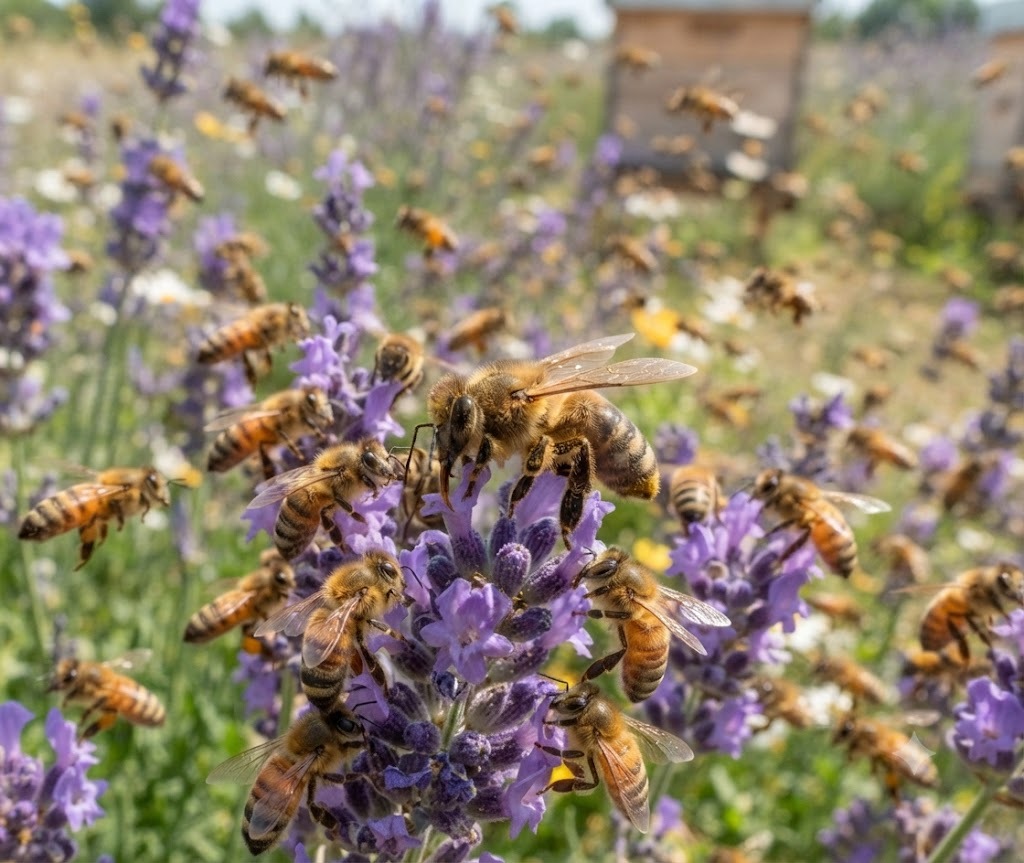
Unlike other livestock products, honeybees possess a dual industrial value as livestock that produce honey and as a production service resource that assists in the pollination of crops. Beekeeping farms can produce not only honey but also propolis, royal jelly, pollen, and bee venom, while the bee colonies themselves serve as a pollination service for greenhouse fruit and vegetable farms.
The Korean government is also fostering the beekeeping industry separately in accordance with the Act on the Promotion and Support of the Beekeeping Industry, and the 2022–2026 Comprehensive Plan has set the expansion of nectar sources, pest and disease management, dissemination of superior varieties, rearing management techniques, research and development, and supply and demand stability as key tasks. In particular, declining productivity due to shrinking nectar sources, high colony densities, and pests and diseases has been pointed out as a significant industrial issue. ( Mafra )
Judgment axis | Key points |
| production units | Colony rather than individual |
| production purpose | Beekeeping products, queen bees, pollination |
| Main Products | Honey, propolis, royal jelly, pollen, bee venom |
| production core | Colony strength, queen bee, nectar source, mites, overwintering |
| Major risks | Honeybee mites, diseases, lack of nectar sources, pesticides, weather |
| service | Pollination of fruit trees and greenhouse crops |
| AX | Colony weight, temperature and humidity, sound, activity, and mite data |
| RFQ | Queen Bee · Bee Colony · Honey · Beekeeping Products · Pollination Service |
| Final goal | Connecting healthy colonies with production, pollination, and buyers |
Therefore, the core of the MarketHub honeybee RFQ is to expand the productivity criteria from “how much honey was produced” to “how healthily a bee colony was maintained while creating product and pollination value . ”
Honeybees live in a single colony consisting of tens of thousands of individuals, including a queen, worker bees, and drones. Therefore, rather than managing a single animal as a production unit like a cow or a horse, it is more realistic to establish a colony, hive, or apiary as the basic management unit.
Furthermore, in the case of honeybees, the living colonies themselves can serve as products and services. Parent bees, queen bees, and swarms are supplied to other beekeeping farms, pollination colonies are supplied to crop farmers, and products such as honey, propolis, and royal jelly each become separate Product Entities.
division | Main purpose | Products and services |
| Honey-collecting bee colony | Honey production | honey |
| Jongbong | Multiplication and improvement | Queen bee · Swarm colony |
| pollination colony | Crop pollination | Pollination Service |
| Propolis production | Beekeeping products | Propolis |
| Royal jelly production | Beekeeping products | Royal Jelly |
| Flowerpot production | Beekeeping products | Bee Pollen |
| Bee venom production | Beekeeping products | Bee Venom |
Therefore, the basic structure is managed as Honey Bee → Colony → Production Purpose → Bee Product/Pollination Service → Buyer .
In honeybees, it is just as important to separate the production purpose and capabilities of the colony as it is to the breed . It is difficult to evaluate colonies with high honey production capacity, those suitable for propagation and queen production, and those utilized for pollination using the same criteria.
The government's 2022–2026 Beekeeping Industry Plan also outlined a direction to develop and distribute varieties with superior nectar-gathering ability and disease resistance through purebred resources and molecular breeding. In other words, going forward, the value of bee colonies with confirmed superior genetic traits and actual productivity data may become more important than farms simply possessing a large number of hives. ( Mafra )
division | Key criteria | conjugation |
| For honey harvesting | Sumilryeok · Bonggun forces | honey |
| Jongbongyong | Queen bee · Reproductive ability | Proliferation and sale |
| For moisture | Active and benevolent forces | Crop pollination |
| For specialty products | Production Technology · Colony Condition | Royal jelly, etc. |
| Improved bee colony | Productivity and disease resistance | Jongbong |
MarketHub classifies items in the order of Colony Type → Production Purpose → Performance → Product/Service .
The productivity of a beekeeping farm should not be judged solely by the number of hives. The actual honey yield and queen bee production are influenced by how stably the colony recovers its strength after overwintering, the queen bee's egg-laying status, whether sufficient worker bees are secured during the nectar season, and whether mites and diseases are controlled.
Furthermore, if nectar sources are scarce or weather conditions are unfavorable, honey yields may decrease even if strong colonies are maintained. As the government also points to the shrinking of nectar resources, rising colony density, and pest and disease issues as causes of declining productivity in the domestic beekeeping industry, it is important to examine nectar source and weather data together, in addition to farm data. ( Mafra )
Management area | Things to see at a farm |
| Queen bee | Spawning, Age, Replacement |
| Bonggun forces | Worker bees · capping area |
| multiplication | swarm and queen bee production |
| feedstuff | Subsidies such as sugar and pollen substitutes |
| nectar source | Flowering period, distance, and nectar supply |
| Honey harvesting | Period and production volume |
| disease | mites, foulbrood, etc. |
| Overwintering | Colony survival before and after overwintering |
The key is to look at the structure leading from the number of bee colonies → ratio of strong colonies → colonies capable of honey harvesting → actual production volume .
In honeybees, managing Varroa destructors is one of the most critical health management challenges. WOAH explains that Varroa destructors parasitize capped larvae and adults, transmit various viruses, and can lead to colony collapse if left uncontrolled. ( WOAH )
The Korean government also conducted an intensive spring control period for Honeybee mites targeting approximately 26,000 beekeeping farms nationwide from March 9 to April 6, 2026. The government advised beekeepers to first assess the level of infection and implement a combination of physical and chemical control measures, while also advising them to refrain from using chemicals immediately before and during the nectar flow and to observe the withdrawal period. ( Mafra )
step | Key Management |
| Bee colony entry | Farm · Source · Colony ID |
| Queen bee | Lineage, Age, Spawning |
| health | Mites, diseases, and deaths |
| medicine | Ingredients, Date of Use, and Discontinuation of Use |
| Honey harvesting | Hive · Date · Honey Lot |
| Pollen and royal jelly | Production Date · Lot |
| Processing and Packaging | Processing Lot |
| circulation | Product · Buyer |
In particular, since the use of chemicals is linked to the safety of honey or beekeeping products, the relationship between Treatment Record → Harvest Date → Product Lot must be managed.
The Korean beekeeping industry consists not solely of honey sales. Important consumers include not only beekeeping farms, queen bee farms, beekeeping product processors, and distribution companies, but also greenhouse and fruit farms that require pollinating bees.
Government data also shows that greenhouse farmers are actually utilizing honeybees for pollination, and in the past, during periods of colony damage, even the potential for disruptions in the supply of pollination hives was managed separately. This demonstrates that beekeeping is an industry that connects the livestock supply chain with the crop production network . ( Mafra )
Participants | Things needed | RFQ |
| Beekeeping farm | Queen bee, queen bee, nectar source | Producer |
| Jongbong farm | Excellent system | Breeding |
| Fruit and greenhouse farms | pollination colony | Pollination RFQ |
| Honey distribution | Origin, Quality, and Quantity | Honey RFQ |
| food companies | Honey and pollen | Ingredient |
| raw material companies | Propolis and Royal Jelly | Material |
| Research Institute | Queen Bees, Diseases, Ecology | R&D |
| local government | Nectar sources, farms, pollination | Regional AX |
Therefore, beekeeping must view both the B2B Product Market and the Pollination Service Market simultaneously.
In the international trade of beekeeping products, customs clearance, quarantine, and food standards vary depending on the product form, such as honey, pollen, and propolis. In particular, new changes have been introduced to Korea's quarantine system in 2026.
The Animal and Plant Quarantine Agency amended the relevant notice on May 27, 2026, newly designating honey and pollen for beekeeping as subjects for animal quarantine , and this system is scheduled to take effect on November 27, 2026. After implementation, the relevant products must meet requirements, such as quarantine certification from the animal quarantine authorities of the exporting country. ( Mafra )
Beekeeping Farm → Harvesting → Primary Processing → Inspection & Processing → Packaging → Import/Export → Buyer
Pollination is separate:
Beekeeping farm → Colony preparation → Transportation → Crop/facility placement → Pollination period → Recovery/recovery
Confirmation area | Main contents |
| honey | Origin·Type·Moisture·Lot |
| pot | For food/beekeeping purposes |
| Jongbong | Queen bee, colony, quarantine |
| Quarantine | Honeybee Diseases · Proof |
| trade | HS·Customs·FTA |
| safety | Residual substances and hygiene |
| distribution | Temperature, Packaging, and Colony Transport |
| Buyer | Specifications, Quantity, and Timing |
Therefore, in the actual RFQ, Product Use + Origin + Quarantine/Food Requirement + HS + Buyer Specification must be re-verified at the time of transaction.
The beekeeping industry is characterized by the ability to produce various products from a single colony. While honey is the most representative product, propolis, royal jelly, pollen, and bee venom each possess distinct production technologies and buyer markets. The government's plan for the beekeeping industry also views the expansion of the market for high-value beekeeping products—such as royal jelly, propolis, and bee venom—beyond honey as a separate priority. ( Mafra )
In PRP, increasing the variety of products is not the goal in itself. A specific farm must determine whether it is better to continue producing honey, diversify products into propolis or royal jelly, or if pollination services are more profitable by comparing the profit per colony with labor, technology, and buyer demand .
Products and services | Main uses |
| honey | Food and raw materials |
| Propolis | Food and raw materials |
| Royal Jelly | Food and raw materials |
| pot | Food and Feed |
| Bee venom | Research and industrial raw materials |
| Queen bee | Beekeeping farm |
| pollinator | Fruit trees and greenhouse horticulture |
Key PRP questions include which product is most profitable per colony, how productivity differs by nectar source, how to allocate pollination colonies and honey harvesting colonies, and whether the quality and supply volume required by the buyer can be reliably met .
The core of smart beekeeping is not the installation of sensors in the beehives themselves. The goal is to enable faster detection of abnormal signs through changes in colony weight, temperature, humidity, activity, and sound, and to check the beehives that require attention first, without the need for a person to open the hives every day.
The government's 2022–2026 Beekeeping Industry Plan also presented a proactive prevention system utilizing data and digital technologies, such as digital sensors, early disease detection, automated pest control, and smartphone-based disease counseling, as its direction. ( Mafra )
Apply AX | farm effect |
| Beehive weight | Checking changes in honey harvesting and consumption |
| Internal temperature and humidity | Monitoring colony status |
| Entry and exit activities | Confirmation of changes in activity |
| Sound and vibration | Anomaly detection assistance |
| Mite records | Determining the timing of pest control |
| Weather and flowering data | Movement and Honey Extraction Plan |
| Production Lot | Honey history |
| Buyer Matching | Pre-production sales plan |
The core structure is Hive Data → Anomaly Detection → On-site Verification → Specifications/Pest Control → Production Forecast → Buyer Connection .
The problems facing the domestic beekeeping industry cannot be explained by a single factor. Declining nectar sources, high colony densities, honeybee mites, abnormal weather conditions, overwintering losses, drug resistance, and competition from imported products all influence one another.
In particular, the Honeybee mite is a critical issue linked to actual large-scale bee colony damage, and the government is continuously implementing intensive control measures. As the spread of resistant mites due to the long-term use of specific control ingredients in the past has been analyzed as one of the causes of the damage, it is important to manage infection rates, control ingredients, and efficacy using data , rather than simply focusing on the amount of pesticide used . ( Mafra )
problem | Data to verify |
| Weakening of the bee colony | Overwintering, egg laying, and colony strength |
| Honeybee mites | Infection level, drug, and effect |
| disease | Symptoms, Diagnosis, and Colony Loss |
| Lack of nectar sources | Flowering · Area · Distance |
| Reduced honey harvest | Weather, nectar sources, and bee colony forces |
| Pesticide hazard | Spraying period and region |
| Bee quality | System and productivity |
| Hydration | Crops, Season, Bee Colony |
| price | Honey and Beekeeping Products |
| Import competition | Origin, Quantity, Price |
The basic structure of the Problem Bank is: problem occurrence → verification of colony and environmental data → cause analysis → field verification → comparison of performance in the next season .
Honeybee RFQs are not intended solely for the sale of honey. Beekeeping farms seeking superior queen bees or breeding stock, fruit and greenhouse farms requiring pollination colonies, and food companies seeking raw materials for honey, propolis, and royal jelly can all register different RFQs.
In particular, pollination RFQ is an area where the beekeeping industry can be directly linked to agricultural RFQ. By connecting crop items, flowering periods, cultivation areas, and the required number of bee colonies with the supply availability of beekeeping farms, it is possible to simultaneously create agricultural productivity and new revenue sources for beekeeping farms .
RFQ Type | Collaboration Examples |
| Jongbong | Superior Colony and Queen Bee |
| Bonggun | Breeding and stocking |
| honey | Ingredients by nectar source |
| Propolis | Raw material supply |
| Royal Jelly | food ingredients |
| pot | For food and beekeeping |
| Bee venom | Research and raw materials |
| pollinator | Fruit trees and greenhouse crops |
| process | Sorting, Packaging, OEM |
| AX Pilot | Bee colonies, diseases, and nectar sources |
Price, exact colony location, production volume, and Buyer contract terms are managed during the Verified/NDA stage.
Honeybees are one of the livestock species to which MarketHub's RFQ (Request First) structure can be applied in the most diverse ways. This is because not only honey buyers but also other beekeeping farms and crop producers can become direct buyers.
In particular, for pollination, accurate matching is possible only if you first register how many colonies are needed for which crop and when, rather than simply buying honeybees.
① Find products/raw materials.
Need Products & Materials
Companies and farms seeking queen bees, queen bees, honey, propolis, royal jelly, pollen, and bee venom register their purchase demands. MarketHub reviews available beekeeping farms and companies by verifying the item, nectar source, production season, quantity, region, and quality conditions.
RFQ Registration → Supply Condition Review → Connecting Beekeeping Farms and Companies → AI Matching
Register
② We are looking for production and pollination partners.
Need Suppliers & Pollination Partners
We are seeking beekeeping farms, queen bee farms, processing companies, or suppliers of pollination colonies. For pollination, we review crop, cultivation area, flowering period, and region together with colony strength and supply period.
RFQ Submission → Review of Bee Colony & Production Capabilities → Partner Connection → AI Partner Matching
Register
③ We are looking for domestic and international buyers.
Need Buyers
Beekeeping farms and processing companies seek new buyers, including food, raw material, and distribution firms, as well as fruit and greenhouse farms. We connect suitable customers not only for products but also for queen bees and pollination services.
RFQ Submission → Review of Product/Bee Colony Supply Capabilities → Buyer Connection → AI Buyer Matching
Register
Contact : mail@markethub.org
The core entities of the honeybee dataset are not individual bees, but colonies and hives . To compare actual productivity, it is necessary to link information such as which queen bee is in which hive within which apiary, where nectar was collected, and how much was produced after mite control and overwintering.
In the pollination service, crop data is added here. By connecting which bee colony was placed on which crop at which farm when, and how the colony's status changed after the pollination period, beekeeping and agriculture RFQs can be combined into a single Relationship Dataset.
Dataset | Simply put |
| Master | Standards for Honeybees, Beekeeping Products, and Nectar Sources |
| Entity | Beekeeping Farm · Bee Colony · Beehive · Buyer |
| Relationship | Queen Bee · Nectar Source · Crops · Products Connection |
| Runtime | Changes in bee colony strength, mites, honey harvesting, and prices |
The representative production structure is as follows.
Apiary → Hive/Colony → Queen → Feed/Melliferous Plant → Health → Harvest → Honey/Bee Product Lot → Buyer
Pollinators are:
Colony → Crop → Farm → Flowering Period → Pollination Service → Colony Recovery
Connect to.
Beekeeping is an industry that requires an simultaneous examination of diseases, nectar sources, weather, pesticides, and pollination, in addition to production statistics. The up-to-date accuracy of this registered edition has been verified based on the Ministry of Agriculture, Food and Rural Affairs' Five-Year Plan for the Beekeeping Industry, the 2026 Guidelines for Intensive Control of Honeybee Mites, the Animal and Plant Quarantine Agency's 2026 Revision of the Quarantine System for Honey and Pollen for Beekeeping, and WOAH's Mite Standards. ( Mafra )
However, the 2026 targets presented in the government's 2022 comprehensive plan, along with past colony and production figures, are not used as current performance values. Plan targets are preserved only as Target Benchmarks, and the Runtime Dataset will be updated separately once the actual final production, farm, and colony statistics for 2026 are published. ( Mapo Library )
Evidence | source |
| A | Ministry of Agriculture, Food and Rural Affairs, Animal and Plant Quarantine Agency, WOAH, FAO |
| B | Rural Development Administration · Research Institutes · Papers |
| C | Beekeeping Association · Verified Industry Data |
| D | Farm, Business, and Transaction Data |
| E | Additional verification needed |
Key factual basis
- The Act on the Promotion and Support of the Beekeeping Industry came into effect on August 28, 2020, laying the legal foundation for the government to formulate a five-year comprehensive plan for the development of the beekeeping industry. ( Mafra )
- The Ministry of Agriculture, Food and Rural Affairs’ 2022–2026 Comprehensive Plan set the expansion of nectar sources, pest and disease management, improvement of queen bees, smart rearing management, and the expansion of demand for beekeeping products as key tasks. ( Mafra )
- In 2026, the government implemented intensive spring control of Honeybee mites targeting approximately 26,000 beekeeping farms and recommended verifying infection levels and rotating the use of ingredients. ( Mafra )
- WOAH officially recognizes Varroa destructor as a significant pest that parasitizes honeybees and can cause virus transmission and colony collapse. ( WOAH )
- New animal quarantine requirements are scheduled to apply to honey and pollen imported into Korea starting November 27, 2026. ( Mafra )
- The FAO assesses that honeybees are important managed pollinators in global agriculture and that pollination itself is an agricultural service with economic value. ( FAOHome )
Version History
Version | Main contents | situation |
| v1.0 | First registration of Beekeeping, Queen Bees, Pollination, Beekeeping Products, and Disease Structure | complete |
| v1.1 | Enhancement of Final 2026 Statistics on Farms, Bee Colonies, Honey Production, and Prices | expected |
| v2.0 | Hive·Queen·Varroa·Melliferous Plant·PRP Runtime Connection | expected |
| v3.0 | Beekeeping Farms · Crop Producers · Raw Material Buyers Verified Matching | expected |