


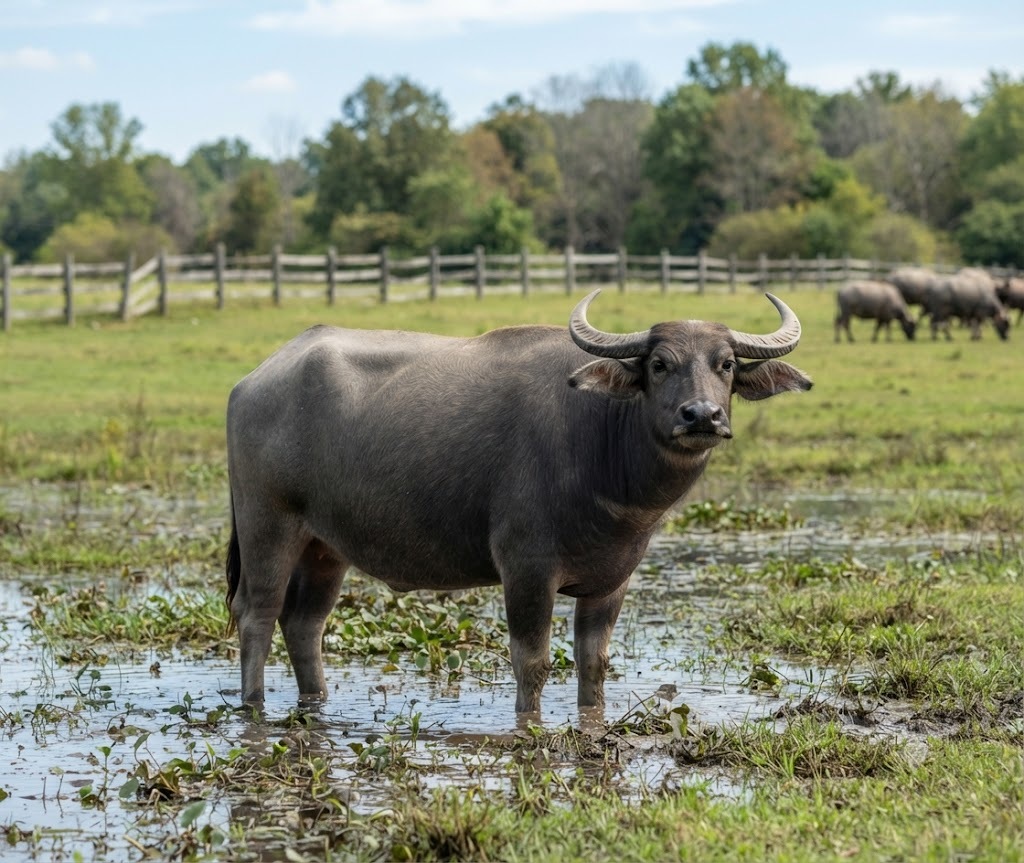
Although water buffaloes are not a common commercial livestock species in Korea, they are an important global animal widely used for milk, meat, and labor, primarily in Asia. The FAO states that over 98% of the world's water buffalo population is located in Asia, and that they are a major dairy-producing animal, particularly in countries such as India and Pakistan. ( FAOHome )
At MarketHub, it is appropriate to view water buffalo from the perspective of global production, dairy, meat, breeding stock, quarantine, and procurement intelligence, rather than as a commodity for expanding domestic farming . In particular, buffalo milk is valuable as a raw material for dairy products such as cheese, and the trading potential of live animals and meat varies significantly depending on the disease status and quarantine conditions of each country.
Judgment axis | Key points |
| Main types | River Buffalo · Swamp Buffalo |
| production purpose | Useful, meat, draft, breeding |
| Major production areas | Asia-centered countries such as India and Pakistan |
| production core | Breeding, feed, milk production, health, and climate adaptation |
| Main Products | Buffalo milk, buffalo meat, breeding stock |
| Major risks | Foot-and-mouth disease, Lumpy skin disease, CBPP, etc. |
| market | Dairy processing, meat, breeding stock, and local agriculture |
| AX | Individual, milk production, feed, breeding, and health data |
| RFQ | Live animals, breeding stock, milk, meat, and processed raw materials |
| Final goal | Accurately connecting global production sites and buyers |
The FAO estimates the global water buffalo population at approximately 205 million , noting that over 98% of them reside in Asia. Since this figure is based on FAO's introductory materials, MarketHub manages it as a runtime baseline value that is re-checked whenever the latest FAOOSTAT raw data is updated. ( FAOHome )
The water buffalo is a large bovine domesticated animal native to Asia and is a different species from the African water buffalo (Syncerus caffer). The FAO divides domesticated water buffalo into **River Buffaloes and Swamp Buffaloes, explaining that River Buffaloes are used more for milk production, while Swamp Buffaloes have traditionally been used more for draft work. ( FAOHome )
The industrial value of water buffalo extends beyond milk and meat to include breeding resources, hides, and manure. In particular, because useful water buffalo are highly valuable as raw materials for dairy processing, water buffalo milk and buffalo milk are not treated as the same product but are managed as separate Product Entities.
division | Main purpose | major products |
| River Buffalo | Useful/Meat | Milk and meat |
| Swamp Buffalo | Forced use, land use | Labor force and meat |
| breeding stock | Breeding and improvement | Breeding mothers · Breeding females |
| Useful objects | dairy | Buffalo Milk |
| meat animals | meat | Buffalo Meat |
| by-product | Industry and Agriculture | Leather and manure |
According to the FAO, River Buffaloes account for approximately 70% of the world's water buffalo population, and representative useful breeds include the Murrah, Nili-Ravi, Surti, and Jaffarabadi. ( FAOHome )
In the case of water buffalo, breed and production purpose must be considered separately. Even among water buffalo, River Buffaloes and Swamp Buffaloes differ in physique, milk production capacity, and purpose of use, so it is meaningless to compare utility breeds with draft individuals based on the same productivity criteria.
In particular, when conducting global RFQs, you should not trade based solely on the name "Buffalo." The criteria for breed, sex, age, health, and productivity vary depending on whether the actual buyer is seeking breeding stock for milk production, live meat, or buffalo milk raw materials.
division | example | On-site management |
| livestock species | buffalo | Water Buffalo |
| category | River·Swamp | Production characteristics |
| varieties | Murrah, Nili-Ravi, etc. | Oil field/oil production |
| production purpose | Useful, meat-use, and labor-use | Farm operation |
| production stage | Self-celebration, rearing, breeding, milking | Step Management |
| product | Milk, Meat, and Breeding Stock | Quality and Standards |
The basic structure is managed as Species → Type/Breed → Production Purpose → Production Stage → Product → Buyer .
Water buffalo productivity varies significantly depending on the regional environment and breeding purpose. For utility buffalo, milk production and breeding intervals are important; for meat buffalo, growth rate and market weight are more important indicators; and for draft buffalo, physical strength and working capacity are more important.
The FAO explains that the milk production of River Buffaloes generally ranges from approximately 1,500 to 4,500 liters per martyrs, pointing out that late age at first calving, seasonality of estrus, and long intervals between calvings are limiting factors in commercial productivity. Therefore, farms utilizing these buffaloes must improve not only feed but also reproductive management. ( FAOHome )
Management area | Things to see at a farm |
| breeding | Estrus, fertilization, pregnancy, childbirth |
| Self-celebration | Birth, Growth, Death |
| feedstuff | roughage, concentrate, moisture |
| Oil production | Daily milk production and milk quality |
| growth | Weight, Growth, Shipment |
| health | Diseases, Parasites, Vaccines |
| environment | Heat, moisture, shade, livestock shed |
| expense | Feed, labor costs, and veterinary expenses |
While water buffalo are widely raised, particularly in high-temperature regions, this does not mean that heat management can be neglected. The rearing environment, water access, shade, and barn and grazing conditions must be designed to suit the actual local climate.
Because water buffalo share some disease risks with cattle, health status and national disease situations are important in the international trade of live and breeding animals. WOAH explains that Foot-and-Mouth Disease (FMD) significantly impacts the production and international trade of cloven-hoofed animals such as cattle, water buffalo, and pigs, noting that there was an outbreak of FMD at a water buffalo farm in Germany in 2025. ( WOAH )
Furthermore, WOAH specifies that Lumpy Skin Disease can occur not only in Bos taurus and Bos indicus but also in water buffalo (Bubalus bubalis). Since water buffalo are also susceptible to Bovine Biological Pneumonia (CBPP), the latest disease status by country and region must be verified in actual RFQs. ( WOAH )
step | Key Management |
| birth | Individual · Parent · Date of Birth |
| breeding | Fertilization, Pregnancy, and Childbirth |
| production | Body weight, milk production, feed |
| health | Vaccine, Test, Disease |
| movement | Farms, markets, and exports |
| milking | Production Date · Milk Lot |
| slaughter | Individual · Conductor · Lot |
| circulation | Product · Country of Origin · Buyer |
MarketHub links Animal ID → Health → Milk/Meat Lot → Processing → Buyer . Diseases and quarantines are managed not as fixed data, but as Disease Status + Effective Date + Last Verified.
In Korea, it is difficult to view water buffalo as forming an independent, large-scale commercial livestock species like cattle, pigs, and chickens. Since the latest survey could not confirm official integrated statistics for 2026 that would represent the number of domestic water buffalo raised and production volume, no arbitrary market size is presented.
Therefore, in the Korean market, MarketHub may be more useful for researching imported dairy products, buffalo milk-based food ingredients, buffalo meat, breeding stock, and global supply chains, rather than for live water buffalo itself . To determine actual commercialization, it is necessary to first identify the products and quantities desired by domestic buyers.
Participants | Things needed | Possibility of cooperation |
| Dairy processing company | Buffalo milk ingredients | Ingredient RFQ |
| Cheese company | milk with high solids | Processing |
| food companies | Meat and dairy ingredients | Product RFQ |
| importer | overseas suppliers | Import RFQ |
| food service companies | Buffalo meat and cheese | Buyer RFQ |
| Breeding stock and research institutions | genetic resources | Breeding/R&D |
| local government | Feasibility of new livestock species | Pilot Analysis |
To start raising water buffalo domestically, one must first consider climate, feed, quarantine, slaughter, milk collection, and buyers together. One should not conclude that domestic farming is viable simply because productivity is good overseas.
The international supply chain for water buffalo is broadly divided into two branches depending on the purpose of production. In the dairy industry, the process follows the sequence of farm → milking → milk collection → processing → export, while in the meat industry, it follows the sequence of farm → shipment → slaughter → processing → refrigeration/freezing → buyer.
In international trade, health status and quarantine are among the most critical conditions. Since the WOAH emphasizes that official recognition of animal disease status is directly linked to safe international trade, Origin + Health Status + Quarantine must be checked before price when selecting RFQs for live animals or breeding resources. ( WOAH )
Dairy Supply Chain
Farm → Milking → Milk Collection → Dairy Processing → Cold Storage → Buyer
Meat supply chain
Farm → Shipment → Slaughter → Processing → Refrigeration/Frozen → Buyer
Transaction confirmation | Main contents |
| Happy Birthday | Breed, Gender, Age, Health |
| milk | Origin, Quality, Processing Form |
| meat | Part · Weight · Refrigerated · Frozen |
| Quarantine | Country/Disease Status |
| trade | HS·Customs·FTA |
| approval | Farms and processing facilities |
| distribution | Refrigeration, freezing, and transportation |
| Buyer | Specifications, Quantity, Delivery Time |
When an actual import RFQ for Korea is generated, live water buffalo, meat, and dairy products are classified separately, and the latest standards from the Animal and Plant Quarantine Agency, the Ministry of Food and Drug Safety, and the Korea Customs Service are verified again.
In the water buffalo industry, the processing value of buffalo milk is particularly important. The FAO explains that water buffalo milk tends to have a higher fat content than cow's milk and is suitable for dairy processing, and in India and Pakistan, water buffalo milk plays a very important role in total milk production. ( FAOHome )
PRP is not a process of importing famous breeds or products from overseas as they are. It is a process of comparing which country and producer are most suitable for the cheese, dairy, and meat standards desired by Korean buyers , or determining actual production costs and marketability if domestic demonstration breeding is conducted.
product | Main uses |
| Livestock and breeding stock | Breeding and production |
| Buffalo Milk | Dairy processing |
| Cheese Raw Milk | Cheese ingredients |
| Buffalo Meat | Food & Dining |
| leather | industrial materials |
| excretions | Compost and energy |
| reverse use | Agriculture in some regions |
Key PRP questions include which breeds are suitable for utility or meat production, whether feed costs are competitive relative to milk yield, whether the processing yield of buffalo milk meets buyer requirements, whether milk collection and processing are feasible domestically, and which method is more economical between imports and domestic production .
Complex automated facilities are not required from the start in Buffalo AX. For a useful farm, the priority is to first connect individual milk production, breeding, feed, somatic cell count, and health, and for meat, to connect weight, weight gain, feed, and shipment data.
In global production regions, it is difficult to apply large-scale facilities to all farms due to the high proportion of small-scale family farms. Since the FAO also explains that water buffalo are widely raised in small-scale mixed livestock systems in developing countries, it is realistic to start with mobile records, simple sensors, and communal milk collection data. ( FAOHome )
Apply AX | Farm and business effects |
| Object records | Productivity Comparison |
| Breeding management | Improvement in delivery interval |
| Oil production records | Confirmation of superior individuals |
| feed data | Production cost analysis |
| Weight measurement | Growth and shipment assessment |
| health sensor | Early detection of abnormalities |
| Probation Lot | Quality and history management |
| Buyer Matching | Expansion of sales channels |
The core structure is Record → Productivity Comparison → Problem Discovery → Improvement/Specification Enhancement → Product Quality → Buyer Connection .
The challenges facing the water buffalo industry vary by country. In regions with large existing production bases, such as India and Pakistan, milk production, breeding, and processing efficiency are key; however, in markets like Korea with almost no industrial foundation, issues such as quarantine, securing breeding stock, milk collection, slaughter, processing, and finding buyers must be resolved first.
International diseases are also a major variable that shakes supply chains. As a single disease—such as the foot-and-mouth disease outbreak at a German buffalo farm in 2025—can affect a nation's disease control status and trade conditions, global RFQs must manage both productivity and quarantine issues simultaneously. ( WOAH )
problem | Data to verify |
| breeding interval | Estrus, fertilization, and childbirth |
| Oil production deviation | Breed, Feed, Health |
| feed costs | Feed amount, milk production, weight gain |
| disease | FMD·LSD·CBPP |
| Processing base | Milk collection, cheese, and meat processing |
| Quarantine | Country, facilities, and disease status |
| domestic production base | Farms, Facilities, Feed |
| Import competition | Price, Logistics, and Customs |
| Buyer shortage | Product, Demand, Price |
| Data shortage | Production, Price, Transaction |
The basic solution structure in Korea is: confirming buyer demand → comparing imports and domestic production → small-scale pilot → verifying production costs and quality → deciding whether to commercialize .
The buffalo RFQ is not a structure designed solely for domestic producers. Global supply RFQs, which connect breeding companies, dairy firms, and meat companies in producing nations such as India and Pakistan with Korean buyers, can become a significant area.
Conversely, if considering trial breeding domestically, you must first secure not only breeding stock, feed, and facilities, but also milk collection, slaughter, processing, and final buyers. It is safer to check RFQs first rather than seeking sales channels after production has started.
RFQ Type | Collaboration Examples |
| breeding stock | Useful/Meat |
| Happy Birthday | Production and fattening |
| Buffalo oil | Dairy raw materials |
| Cheese ingredients | Regular supply |
| Buffalo meat | Food Service & Food |
| import | By Country and Product |
| process | Dairy products and meat |
| Domestic Pilot | experimental rearing |
| Research cooperation | Varieties and Dairy Processing |
| Buyer | Food, dining out, and distribution |
Price, production volume, contract conditions, and farm details are managed at the Verified or NDA stage.
In the MarketHub Livestock Library, water buffalo is not an item that provides information solely for domestic farms. It has a strong character as a global RFQ-type item , where necessary products and production conditions are first verified between overseas producers and domestic food, dairy, and restaurant companies .
Therefore, rather than expanding production, it is appropriate to approach the issue of water buffalo in the order of actual buyer demand → suitable production country → product and quarantine conditions → supplier verification .
① Find products/raw materials.
Need Products & Materials
Companies and institutions seeking necessary breeding stock, live animals, buffalo milk, buffalo meat, and dairy raw materials register their purchase demands. MarketHub reviews available producers and companies by verifying the country of origin, breed, product type, quantity, and quarantine conditions.
RFQ Registration → Supply Condition Review → Connecting Producers and Companies → AI Matching
Register
② We are looking for production and manufacturing partners.
Need Suppliers & Manufacturers
We are seeking necessary supply partners, including water buffalo farms, milk collection centers, dairy processing plants, slaughterhouses, and meat processing companies. We evaluate not only production capacity but also health, quarantine, processing, and the feasibility of a sustainable supply.
RFQ Submission → Review of Production/Processing Capabilities → Partner Connection → AI Partner Matching
Register
③ We are looking for domestic and international buyers.
Need Buyers
Production farms and processing companies seek new buyers, including dairy, food, restaurant, and distribution firms. We verify product specifications, origin, quantity, and supply cycles to connect them with suitable buyers.
RFQ Submission → Product & Supply Capability Review → Buyer Connection → AI Buyer Matching
Register
Contact : mail@markethub.org
For the water buffalo dataset, information on global suppliers is more important than that of domestic suppliers. To compare actual procurement competitiveness, it is necessary to connect which breeds from which countries produce what milk production and growth results at which farms, and through which processing companies they are supplied to buyers.
In particular, milk and meat have completely different supply chains even though they originate from the same water buffalo. Therefore, it is necessary to separate the purpose of production from the Product Lot and connect the relationships between countries, farms, quarantine and processing facilities, and buyers.
Dataset | Simply put |
| Master | Type, Variety, and Product Standards |
| Entity | Farms, Buffaloes, Processing Companies, Buyers |
| Relationship | Connecting production, processing, and trade |
| Runtime | Changes in oil production, prices, diseases, and quarantine |
A useful supply chain is:
Farm → Buffalo → Breeding/Feed → Milk Production → Milk Lot → Dairy Processing → Buyer
The meat supply chain is:
Farm → Buffalo → Growth → Shipment → Slaughter → Buffalo Meat → Buyer
For global transactions, add Country → Disease Status → Quarantine → Logistics here .
Since official domestic statistics on water buffalo are very limited, this report does not estimate the size of the Korean market. Instead, the production structure and risk factors were identified based on FAO global water buffalo production and dairy data, as well as WOAH's latest animal disease and trade standards.
In addition, the latest data as of 2026 was prioritized for disease information. WOAH includes water buffalo among animals susceptible to Lumpy Skin Disease as of July 2026 and emphasizes that the official status of animal diseases remains a key foundation for safe international trade in 2026. ( WOAH )
Evidence | source |
| A | FAO · WOAH · Government · Official Statistics |
| B | Papers · Research Institutes |
| C | Association/Verification Industry Data |
| D | Corporate and Market Data |
| E | Additional verification needed |
Key factual basis
- FAO — There are approximately 205 million water buffalo worldwide, with over 98% distributed in Asia, and they are broadly classified into River Buffalo and Swamp Buffalo. ( FAOHome )
- FAO — Buffaloes are major dairy livestock in many countries, and buffalo milk production accounts for a significant share, particularly in India and Pakistan. ( FAOHome )
- FAO — River Buffaloes generally produce about 1,500 to 4,500 liters per organism, and factors such as breeding intervals are limiting factors in productivity. ( FAOHome )
- WOAH — Lumpy skin disease can infect not only cattle but also water buffalo. ( WOAH )
- WOAH — Buffaloes are included among the animals susceptible to infectious bovine pneumonia (CBPP). ( WOAH )
- WOAH — An outbreak of foot-and-mouth disease at a German buffalo farm in 2025 demonstrated real-world risks to international disease control and trade. ( WOAH )
Version History
Version | Main contents | situation |
| v1.0 | First registration based on precise global production, dairy, disease, and supply chain surveys | complete |
| v1.1 | Reinforcement of official raw data on Korea's imports, HS codes, quarantine, and markets | expected |
| v2.0 | Breed · Milk Production · Meat Yield · PRP Runtime Connection | expected |
| v3.0 | Global Producer, Processor, and Korean Buyer Verified Matching | expected |