


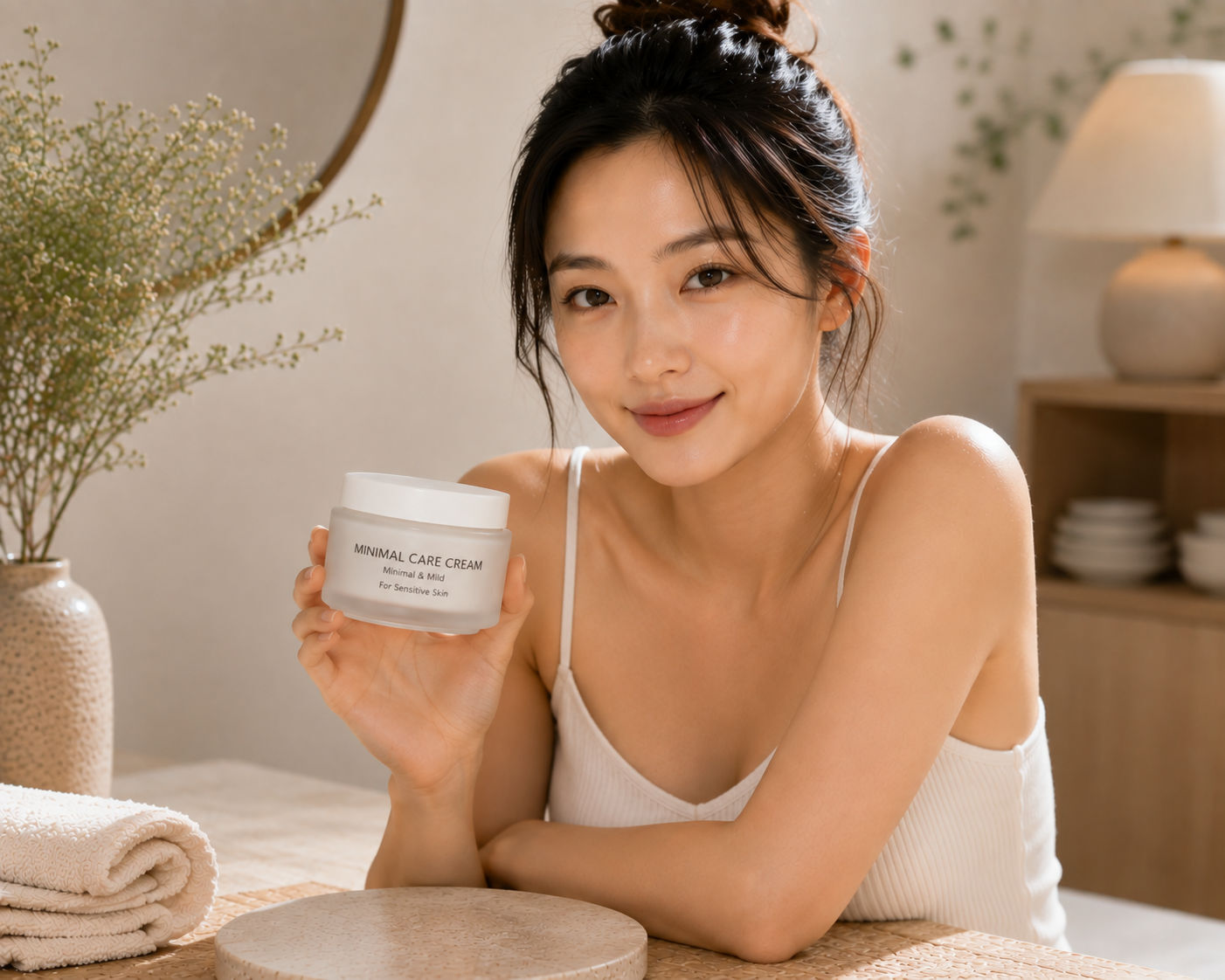
The Sensitive Skin Minimal Cream is a facial cream formulated with only essential functions—such as moisturizers, emollients, emulsifiers, and preservatives—while reducing ingredients that are not essential for basic moisturization, such as fragrances, essential oils, colorants, and numerous plant extracts. The key lies not in competitively reducing the total number of ingredients, but in clearly defining the purpose of each ingredient and the tolerability of the finished product.
While No. 043 Soothing Cream focuses on improving redness using representative soothing ingredients such as Centella Asiatica and oats, the product identity of No. 044 lies in the simplicity of its ingredient composition, low sensory irritation, and skin suitability for repeated use, rather than specific hero ingredients . This does not mean it is preservative-free, natural, or allergy-free; rather, the simpler the formula, the more objectively its preservation capabilities and packaging system must be verified.
Key consumers are those with sensitive skin who experience stinging, itching, or redness when using various functional cosmetics or plant extracts, or who find it difficult to determine which ingredients are unsuitable. This also includes consumers seeking to simplify their cosmetic routines, as well as customers who use retinol and exfoliation products but desire only a minimal amount of products for their basic moisturizing step.
Rather than flashy efficacy, they want products that do not sting when applied, are fragrance-free, feel comfortable on the skin, and do not smudge under makeup. Since safety cannot be guaranteed solely by the fact that the ingredient list is short, the actual reasons consumers purchase are transparency in reducing unnecessary exposure, sufficient moisturization, and proven tolerability .
Minimal skincare is an overlapping area with the sensitive/dermacosmetics, skinimalism, and fragrance-free markets. In North America, fragrance-free, dye-free, essential-oil-free, and non-comedogenic are key purchasing terms, while in Europe, ultra-sensitive products combining short formulas with sealed packaging have developed. In contrast to the existing approach of emphasizing numerous ingredients, low-irritation formulas containing only necessary components can serve as a differentiating factor in K-Beauty.
The main target customers are as follows.
- Reactive/Sensitive Skin: Customers who experience recurring stinging or redness when using cosmetics
- Active skincare users: Consumers seeking to reduce ingredient duplication in the basic moisturizing step.
- Allergy-conscious consumers: Customers seeking to avoid fragrances, essential oils, dyes, and numerous extracts
- Combination Skin: Customers who want a daily cream that is simpler and lighter than a rich barrier cream.
Consumers with medical conditions or allergies to specific ingredients should not be presented with the claim that the product is safe for everyone. The market promise of a minimal cream should not be “non-responsive,” but rather a product that has reduced non-essential ingredients and proven suitability for use on sensitive skin .
Even a minimal formula requires the basic structure of a cream, including water, moisturizers, oils, emulsifiers, viscosity modifiers, and a preservation system. Since forcibly excluding ingredients can weaken moisturizing power or compromise emulsification and microbial stability, it is more appropriate to reduce functional duplication and unnecessary marketing ingredients rather than focusing on the number of ingredients.
| Formula Route | Key Components and User Experience | Buyer's judgment |
|---|---|---|
| Essential Moisture Minimal Cream | Simple emulsion system with glycerin, squalane, neutral esters, or triglycerides | Recommended Route with Wide Application Range for Skin Types and Export Markets |
| Minimal Lipid Cream | Glycerin, squalane, limited ceramide or similar lipids | Beneficial for dry skin, but requires overlapping management with No. 041. |
| Sterile-Style Minimal Cream | Minimize ingredients and preservation systems, and manage external contamination with airtight containers. | Advanced differentiation is possible, but costs for packaging, charging, and storage verification increase |
Fragrance-Free Essential Moisture Minimal Cream is suitable for NoChemiLife . The approach is to select only the necessary ingredients from glycerin, squalane, neutral emollients, panthenol, or betaine, while excluding fragrances, essential oils, dyes, numerous plant extracts, and strong functional ingredients.
While hyaluronic acid, ceramide, and panthenol can all be included, the necessity and usage amounts for each must be clearly defined. In a minimalist concept, it is not appropriate to unconditionally exclude preservatives simply to reduce the number of ingredients. It is necessary to use a safe preservation system or implement a separate design that includes contamination-proof containers and manufacturing environments.
Sensitive skin has various causes, ranging from subjective stinging to compromised skin barriers and contact allergies. Therefore, rather than claiming "ultra-sensitive" or "allergy-free" based solely on a patch test conducted on general adults, it is necessary to secure tolerability data for the finished product tailored to the target consumers and actual usage conditions.
| Confirmation area | Buyer Required Data | Go/Hold criteria |
|---|---|---|
| Formula transparency | Total INCI, function, specifications, and actual input amount of each component | If there are fragrances, dyes, extracts, or masking fragrances with an unclear purpose, hold |
| Sensitivity Validation | Repeated use on sensitive skin, dermatological evaluation, recording of stinging, itching, and redness | If the good tolerability of the actual finished product is confirmed, Go |
| Moisturizing and quality | Skin moisture content · TEWL, stability · microorganisms · preservation power | Sufficient moisturization and preservation stability must be ensured together. |
| Claims·Export | Fragrance-free·hypoallergenic·dermatologist-tested evidence | Absolute expressions such as "allergy-free" or "non-irritating," or phrases regarding disease treatment, are prohibited. |
Moisturizers are generally used to increase moisture in the stratum corneum and reduce skin surface roughness, but their feel and suitability vary depending on the type of moisturizer and emulsification system. Therefore, moisturizing power or safety cannot be estimated solely on the basis of a low ingredient content. Moisturizers and formulation review
"Hypoallergenic" or "dermatologist-tested" does not mean that there is no possibility of allergy or irritation for all users. In the United States, cosmetic labeling must be truthful and unmistakable, and claims regarding the treatment of conditions or changes in skin function may affect product classification. US FDA—Cosmetics Labeling Claims
A 40–50mL airless pump is most suitable for minimal creams. It reduces repeated hand contact and the entry of external air, and allows the product message of simplicity, hygiene, and sensitivity to be conveyed through the packaging. A 50mL laminated tube is also possible to lower costs, but it is necessary to check for cap and nozzle contamination and the remaining contents.
When reducing preservatives or using special airtight containers, the entire process—from the manufacturing line, filling environment, container operation, to post-opening use—must be verified as a single system. A "preservative-free" label cannot be used merely because a standard formula was placed in an airless dispenser. The shelf life must be determined by verifying stability, preservation efficacy, repeated dispensing, backflow, residual volume, and leakage in the actual containers sold.
Sensitive skin minimal creams can range from popular fragrance-free moisturizers to premium derma products featuring sealed packaging and proprietary tolerability data.
- Entry: US$15–22 — Basic Fragrance-Free & Colorant-Free Facial Moisturizer
- Core: US$23–34 — Products with exclusion of non-essential ingredients and tolerability data for sensitive skin
- Premium: US$35–50 — Short Formula, Special Airtight Container, and Enhanced Finished Product Verification
- NoChemiLife Recommended: 40–50mL, US$27–35
The price is determined not by the fact that the number of ingredients is low, but by raw material specifications, usability, sensitivity assessment, and the container system that manages contamination. Instead of the buyer's assumption that a product should be cheaper simply because the ingredients have been reduced, the total cost, including quality control and validation expenses, must be evaluated.
Avène Tolérance Control Soothing Skin Recovery Cream is an example of an ultra-sensitive cream that combines a limited formula centered on glycerin, squalane, and emollients with packaging designed to manage external contamination. The key benchmark lies in the simultaneous design of the formulation, packaging, and production system, rather than just the minimization of ingredients. (Avène Official Product Data)
Vanicream Daily Facial Moisturizer is a lightweight facial product formulated with hyaluronic acid and ceramides, while excluding common ingredients of concern such as fragrances and colorants. It is positioned as a non-comedogenic daily product suitable for sensitive, oily, dry, and combination skin types. Vanicream Official Product Data
La Roche-Posay Toleriane Dermallergo Moisturizing Cream is a fragrance-free facial cream designed for ultra-sensitive skin prone to allergies. It represents a premium benchmark combining derma brand reliability, sealed packaging, and usability for sensitive skin. La Roche-Posay Official Product Data
NoChemiLife should differentiate itself as a minimal facial cream that discloses the purpose of each ingredient and verifies the tolerability of the finished product and hygienic packaging, rather than adding numerous K-Beauty extracts .
While Korean OEM/ODMs possess numerous fragrance-free and sensitizing ready formulas, many products consist of existing bases with only fragrances and certain extracts removed. Buyers should verify the exclusion criteria, the function of each ingredient, the scope of formulation changes, and the preservation system, rather than focusing solely on the actual number of ingredients.
| RFQ Item | Recommended specifications | OEM/ODM Verification |
|---|---|---|
| Product Concept | Fragrance-Free Essential Moisture Minimal Cream | Number of ingredients in the existing base, range of possible changes, and similar supplied products |
| Formula | Glycerin, squalane, simple emollient, selective panthenol, or ceramide | Function and specifications of each ingredient, and whether fragrance or masking fragrance is included |
| Exclusion criteria | Exclusion of fragrances, essential oils, colorants, numerous extracts, and non-essential active ingredients | Verification of the actual INCI and supply chain for the “Free-from” phrase |
| Validation Package | Sensitivity · Moisture · TEWL · Stability · Preservative power, 40–50mL Airless | Container backflow, dispensing, leakage, and claim usage scope |
| Commercial conditions | Semi-Custom or Full-Custom Quote | MOQ, sample/test/special container costs, delivery time and prescription ownership |
Contact to: mail@markethub.org
The RFQ must include the target country, ingredient groups to be excluded, key moisturizing ingredients to be allowed, skin texture, sensitivity testing level, packaging, and target retail price. Since formula safety and performance cannot be assessed based solely on a request to “minimize ingredients,” the necessary functions and reasons for exclusion must be conveyed together.
The Go condition applies when the functions and specifications of all ingredients are clear, and sufficient data on moisture, TEWL, sensitivity, and preservation are secured while reducing non-essential sources of exposure such as fragrances, essential oils, and dyes. Because it has a simple message and broad consumer applicability, it is suitable for use as a basic moisturizer for brands.
A hold condition applies when preservation stability or usability is sacrificed to reduce the number of ingredients, or when claiming to be preservative-free solely through airless containers. Absolute claims such as “100% non-irritating,” “allergy-free,” and “for all sensitive skin,” the absence of operating data for special containers, and formulas that include all the representative ingredients of No. 041, 042, and 043 require redesign.
When comparing samples, the Buyer must record stinging immediately after application, absorption after 10 minutes, tightness or stickiness, pilling of sunscreen or makeup, and skin discomfort after repeated use. If the unit price is similar, the Buyer should select a manufacturer with clear data on preservation, container suitability, and sensitivity, rather than the manufacturer with the shortest list of ingredients.
Core Evidence
- Avène — Tolérance Control Soothing Skin Recovery Cream — An example of an ultra-sensitive product combining a restricted formula and contamination control packaging
- Vanicream — Daily Facial Moisturizer — An example of a daily facial product with reduced ingredients of concern, such as fragrances and dyes
- La Roche-Posay — Toleriane Dermallergo Moisturizing Cream — An example of a derma product targeting ultra-sensitive and allergy-prone skin
- The Role of Moisturizers in Addressing Various Kinds of Dermatitis — Academic Data Examining Moisturizer Composition and Skin Barrier Management Functions
- US FDA — Cosmetics Labeling Claims — Official Standards on the Truthfulness of Cosmetic Claims and the Boundary of Pharmaceuticals
Runtime: 2026-09-01
