


Analysis Region: 11 cities and counties in Chungcheongbuk-do and the Chungcheongbuk-do Office of Education
Core Region: AI and education infrastructure in the Cheongju area and population decline areas in Jecheon, Boeun, Okcheon, Yeongdong, Goesan, and Danyang
Agenda: Are the expansion of AI-focused schools, digital leading schools, teacher training, AI ethics, and regional education infrastructure leading to students' actual future intelligence and a reduction in the educational gap between regions?
Golden Time Type: Opportunity + Capability Gap Risk
Reference Date: August 28, 2026
Version: Regional AX Golden Time Intelligence v3.1
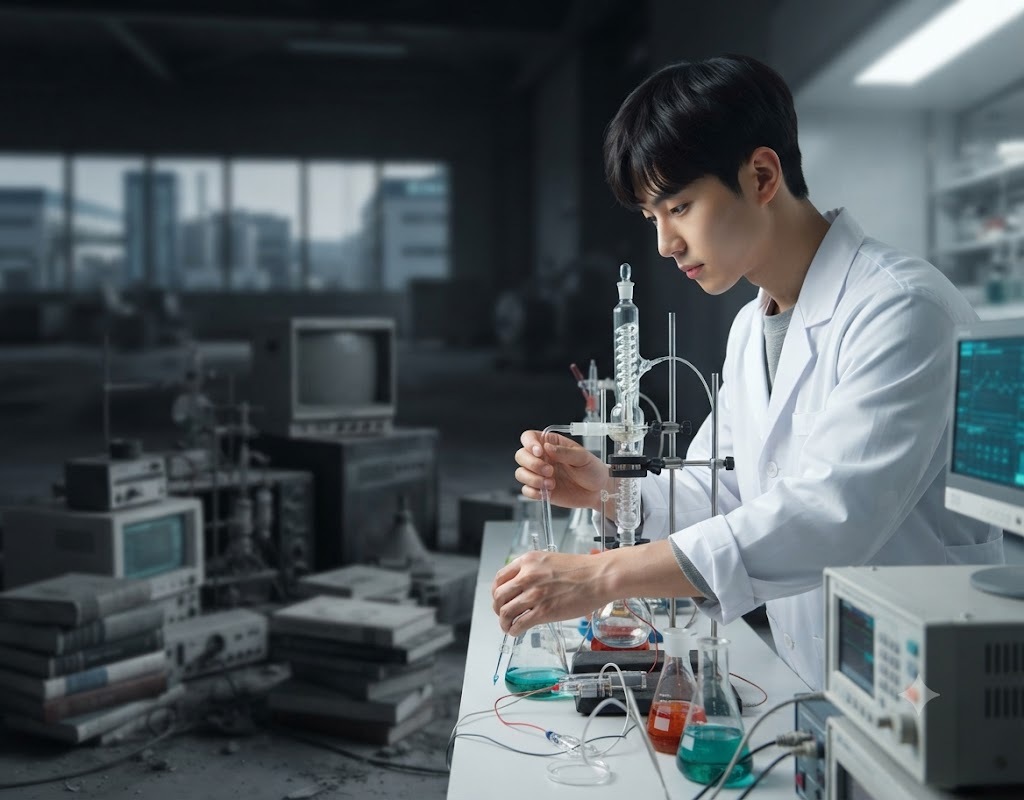
Chungbuk's AI education policy entered a phase in 2026 where quantitative expansion and qualitative redesign are proceeding simultaneously. The Chungbuk Office of Education expanded the number of AI-focused schools from 11 in 2025 to 40 in 2026 and began increasing the number of hours for information technology classes, operating subject-integrated AI lessons, and running student-led AI clubs and experience camps. Separate leading schools for AI and digital utilization are also being operated, and the policy unit of AI education is shifting from specific experiential events to the school curriculum. ( CBE )
The theme of the Chungbuk AI Education Forum held on August 27, 2026, was also "Designing AI Literacy into the Curriculum." This demonstrates that AI education in Chungbuk is expanding beyond instruction in tool usage to include curriculum, ethics, and judgment skills. Based on the AI ethics standards established in 2025, the Chungbuk Office of Education distributed separate explanatory materials and guidelines in June 2026. Furthermore, reflecting a survey of 2,286 teachers, students, and parents , the office began addressing actual risks at the school level regarding personal information, copyright, deepfakes, misinformation, student evaluation, and school administration. ( CBE )
Educational infrastructure is also being expanded. The Chungbuk Provincial Office of Education is pursuing a plan to construct the tentatively named Chungbuk AI Education Research Center in Cheongju with a total project cost of approximately 28.5 billion won and a gross floor area of about 3,200 square meters, aiming for an opening in the first half of 2030. The structure includes a GPU server-based AI Data Hub, AI robot, drone, 3D, and data exploration labs, and research spaces for teachers and students. Having received favorable approval during the Local Education Finance Investment Review in May 2026, the project has entered the full-scale implementation phase. ( CBE )
However, the core AX issue in North Chungcheong education lies in the possibility that future capabilities may vary depending on where students meet which teachers and what level of experience they accumulate in using AI, rather than a lack of AI facilities .
Educational conditions in North Chungcheong Province vary significantly even within the same Office of Education. While Cheongju is home to a concentration of universities, research institutes, AI educational infrastructure, and high-tech industries, six cities and counties—Jecheon, Boeun, Okcheon, Yeongdong, Goesan, and Danyang—are experiencing population decline. North Chungcheong Province has designated the educational gap in these regions as a separate policy issue and is operating the online learning and mentoring program "ChungBook-e" for approximately 1,500 youths by 2026. The project budget has been expanded to approximately 2.3 billion won and includes AI learning diagnostics, online lectures, university student mentoring, and on-site college admission support. ( North Chungcheong Provincial Government )
Spatial complementary policies are also emerging in AI education. In July 2026, the Educational Research and Information Service, Chungbuk Provincial University, the Okcheon Office of Education, and the Yeongdong Office of Education established a system for joint education, teacher training, and the sharing of human and material resources to expand SW and AI educational opportunities for students in the southern region. This represents an initial form of utilizing Cheongju-centered educational resources through a joint network of universities, offices of education, and schools, rather than simply replicating them in the region. ( Mhc )
The criteria for assessing the future intelligence of students in North Chungcheong Province must also move beyond their participation in AI programs.
In this analysis, future intelligence is defined as a continuous capability of questioning → searching → verifying → data interpretation → AI collaboration → problem solving → creation → responsible judgment .
The ability to generate answers using AI is merely a part of this structure. To be considered future intelligence, it must be possible to verify generated information, reconstruct problems, analyze data, identify AI errors and biases, and transform regional and industrial issues into actual tasks for solution.
Therefore, the Golden Time for Chungbuk education is not the time to designate more AI-focused schools. The key is whether the quality of AI education can be standardized and regional disparities measured as outcomes between 2026 and 2028, so that students acquire a minimum level of future intelligence within public education regardless of their school, teacher, region, or family environment .
The AI transition in Chungbuk education is proceeding amidst a decline in the school-age population and regional imbalances. In Jecheon, Boeun, Okcheon, Yeongdong, Goesan, and Danyang—regions designated as areas of population decline—issues of school downsizing and limited access to career and college admission information are occurring simultaneously. The fact that the Chungbuk Office of Education has maintained the revitalization of small schools as a major policy objective by 2026 while emphasizing the expansion of distinctive and joint curriculums demonstrates that the reduction in school size is already transforming the structure of education supply. ( CBE )
Regional disparities in educational resources have a more direct impact on AI education. AI education is difficult to provide uniformly using only textbooks and devices. The quality of instruction is determined by IT teachers, teachers with AI utilization capabilities, experience in project guidance, access to universities, companies, and research institutions, and practical resources such as robots, drones, and GPUs.
Cheongju has established a foundation that connects the Educational Research and Information Service, Cheongju National University of Education, Chungbuk National University, and the future AI Education Research Center. In contrast, it is difficult for individual schools in the southern and northern regions to independently secure the same level of human and material resources.
The design of the 2026 Southern Region SW·AI Agreement, which links Chungbuk Provincial University with the Okcheon and Yeongdong Offices of Education to jointly utilize human and material resources, is based on the premise of these structural differences. ( Mhc )
Therefore, the spatial readiness of Chungbuk education needs to be evaluated based on the distance and frequency of access to high-quality AI classes and project education, rather than the number of equipment per school.
The expansion of AI-focused schools means an increase in educational opportunities, but it does not automatically guarantee the improvement of student capabilities.
The number of AI-focused schools expanded to 40 by 2026. These schools are expanding AI and information classes, conducting interdisciplinary lessons, and operating student clubs and camps. This represents clear progress in that the approach to AI at the curriculum level has expanded. ( CBE )
However, in the next step, you must verify the quality of the actual learning experience, not the number of schools.
- Designation as an AI-focused school ≠ Enhancement of students' future intelligence
- Device distribution ≠ AI utilization capability
- AI class experience ≠ problem-solving skills
- Using Generative AI ≠ Information Verification Ability
- Completion of teacher training ≠ Classroom innovation
- Establishing an AI education center ≠ resolving regional disparities.
The fact that the Chungbuk Office of Education specifically addressed deepfakes, misinformation, copyright, and student evaluation in its 2026 AI Ethics Guidelines is evidence that it has begun to institutionalize the view that the quality of judgment and responsibility, rather than the use of AI itself , constitutes educational outcomes. ( CBE )
The key achievements of future AI education in Chungbuk should be identified not by how quickly students produce results using AI, but by how they verify the information generated by AI, compare evidence, and form their own judgments .
The first structural change in AI education in Chungbuk is the shift from AI utilization education to AI literacy education .
Curriculum design was established as a core agenda item at the 2026 Chungbuk AI Education Forum, and AI ethical standards were strengthened to connect with actual teaching and learning in schools. The field is shifting from separating AI into a specialized information technology subject to utilizing it as a tool for questioning, exploration, creation, and verification across various subjects. ( CBE )
The second change is that teacher competence is shifting to become a key variable of the educational gap .
The Chungbuk Office of Education has been operating practical training for teachers on AI application in classes, content creation, evaluation, and machine learning since January 2026. In August, it conducted a microdegree-style professional development program for teachers in collaboration with Cheongju National University of Education, enabling 61 teachers to complete courses on understanding AI in the field, AI convergence projects, and AI ethics literacy. These courses were designed to be linked to graduate school credits in the future. ( CBE )
If teachers' AI capabilities become concentrated among a few leading teachers, the gap between schools could widen again. Therefore, rather than focusing on the number of trainees, the outcomes of teacher training should track whether the process leads from training to lesson design, student activities, and finally to student competencies.
The third change is the combination of AI education and career education .
As semiconductors, secondary batteries, biotechnology, and mobility expand as key growth axes of Chungbuk’s industry, the competencies required of local students are also changing. The requirement for future talent in regional industries is shifting from the mere utilization of generative AI to convergent capabilities that combine AI with data, processes, robotics, software, and biotechnology.
The fourth change is a shift in the evaluation system . The Chungbuk Office of Education secured 750 million won in state funding through a 2026 Ministry of Education open competition to proceed with the establishment of the Chungbuk Evaluation Management Center. With the goal of launching operations in March 2027, the center plans to strengthen the analysis and feedback of evaluation results as well as the school-specific consulting system. The Office of Education officially stated that it is also necessary to address the limitations of the AI-based evaluation system. ( Mpool )
The expansion of future intelligence ultimately leads to changes not only in classes but also in what is evaluated .
The North Chungcheong Provincial Office of Education's current AI education policy is being implemented along five axes: schools, teachers, infrastructure, ethics, and regional disparities.
At the school level, the number of AI-focused schools has been expanded to 40, and AI and digital utilization leading schools are operated separately. The structure of these focus schools increases the density of AI education within the school through expanded class hours, subject convergence, and AI clubs and camps. ( CBE )
In terms of student experiences, the Educational Research and Information Service has been operating SW and AI experience classes and after-school programs for elementary school students in grades 4 through 6 and middle school students since April 2026. Physical computing, maker culture, machine learning, and generative AI have been included in the curriculum. ( CBE )
In terms of teacher competency, practical job training and microdegree-type courses are being conducted in parallel, and the scope of education has expanded beyond the simple use of AI tools to include convergence projects, ethics, and instructional design. ( CBE )
In terms of infrastructure, the Chungbuk AI Education and Research Center, worth 28.5 billion won, is being pursued with the goal of opening in 2030. It features a GPU server-based data hub and includes functions for AI robots, drones, 3D, and data exploration, structured to strengthen research and demonstration capabilities rather than student experience facilities. ( CBE )
In the ethics domain, the 2026 AI ethics standards and guidelines were distributed to all educational institutions, reflecting the opinions of 2,286 teachers, students, and parents. ( CBE )
Regarding regional disparities, Chungbuk-e and the Southern Region SW·AI cooperation system are operating separately. The former complements access to learning and further education for approximately 1,500 students in areas experiencing population decline, while the latter reinforces SW·AI educational resources in Okcheon and Yeongdong through cooperation between universities and education support offices. ( Chungbuk Provincial Government )
Currently, a significant number of AI policy tools have been secured in Chungbuk education. Future competitiveness will be determined not by the number of projects, but by whether each project leads to a common future intelligence outcome at the student level .
AI education nationwide is rapidly shifting from a focus on the distribution of devices and platforms to AI literacy, teacher expertise, and issues of ethics and evaluation. In response to this change, North Chungcheong Province is expanding AI-focused schools while simultaneously promoting ethical guidelines, professional teacher training, and an AI Education Research Center.
Chungbuk’s distinctive advantage lies in the short physical distance between its education policies and local industries.
Cheongju is home to major semiconductor, secondary battery, and biotech companies as well as research institutes, while Chungju is establishing a foundation for the mobility and bio industries. This creates the conditions for the AI that students learn to be connected to actual industrial problems.
On the other hand, North Chungcheong Province simultaneously has a large number of small schools and areas with declining populations. If AI education is approached solely as advanced STEM education, students in schools that already have abundant educational resources are likely to benefit more quickly.
Therefore, the Chungbuk model cannot be completed solely by fostering AI gifted students and specialized talents.
We must simultaneously establish a Public Baseline that guarantees the minimum future intelligence of all students and an Advanced Track that fosters advanced AI capabilities at the industry and research levels.
Whether this dual structure can be created determines the Readiness of AI education in Chungbuk.
The number of AI-focused schools increased to 40 in 2026, an expansion of approximately 3.6 times compared to 11 in the previous year. ( CBE )
In teacher professional training, 61 people participated in the microdegree-type course in August. The Educational Research and Information Service is also operating separate job training utilizing AI. ( CBE )
Approximately 28.5 billion won is scheduled to be invested in the Chungbuk AI Education and Research Center, which is targeted to open in 2030. ( CBE )
Meanwhile, the Chungbuk-e project, targeting six population-declining regions in North Chungcheong Province, will support approximately 1,500 people by 2026 with a budget of about 2.3 billion won. ( North Chungcheong Provincial Government )
It is inappropriate to interpret these figures as an overemphasis on educational investment by simply comparing them. This is because the AI Education Center is a long-term infrastructure investment, whereas Chungbuk-e is a direct support program for students.
However, when connecting the numbers, the problem remains that while the quantitative expansion of educational opportunities is rapid, regional outcome data on students' future intelligence is almost invisible .
- How often do students in each city and county use AI?
- Which school students experience data analysis and problem-solving projects?
- Is there a difference in capabilities between students at AI-focused schools and students at regular schools?
- Has the AI literacy of students in declining population areas actually improved?
- How does the regional distribution of teachers' AI expertise differ?
It is difficult to quantitatively determine these questions based solely on currently available evidence.
The Data GAP in Chungbuk education is not a lack of project statistics, but a lack of a measurement system for future intelligence at the student level .
The biggest gap exists between Access and Capability .
Even if students can use devices and access generative AI, their actual AI capabilities may be low if they cannot design questions, verify materials, and analyze data.
The second is the gap in teacher competency between schools .
Depending on a teacher's instructional design skills, the same tool in AI education can remain limited to search and summary lessons or evolve into problem-solving projects. While the expansion of microdegree-type training and professional development serves as a foundation for enhancing teacher capabilities, the outcomes regarding the distribution of specialist teachers across schools are limited. ( CBE )
The third point is the experience gap between AI-focused schools and general schools . While a policy design exists to disseminate best practices from 40 AI-focused schools to nearby schools and the local community, the actual speed of dissemination and the homogeneity of student experiences require future verification. ( CBE )
The fourth point is the gap in the educational ecosystem between the Cheongju region and areas with declining populations . As the AI Education Research Center is being established in Cheongju, it is important to consider how regularly the center's high-quality educational resources are provided to students in both the southern and northern regions.
The fifth point is the gap between education and industry . While the demand for AI semiconductors, batteries, and biotechnology is rapidly increasing in Chungbuk, the scale of systematically connecting school AI education with local industry problem-solving projects is still limited.
The sixth is the gap between educational outcomes and evaluation .
If existing assessments remain centered on correct answers while emphasizing problem-solving, creativity, verification, and collaboration skills, classroom instruction will converge back into a method suitable for exams.
The final Readiness GAP of AI education therefore exists between the number of schools teaching AI and the students' actual future intelligence.
The infrastructure strategy for AI education in Chungbuk needs to combine centralized high-end facilities with regionally decentralized educational access.
It is efficient for the Chungbuk AI Education Research Center to concentrate high-cost assets such as GPU servers, robots, drones, and data experiments. On the other hand, student access should be expanded through mobile classes, remote practice, and collaboration with local universities and education support offices. ( CBE )
Teacher talent is a more important public asset. We need a Teacher AI Commons that enables the sharing of excellent teaching models, projects, and assessment tools without relying on the individual capabilities of specialist teachers.
In particular, since small schools are highly likely to have a single teacher responsible for multiple subjects and activities, it is necessary to apply regional joint curricula and systems of itinerant and remote instruction by specialist teachers to AI education. This aligns with the direction proposed by the North Chungcheong Provincial Office of Education to strengthen joint curricula for the revitalization of small schools. ( CBE )
Data requires a measurement system that does not reduce a student's future intelligence to a single test score.
At a minimum, capabilities in the areas of information verification, data interpretation, problem definition, AI collaboration, creation, and ethical judgment must be tracked over the long term.
Institutionally, the Chungbuk-type AI ethics standards should be included in general subjects, performance assessments, and projects rather than being maintained as separate educational materials. Ethics should not be a set of precautions before using AI, but rather a standard for evaluating the quality of judgments made using AI .
The regional effects of Education AX ultimately manifest in the process of connecting with the local industry and society after graduation.
If students in Chungbuk lack career paths to utilize their capabilities at local universities or companies even after gaining experience in AI projects, AI education and regional industrial policy become disconnected.
The semiconductor, secondary battery, bio, and manufacturing AX identified in No. 013~015 are highly likely to increase the demand for personnel in data analysis, process AI, materials AI, robotics, and software in the future.
Therefore, AI education at the high school level needs to connect real-world problems of local industries to projects, rather than focusing on simple coding and generative AI experiences.
Semiconductor process data analysis, battery safety and material issues, agricultural crop forecasting, natural product data analysis, tourism resident population analysis,
Issues such as local care can be projects that students in Chungbuk can carry out in connection with the actual local community.
Once this structure is established, AI education will not end with educational policy but will become the first step of the local talent supply chain .
The AX provided to students is not to offer an AI account, but to provide a learning experience that allows them to handle world-class problems even in their local area .
The spatial gap in AI education in Chungbuk stems from the density of the educational ecosystem rather than the number of schools.
The Cheongju area has high accessibility to the Chungbuk Educational Research and Information Institute, universities, the future AI Education Research Center, and high-tech industrial companies.
Chungju can expand mobility and AI linkages centered around Korea National University of Transportation.
Okcheon and Yeongdong are in the stage of expanding the SW and AI education infrastructure in the southern region through the joint system of Chungbuk Provincial University and the Office of Education. ( Mhc )
Jecheon, Boeun, Okcheon, Yeongdong, Goesan, and Danyang share the common condition of being areas with declining populations and are eligible for direct support under Chungbuk-e. ( Chungbuk Provincial Government )
In AI education in this region, the frequency of access to external educational resources is more important than the possession of advanced facilities by individual schools.
Chungbuk's education gap policy also needs to shift from in-school resources to shared community resources in line with this.
If all schools can use the content of the AI Education Research Center and AI-focused schools through remote, mobile, and joint curriculum methods, the location of facilities and the beneficiary areas of education can be separated.
Spatial balance should be measured not by arranging AI educational facilities equally, but by ensuring a minimum amount of high-quality AI learning time per student .
2026 is the year when the basic structure of AI education in Chungbuk will be determined.
The number of AI-focused schools expanded from 11 to 40 in just one year. The AI Education Research Center passed the investment review and entered the construction phase with the goal of opening in 2030. AI ethical standards have also been disseminated to schools, and professional training for teachers is being expanded. ( CBE )
At the same time, in regions experiencing population decline, disparities in educational conditions exist to the extent that access to learning and further education must be separately supplemented. ( Chungbuk Provincial Government )
If excellent AI education teachers, projects, facilities, and university collaborations are concentrated in specific schools and urban areas over the next two to three years, it is highly likely that the gap in students' experiences will accumulate thereafter.
The cumulative effect of AI education can be faster than that of general educational disparities.
Students who use AI well can use it to learn faster, compare more materials, and repeat coding and creative work.
Conversely, students who remain stuck in simple answer generation may actually externalize their thought processes the more they use AI.
Therefore, differences in initial utilization methods can lead to differences in long-term learning productivity.
The irreversible danger to Chungbuk education is not starting AI education late.
The quality of how each student uses AI becomes entrenched differently .
The period from 2026 to 2028 is close to the final initial design period during which standards and measurement methods for minimum future intelligence can be determined in all schools.
12-1. Golden Time Application Case in Basic Local Governments ① — Okcheon-gun
Okcheon is a region experiencing population decline, while simultaneously transitioning into a central demonstration area for the southern SW and AI education network.
In July 2026, the Educational Research and Information Service, Chungbuk Provincial University, the Okcheon Office of Education, and the Yeongdong Office of Education signed a memorandum of understanding in Okcheon to promote SW and AI education for students in the southern region. The structure involves the joint implementation of joint educational programs, the sharing of human and material resources, and training and consulting for school staff. ( Mhc )
The core of this model lies in the fact that small local schools do not build all the necessary AI resources within the school.
By utilizing the teaching and practice infrastructure of Chungbuk Provincial University, the expertise of the Education Research and Information Center, and the school network of the Office of Education as shared assets, the quality of education provided to local students can be separated from the size of the school.
The Okcheon-style Golden Time lies not in increasing the number of AI education programs, but in establishing a repeatable educational network connecting local university resources → Office of Education → schools → student projects → local industries.
By connecting Okcheon's medical device, agricultural, and local industry issues with student SW and AI projects, AI education can shift from experiential learning to education for solving local problems.
If this structure spreads to Yeongdong and Boeun, a Shared AI Education Network can be formed in the southern region itself.
12-2. Golden Time Application Cases in Basic Local Governments ② — Danyang-gun
Danyang is a suitable case study for verifying the accessibility of future intelligence for students in areas with declining populations.
North Chungcheong Province is providing online learning and mentoring to approximately 1,500 youths in six population-declining regions, including Danyang, through the 2026 Chungbuk-e project. As part of the project's visiting program, special lectures on college entrance exams and major-specific mentoring by university students were conducted at Danyang High School in February 2026. ( North Chungcheong Provincial Government )
The educational gap in Danyang is not limited to the simple issue of access to private academies.
In areas with a small number of students, the range of choices for elective subjects, specialized teachers, clubs, career information, and external projects may be limited.
AI can either worsen or alleviate this structure.
While providing only remote AI tutors and online courses enables individualized learning support for students, the experience of advanced projects and collaborative learning may continue to differ from that of urban areas.
On the other hand, connecting the Chungbuk AI Education Research Center, AI-focused schools, and universities through remote projects and intensive camps can provide advanced AI practice and collaboration experiences regardless of location.
Therefore, Danyang-type Golden Time is at a point where it is establishing a hybrid education system that goes beyond simple online learning access and combines basic online learning + remote classes by specialized teachers + regular intensive AI projects + local problem verification .
Issues related to tourism, resident population, climate, agriculture, and transportation can become assets for AI projects that Danyang students can handle using local data.
The key is whether we can transition to an educational model that utilizes the entire region as a small AI laboratory, rather than treating the condition of a small population merely as a weakness in education .
If Chungbuk fails to manage the quality of regional education during the current expansion phase of AI education, the first risk is a cumulative gap in future intelligence .
As urban students accumulate more experience with projects, specialized teachers, universities, and companies, their learning productivity using AI can also increase.
The second factor is the teacher gap. If teachers who have received specialized training are concentrated in specific schools and best teaching practices remain within those schools, students' AI experiences vary depending on the teacher in charge.
The third factor is the brain drain of local talent. If students hoping for careers in AI and high-tech industries find it difficult to find pathways to advanced education within the region, their incentive to move to educational institutions in Cheongju or the Seoul metropolitan area increases.
The fourth risk is the entrenchment of AI misuse. If the learning habit of using generative AI as a tool for generating correct answers becomes ingrained from the beginning, it may lead to a new educational risk of weakening information verification, thinking, and writing skills.
The fifth point is the separation of industry and education. As Chungbuk’s semiconductor, battery, and bio AX industries are progressing rapidly, if the curriculum for local students fails to keep pace with industrial changes, companies will once again become dependent on external talent.
The biggest time risk for education in Chungbuk is not a lack of AI education programs, but rather the early entrenchment of differences in students' future intelligence depending on the region, school, and teacher .
In Chungbuk, the conditions for establishing a future intelligent public education model exist simultaneously.
AI-focused schools are rapidly expanding.
Professional training for teachers is conducted.
AI ethical standards have already been established.
A specialized research and experience center is scheduled to be established in 2030.
Cooperation between local universities, such as Chungbuk Provincial University and Cheongju National University of Education, and the Office of Education has also begun.
Above all, real-world industrial issues in semiconductors, batteries, biotechnology, agriculture, and tourism can be utilized as student projects.
By connecting these assets, Chungbuk can transition AI education from Computer Skill Education to Future Intelligence Education .
Students do not learn how to use generative AI, but rather examine data, verify facts, analyze local issues, and collaborate with AI to create alternatives.
The region can provide students with real-world problems and data, while universities and companies can provide mentors and technology.
In this process, educational outcomes can be accumulated not only through test scores but also through a problem-solving portfolio .
The fact that Chungbuk is a small metropolitan area is also an advantage.
Excellent classes verified at 40 AI-focused schools can be rapidly disseminated to 11 cities and counties, and universities, education support offices, and schools can be linked into a wide-area sharing system.
It is possible to create a structure that reduces regional disparities in AI education while simultaneously building a foundation for future talent in local industries.
Changes to observe | Things to do with AX | Education policy decision | Verification indicators |
| AI-focused schools | Spreading excellent classes to all schools | Hub → Sharing Model | General school diffusion rate |
| Student AI utilization | Establishment of a Future Intelligence Diagnostic System | Setting minimum competency standards | Verification, analysis, and creative capabilities |
| Teacher Competency | Building Teacher AI Commons | Joint use of specialized teachers | Competency gaps by school |
| Population decline areas | Remote + Intensive Project | Guaranteed access time | Advanced class hours per student |
| AI Education Center | evangelism shared operation | Regional usage quotas and touring | Non-Cheongju usage rate |
| AI Ethics | Linkage with performance assessments across all subjects | Judgment and Verification Evaluation | Error and source verification capabilities |
| Career education | Regional Industry Problem Project | Corporate-University Linkage | Project and Career Linkage |
| small school | Strengthening joint curriculum | Regional AI Classrooms | Elective subject accessibility rate |
| Evaluation system | Process and Portfolio Data Conversion | Redesigning Evaluation in the AI Era | Problem-solving Outcome |
| regional disparities | Future Intelligence Map of 11 Cities and Counties | Differential support | Regional Capability GAP |
Runtime per student is
It is necessary to track the progression from AI access → teacher/class quality → questioning/exploration → verification/data interpretation → AI collaboration → problem solving/creation → career competency → regional/industry connection .
Opportunity + Capability Gap Risk
The readiness of AI education in Chungbuk is rapidly increasing.
The number of AI-focused schools has been expanded from 11 to 40, and AI and Digital Leading Schools are also being operated in parallel. ( CBE )
Practical training and microdegree programs were introduced to enhance teacher professionalism, and AI ethics standards were also distributed to schools. ( CBE )
The AI Education and Research Center, worth a total of 28.5 billion KRW, has passed the investment review and is currently underway with the goal of opening in 2030. ( CBE )
Areas experiencing population decline have also been designated as separate policy targets, providing online learning and mentoring to approximately 1,500 students, and a joint AI education network between universities and education support offices has been launched in the southern region. ( Chungbuk Provincial Government )
Therefore, it is difficult to assess Chungbuk as a region lacking an AI education infrastructure.
However, there is currently insufficient outcome data in publicly available evidence to compare students' actual future intelligence by region and school.
While AI accessibility and the expansion of programs are confirmed, it is difficult to determine by city and county which students can ask questions, verify, analyze data, and collaborate with AI to solve real-world problems .
Therefore, the risk lies in the Capability Gap rather than the Access Gap.
The current final assessment is Opportunity + Capability Gap Risk .
- Distribution of AI-focused schools by city/county
- Distribution of AI and Digital Leading Schools
- Information education hours by school
- AI project class hours per student
- Generative AI Actual Learning Utilization Rate
- AI source and fact-checking capabilities
- Data interpretation skills
- Problem definition and problem-solving skills
- AI-powered creative portfolio
- Understanding of AI Ethics and Copyright
- AI-Focused Schools vs. General Schools Competency Gap
- Urban-Rural Future Intelligence GAP
- Changes in future intelligence of students in population-declining regions
- Teacher AI training participation rate
- City and County Distribution of Teacher AI Training
- Actual application rate of AI classes after training
- Distribution of specialized information and AI teachers
- Number of students participating in the joint curriculum
- AI Education Research Center Non-Cheongju Usage Rate
- Number of SW·AI regional university joint projects
- Number of projects linked with companies and research institutions
- Career selection rate related to AI and high-tech industries
- Enrollment Rate of AI and Advanced Majors at Local Universities
- Local company internship-employment linkage rate
- Chungbuk future industry settlement rate after high school graduation
The biggest data gap currently is that while the number of AI-focused schools, training participants, and program operation volumes are being disclosed, there is a lack of standardized public data that can continuously compare the future intelligence actually acquired by students based on city, county, school, and teacher conditions .
Runtime Chain
AI Access → Teacher Competency → Class/Project Quality → Questioning, Verification, Analysis → AI Collaboration → Problem Solving/Creation → Career Competency → Connection to Local Industries → Local Settlement
The most direct change in AI education in Chungbuk in 2026 is the expansion of AI-focused schools. The number has been increased from 11 to 40, and expanded information technology classes, subject convergence, student clubs, and camps will be implemented. These focus schools are designed to serve as hubs for disseminating best practices to surrounding schools and the local community. ( CBE )
The second point is the institutionalization of AI literacy and ethics. In August 2026, the Chungbuk AI Education Forum addressed the integration of AI literacy into the curriculum as a core topic, and AI ethical standards were refined to include personal information, copyright, deepfakes, misinformation, and evaluation issues, reflecting the opinions of 2,286 teachers, students, and parents. ( CBE )
The third is the strengthening of teacher capabilities. The Korea Institute for Educational Research and Information Service's AI instruction professional development training and Cheongju National University of Education's microdegree-type training are being operated simultaneously, and 61 teachers participated in the microdegree course in August 2026. ( CBE )
The fourth point is long-term infrastructure investment. The Chungbuk AI Education and Research Center is planned to cost approximately 28.5 billion won and cover an area of 3,200 square meters; it aims to open in the first half of 2030, including a GPU Data Hub and research facilities for AI robots, drones, and data. Currently, it is in the planning and construction phase having passed the investment review , and this should be distinguished from actual educational outcomes. ( CBE )
The fifth point is that regional disparities are identified as an independent policy issue. North Chungcheong Province is operating online learning and mentoring programs for approximately 1,500 students in six population-declining regions—Jecheon, Boeun, Okcheon, Yeongdong, Goesan, and Danyang—and is implementing separate on-site support for areas with limited access to educational information. ( North Chungcheong Provincial Government )
The sixth point is initial evidence of region-shared AI education. The Korea Institute for Educational Research and Information, Chungbuk Provincial University, and the Okcheon and Yeongdong Offices of Education established a system for joint SW and AI education, teacher training, and infrastructure sharing in the southern region in July 2026. ( Mhc )
Structural insights remaining from this analysis
The problem with AI education in Chungbuk does not end with the gap between students who learn AI and those who do not .
Moving forward, a more significant gap will be the gap between students who 'use' AI and students who 'use AI as a thinking tool'.
all.
Both students can use generative AI.
One student enters a question and copies the result.
Another student defines the problem, compares various sources, verifies the AI's errors, analyzes the data, and then revises the results.
Accessibility is the same, but future intelligence is completely different.
Therefore, the goals of public education must also change.
If the traditional digital divide was about device ownership, the educational gap in the AI era is about how deeply one can think with AI.
Move to.
This difference is likely to have a more direct impact on long-term productivity and career paths than on simple information utilization skills.
The industrial structure of Chungbuk identified in Nos. 013–015 makes this issue even more significant.
Cheongju's semiconductor, secondary battery, and bio industries are already moving to the AX stage, and process AI, data, and automation are spreading to small and medium-sized manufacturing companies.
As industry moves toward using AI and data, if education remains focused on AI search and content creation, the competency paths of local students and local industries will become separated.
Therefore, the future intelligence required of students in Chungbuk is a combination of general-purpose AI capabilities and the ability to solve industrial problems.
- It is not necessary for only students from Cheongju to carry out projects with semiconductor companies.
- Danyang students can analyze tourism and resident population data.
- Yeongdong students can use fruit, climate, and price data.
- Jecheon students can handle natural product and bio data.
- Students from Goesan can analyze issues related to agricultural and food production and distribution using AI.
Differences in regional industries are not a cause of the educational gap but can be used as different project assets .
At this time, the direction of North Chungcheong Province's regional disparity policy also changes.
Rather than building identical educational facilities in the southern and northern regions of Cheongju, the structure involves sharing high-quality infrastructure and specialized teachers, while students from each region provide projects addressing their local issues.
in other words
It is a Centralized Advanced Infrastructure + Distributed Problem-based Learning model.
Even if the Chungbuk AI Education Research Center opens in Cheongju in 2030, the center's performance should not be evaluated solely by the number of visiting students.
We need to examine how much non-Cheongju students utilized remote GPU and data environments, how much the center's researchers participated in local projects, how widely the teaching models of AI-focused schools spread to general schools, and how much teacher expertise was shared across regions.
The same standards must be applied to the 40 AI-focused schools as well.
If the purpose of hub schools is limited to providing more AI education to their students, the focus school policy itself could create a new gap.
Conversely, if the class model is disseminated through teacher training at nearby schools, joint projects, remote classes, and camps, 40 schools become Network Nodes .
The importance of teacher policy also increases here.
In the age of AI, the role of a good teacher does not diminish but rather grows larger.
As AI generates correct answers, teachers become not mere transmitters of answers, but people who design the quality of questions, verification, and thought processes.
It must be this
The fact that Chungbuk-type AI ethics standards include deepfakes, false information, and student evaluations is the initial foundation for this role shift.
In the future, ethics education must be moved from independent explanatory materials to actual project evaluation criteria.
- Did you verify the source of the information presented by the AI?
- Have you recognized the limitations of the data?
- Did you protect the copyright?
- Did you add your own judgment instead of submitting the AI results as is?
The process itself must be evaluated.
Ultimately, the most important policy indicator in Chungbuk Education AX is neither the 40 AI-focused schools nor the 28.5 billion won for AI education centers.
The final indicator should be whether students, regardless of where they were born in Chungbuk, are guaranteed a minimum level of future intelligence—including questioning, verification, analysis, AI collaboration, problem-solving, and responsible judgment—upon completing their public education .
The reason 2026–2028 is the Golden Time is that if these standards are not established now, the speed of AI education expansion in the future could actually widen the competency gap among students.
Golden Time Thesis — The AX Golden Time for Chungcheongbuk-do education is not simply a time to increase the number of AI-focused schools or have students use generative AI more. The key lies in whether, within the next two to three years, we can guarantee a minimum level of future intelligence—specifically, questioning, searching, verifying, interpreting data, collaborating with AI, solving problems, creating, and making responsible judgments—for all students, regardless of their school, teacher, or place of residence, and whether we can connect Cheongju’s advanced AI infrastructure with the diverse regional problems of its 11 cities and counties into a single learning network. If this standard is missed, even if the gap in AI access narrows, a new educational gap between "students who use AI to think more deeply" and "students who let AI think for them" could widen even more rapidly.
Version | Reference Date/Revision Date | Major changes |
| v1.0 | 2026.08.28 | This study conducted the first analysis of the future intelligence of Chungbuk students in the AI era and the Capability Gap among regions, schools, and teachers. It cross-validated the expansion of AI-focused schools to 40 by 2026, leading schools utilizing AI and digital technology, Chungbuk-type AI ethics standards reflecting the opinions of 2,286 individuals, AI job training and microdegrees for teachers, the Chungbuk AI Education Research Center worth approximately 28.5 billion KRW, Chungbuk-e targeting about 1,500 people in six population-declining regions, and the joint SW/AI education system in the southern Okcheon and Yeongdong regions. Through the case of Okcheon and Danyang, it presented a Centralized Advanced Infrastructure + Distributed Problem-based Learning model and a Runtime connecting AI access → Teacher competence → Questioning, verification, and analysis → AI collaboration → Problem solving and creation → Career and local industry connection, identifying the Golden Time as Opportunity + Capability Gap Risk. |
