


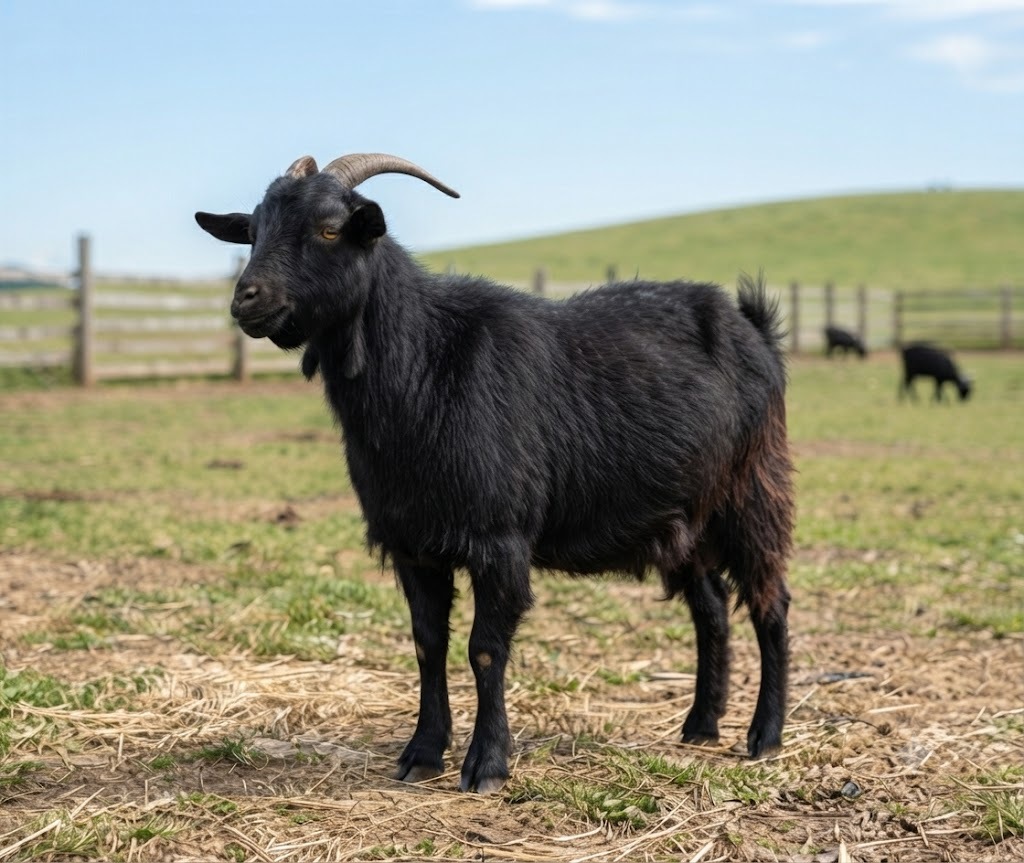
In Korea, goat production is predominantly centered on black goats for meat, whereas overseas, it is raised in various forms for meat, utility, and breeding purposes. Although the domestic infrastructure for production, slaughter, and distribution has been relatively lacking compared to other major livestock species, the scale of the industry and policy interest are growing alongside the expansion of goat meat consumption and the increase in imports.
The year 2026 marks a significant turning point for the domestic goat industry. In February, the Ministry of Agriculture, Food and Rural Affairs announced the "Goat Industry Development Plan" and decided to pursue 30 detailed tasks across the fields of production, distribution, and disease; it is now actively improving breeding systems, traceability systems, dedicated slaughterhouses, price information, and disease management. ( Mafra )
Judgment axis | Key points |
| Korean Core Type | Black goat-centered meat |
| production core | Breeding · Livestock Survival · Feed · Growth · Shipment |
| Industrial challenges | Lack of productivity, slaughter, distribution, and price information |
| Major risks | Young Celebration Death, Parasites, and Infectious Diseases |
| quality | Shipping weight, carcass, meat quality, hygiene, and country of origin |
| market | Competition between domestic and imported goat meat |
| AX | Linking individual, breeding, growth, slaughter, and price data |
| RFQ | Live Livestock · Breeding Stock · Goat Meat · Slaughter · Processing · Buyer |
| Final goal | Improving productivity and securing transparent distribution and sales channels |
As the government has shifted the focus of goat farming from a 'niche livestock' category to one for industrialization, it is highly likely that the ability to manage productivity and distribution using data will become more important in the future than simply raising large quantities. MarketHub also views the entire flow from production farms to buyers as a single intelligence structure. ( Mafra )
Goats are ruminant livestock like cattle and sheep, and in Korea, production is centered on meat, including native black goats. The National Institute of Animal Science manages black goats as a separate field of livestock technology, covering the entire production process from breeding, feed, rearing management, housing, distribution, and disease control. ( National Institute of Animal Science )
Since the overseas market is large for dairy products such as milk and cheese from utility breeds as well as meat, MarketHub Global RFQs must differentiate between meat, utility, and breeding purposes. Domestic black goats and foreign goat breeds are not treated as a single product; instead, breed, production purpose, and country of origin are managed separately.
division | Main purpose | major products |
| black goat | Meat and breeding | Live meat and goat meat |
| Meat goat | meat | Live meat, carcasses, and cuts |
| Useful chlorine | milk production | Raw milk and dairy product ingredients |
| breeding stock | Improvement and breeding | Breeding females |
| by-product | Food and Industry | Interior, leather, etc. |
| excretions | Resource circulation | Compost and organic resources |
Therefore, the standard practice is to manage goats as a Livestock Master and link goat meat, goat milk, breeding stock, and by-products to their respective Product Entities.
In the domestic market, the name "black goat" often encompasses both the breed and the product image, but a more detailed distinction must be made in the RFQ. This is because native black goats, improved strains, and overseas meat or utility breeds can differ in growth rate, body weight, reproduction, and final product.
In its 2026 Goat Industry Development Plan, the government also presented a direction to protect genetic resources by recognizing native black goats as indigenous livestock, while simultaneously developing new meat-producing breeds to advance the time of shipment and increase productivity. This demonstrates the necessity of managing breeds and production purposes separately. ( Mafra )
division | example | On-site management |
| livestock species | chlorine | Goat |
| Variety/Lineage | Native black goats, improved breeds, etc. | Genetics and Growth |
| production purpose | Meat, Useful, Breeding | Farm operation |
| production stage | Self-celebration, rearing, fattening, breeding | Step-by-step specifications |
| product | Live meat, goat meat, goat milk | Quality and Standards |
| Buyer | Restaurants, Processing, Distribution, Import | Purchase conditions |
The basic structure is managed as follows: Livestock type → Breed/line → Production purpose → Production stage → Product → Buyer .
The productivity of a goat farm begins with the stable production and raising of healthy young. Even with a high breeding rate, high mortality rates among young goats or slow growth after weaning can lead to a decline in the number of goats shipped and farm income.
Feed management is also important. While roughage and agricultural by-products can be utilized for goats, nutritional management tailored to their growth stage and reproductive status is necessary; the National Institute of Animal Science also provides separate technical projects covering nutritional levels during weaning and rearing periods, feed management for breeding goats, and the utilization of agricultural by-products. ( National Institute of Animal Science )
Management area | Things to see at a farm |
| breeding | Mating · Pregnancy · Childbirth · Number of Offspring |
| Self-celebration | Birth weight, weaning, and death |
| feedstuff | roughage, concentrate feed, and by-products |
| growth | Weight, Weight Gain, and Shipment Age |
| health | Parasites, Infections, Treatment |
| environment | Barn, ventilation, humidity, grazing |
| expense | Feed, labor costs, and veterinary expenses |
| shipment | Weight, Age, Price |
The government currently considers the standard shipping model to be 13–15 months and 50 kg, and has proposed a goal to improve this to 12 months and 55 kg through new meat-yielding varieties . Since this is a policy development goal rather than a finalized production standard, it is managed as a Target Benchmark on MarketHub. ( Mafra )
In the goat industry, the health and disease management of young goats are just as important as production volume. In particular, if young goats die from parasites or infectious diseases, the number of goats available for sale decreases even if breeding performance is good, directly leading to losses for the farm.
The Ministry of Agriculture, Food and Rural Affairs announced in its 2026 development plan that it will promote the development and distribution of vaccines for cryptosporidiosis and caseous lymphadenitis, as well as improve the licensing procedures for veterinary drugs for goats. This implies that the disease management infrastructure for goats still has many areas that need improvement compared to other major livestock species. ( Mafra )
step | Key Management |
| birth | Individual · Mother · Date of Birth |
| upbringing | Weight, Feed, Growth |
| health | Parasites, Infections, Treatment |
| breeding | Mating, pregnancy, and childbirth |
| movement | Farm, Market, Shipment |
| slaughter | Slaughterhouse · Date · Individual |
| process | Conductor/Product Lot |
| circulation | Origin · Buyer |
As of 2026, the goat traceability system is not a fully implemented system but is in the stage of feasibility studies and implementation . Therefore, it is appropriate to design MarketHub with a structure that links Farm ID, Animal/Herd ID, and Slaughter Lot ahead of the current system, enabling integration with the public traceability system in the future. ( Mafra )
Price information and transaction transparency have been identified as critical issues in the domestic goat industry, where door-to-door transactions between production farms and restaurants/distributors are relatively high. The government is also pursuing measures to enhance farmers' price negotiation power by expanding livestock market auctions and providing online price information. ( Mafra )
At the same time, the increasing proportion of imported goat meat is having a direct impact on domestic farms. In 2026, goat meat was selected as an eligible item for FTA damage compensation direct payments; this is the result of an official review acknowledging the impact of increased imports and falling domestic prices caused by the implementation of the FTA. ( Mafra )
Participants | Things needed | Possibility of cooperation |
| production farms | Breeding Livestock, Feed, and Sales Outlets | Producer RFQ |
| Producer organizations | Joint Shipment & Price Information | Cooperative RFQ |
| livestock market | Birthday celebrations and auctions | Trading |
| slaughterhouse | Stable shipment volume | Slaughter RFQ |
| processing company | Hygienic and Standardized Raw Meat | Processing |
| eating house | Domestic/Imported/Quality | Buyer RFQ |
| distribution company | Country of origin and quantity | Distribution |
| importing companies | Country, Price, Quarantine | Import RFQ |
| local government | Production, Distribution, Disease | Regional AX |
In March 2026, the National Federation of Goat Producers was established as a corporation authorized by the Ministry of Agriculture, Food and Rural Affairs, presenting the common interests of producers, technological advancement, and income growth as its primary objectives. The organization of producers can also serve as an important foundation for future joint RFQs and joint shipments. ( Mafra )
The domestic supply chain for goat meat follows a process where live animals are shipped from farms, passed through livestock markets or direct transactions, and then proceed to slaughter, processing, distribution, and the food service industry. The problem is that the current lack of dedicated goat slaughtering infrastructure and insufficient traceability and pricing information leaves distribution transparency and hygiene management as areas for improvement.
The Ministry of Agriculture, Food and Rural Affairs is pushing for the expansion of regional goat-dedicated slaughterhouses and the development of standard process manuals by 2026. As of May 2026, there were 27 goat livestock markets operated by regional livestock cooperatives, and the government is also expanding financial support for the establishment of new dedicated slaughterhouses. ( Mafra )
Farm → Livestock Market/Collection → Slaughter → Processing → Refrigeration/Frozen → Distribution → Restaurants/Buyers
Transaction confirmation | Main contents |
| Happy Birthday | Breed, Gender, Age, Weight |
| goat meat | Origin, Slaughter, Part |
| Quarantine | Country of Origin, Disease, Product Condition |
| trade | HS·FTA·Tariff |
| origin | Distinction between domestic and imported products |
| distribution | Refrigeration/Freezing |
| Buyer | Quantity, Specifications, Delivery Date |
In international trade, it is particularly necessary to analyze the impact of imports from FTA partners, such as Australia, separately. In the actual RFQ, the country, product type, HS code, and quarantine conditions must be reconfirmed at the time of transaction. ( Mafra )
While goat meat is the core product of the domestic goat industry, the product portfolio should not be managed solely as a live animal. After slaughter, the product is categorized into carcasses, cuts, chilled meat, and frozen meat; furthermore, goat milk and raw materials for dairy processing become important product entities in overseas markets.
PRP is a process of analyzing whether goats produced on farms meet the weight, quality, origin, slaughter, and delivery conditions required by actual buyers. Particularly as competition between domestic and imported products intensifies, competitiveness must be judged not merely on the grounds of being "domestic," but by comparing production costs, quality, and stable supply together.
product | Main uses |
| Self-celebration · End-of-year celebration | Rearing and breeding |
| Happy Birthday | Fattening and slaughtering |
| goat meat | Restaurants and Distribution |
| Refrigerated and frozen meat | Foodservice and Processing |
| goat milk | Dairy processing and raw materials |
| by-product | Food and Industry |
| excretions | Composting and resource recovery |
Key PRP questions include whether mortality of young goats can be reduced, whether the time to market can be advanced, whether the weight gain is adequate relative to feed costs, what the buyer competitiveness of domestic goat meat is, and whether stable slaughtering and processing are possible .
The priority for Goat AX is not to install expensive automation equipment. Since it is an industry where production, breeding, slaughter, pricing, and traceability data are not yet sufficiently connected, it is realistic to start with record-keeping and standardization first.
The government is also simultaneously pursuing the 2026 goat breeding system, online provision of price information, a feasibility study for a traceability system, and standardized livestock housing and slaughtering processes. This implies that the appropriate AX for the goat industry is to proceed in the order of securing basic data → comparing productivity → increasing transaction transparency . ( Mafra )
Apply AX | farm effect |
| Object records | Confirmation of breeding and growth |
| Automatic weight | Determining the shipping time |
| Breeding management | Improvement in childbirth and offspring production |
| Historical records | Production cost analysis |
| Disease records | Analysis of the cause of death |
| Price Runtime | Determining the appropriate sales price |
| Slaughterhouse information link | Quality improvement |
| Origin tracking | Improving transaction trust |
| Buyer Matching | Expansion of sales channels |
In other words, in Goat AX, the order of priority is recording → comparison → problem identification → productivity improvement → market connection .
The domestic goat industry faces simultaneous issues regarding productivity and distribution. Issues such as young goat mortality, a lack of standardized feeding management, and insufficient breed improvement are interconnected, as are door-to-door sales, insufficient slaughtering infrastructure, a lack of price information, and competition with imports. ( Mafra )
Furthermore, the reliability of the country of origin is also a critical issue. During a special crackdown on goat and duck meat in the spring of 2026, the National Agricultural Products Quality Management Service uncovered 17 businesses violating country of origin regulations for goat meat and confirmed cases of falsely labeling Australian and Mongolian goat meat as domestic. ( Mafra )
problem | Data to verify |
| Self-congratulatory death | Birth, Disease, Feed |
| low productivity | Weight and shipping age |
| breed improvement | pedigree and growth performance |
| feed costs | Salary, Weight Gain, Price |
| Transaction price | Market, Region, Weight |
| slaughterhouse | Distance and processing capacity |
| illegal slaughter | Shipment and slaughter history |
| Confusion regarding country of origin | Import · Lot · Distribution |
| Competition from imported products | Price, Volume, FTA |
| Lack of sales channels | Product · Buyer |
The basic solution structure is problem discovery → data verification → cause analysis → farm/regional demonstration → improvement of joint production/distribution → buyer connection .
A goat RFQ does not refer solely to the sale of live animals. It can encompass everything from finding breeding stock, offspring, and feed to requesting cooperation with joint shipments, slaughterhouses, processing companies, restaurant buyers, and importers/exporters.
In particular, since the distribution infrastructure for goats is still developing, a joint RFQ that groups producer organizations, regional livestock cooperatives, slaughterhouses, and processing companies can be more effective than one directed at individual farms. Sensitive information, such as price, farm production volume, and contract conditions, is managed at the Verified or NDA stage.
RFQ Type | Collaboration Examples |
| breeding stock | Improvement and breeding |
| Self-celebration | Buying and selling |
| fattening goat | Stocking and shipping |
| feedstuff | roughage and compound feed |
| Joint shipment | Producer organizations and livestock markets |
| slaughter | Official slaughterhouse connection |
| goat meat | Restaurant and distribution supply |
| process | Partial meat · Refrigerated · Frozen |
| import | Country, Product, Quarantine |
| Buyer | Food Service, Food, Distribution |
| AX Pilot | Productivity, History, Price |
| Research cooperation | Improvement, disease, and specifications |
MarketHub views supply chain RFQs connecting farms → producer organizations → slaughtering/processing → buyers as an important cooperation model.
MarketHub Livestock Library is not merely a resource center for reading information about the goat industry. It is structured so that farmers and companies can proactively request necessary products, production partners, and buyers, verify supply feasibility, and connect these requests to actual collaboration.
As the goat industry is currently in a stage where production and distribution infrastructures are growing together, requests for joint shipment, slaughter, processing, and distribution partners are important, in addition to individual product RFQs.
① Find products/raw materials.
Need Products & Materials
Companies and institutions seeking necessary breeding stock, young livestock, fattening goats, goat meat, feed, and raw materials register their purchase demands. MarketHub reviews items, regions, specifications, and quantities to identify potential collaborations with supplying farms and companies.
RFQ Registration → Supply Feasibility Review → Connecting Producers and Companies → AI Matching
Register
② We are looking for production and manufacturing partners.
Need Suppliers & Manufacturers
We are seeking necessary production and supply partners, including goat farms, producer organizations, slaughterhouses, and processing companies. We evaluate not only production capacity but also formal slaughtering and processing, hygiene, and the feasibility of a sustainable supply.
RFQ Submission → Review of Production/Processing Capabilities → Partner Connection → AI Partner Matching
Register
③ We are looking for domestic and international buyers.
Need Buyers
Farms and production companies seek new buyers, including restaurants, food companies, distributors, and importers. We verify products, supply volumes, origins, and slaughter and processing conditions to connect them with suitable buyers.
RFQ Submission → Product & Supply Capability Review → Buyer Connection → AI Buyer Matching
Register
Contact : mail@markethub.org
The purpose of the goat dataset is not to add complex record-keeping tasks for farmers. The core objective is to connect currently insufficient production, history, and price information using minimal common standards to compare the productivity of farms and regions and enhance transaction reliability.
For example, if we can connect where a goat was born and how much it grew, what disease management and shipping processes it went through, and what product it became at which slaughterhouse, we can simultaneously analyze productivity and trace the origin and distribution.
Dataset | Simply put |
| Master | Livestock type, breed, and product standards |
| Entity | Farm · Goat · Slaughterhouse · Buyer |
| Relationship | Connecting production, slaughter, and distribution |
| Runtime | Change information regarding weight, price, disease, etc. |
The representative structure is as follows.
Farm → Goat → Breeding → Feed → Growth/Health → Livestock Market/Shipment → Slaughter → Goat Meat → Buyer
Once the government's introduction of the goat traceability system materializes, the MarketHub Dataset will update its codes and relationship structure to enable connection with the official traceability system. ( Mafra )
As of 2026, the goat industry is a livestock sector where systems and infrastructure are rapidly changing. Therefore, rather than storing breeding, prices, slaughterhouses, traceability systems, import volumes, and FTA support as fixed facts, verification dates and policy implementation statuses must be managed together.
This registered version was verified based on the Ministry of Agriculture, Food and Rural Affairs' 2026 Goat Industry Development Plan, decisions on FTA damage compensation direct payments, explanatory materials on the expansion of slaughter facilities, and feed management data from the National Institute of Animal Science. Older technical data was not used to explain the latest market conditions but was utilized solely as background information for rearing techniques. ( Mafra )
Evidence | source |
| A | Government, International Organizations, Official Statistics |
| B | Papers · Research Institutes |
| C | Association/Verification Industry Data |
| D | Corporate and Market Data |
| E | Additional verification needed |
Key factual basis
- Ministry of Agriculture, Food and Rural Affairs "Measures for the Development of the Goat Industry" — 30 detailed tasks for production, distribution, and disease; improvements to breed improvement, traceability system, slaughter facilities, and price information. ( Mafra )
- Ministry of Agriculture, Food and Rural Affairs 2026 FTA Damage Compensation Direct Payment — Goat Meat Confirmed as Eligible. ( Mafra )
- Ministry of Agriculture, Food and Rural Affairs Explanation on Expansion of Slaughter Facilities in August 2026 — Support for Regional Dedicated Slaughterhouses, Operation of 27 Goat Livestock Markets by Regional Livestock Cooperatives. ( Mafra )
- National Agricultural Products Quality Management Service 2026 Country of Origin Inspection — 17 Goat Meat Country of Origin Violations Detected. ( Mafra )
- National Institute of Animal Science — Field technology system related to black goat breeding, feed, rearing environment, diseases, and distribution. ( National Institute of Animal Science )
- Ministry of Agriculture, Food and Rural Affairs — Approval for the incorporation of the National Federation of Goat Producers. ( Mafra )
Version | Main contents | situation |
| v1.0 | First registration based on 2026 precision survey | complete |
| v1.1 | Breeding, Price, Slaughter, Import Runtime Update | expected |
| v2.0 | Connecting Objects, Productivity, History, and PRP | expected |
| v3.0 | Producer Organization · Slaughter · Buyer Verified Matching | expected |