


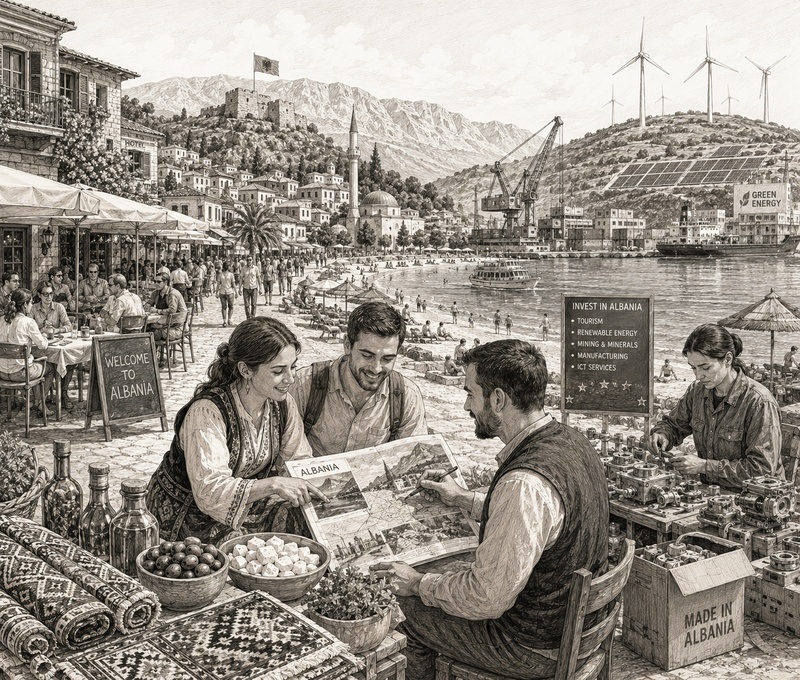
Economy Type
Tourism Transition Economy
Albania is classified as a Tourism Transition Economy country.
It is a Western Balkan country that has been growing rapidly centered on the tourism industry since transitioning from a socialist planned economy to a market economy, while simultaneously pursuing EU membership. Recently, its economic structure has been diversifying as renewable energy, minerals, light industry, automotive parts, and ICT service industries grow alongside tourism.
The geographical advantage of bordering the Adriatic and Ionian Seas, relatively low production costs, and access to the European market are considered key factors for enhancing future industrial competitiveness.
Country Definition
Albania is an emerging growth market in the Western Balkans, transforming its industrial structure based on tourism growth and EU integration.
Why It Matters
Although Albania does not have a large market, it is a country highly likely to simultaneously benefit from the expansion of the European tourism market, preparations for EU accession, the expansion of renewable energy, mineral development, and manufacturing narrowhoring. In particular, Albania's strategic value is gradually increasing as European companies diversify their production bases.
Korea Perspective
For South Korea, Albania holds greater significance as a base for entering the Balkan market than as a large-scale consumer market . There is high potential for cooperation in the fields of tourism infrastructure, smart cities, power grids, renewable energy, construction technology, ICT, automotive parts, and medical devices, and its strategic importance is expected to expand further if its future accession to the EU becomes a reality.
Key Keywords
- Tourism Transition Economy
- Western Balkans
- EU Candidate
- Nearshoring
- Chromium
- Hydropower
- Renewable Energy
- Adriatic Gateway
- Emerging Europe
Albania is a country located in the western part of the Balkan Peninsula, bordering the Adriatic and Ionian Seas, and is one of the Western Balkan countries closest to Italy. These geographical characteristics serve as a significant competitive advantage in the European logistics and tourism industries.
Since the 1990s, as it transitioned to a market economy, tourism and private investment expanded rapidly, and recently, institutional stability is being enhanced by simultaneously conducting EU accession negotiations and administrative and judicial reforms.
Although the country is not large in scale, its economic base is gradually expanding due to factors such as an increase in tourists, expanded foreign investment, energy development, and the relocation of manufacturing industries.
Key Features
- Western Balkan Strategic Bureau
- EU candidate countries
- Tourism-centered growth
- Clean energy centered on hydroelectric power
- Potential benefits from the relocation of European manufacturing
The Albanian economy is structured such that the service and tourism sectors account for the largest share, while construction, energy, agriculture, and mining complement them.
In recent years, the increase in tourists has been driving economic growth, and the government is diversifying the industrial structure by fostering the manufacturing, digital economy, and energy industries alongside the tourism industry.
The push for EU accession is facilitating improvements in the investment environment and the refinement of laws and systems, and foreign direct investment (FDI) is also on the rise, centered on energy, real estate, tourism, and manufacturing.
Market characteristics
- tourism-centered economy
- EU integration process in progress
- Expansion of the service industry's share
- Increase in foreign investment
- Expansion of the manufacturing base
MarketHub Point
It is appropriate to approach Albania as an EU-linked investment market rather than a consumer market.
The tourism industry is a key growth engine for the Albanian economy. Based on its beautiful coastlines and natural environment, the number of European tourists is increasing rapidly, and the hotel, resort, transportation, and food and beverage industries are growing alongside it.
In the energy sector, hydropower accounts for a very high proportion, and investment in renewable energy, such as solar and wind power, is expanding.
Mining is also an important industry; chromium production is competitive even in Europe, and minerals such as nickel, copper, and limestone are also being developed.
The light industry and textile OEM sectors are growing based on supply chain linkages with Italy, and the production of automotive parts and electrical equipment is also gradually expanding.
Key industries
- sightseeing
- renewable energy
- hydroelectric power
- mine
- Textile and Apparel OEM
- food processing
- car parts
Key resources
- chrome
- copper
- nickel
- limestone
- hydroelectric resources
MarketHub Point
It is a structure where tourism drives the current economy, while renewable energy and mining enhance future industrial competitiveness.
Albania is being integrated into the European supply chain based on maritime logistics through the Adriatic Sea and transportation networks connecting the Balkan interior.
Italy is the largest trading partner, and Greece, Germany, China, and Kosovo are major trading partners. Industrial ties with Italy are particularly important in the manufacturing and textile OEM sectors.
Major exports include clothing, footwear, minerals, construction materials, and electricity, while major imports include machinery, automobiles, petroleum products, chemical products, and consumer goods.
If EU membership progresses in the future, it is highly likely that logistics efficiency and the investment environment will improve simultaneously.
major trading partners
- Italy
- Greece
- germany
- china
- Kosovo
- Turkey
Supply chain characteristics
- Italian supply chain linkage
- Utilization of Adriatic Sea logistics
- EU market access
- Potential benefits from manufacturing relocation
- Expanding the role of the Balkan hub
MarketHub Point
Albania's competitiveness lies in its strategic location connected to the EU supply chain rather than its small domestic market.
It is appropriate to view Albania not as a large consumer market, but as a business hub connecting the EU supply chain and the Western Balkan market . Due to relatively low labor costs and access to the European market, manufacturing industries such as textile and clothing OEM, automotive parts, electrical equipment assembly, and food processing are gradually expanding, and along with the growth of the tourism industry, investment in hotels, resorts, smart cities, and transportation infrastructure is also increasing.
As EU accession negotiations progress, the business environment and legal and institutional frameworks are continuously improving, and foreign direct investment (FDI) is expanding, centered on the energy, real estate, tourism, and manufacturing sectors. In particular, industrial cooperation with Italy is one of the core competitive strengths of Albania's manufacturing industry.
For South Korean companies, a mid-to-long-term strategy that considers local partnerships and connections to the European market is more effective than simple exports. Smart infrastructure, eco-friendly energy, ICT, medical devices, and construction technology are assessed as sectors with high potential for future cooperation.
Market characteristics
- EU-linked investment market
- Expansion of tourism infrastructure
- Expansion of manufacturing relocation (Nearshoring)
- Increase in foreign investment
- Promoting investment in eco-friendly energy
Key Opportunities
- Tourism infrastructure development
- Smart City
- hydroelectric and solar power generation
- Automotive parts production
- ICT services
- Medical devices
- Construction and Engineering
Major Risks
- small domestic market
- Inefficiency of administrative procedures
- Overseas outflow of labor
- Industrial base scale limitation
- Uncertainty regarding the EU accession schedule
Albania's future growth engines can be summarized into four axes: tourism development, EU accession, expansion of renewable energy, and relocation of manufacturing .
The tourism industry is expected to continue serving as a core growth engine for the national economy, and it is highly likely to expand beyond hotels and resorts to include cultural tourism, eco-friendly tourism, and marine tourism.
In the energy sector, a strategy is being pursued to grow into a clean energy hub of the Western Balkans by adding solar and wind power generation to the abundant hydropower base.
In the manufacturing sector, there is a possibility that the role of production bases in the automotive parts, electrical and electronic, and textile OEM fields will expand in accordance with European companies' supply chain diversification strategies.
If EU membership becomes a reality, the investment and trade environments are expected to improve further.
Changes to Watch Out For in the Future
- Progress in EU accession negotiations
- High Value-Added Tourism Industry
- Expansion of investment in renewable energy
- Growth of the automotive parts industry
- Development of a Western Balkan logistics hub
- Expansion of the digital economy
Market Position
Tourism Growth Market + Western Balkans Gateway
Western Balkan strategic hub market based on tourism growth and EU integration
Key Opportunities
- tourism infrastructure
- renewable energy
- Smart City
- car parts
- ICT services
- Mineral development
- Construction technology
- EU Supply Chain Linkage
Recommended Strategy
Observe
We continuously monitor EU accession negotiations, improvements in the investment environment, tourism market growth, and trends in manufacturing relocation.
↓
Prepare
Identify local partners and establish strategies to link with the Italian supply chain, and lay the foundation for cooperation in the tourism, energy, and manufacturing sectors.
↓
Participate
As EU integration progresses, we will participate in tourism infrastructure, smart cities, eco-friendly energy, automotive parts, and ICT projects in stages.
Final Assessment
Albania is an emerging growth market in the Western Balkans whose strategic value is increasing based on EU integration, tourism growth, and the relocation of manufacturing, rather than its small consumer market.
Scope of investigation
This material was compiled by cross-reviewing publicly available international organizations, government agencies, research institutes, industry reports, and major foreign media.
international organizations
- United Nations (UN)
- World Bank
- International Monetary Fund (IMF)
- World Trade Organization (WTO)
- OECD
- UNCTAD
- European Commission
Government and public institutions
- Government of Albania
- Albanian Institute of Statistics (INSTAT)
- Bank of Albania
- European Commission Enlargement Reports
- KOTRA
- Korea Export-Import Bank Overseas Economic Research Institute
- Korea Institute for International Economic Policy (KIEP)
Major foreign media
- Reuters
- Bloomberg
- Financial Times
- The Economist
- Politico Europe
- Euronews
- AP
- BBC
Research and industrial data
- World Economic Forum
- European Bank for Reconstruction and Development (EBRD)
- Deloitte
- PwC
- McKinsey
- Google Scholar public paper
Writing Verification
This document was prepared in accordance with the following principles.
- Written based on facts and open sources
- Cross-review of international organizations, government and industry data, academic papers, and foreign media
- Summary based on the latest publicly available data
- Reflecting the perspective of utilization by South Korean companies and public institutions
- Apply MarketHub World Country Intelligence (WCI) standard template
- Applying the same structure and standards to 195 countries
Albania is a country likely to grow based on its tourism economy while simultaneously benefiting from EU integration and the Nearshoring of manufacturing. Although the current size of its domestic market is limited, logistical accessibility via the Adriatic Sea, industrial linkages with Italy, the expansion of renewable energy, and mineral resources including chromium are considered key factors for enhancing long-term national competitiveness.
It is more effective for South Korea to establish a foundation for cooperation in the fields of tourism infrastructure, eco-friendly energy, smart cities, automotive parts, ICT, and construction technology rather than focusing on short-term expansion of the consumer market . If EU accession progresses in the future, Albania is likely to hold even greater value as a strategic production and investment hub connecting the Western Balkans and the European market .
Final evaluation
Albania is a representative emerging growth market in the Western Balkans, transforming its industrial structure based on the tourism industry and EU integration; from a MarketHub perspective, it is evaluated as a "Tourism Growth Market + Western Balkans Gateway."